When you step into a swimming pool, your body feels distinctly lighter. A ship built of tens of thousands of tons of steel floats on the sea, yet a small iron nail sinks as soon as it hits the water. Behind these scenes that look so different, the same rule is at work. That rule is Archimedes’ principle.
Put simply, Archimedes’ principle means that an object immersed in a fluid is pushed upward by a force equal to the weight of the fluid it displaces. That upward force is called buoyancy. In the 3rd century BCE, the mathematician Archimedes of Syracuse in Sicily set it out in On Floating Bodies, and it remains one of the most basic principles in fluid mechanics.
In this piece we will look in turn at the definition of buoyancy and why it arises, the conditions for floating or sinking and the secret of iron ships that float, and everyday and industrial cases such as submarines, hot-air balloons, and the Dead Sea.
Rise by What You Displace: The Principle of Buoyancy and Its Uses
What Is Archimedes’ Principle?
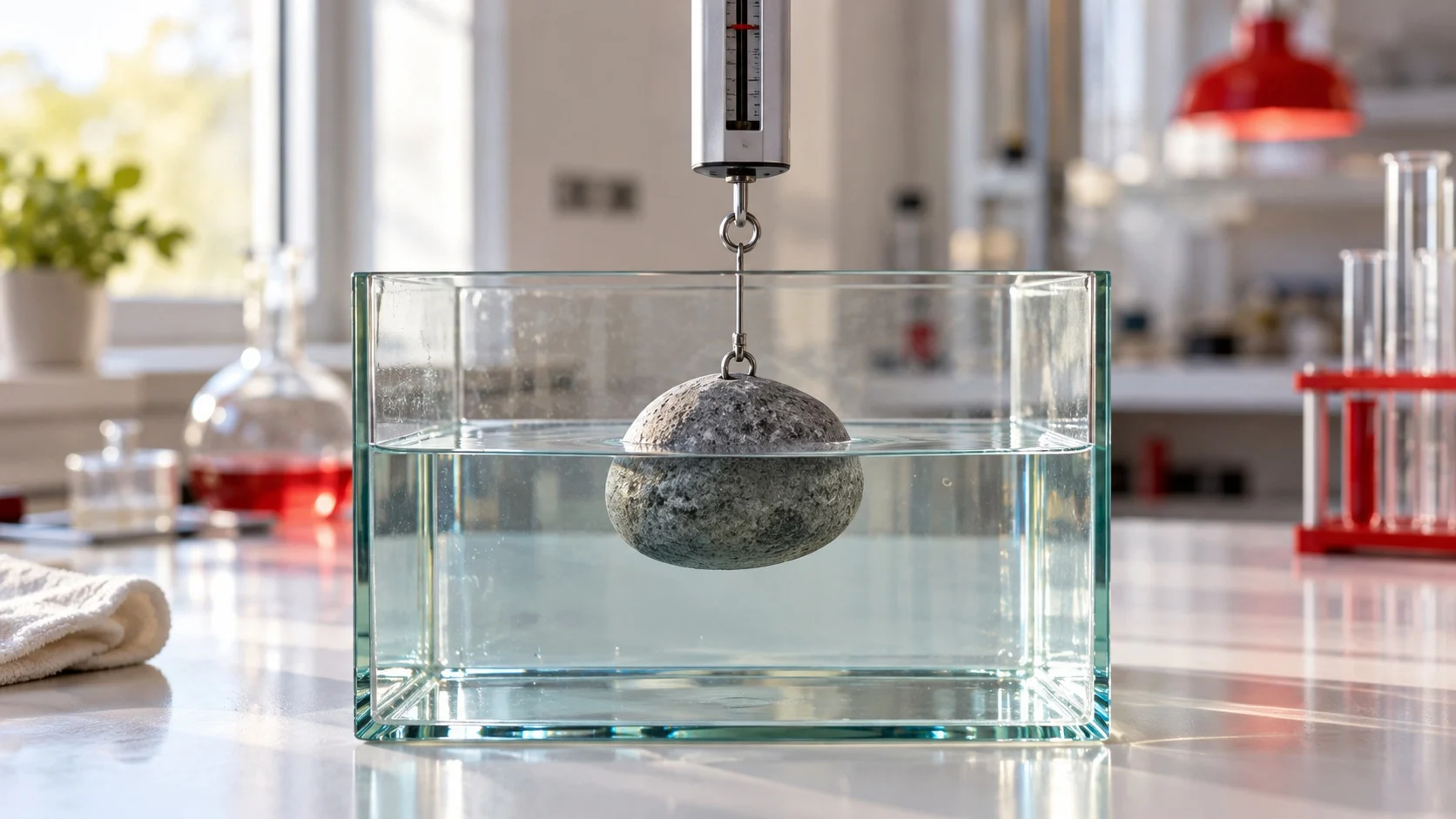
A substance that can flow, such as water or air, is called a fluid. When an object is placed in a fluid, the fluid is pushed aside by the volume the object occupies. Archimedes’ principle tells us that the weight of the fluid so displaced is exactly the size of the upward force on the object. It applies whether the object is fully or only partly immersed.
- Buoyant force: the upward force a fluid exerts on an immersed object.
- Displacement: the amount of fluid the object pushes aside; the same word is also used for the size of a ship.
- Apparent weight: the weight measured in a fluid, equal to the true weight minus the buoyant force.
For example, if a stone that weighs 10 newtons in air displaces 3 newtons’ worth of water underwater, the force on the string holding the stone falls to 7 newtons. That is why even a heavy stone is easier to lift in water. The famous crown anecdote—that Archimedes cried “Eureka” after seeing water overflow in a bath—comes from the Roman architect Vitruvius; what method was actually used is not certain.
Why Does Buoyancy Arise? Pressure That Changes with Depth

The root of buoyancy is a pressure difference. In a fluid, the deeper you go, the greater the weight of fluid piled above, and so the greater the pressure. The bottom face of an object is therefore pushed harder than the top face. Forces on the sides cancel each other, but the up–down difference remains and becomes an upward force.
(1) Depth and pressure
Underwater, pressure rises by roughly 1 atmosphere for every 10 meters of depth. The ears that feel plugged when you dive deeper feel that pressure.
(2) Density and submerged volume
The size of the buoyant force equals the fluid’s density times the submerged volume of the object times the acceleration due to gravity. The same object feels a larger buoyant force the more it is submerged, and the denser the fluid it enters.
(3) A result that does not depend on shape
No matter how complex the object’s shape, once you know the weight of the fluid displaced you can find the buoyant force. That simplicity—leaving only the essentials without complicated calculation—is the principle’s greatest strength.
Will It Float or Sink? The Secret of Iron Ships That Float

On an object in water, weight acts downward and buoyancy acts upward. If buoyancy is greater than weight, the object rises; if smaller, it sinks; if equal, it stays put. In the end, whether the object’s average density is smaller or larger than the fluid’s decides the outcome.
Steel is nearly eight times as dense as water, so a solid lump of iron sinks as it is. But if the same steel is shaped into a wide, hollow bowl, things change. An empty hull displaces far more water, so the ship sinks only until it has displaced water equal to its own weight, and no farther. This is often called the principle of flotation.
Seawater is denser than fresh water, so the same ship sits a little higher in the sea. That is why ships’ sides carry load-line marks showing how deep they may be immersed depending on the kind of water and the season. Ice is nearly 10% less dense than water and floats, yet about 90% of its volume stays underwater. The phrase “the tip of the iceberg” comes from exactly that.
Archimedes’ Principle in Everyday Life and Industry

Buoyancy is not a water-only story. Air is a fluid too, so any device that can adjust its density can put the same principle to work anywhere.
- Submarine: filling ballast tanks with seawater makes the craft heavier so it dives; forcing the water out with compressed air makes it rise again.
- Swim bladder of fish: many bony fishes adjust the amount of gas in the bladder so they can stay at a chosen depth with less effort.
- Hot-air balloon: warmed air is less dense than the outside air, so the balloon rises with a force equal to the weight of the cool air it displaces.
- Dead Sea floating: in the very salty, dense water of the Dead Sea, a person can float without much effort.
- Hydrometer: a rod floated in a liquid shows density—of seawater or of a fermenting liquid—by how far it sinks.
The principle, however, assumes that the fluid surrounds the object evenly. If an object sits flush on the bottom so that no water can seep underneath, the upward pressure on the bottom face disappears and the outcome changes. When applying the principle, those conditions need to be checked as well.
Archimedes’ principle says that an object in a fluid receives a buoyant force equal to the weight of the fluid it displaces. Compare that force—born of the pressure difference with depth—with the object’s weight, and you can explain what floats and what sinks. Giant ships and submarines, hot-air balloons and hydrometers all move on the same principle.
When you sink into a bathtub and watch the water rise, try recalling the weight of the water you have displaced. That is the first step into fluid mechanics.