
You have probably pushed a swing at a playground. If you push hard at random moments, the swing just jolts, but if you push gently just as it swings back and is about to come forward, it climbs higher and higher with only a small force. The timing of the push mattered more than how hard you pushed.
In physics, the phenomenon in which the rhythm an object naturally likes to sway at matches the rhythm of a force applied from outside, so that the swaying swells greatly, is called ‘resonance.’ Resonance makes musical instruments louder and powers hospital diagnostic equipment, but it can also sometimes shake a sturdy bridge.
This article explains, in easy-to-understand terms, what resonance is and what natural frequency means, how the swaying grows, the uses of resonance in everyday life and technology, and the accidents resonance has caused and how to prevent them.
The Principle and Uses of Resonance
What Is Resonance?
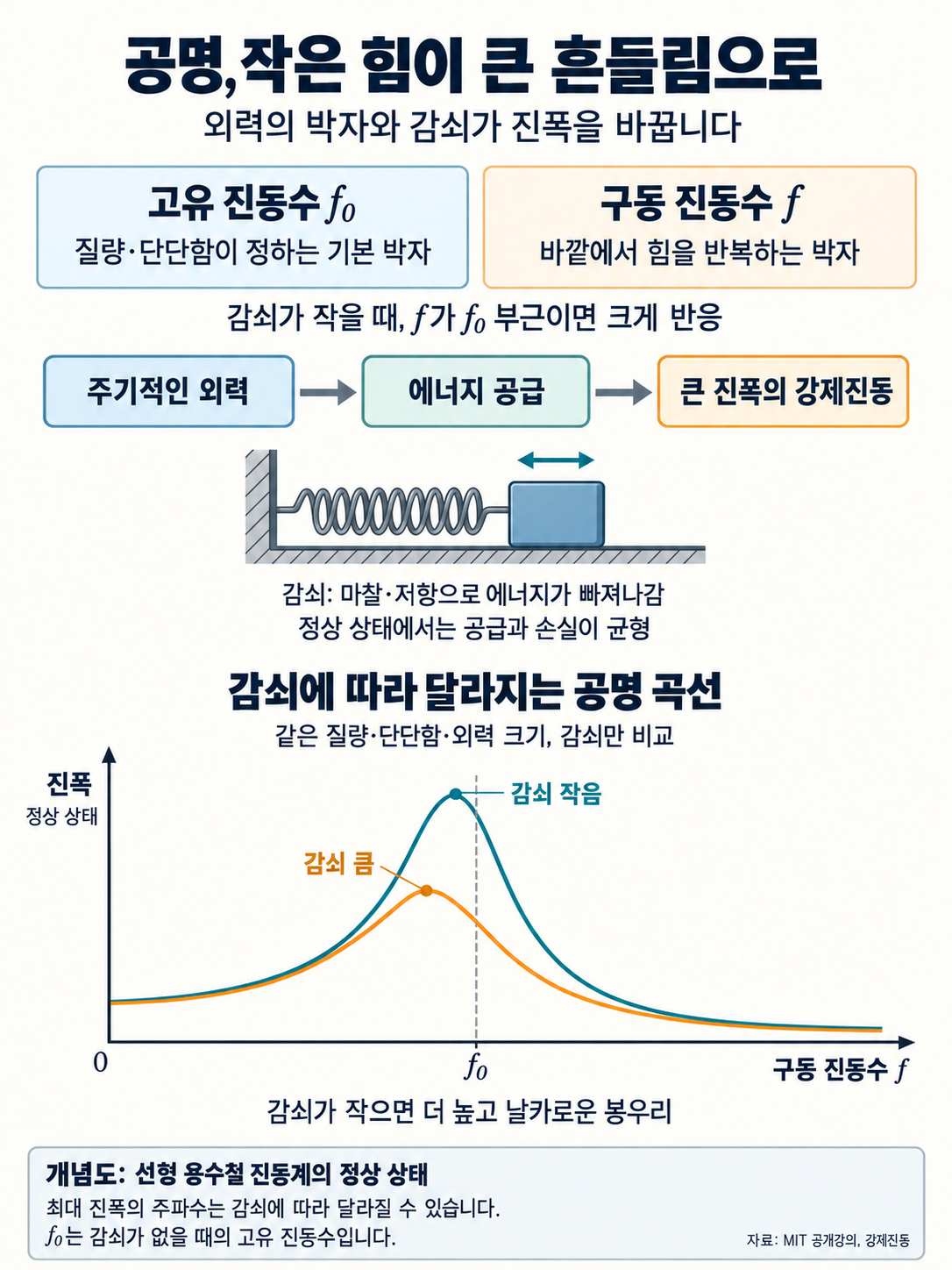

Every object has its own rhythm at which it likes to sway. If you nudge a weight hanging on a string once, it swings back and forth at a steady pace without anyone setting it. The rate at which an object sways on its own like this is called its natural frequency.
Frequency indicates how many times something goes back and forth in one second, and its unit is the hertz (Hz). Swaying once per second is 1 Hz, and ten times per second is 10 Hz. An object's natural frequency is determined by its mass, stiffness, and shape. This is also why a short, taut guitar string vibrates quickly, while a long, slack one vibrates slowly.
Resonance occurs when the frequency of a force applied periodically from outside is equal or very close to this natural frequency. Then, even a small force makes the width of the swaying, that is, the amplitude, grow noticeably.
How the Swaying Grows

The secret of resonance lies in the way energy builds up. When the rhythms match, the outside force always acts in the direction the object is moving, so a little energy is added with every push.
(1) When the rhythms don't match
Sometimes the force helps the motion and sometimes it works against it. The energy added and the energy taken away cancel each other out, so the swaying cannot grow much.
(2) When the rhythms match
The force helps the motion every time, so energy piles up steadily. Even with a force of the same size, the swaying keeps growing.
(3) The role of damping
Real objects gradually lose energy to air resistance and friction. This is called damping, and the less damping there is, the more the swaying swells at resonance.
So an object with almost no damping responds very strongly at its resonant frequency, and the response quickly drops off if the frequency shifts even slightly. Conversely, in an object with heavy damping, the swaying does not grow much even when resonance occurs. The same thing happens with sound. If two tuning forks have the same natural frequency, striking one makes the other, untouched one ring along with it.
Resonance in Everyday Life and Technology

Thanks to its ability to amplify swaying, resonance is put to good use in many places.
- Musical instruments: The wooden bodies of guitars and violins resonate with the vibration of the strings, turning a small sound into a loud, rich one.
- Radio tuning: A radio matches the resonant frequency of its circuit to the frequency of the desired station, picking up only that signal.
- Magnetic resonance imaging: Using the way hydrogen nuclei in the body resonate with radio waves of a particular frequency inside a strong magnetic field, it produces images of the inside of the body.
- Microwave oven: Microwaves rapidly jostle the water molecules in food, producing heat. This is a little different from resonance in the strict sense, but it is often introduced alongside it because it shakes molecules with electromagnetic waves.
The tiny piece of quartz in a watch also uses resonance. Quartz vibrates at a very steady frequency when a voltage is applied, and many wristwatches keep time using a quartz crystal that vibrates 32,768 times per second. When a singer shatters a wine glass with a high note, it is because a sound matched to the glass's natural frequency makes the glass vibrate strongly.
Accidents Caused by Resonance and How to Prevent Them

Resonance affects huge structures too. In 1831, at the Broughton Suspension Bridge in England, 74 soldiers marched in step and the bridge swayed strongly in time with their footsteps, until one end finally collapsed into the river. Fortunately no one was killed, but the British Army afterwards ordered troops not to march in step when crossing bridges.
The Millennium Bridge, which opened over the River Thames in London in June 2000, also swayed sideways strongly right after it opened. When the bridge swayed slightly, crowds of pedestrians, trying to keep their balance, unconsciously matched their steps to the bridge's sway, and that force made the swaying even larger. The bridge was closed two days after opening and only reopened in February 2002, after dampers were fitted to reduce the swaying.
To prevent such incidents, engineers calculate natural frequencies in advance when designing structures and adjust mass and stiffness so that they do not coincide with the rhythm of people's footsteps, wind, or machine vibrations. Tall buildings sometimes have tuned mass dampers installed: huge weights that sway opposite to the building to reduce its vibration.
Resonance is nature's amplifier, turning a small force into a big motion. Understanding its rhythm lets us use it to make sounds louder and pick out signals, and also to avoid dangerous swaying in advance.
Reading the invisible rhythm: that is the first step toward the wisdom of taming vibration.