On a clear day near an air force base, a loud double “boom, boom” can suddenly rattle the windows. There is not a cloud in the sky, yet you hear something like thunder, so it is no wonder people are startled. The source of this sound is not an explosion but a trace left behind by an aircraft flying faster than sound.
The loud sound produced when the shock waves formed by an object moving through the air faster than the speed of sound reach the ground is called a “sonic boom,” sometimes also known as a sonic bang.
This article looks in turn at how sonic booms form, the small sonic booms we can hear around us, why supersonic airliners disappeared, and the research aimed at reducing the boom.
The Moment of Breaking the Sound Barrier: How Sonic Booms Work and What They Do
How Does a Sonic Boom Form?
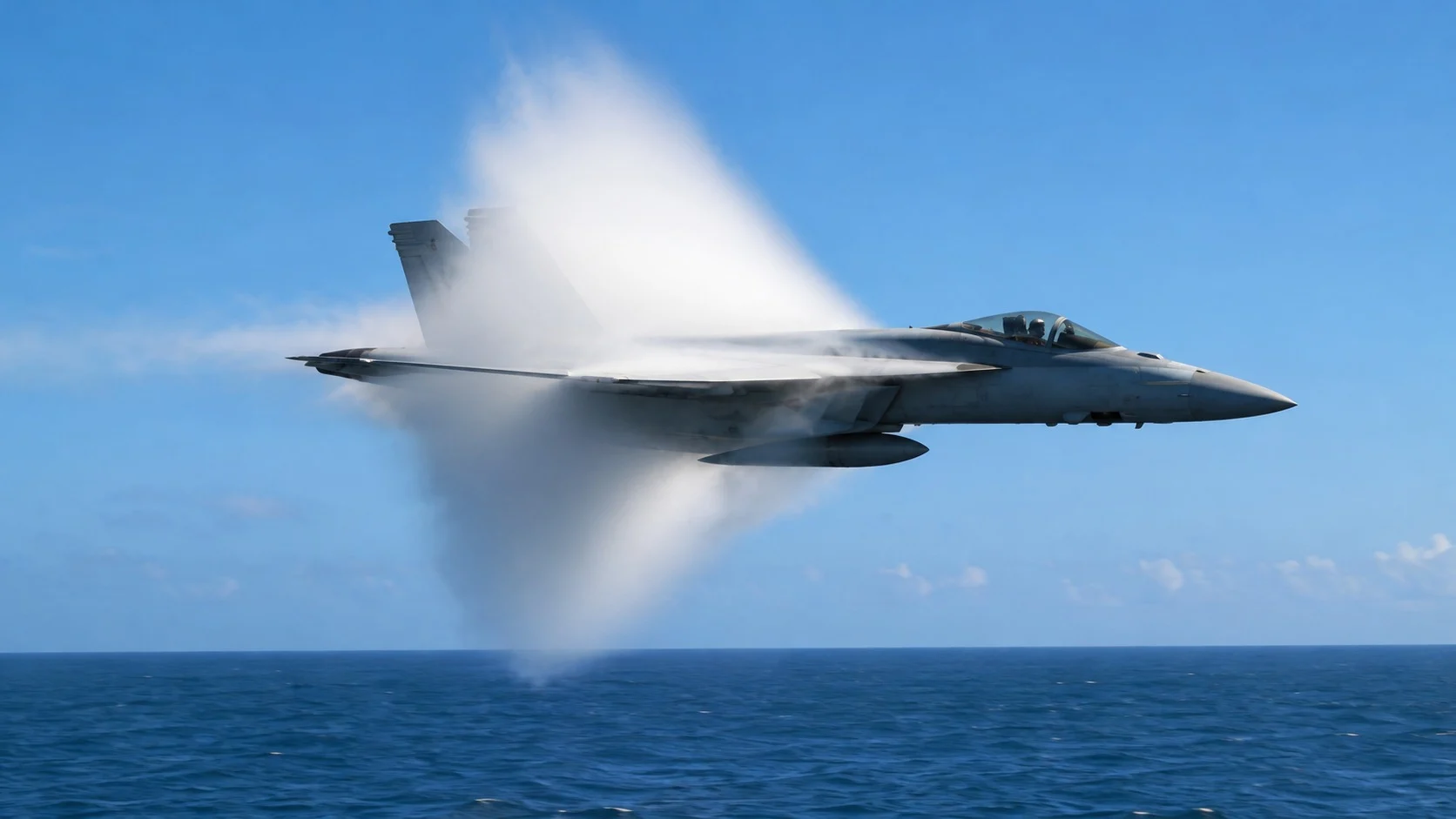
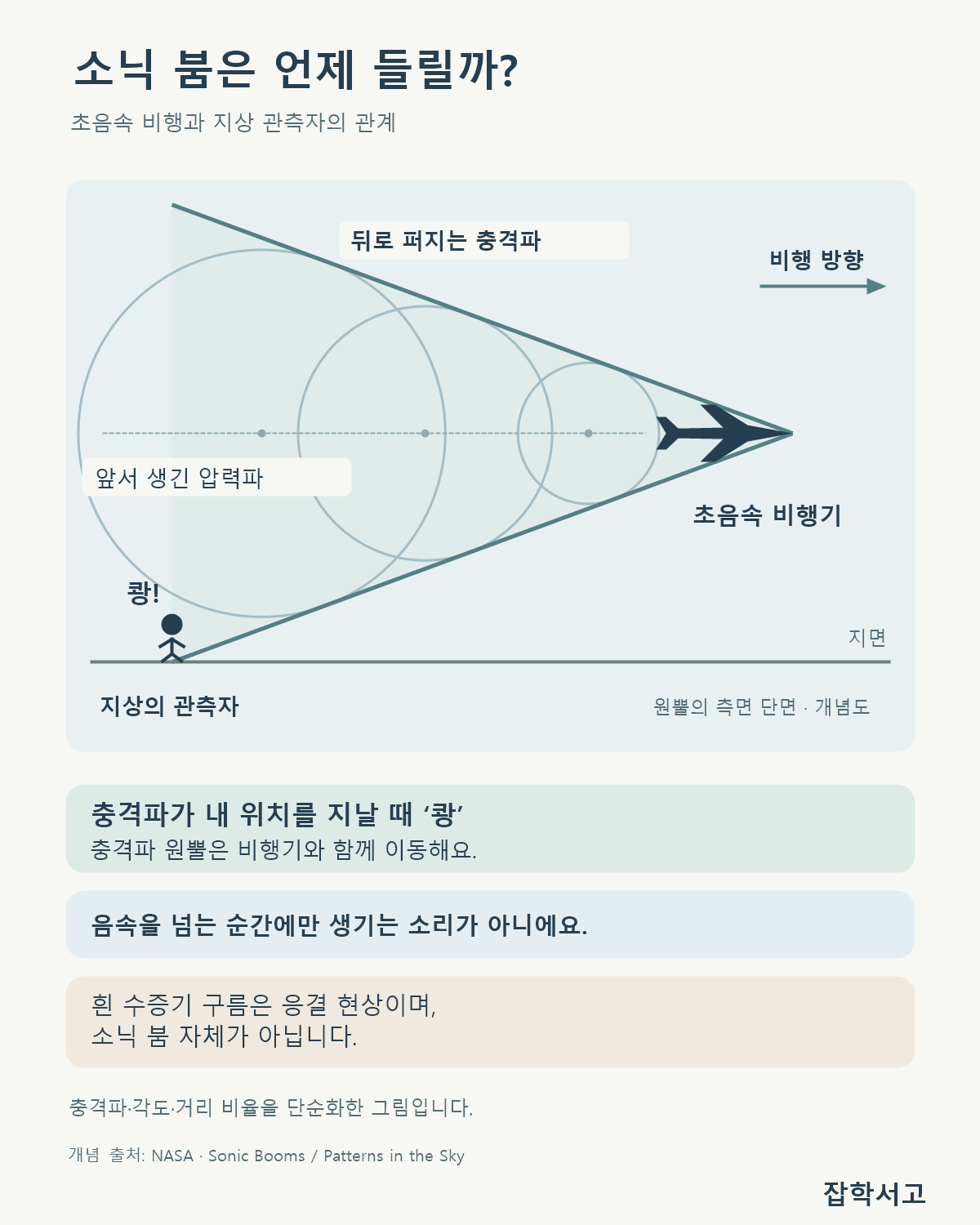
Sound is a wave in which changes in air pressure spread out like ripples. In air at 20 degrees Celsius, sound travels about 343 meters per second. The Mach number expresses an object's speed relative to this speed, and moving at the same speed as sound is Mach 1.
(1) Pressure Waves Piling Up in Front
As an aircraft flies, it keeps creating pressure waves at its front and rear, much like the waves that form at the bow and stern of a boat moving through water. When the aircraft is slower than sound, the pressure waves spread out ahead of it, but as its speed approaches the speed of sound, the waves cannot get away in time and pile up layer upon layer in front of the aircraft.
(2) Merging into a Single Shock Wave
Once the aircraft is faster than sound, the piled-up pressure waves merge into a shock wave, in which the pressure jumps abruptly. This shock wave spreads backward in the shape of a cone with the aircraft at its tip, known as the Mach cone. The faster the aircraft, the narrower the cone.
(3) Why It Booms Twice
At the aircraft's nose the air pressure rises suddenly, and toward the tail it drops below normal before returning to normal once the aircraft has passed. Because this pressure change resembles the letter N, it is called an N-wave. Since there are two moments when the pressure changes abruptly, people on the ground hear a double “boom, boom.”
Does It Boom Only Once, When the Sound Barrier Is Broken?

It is commonly believed that an aircraft makes a single “boom” at the instant it exceeds the speed of sound, but this is a misconception.
(1) A Sound That Follows Along
A sonic boom is produced the entire time an aircraft flies at supersonic speed. The cone-shaped shock wave moves with the aircraft and sweeps across the ground, and each person in the path of the cone hears the boom once. This zone, stretching out in a long strip beneath the flight path, is called the boom carpet.
(2) The Cockpit Is Quiet
Because the shock wave spreads out behind the aircraft, the people on board do not hear the boom at all. Concorde pilots likewise said they could only confirm the pressure change on their instruments and heard no sound.
(3) Loudness Varies with Altitude and Weather
The higher an aircraft flies, the more the shock wave spreads out and weakens, lowering the pressure that reaches the ground. In exchange, the area where the boom can be heard becomes wider. The sound may reach the ground anywhere from a few seconds to about a minute after the aircraft has passed, and how loud it sounds also depends on temperature, wind and the ground surface.
Small Sonic Booms All Around Us

Sonic booms are not just about fighter jets. On a much smaller scale, we can hear sounds made by the same principle in everyday life.
- Whip crack: When a whip is swung hard, its tapering tip moves faster than sound and makes a small sonic boom, the familiar “crack.”
- Towel snap: The sharp sound of a rolled-up towel being snapped hard is another example of a small sonic boom.
- Supersonic bullet: The sharp cracking sound heard when a bullet faster than sound passes overhead is also made by a shock wave.
A whip can move faster than sound because the motion from the handle is passed along to the ever thinner and lighter tip, which picks up a great deal of speed.
The Challenge of Flying Quietly
After American pilot Chuck Yeager flew the Bell X-1 past the sound barrier in level flight for the first time on October 14, 1947, supersonic flight advanced rapidly. The sonic boom, however, became a major obstacle.
(1) A Ban on Supersonic Flight over Land
In 1964, a six-month experiment in Oklahoma City, USA, produced sonic booms eight times a day, and as many as 15,000 complaints poured in. Because of noise that woke people up and shook window panes, the United States and several other countries banned civil aircraft from flying at supersonic speed over land, and even Concorde had to fly supersonically mainly over the sea.
(2) Designs That Soften the Boom
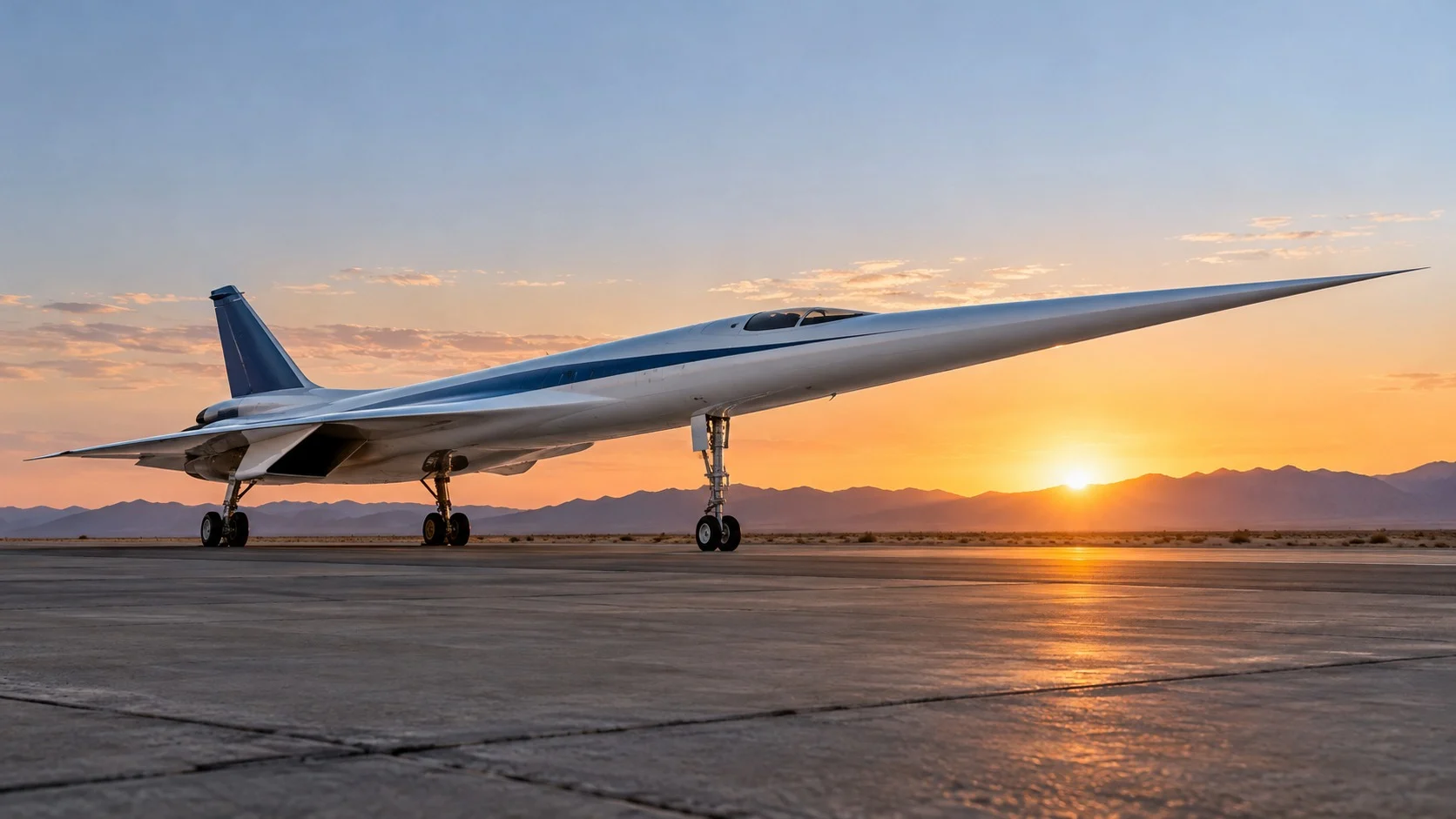
Scientists noticed that changing the shape of an aircraft keeps the shock waves from bunching into one and scatters them instead, making the sound softer. Using this principle, NASA built the X-59, an experimental aircraft with a very long, pointed nose, which made its first successful flight in October 2025. The goal is to reduce the boom to about the sound of a car door closing.
(3) Flying So the Boom Never Reaches the Ground
High in the sky the air is colder than near the ground, so sound bends upward. Researchers are also studying a technique called Mach cutoff, in which an aircraft flies only slightly faster than sound so that the shock wave bends back upward before it reaches the ground.
A sonic boom is like a giant footprint that an object moving faster than sound leaves in the air. Within the roar that splits the sky lies a simple yet remarkable law of physics in which waves pile up and merge.
Finding a way to fly fast without startling the people on the ground is the first step toward the return of supersonic airliners.