Quantum mechanics is a theoretical framework that plays an important role in understanding the fundamental properties of matter and energy. Among its principles, the uncertainty principle forms the core of quantum mechanics and has fundamentally changed how we observe and interpret physical reality. By establishing the limits of observation and breaking down the boundaries between experiment and theory, this principle has become an essential element in understanding the nature of the quantum world.
This material covers the conceptual foundations, historical background, and mathematical expressions of the uncertainty principle, and examines its influence across science and technology. It also discusses how this principle is applied in modern science and various fields of application through specific examples.
Basic Concepts and Background of the Uncertainty Principle

Basic Concepts of the Uncertainty Principle
The uncertainty principle is a theory that explains the fundamental limits of quantum observation, stating that it is impossible to measure a particle's position and momentum precisely at the same time. This is not simply a matter of the accuracy of measuring instruments or the precision of experiments, but reflects a fundamental property of nature. The more precisely we try to determine a particle's position, the more uncertain the information about its momentum—that is, its speed and direction—becomes. Conversely, if we can measure its momentum very accurately, information about the particle's position becomes blurred.
The uncertainty principle goes beyond explaining the limits of our ability to observe and reflects the fundamental indeterminacy of nature. This means that it is an intrinsic property of nature itself, rather than merely a technical problem or a limitation of observational instruments. This principle is essential to understanding the microscopic world of the universe and serves as an important cornerstone for understanding quantum properties.
Heisenberg and the Emergence of the Uncertainty Principle
In 1927, the German physicist Werner Heisenberg formally proposed the uncertainty principle. While considering the limits of observation and measurement, Heisenberg explained uncertainty in the quantum world through a mathematical model. His research provided an important foundation for explaining various previously observed quantum phenomena, and through it he brought the fundamental limits of quantum observation to the world's attention.
The proposal of the uncertainty principle caused a major stir among physicists and challenged the existing classical worldview. Heisenberg's research played an important role in understanding complex phenomena in the microscopic world that had previously remained unexplained. His theory, which sought to explain uncertain phenomena in the quantum world, subsequently became an important foundation throughout quantum theory and played a significant role in establishing the foundations of modern physics.
Differences from the Classical Perspective
Before the uncertainty principle emerged, scientists believed, from the perspective of classical physics, that a particle's position and state of motion could be measured with infinite precision. In the classical worldview, complete certainty existed: knowing an object's current position and state of motion made it possible to predict its future position and trajectory. This was based on a deterministic worldview, as exemplified by Newton's laws of motion, and the belief that all phenomena could be predicted mathematically had become established.
However, Heisenberg demonstrated that this kind of determinism could not apply at the quantum level. The discovery that a particle's position and momentum cannot both be definite at the same time brought about a major shift in the existing understanding of physics. The uncertainty principle describes limits that arise from the intrinsic properties of the quantum world itself, rather than simply from the limitations of measuring instruments. As a result, scientists had to reconsider definite predictions about natural phenomena, opening a new chapter in the understanding of the microscopic world.
A Paradigm Shift in the Quantum World
The uncertainty principle completely overturned the existing way of thinking in physics and introduced a new paradigm. Uncertainty in the quantum world does not simply mean unpredictability; it is also interpreted as a principle that reflects the effect of observation on its subject. This suggests that observation itself can change the subject's state, and therefore that what we observe cannot be the same before and after observation.
This uncertainty led to the introduction of a probabilistic approach that moved beyond earlier deterministic thinking. Understanding quantum systems came to require predictions based on probability and statistics, demanding an approach entirely different from earlier models of certainty. This paradigm shift in quantum mechanics fundamentally changed how scientists viewed the microscopic world and subsequently prompted the introduction of probabilistic thinking in various fields.
The Uncertainty Principle and Debate Among Scientists
When the uncertainty principle was announced, it sparked heated debate among scientists. Albert Einstein, in particular, expressed strong skepticism about the uncertainty principle. Because Einstein believed that all phenomena in nature could be explained mathematically, he found it difficult to accept the probabilistic interpretation of the uncertainty principle. His famous statement, "God does not play dice," is a representative expression of his skeptical stance toward the uncertainty principle.
However, debate over the uncertainty principle helped advance quantum theory. Skeptics such as Einstein attempted various experimental approaches and theoretical analyses to identify the limits of the uncertainty principle, and these discussions became an important foundation for the development of quantum mechanics. Debate for and against the uncertainty principle energized the scientific community, enabling quantum theory to become more refined and developed.
An Essential Element in Understanding the Nature of the Quantum World
The uncertainty principle has become an important concept that explains the intrinsic properties of the quantum world, rather than simply indicating the limits of measurement. Moving beyond the classical view of nature as perfectly predictable, it has become an essential element in understanding a quantum world in which particular regularities exist even amid uncertainty. The uncertainty principle enables a deeper understanding of quantum properties, and through this, research into the microscopic world has made considerable progress.
Today, the uncertainty principle is applied in various areas of modern science and technology, including quantum computing and cryptography, driving practical innovation. This principle serves as an important foundation for the development of modern science and technology, and its importance will become even more prominent through further research and applications.
Mathematical Expressions of the Uncertainty Principle in Quantum Mechanics
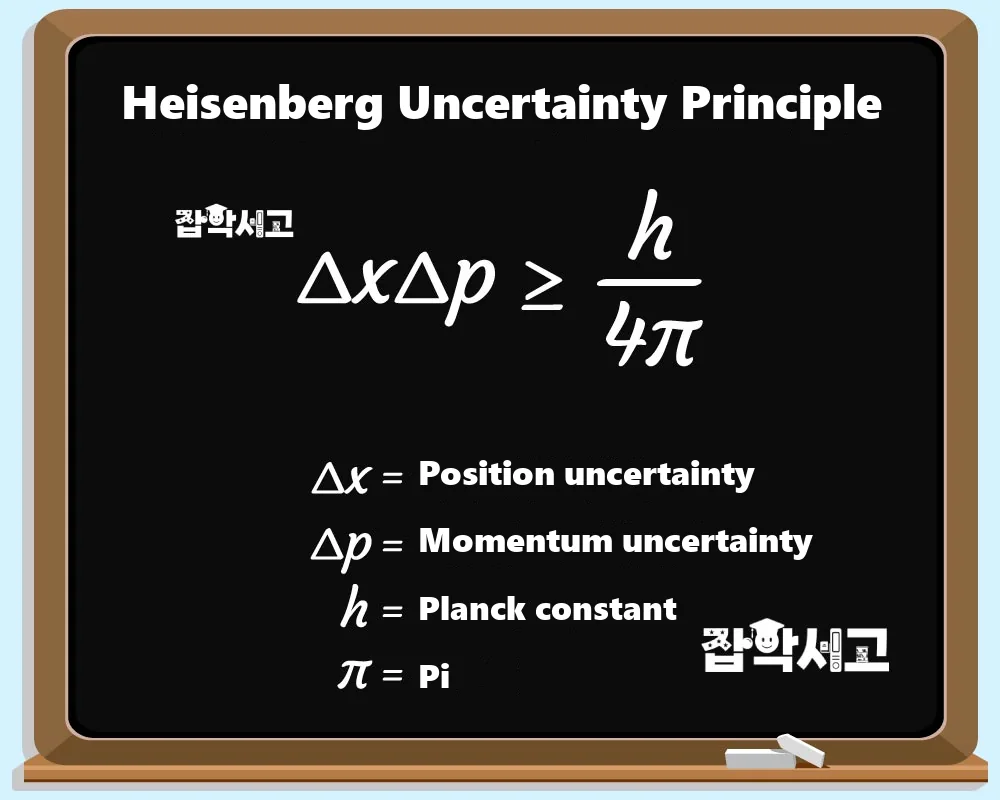
Mathematical Expression of the Uncertainty Principle
The uncertainty principle is expressed mathematically through Heisenberg's uncertainty relation, which takes the form Δx Δp ≥ ℏ/2. In this equation, Δx represents uncertainty in position, Δp represents uncertainty in momentum, and ℏ is the reduced form of Planck's constant, an important constant representing quantum properties. This uncertainty relation mathematically expresses the impossibility of measuring a particular particle's position and momentum precisely at the same time. It shows that the two values vary in inverse proportion, so that the more precisely one value is known, the more uncertain the other becomes.
The uncertainty principle defines the limits of observation in quantum systems, reflecting an intrinsic property of nature rather than a simple technical problem or a restriction of experimental equipment. This equation mathematically explains how observations of the microscopic world can be made and is an important concept that constrains the predictability of quantum systems. As such, it serves as a fundamental means of understanding complex phenomena in the microscopic world.
Derivation of the Uncertainty Relation and the Wave Function
Heisenberg's uncertainty principle is derived from the properties of the wave function. In quantum systems, the state of every particle is expressed in a mathematical form called a wave function, which appears as a probability distribution over positions or momenta. The wave function cannot specify a particular particle's position and momentum with certainty at the same time, but instead provides values distributed probabilistically. Because the position and momentum operators do not commute, it is impossible to measure them both precisely at the same time.
Uncertainty in position and momentum in quantum systems arises from the inherent properties of the wave function. The degree to which the wave function spreads determines the uncertainty in measurements of position and momentum, so the more accurately we try to measure position, the greater the uncertainty in the momentum measurement becomes. These properties of the wave function explain why a probabilistic interpretation is essential in quantum observation, which differs fundamentally from conventional classical observation.
Eigenstates and the Role of the Uncertainty Principle
The uncertainty principle leads to the problems of eigenstates and eigenvalues in quantum systems, and this relationship serves as an important principle defining the characteristics of quantum measurement. An eigenstate is a state in which the measured value of a particular physical quantity is definite, and in this state the quantity is measured as a fixed value. In quantum systems, however, not all measured values depend solely on eigenstates, and they tend to exhibit multiple probabilistic outcomes.
The uncertainty principle clearly defines these limits of measurement in quantum systems, suggesting that, unlike in classical determinism, a particular physical quantity cannot always be in an eigenstate. In classical physics, a measured value is definitively determined by a particular state, whereas quantum systems appear as superpositions of multiple eigenstates. The uncertainty principle therefore plays an important role in mathematically explaining why quantum observation must be based on a probabilistic interpretation.
The Uncertainty Relation Between Time and Energy
The uncertainty principle applies not only to position and momentum but also to time and energy. The time–energy uncertainty relation is expressed as ΔE Δt ≥ ℏ/2, indicating that time and energy cannot both be measured with certainty at the same time in a particular quantum process. Uncertainty in time and energy means that the more precisely we try to measure a particle's energy over a particular period of time, the greater the uncertainty in its energy value becomes.
This time–energy uncertainty relation plays an important role in explaining quantum phenomena such as radioactive decay. During radioactive decay, it is impossible to predict simultaneously the exact time at which a particular particle will be emitted and its energy. This principle provides a means of quantitatively explaining various uncertainties that arise in quantum processes and helps us understand the quantum properties of time and energy. Through this, the uncertainty principle enables us to grasp the nature of various quantum interactions beyond the simple observation of particles.
Extensions of the Uncertainty Principle and Its Effects on Quantum Systems
The uncertainty principle is extended in various ways in quantum systems, playing an important role in understanding the properties of more complex systems. This principle is not limited to observing particles at the microscopic level, but also helps us understand complex molecules, atoms, and various interactions. For example, beyond position and momentum, it is often applied to measuring particular properties of wave functions and is used to analyze interactions and correlations among different quantum states.
The uncertainty principle has also become an important foundation of modern science and technology. It is used in various advanced fields, including quantum computing, cryptography, and sensor technology, and plays a central role in understanding the properties of quantum systems. In quantum encryption in particular, the uncertainty that inevitably arises during measurement helps ensure security, allowing the uncertainty principle to hold an important place in practical applications as well.
The Uncertainty Principle as an Essential Concept for Understanding the Quantum World
The uncertainty principle has become an essential concept for understanding the nature of the quantum world, extending beyond a simple mathematical relation. Through the uncertainties that exist between all measurable physical quantities, such as position and momentum or time and energy, this principle establishes the fundamental limits of quantum systems. These limits provide a means of explaining the unavoidable characteristics of quantum observation and measurement, enabling a deeper understanding of the quantum world.
In modern science, the importance of the uncertainty principle is further emphasized through a variety of applications. The probabilistic nature of quantum observation has moved beyond conventional classical determinism to highlight the importance of probability and statistics, producing effects not only in physics but also in fields such as statistics and computer science.
Major Effects of the Uncertainty Principle on Physics

A New Understanding of the Nature of Observation
The uncertainty principle provided the first scientific demonstration of the effect of observation on its subject. In the conventional classical view, the observer was regarded as a passive entity that simply recorded results, but the uncertainty principle revealed that the observer intervenes in the target system during measurement. According to this principle, observation itself can alter the state of the system, expanding the meaning of observation from simply "recording" to "intervention." This phenomenon is called the "observer effect" and has become an important concept indicating that the act of measurement itself can change its subject in the microscopic world.
The observer effect is an essential concept for explaining the distinctive interactions that occur particularly in the microscopic world. Quantum systems such as particles can exist in a superposition of multiple possibilities when they are not observed, but converge to a single state at the moment observation takes place. As a result, the outcomes of quantum systems vary according to the act of observation, meaning that observation is not independent but influences its subject. Through the uncertainty principle, we have come to understand that observation is not an independent process separate from its subject.
A Challenge to the Deterministic Worldview
The uncertainty principle posed a fundamental challenge to the classical deterministic worldview. From the classical perspective, all physical phenomena were believed to be perfectly determined by cause and effect. In other words, a way of thinking based on certainty had become established, holding that knowing the present state made it possible to predict the future state perfectly. However, the uncertainty principle mathematically demonstrated that this kind of determinism does not apply in the microscopic world. The fact that a particle's position and momentum cannot be measured precisely at the same time suggests that not all phenomena in nature can be predicted with certainty.
The uncertainty raised by the uncertainty principle brought major changes to the scientific community and required a new approach to understanding the quantum world. In the microscopic world, all events must be explained on the basis of probability, and accepting a distribution of possibilities rather than a specific value became essential. This probabilistic interpretation completely overturned the thinking based on certainty in classical physics, extending its influence beyond physics to philosophical thought. Through the uncertainty principle, we came to acknowledge that absolute predictions of natural phenomena are impossible, leading to a fundamental paradigm shift in modern science.
Effects on Applied Technologies
The uncertainty principle has had an enormous influence not only on theoretical understanding but also on modern science and technology. Semiconductor technology is a representative example. Semiconductors are materials that use the quantum properties of particles such as electrons, and understanding the uncertainty principle has made it possible to maximize the properties of these materials and control them more precisely. Thanks to the uncertain nature of electrons, semiconductors can rapidly regulate current while maintaining particular electron states, making the development of modern electronic devices possible.
The uncertainty principle also provides a foundation for new technologies such as quantum computing. Quantum computers use the quantum properties of particle superposition and entanglement to perform complex calculations much faster than conventional computers. The uncertainty principle provides an essential theoretical foundation for understanding and using these quantum properties, allowing quantum computing to offer possibilities beyond existing computing technology. This demonstrates how important a foundational role the uncertainty principle plays in the development of theories in physics into advanced technologies.
Contributions to Quantum Encryption and Information Security
The uncertainty principle plays an important role in quantum encryption technology. Quantum encryption is a technology that protects information using quantum properties, and it can prevent information leakage because external observation alters the state of information according to the uncertainty principle. This technology has advantages in defending against illegal eavesdropping and hacking and has become a key element of modern information security. Quantum encryption provides stronger security than traditional encryption methods by causing the information itself to change when an observer tries to steal it, making such attempts easy to detect.
The uncertainty principle serves as a core principle in this quantum encryption technology, providing an environment in which external intervention automatically alters information so that the original information can be protected. These characteristics give quantum encryption strong potential for application in various fields requiring high levels of security, including the military, finance, and medicine. Quantum encryption is an example of the development of the uncertainty principle into a practical, applicable technology and is opening a new era in information security.
Effects on Theoretical Research and Future Science
The uncertainty principle also has a profound influence on theoretical research in modern science. For example, when developing new physical theories such as quantum gravity, the uncertainty principle serves as an important element in harmonizing existing physical principles with new approaches. Quantum gravity is an attempt to unify quantum theory and general relativity, addressing problems that are difficult to explain fully without considering the limits of observation and measurement raised by the uncertainty principle. This suggests that the uncertainty principle is an essential concept in studying the relationship between the quantum world and gravity.
The uncertainty principle also acts as a catalyst for new scientific discoveries and innovations beyond theoretical research. By understanding uncertainty in the microscopic world and exploring it theoretically, we are uncovering nature's deeper secrets, providing an important foundation for the future of science and technology. Research continues to understand quantum properties based on the uncertainty principle and apply them to various scientific challenges, offering an essential path for humanity's exploration of broader knowledge.
Overall Effects on Scientific Thinking and Technological Innovation
Ultimately, the uncertainty principle has gone beyond being a single theory, sparking new ways of thinking and driving technological innovation in various fields while opening new frontiers beyond existing understanding. By defining the limits of quantum observation and measurement, the uncertainty principle broadens the scope of scientific thinking and deepens our understanding of complex natural phenomena. The uncertainty presented by this principle moves beyond the limits of classical thinking, enabling new approaches in various scientific fields.
In scientific research and technological innovation, the uncertainty principle serves as a driving force that breaks existing frameworks and encourages the exploration of new possibilities. Its influence extends broadly across disciplines including biology, chemistry, and computer science as well as physics, and it also makes important contributions to philosophical thought and understanding in the humanities. The uncertainty principle changes the fundamental framework of scientific inquiry and will remain a key concept driving diverse research and innovation.
Applications of the Uncertainty Principle in Modern Science

The Uncertainty Principle in Quantum Computing
The uncertainty principle forms a fundamental theoretical foundation of quantum computing and plays an essential role in understanding and controlling the superposition and entanglement of quantum states. Quantum computers operate using qubits instead of the bits used by conventional digital computers. Qubits have the property of superposition, allowing them to be in the states 0 and 1 simultaneously, giving quantum computers enormous computational power to process complex problems in parallel. The uncertainty principle makes the states of qubits fluctuating and indeterminate, allowing superposition states to be maintained and computations to be performed.
Quantum computers have the potential to solve problems that are difficult for classical computers, such as prime factorization, optimization problems, and complex data analysis, much faster. The uncertainty principle provides the flexibility for quantum states to change continuously during these computational processes, allowing complex calculations to be performed beyond existing limits. Through this, quantum computing is establishing itself in various fields, including finance, drug development, and cryptography, as a new technology that outperforms conventional computers. The success of quantum computing depends heavily on the ability to use the uncertainty principle effectively, and the technology is developing on this basis.
The Uncertainty Principle in Medicine and Nanotechnology
The uncertainty principle serves as an important principle driving the development of nanotechnology in medicine. Nanotechnology deals with structures at the atomic or molecular level, and nanoparticles such as quantum dots (Q-dot), in particular, can have their optical properties adjusted based on the uncertainty principle. Quantum dots emit light at specific wavelengths and are used as tools for precisely visualizing particular areas of tissue in imaging within living organisms. As a result, nanotechnology has come to play an important role in various areas of medicine, including early disease diagnosis, cancer cell detection, and the analysis of internal cellular structures.
The uncertainty principle also plays a key role in drug delivery systems that use nanoparticles. By using quantum properties, a particular drug can be delivered precisely to its target cells or tissues, allowing effective treatment while minimizing side effects. For example, technology has been developed to deliver anticancer drugs only to particular tumor sites, reducing the side effects of drugs spreading throughout a patient's body. These technologies have become possible by controlling electronic and optical properties based on the uncertainty principle and are opening new horizons in medicine.
Analysis of Molecular Interactions in the Life Sciences
In the life sciences, the uncertainty principle is used as an important tool for analyzing interactions between molecules and atoms. Various biochemical reactions within cells are determined by the quantum properties of atoms and molecules, and interactions at the minute molecular level, in particular, are explained through uncertainty. For example, when analyzing protein structure and function, uncertainty makes it difficult to determine the exact positions and momenta of molecules. The uncertainty principle is therefore essential for understanding the complex processes through which molecules interact within living organisms.
Through the uncertainty principle, life scientists can gain a deeper understanding of the various structural changes and reaction pathways of molecules. In particular, the uncertainty principle plays an important role in research on how a particular drug binds to and interacts with its target molecule. New drugs are developed based on this understanding, contributing to more effective treatment of diseases and the development of new therapies. In the life sciences, the uncertainty principle provides an essential theoretical foundation for explaining biological phenomena at the molecular level.
Quantum Sensors and the Uncertainty Principle in Environmental Science
The uncertainty principle also enables important technological advances in environmental science. Quantum sensors, in particular, have developed into devices that use the uncertainty principle to enable extremely sensitive measurements, allowing environmental changes and pollutants to be detected in real time. Quantum sensors are highly sensitive and respond even to minute stimuli, making it possible to measure even small environmental changes accurately. As a result, quantum sensors are widely used in various environmental protection activities, including air pollution detection, monitoring changes in water quality, and measuring radioactive substances.
The sensitivity of quantum sensors operates on the basis of the uncertainty principle, allowing them to capture small changes that conventional measuring equipment cannot detect. In environmental science, this technology is very useful for monitoring global issues such as climate change in real time and providing the necessary data. Quantum sensors can also measure pollutants such as microplastics and heavy metals precisely, playing a very important role in environmental protection and resource management. The uncertainty principle is the fundamental principle behind this quantum sensor technology, opening new possibilities in environmental science.
The Uncertainty Principle and New Material Development in Materials Science
The uncertainty principle also plays a key role in researching and developing new substances in materials science. Understanding quantum properties makes it possible to design new materials with properties such as electrical conductivity, durability, and thermal conductivity, which are used in various industries, including electronics, aviation, and construction. For example, specialized materials such as those with maximized electrical conductivity or superconductors are created by controlling the quantum properties of electrons through the uncertainty principle. These specialized materials can reduce power consumption or withstand extreme environments, playing an important role in improving energy efficiency and developing sustainable technologies.
Research using the uncertainty principle also has a major influence on energy storage and conversion technologies. For example, highly efficient energy devices such as next-generation batteries and fuel cells require precise control of electron movement, and the uncertainty principle plays an important role here. The development of new materials that take quantum properties into account is environmentally friendly and offers ways to maximize energy efficiency. These innovative materials have become essential technologies in modern industry, and the uncertainty principle provides a foundation for such advances.
Overall Effects on Modern Science and Future Possibilities
The uncertainty principle enables practical applications in various fields of modern science and drives the development of new technologies. Through it, scientists have gained a deeper understanding of complex systems in the natural world and are using this understanding to achieve innovation across various industries. The uncertainty principle has become an essential concept in quantum computing, nanotechnology, medicine, environmental science, and materials science, providing an important foundation for the development of each field.
The uncertainty principle is also becoming a driving force that opens possibilities for future science and technology. More effective applications of the uncertainty principle are expected to lead to the development of new technologies that can solve the various problems humanity faces. It will remain an important concept driving continued research and innovation throughout science and engineering as well as physics. Through the uncertainty principle, we are continuing to expand the boundaries of science by understanding the fundamental limits of nature and seeking various ways to overcome them.
The uncertainty principle is a concept at the heart of quantum mechanics that has had a major influence on both scientific thinking and technological innovation. It goes beyond a simple theory to lead to practical applications in various fields of modern science, serving as a driving force that promotes innovation.
The uncertainty principle goes beyond understanding physical reality to establish a foundation for new technological developments and will continue to play a central role in future research and inquiry. Through it, we will be able to pursue a deeper understanding of the natural world and use that understanding to develop technologies that improve quality of life.