
Theories that explain how matter and energy interact in the quantum world form an important foundation of modern physics. Among them, the Schrödinger equation plays an important role in mathematically describing the wave-like properties of particles. Proposed by Erwin Schrödinger, this equation is an essential tool for understanding the complex phenomena of the microscopic world that classical physics could not address.
This material explores the fundamental concepts and principles of the Schrödinger equation in depth, using them to explain quantum changes over time and their applications. It examines the equation's mathematical structure and the physical interpretations it provides, and considers how it is used to explain the fundamental properties of matter.
Fundamental Concepts of the Schrödinger Equation
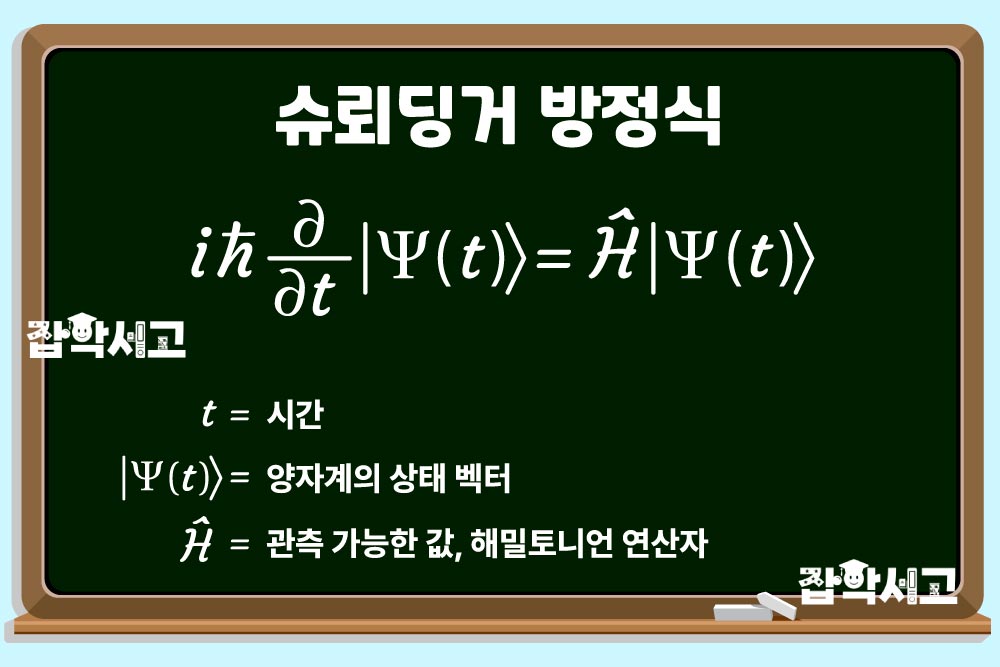
The Schrödinger equation mathematically describes the wave-like properties of particles and plays an essential role in describing quantum motion. It expresses how a particle occupies space as a wave and how its state changes over time. The equation uses a wave function (ψ) to describe a particle's state, and the wave function indicates the probability of the particle existing at a particular position.
Through this equation, a particle's position or state of motion is represented by various probabilities rather than determined as a single value. Consequently, the particle's exact position cannot be known, and only the likelihood of it being at a particular position can be estimated. This uncertainty is one of the important features that distinguish quantum physics from classical physics.
Time-Dependent and Time-Independent Equations
The Schrödinger equation has two main forms: the time-dependent Schrödinger equation and the time-independent Schrödinger equation.
The time-dependent equation explains how a particle's state changes over time. It is used to address dynamic systems, or situations that change as time passes. For example, it can calculate how a particle moves within a particular space or how its energy changes over time. This equation shows how a particle's wave function evolves in time and space.
The time-independent equation describes a particle's energy in static situations. It applies to systems that do not change over time, such as constant conditions involving the energy states of electrons within an atom. In this case, the wave function focuses on describing the particle's spatial distribution independently of time. This makes it possible to identify the properties of a particle in a particular energy state.
Wave Functions and Probabilistic Interpretation
The concept at the heart of the Schrödinger equation is the wave function (ψ). This function mathematically represents a particle's state in a physical system and describes the probability amplitude of the particle being at a particular position. The squared absolute value of the wave function (|ψ|²) represents the probability of the particle existing at a particular position. This differs from the classical concept of a particle in that a quantum particle does not move along a definite orbit or path, but instead has a probability of being at a particular position.
The wave function has great significance as a solution to the Schrödinger equation and is used in physics as a tool for estimating a particle's position or energy. This makes the Schrödinger equation an important mathematical model capable of describing particle behavior probabilistically.
The Hamiltonian Operator and Energy Eigenvalues
In the Schrödinger equation, the Hamiltonian operator (Hamiltonian Operator) is an important element representing the total energy of a system. This operator is the sum of kinetic and potential energy and explains how energy is distributed and changes within the system.
In particular, energy eigenvalues (Eigenvalue) determined by the Hamiltonian operator play an important role in the time-independent Schrödinger equation. These values represent the system's possible energy states and make it possible to calculate the energy levels a particle can have. They are used to analyze the energy levels of electrons within atoms, the energy states of molecules, and similar properties.
Wave–Particle Duality and the Role of the Schrödinger Equation
The Schrödinger equation is based on the important concept of wave–particle duality. This refers to the dual nature of a particle, which is a particle while simultaneously possessing wave-like properties. A particle behaves like a particle in physical space while also exhibiting wave phenomena such as interference and diffraction. The Schrödinger equation plays a central role in describing this duality mathematically.
Through this, a particle is reinterpreted as an entity that occupies space and moves with particular probabilities, like a wave, rather than moving as a simple object as understood in classical physics. This equation describes a particle's wave function in time and space, thereby explaining quantum phenomena more clearly.
Applications and Advances in Quantum Systems
The Schrödinger equation is essential for analyzing and applying various quantum systems. It is used to understand and predict complex quantum phenomena, including electron motion, the energy states of atoms and molecules, and electron tunneling effects. In particular, the equation can explain both phenomena with wave-like properties, such as electromagnetic waves, and particle motion, giving it an important role in various scientific fields, including physics, chemistry, and nanotechnology.
In modern technology, the Schrödinger equation also contributes to the development of semiconductors, lasers, and quantum computers, and is expected to play a central role in future technological advances. This is because it has become established as a tool for identifying the fundamental properties of the material world and accurately explaining phenomena occurring in the microscopic world.
Wave Functions and Probability: Understanding the Nature of the Quantum World

The Concept and Role of the Wave Function
The wave function is a key element in understanding the quantum world and a tool for mathematically expressing a particle's state. This function has complex values and describes physical properties such as a particle's position and momentum probabilistically. One of the most important features of the wave function is that its squared absolute value represents the probability density of a particle existing at a particular position. In other words, the wave function is used to predict probabilistically the exact position or state of a particle that we cannot know. This is an important distinction from the classical concept of a particle.
Wave functions are used not only for individual particles but also for complex quantum systems involving multiple related particles. For example, they are essential for describing the states of electrons, atoms, and molecules, and play a central role in understanding physical phenomena.
Probabilistic Interpretation and Uncertainty
In classical physics, a particle's position and velocity could be known precisely, but in the quantum world, these concepts can only be explained probabilistically. This arises from the nature of the wave function. Instead of describing a particle's state precisely, the wave function indicates the likelihood of that state being at a particular position.
This probabilistic interpretation is closely related to the uncertainty principle. The uncertainty principle states that a particle's position and momentum cannot both be measured precisely at the same time, emphasizing the inherent properties of the wave function. Through this, the wave function expresses the limits of measurement in the quantum world, where a particle's physical properties cannot be known with certainty.
The Superposition Principle and the Complexity of Quantum Systems
The superposition principle of wave functions explains that multiple states can exist simultaneously in a quantum system. In the classical physical world, a particle can have only a single state, but the wave function shows the possibility that multiple states can exist in superposition in a quantum system. Such superposition states form the foundation of advanced technologies such as quantum computing and constitute an important principle that enables complex calculations in quantum systems.
Superposition states are also closely connected to complex phenomena such as quantum entanglement. In an entangled state, particles influence each other's states even when they are far apart, demonstrating how important the superposition principle of wave functions is in the quantum world.
A representative thought experiment related to this is Schrödinger's cat. Schrödinger sought to explain the concept of quantum superposition using a box containing a cat and radioactive material. The state of the cat inside the box is determined by the probabilities of the radioactive material decaying or not decaying, and until an observer opens the box, the probabilities of the cat being alive and being dead are considered to be in superposition. In other words, the cat is said to exist in a state of being simultaneously alive and dead until it is observed, which greatly helps an intuitive understanding of the superposition states of wave functions.
Wave Function Collapse Through Measurement
Before measurement, a wave function is a superposition of multiple states, but at the moment of measurement it collapses into a definite physical state. This process is called wave function collapse and is an important topic of discussion in quantum mechanics. Until it is measured, a particle exists with multiple possibilities, but the moment a measurement actually takes place, it is determined to be in a single state. This is one of the important phenomena that explain the distinctive nature of the quantum world.
The concept of wave function collapse is also clearly illustrated in the Schrödinger's cat thought experiment. Before the box is opened, the cat can exist in multiple states, but the moment the box is opened and an observation is made, the cat's state is determined to be a single state, either 'alive or dead.' This example symbolically illustrates the process by which a superposition state converges to a single outcome through measurement.
Quantum Tunneling: Beyond Classical Physics
Quantum tunneling is an important phenomenon arising from the probabilistic interpretation of the wave function, describing how a particle crosses an energy barrier that it could not cross according to classical physics. In classical physics, a particle can never pass through a barrier unless it has enough energy to overcome it. In quantum mechanics, however, the particle's wave function provides a probability of passing through the barrier, and this phenomenon does indeed occur.
Quantum tunneling plays an important role in modern technologies such as semiconductors and superconductors. It is used to explain electron motion in electronic devices and nanotechnology, making it an important example of a quantum phenomenon that cannot be explained using classical concepts.
Challenges and Significance of Interpreting Wave Functions
Although the wave function is a central tool for explaining the quantum world, the difficulty of interpreting it intuitively clearly illustrates the complexity of quantum mechanics. Rather than determining a particle's state as a single value, the wave function indicates that multiple states exist in probabilistic superposition. This concept is completely different from classical physics and requires a new way of thinking to understand the quantum world.
Despite this complexity and difficulty, the wave function contributes to clearly explaining various physical phenomena as an important interpretive tool in quantum mechanics. The concept of the wave function has enabled us to analyze particle motion, energy states, and interactions more precisely, and this has had a major impact on the development of modern science and technology.
The Importance of the Wave Function
The wave function is the key to understanding the complex nature of the quantum world. It allows us to explain how particles move and interact in the microscopic world and enables various scientific applications. In particular, through its probabilistic interpretation, the wave function plays an important role in explaining the behavior of tiny particles that classical physics could not address.
The wave function will continue to play a central role in the development of quantum technology, and technological advances based on it will continue. Understanding the concept of the wave function will be an important task in grasping the nature of the quantum world and thereby contributing to future advances in science and technology.
Energy States and Eigenvalues: Applications of the Schrödinger Equation

The Concepts of Energy States and Eigenvalues
Energy states and eigenvalues are central concepts of the Schrödinger equation that describe a particle's energy in quantized form. The energy a particle can have within a system is limited to particular values, which are called eigenvalues. An eigenvalue indicates which energy state a particle is in, and the energy state corresponding to each eigenvalue is called an eigenstate. It is the time-independent Schrödinger equation that determines these eigenstates and eigenvalues.
A particular eigenvalue describes a situation in which a system has a particular energy, and this analysis plays an important role in identifying the electronic structure of atoms. For example, eigenvalues explain the phenomenon in which an electron moves along a particular orbit within an atom and the energy associated with that orbit exists discontinuously.
Eigenstates and Energy Levels
An eigenstate is the state of a system when it has a particular energy. It is essential for specifically describing the positions occupied by electrons within atoms or molecules, or their states of motion. For example, the energy an electron can have within an atomic orbit has a particular eigenvalue, which explains the electron's motion within the atom and its energy level.
These energy levels exist discontinuously. In other words, when an electron moves from a particular energy state to another state, its energy does not change continuously but changes only between particular values. This discontinuity of energy levels is a phenomenon that cannot be explained by classical physics.
The Bohr Model and Spectral Analysis
The discontinuous nature of energy levels also appears in Bohr's atomic model. Bohr proposed that when electrons move along particular orbits, the energy between those orbits is discontinuous. Consequently, an atom can maintain electrons only at particular energy levels, and this phenomenon is the principle underlying the formation of atomic spectra.
In spectral analysis, the properties of atoms can be analyzed through the energy emitted or absorbed when an electron transitions from one energy state to another. The eigenvalue problem of the Schrödinger equation plays a very important role in understanding these electron transitions.
Applications of the Eigenvalue Problem
The eigenvalue problem in the Schrödinger equation is essential for solving various problems involving quantum systems. For example, when analyzing interactions between two particles, electron orbital transitions, or molecular vibrational and rotational motion, eigenvalues can be calculated to predict the results. These calculations are used to accurately predict the properties of atoms and molecules, and play a particularly significant role in analyzing molecular spectra and reactivity.
The eigenvalue problem is also important for understanding quantized energy states. In a quantum system, the system's energy is expressed as particular eigenvalues, and analyzing these values makes it possible to explain various properties of physical systems.
The Ground State and the Stability of Matter
Every quantum system has a ground state with the lowest energy, and this state determines the system's stability. In the ground state, the system no longer loses energy, and this state is an important element that provides the fundamental stability of a physical system. Analyzing the ground state and its corresponding eigenvalue provides important information for understanding the energy states in which matter is stable.
This analysis makes it possible to predict the transition pathways or reactivity of particular substances. The eigenvalue problem provides important clues about the conditions under which matter undergoes reactions and the pathways through which it changes.
Applications of the Schrödinger Equation in Advanced Technology
Understanding eigenvalues and eigenstates extends beyond the realm of theory and also has a major impact on the development of modern technology. The Schrödinger equation plays an important role in fields such as nanotechnology, quantum computing, and quantum cryptography. For example, in quantum computing, accurately understanding and applying eigenstates and eigenvalues is central to calculations that use the quantum states of particles.
In nanotechnology in particular, electron motion can be precisely controlled to produce desired reactions or design particular materials. In quantum cryptography, the Schrödinger equation is also essential for developing security technologies that use particle states. In these advanced technologies, the Schrödinger equation serves as an important tool driving future innovation.
Changes in Quantum Systems Over Time: The Time-Dependent Schrödinger Equation

An Overview of Changes in Quantum Systems Over Time
The time-dependent Schrödinger equation is an important tool for explaining how the state of a quantum system changes over time. Based on the system's initial state and the Hamiltonian operator, this equation describes how a particle's wave function evolves over time. This makes it possible to analyze and predict the complex dynamic behavior of quantum systems. Changes in quantum systems over time show that they are dynamic phenomena influenced in complex ways by various external factors, rather than simple static states.
The Role of the Time-Dependent Schrödinger Equation
The time-dependent Schrödinger equation is essential for explaining changes in a system over time. It is primarily used to analyze quantum systems that change because of external factors or interactions. For example, this equation can specifically describe how a system changes when particles interact with electromagnetic fields, or because of collisions between particles or an external supply of energy. This analysis is essential for studying chemical reaction dynamics and optical phenomena, and enables precise predictions of changes occurring in various physical systems.
The time-dependent Schrödinger equation plays a very important role in understanding dynamic situations. Through this equation, we can understand how particles move over time and how their states change. Beyond simply explaining changes in physical states, it is highly useful for analyzing the various interactions and changes that occur in complex systems.
The Time-Dependent Schrödinger Equation in Quantum Computing
The time-dependent Schrödinger equation plays an important role in quantum computing. In a quantum computer, quantum gates change the states of qubits over time, thereby performing complex calculations. During this process, qubits move between various states over time, and these state changes are explained through the Schrödinger equation.
Quantum gates also manipulate qubit states to perform the desired calculations, and these manipulations are designed based on the time-dependent Schrödinger equation. By accurately predicting and controlling changes in qubit states over time, quantum computers become capable of performing complex operations. This temporal analysis is also a very important element in the design and optimization of quantum algorithms.
Quantum Interference and Coherence
The time-dependent Schrödinger equation is also essential for explaining the phenomena of quantum interference and coherence. As quantum states evolve over time, superposition and interference between states occur, and these interference phenomena play a very important role in the quantum world. For example, when a particle travels along multiple paths simultaneously, the interference patterns arising along those paths change over time.
The process by which a quantum state collapses from a superposition into a single state over time can also be explained through this equation. Coherence is related to the length of time a superposition state is maintained and plays an important role in understanding how coherence is maintained or breaks down as time passes. This provides key information for analyzing how changes in quantum systems over time affect quantum interference patterns.
Quantum Control and Potential Applications
The time-dependent Schrödinger equation also offers important potential applications in quantum control. To precisely control and manipulate quantum systems, changes in quantum states over time must be understood accurately. This enables high levels of security and information processing in fields such as quantum information transmission and quantum cryptography.
Quantum control plays an important role particularly in advanced technological fields such as quantum navigation, quantum sensors, and quantum communication. Manipulating quantum states that change over time enables more sophisticated technological applications. This makes real-time manipulation of quantum systems possible and establishes a technological foundation for efficiently processing complex quantum information.
Analyzing the Dynamic Behavior of Quantum Systems
The time-dependent Schrödinger equation is an essential tool for analyzing the dynamic behavior of complex quantum systems. It can be used to analyze particle motion over time, state changes, and the effects of external factors, thereby making it possible to discover and explain new physical phenomena. For example, it can precisely identify how a quantum particle evolves in a particular energy state and how it responds to external stimuli.
This equation is useful not only for theoretical analysis but also for explaining physical phenomena in actual experimental situations. Tracking changes in particle states over time makes it possible to interpret and predict various experimental results. Consequently, the range of applications of quantum mechanics continues to expand, and it has become an important cornerstone of advances in modern science and technology.
The Importance of Time-Dependent Analysis
The time-dependent Schrödinger equation is an important tool for explaining changes in quantum systems over time and plays a central role in understanding and analyzing the behavior of dynamic systems. It allows us to predict and control changes in quantum states over time, and on this basis to drive innovation in various application fields, including quantum computing and quantum control.
This equation also contributes to explaining complex quantum phenomena and discovering new physical laws based on them. The importance of time-dependent analysis will continue to grow in future advances in science and technology, and it is expected to enable the development of more sophisticated technologies across various fields.
The Schrödinger equation is a tool that plays a central role in explaining the complex phenomena of the microscopic world. Through this equation, we can predict particle states and energies, contributing to the resolution of various scientific and technological challenges as well as those in physics.
The potential applications of the Schrödinger equation will continue to expand, and it is expected to enable innovative advances across various academic disciplines.