A trip where you check the next city at the airport gate, ‘tick off’ ten sights in a single day, and come home with nothing but a pile of photos. It is familiar, yet looking back, you often can’t quite remember the smells of that city or the rhythm of its alleys. In tourism studies, the trend that contrasts with this speed-focused travel goes by a single name: ‘slow travel.’
Put simply, slow travel means ‘a way of traveling in which, rather than brushing past many places in a short time, you stay in one place for a long time and experience it at a pace close to everyday life.’ It is not just an aesthetic of walking slowly but a choice to deliberately lower the rhythm of moving, lodging, spending, and meeting people in order to deepen your relationship with a place.
This article explains, in an easy-to-understand way and from the perspective of tourism studies, everything from the concept and background of slow travel to its core principles, everyday examples, and points to keep in mind when putting it into practice.
Slow Travel: Concept and Practice
What Is Slow Travel?

Slow travel is understood as the travel version of the ‘Slow Movement,’ which spread around the 2000s. Like slow food for eating and slow cities for urban life, it is an attitude that does not treat efficiency and speed as absolute values but puts quality, relationships, and sustainability first. Tourism studies sees it as a practice that overlaps with ‘stay-based and experience-based tourism.’
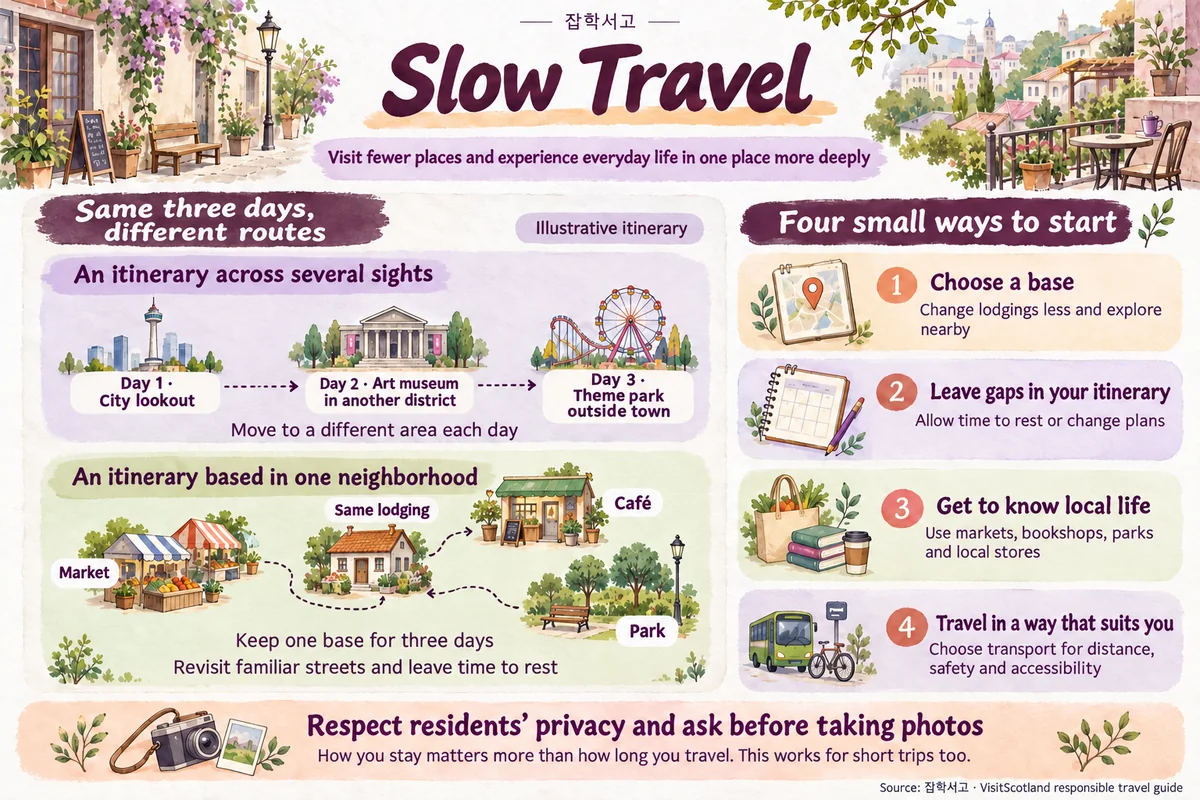
The key is not ‘slowness’ itself but ‘intentional staying.’ Even in the same city, an itinerary that sweeps through three districts a day by car and one where you stay three nights in a single neighborhood, repeatedly visiting its market, cafés, and walking paths, create completely different experiences. The latter is closer to slow travel.
- Package-style sightseeing tours: Short stays, lots of moving around, and photo-centered consumption.
- Slow travel: Little moving around, long stays, and experiences close to the rhythm of daily life.
What matters is that slow travel is not limited to ‘travel for people with plenty of money and time.’ Staying two days in an alley of a neighboring city, or having one dinner at a local market while on a business trip, can carry the same philosophy.
Four Principles That Support Slow Travel

If slow travel is left as just a buzzword, its practice becomes blurry. Dividing the principles that often come up in discussions of tourism and sustainable tourism into four makes the direction clearer.
(1) Depth of stay
Reduce the number of places you visit and increase the number of nights in one place and the repetition of a daily routine. The point where ‘the strangeness of the first day’ turns into ‘the familiarity of the third day’ is the core experience of slow travel.
(2) Low mobility
When choosing transportation, look at the process, carbon, and fatigue rather than speed. Priority goes to ways of moving that are slow but let you sense the streets and scenery, such as walking, cycling, and local public transit.
(3) Everyday immersion
Include in your itinerary not only big landmarks but also spaces where residents’ daily lives flow, such as markets, neighborhood restaurants, libraries, and parks. The aim is to step a little away from tourist-only routes.
(4) Local linkage
Connect lodging, meals, and experiences with local businesses as much as possible. The higher the share of money that stays in the area, the more travel moves beyond consumption toward a reciprocal relationship.
These four principles do not demand ‘perfect practice.’ Even if on one trip you only lengthen your stay or only cut down on moving around, you have taken a step in the direction of slow travel.
Understanding Slow Travel Through Simple Examples

Abstract principles hit home better when you look at a concrete comparison of itineraries.
[Case 1] The same city, three different days
A fast itinerary moves from a downtown observation deck on day one to a famous art museum on day two and a theme park on the outskirts on day three. A slow itinerary books an Airbnb or guesthouse in one residential area, eats breakfast every day at the same alley café, shops at the market, and in the evening watches residents on their way home from a park bench. The ‘number’ of sights goes down, but the rhythm of life in that city stays with you.
[Case 2] Close by rather than far away
Choosing to stay four days in a small town three hours away by train instead of a trip around another country is also slow travel. Travel fatigue drops, and you gain the flexibility to change your plans to match a local festival or market day. It is also a way of practicing letting go, for a while, of the common belief that ‘travel means going far.’
Slow travel also connects with discussions of overtourism. When huge numbers of people crowd into the same sights in a short time, carrying capacity quickly hits its limit. Lengthening stays and spreading out routes creates more room to take care of both individual travelers’ satisfaction and the area’s breathing space. Of course, slow travel alone will not solve tourist overcrowding, but it is meaningful as a shift in attitude on the demand side.
Practices to Start in Everyday Life and Points to Keep in Mind

To avoid putting off slow travel as ‘a long vacation someday,’ it is more realistic to start by changing small parts of your planning.
(1) Leave ‘blank spaces’ in your schedule
Don’t fill the day minute by minute; leave two or three hours of free time in the afternoon. A bookshop you wander into by chance, or a café where you stop because of the rain, can become the central scene of the trip.
(2) Choose lodging as a ‘base,’ not just ‘a place to sleep’
If you choose a place close to where locals live, with a kitchen or a walking path nearby, going out and resting blend together naturally.
(3) Fix one or two local routines
Create ‘repetition’ by, for example, buying coffee at the same bakery at the same time every day or walking along the same riverside every evening. Repetition creates familiarity, and familiarity creates depth of observation.
(4) Record ‘sensations’ rather than ‘lists’
Rather than listing places you visited on a checklist, jot down brief sensory cues such as smells, sounds, and the direction of the light. Later, when you look at your photos, those cues become the key that brings back the texture of the place.
There are, however, points to watch out for. Getting too close to residents’ daily lives can become an invasion of privacy or ‘voyeuristic tourism,’ and in some areas low-cost long-term stays worsen housing shortages. The ethics of slow travel is an attitude that goes beyond ‘I enjoy it slowly’ to also ask whether the place will remain livable after your visit.
When you redefine a trip’s success not as ‘how many places you ticked off’ but as ‘where you stayed, and for how long,’ the dots on the map grow fewer and the texture in your memory grows thicker. Lowering your speed by one notch and settling in a little longer—that is the first step of slow travel.