You get a student discount at the movie theater, airfares change depending on when you book, and online shopping malls hand out different coupons for each membership tier. On the surface these look like simple discounts, but economics ties them together under a single logic. That logic is ‘price discrimination.’
Put simply, price discrimination means ‘a strategy of selling the same product or service at different prices depending on the group of consumers.’ It is not simply because costs differ; it is a way of boosting revenue by taking advantage of differences in willingness to pay and in how sensitive demand is.
This article lays out, in an easy-to-understand way, the concept of price discrimination and its division into first, second, and third degree, the three conditions needed for it to work, examples from everyday life, and the debates surrounding efficiency and fairness.
The Concept and Mechanics of Price Discrimination
What Is Price Discrimination?
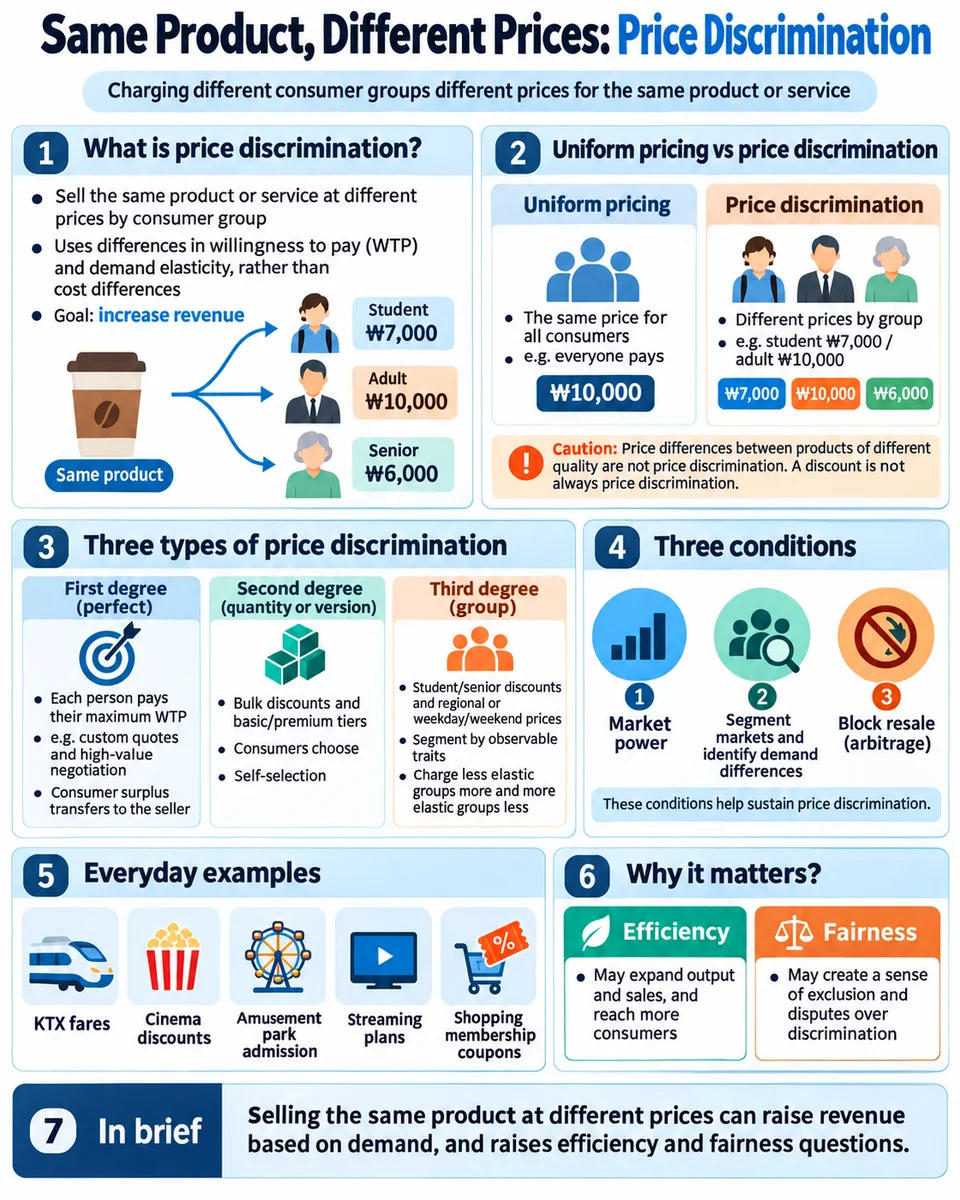

In classical microeconomics, price discrimination is defined as ‘the practice in which a firm with a monopoly or market power charges different prices for the same good because of differences in demand conditions, not differences in marginal cost.’ The key is attaching ‘different prices’ to ‘the same thing.’ Price differences between products of different quality, such as premium fabric and cheap fabric, are not price discrimination.
Why don’t firms use just one price? With a single price, people who would have paid more buy cheaply, and people who would have bought if it were a little cheaper don’t buy at all. By splitting prices, a firm can offer a higher price to the former and a lower price to the latter, increasing both sales volume and profit at the same time.
- Uniform Price: the same price is offered to all consumers.
- Price Discrimination: different prices are offered to groups that differ in willingness to pay or price elasticity of demand.
The important point is that ‘discount’ and ‘price discrimination’ do not always mean the same thing. A temporary discount to cut costs or clear inventory may not be price discrimination, while, conversely, using different list prices for different groups counts as price discrimination even if it looks like a regular list price on the surface.
First, Second, and Third Degree: The Three Types of Price Discrimination

The economist Arthur Pigou divided price discrimination into three degrees according to how complete the seller’s information is and how buyers are sorted. This classification is still used as the standard today.
(1) First-degree price discrimination (perfect price discrimination)
The seller knows each consumer’s maximum Willingness to Pay exactly and charges each individual a different price equal to that amount. In theory, consumer surplus almost disappears and is transferred to producer surplus. Full implementation is difficult in reality, but custom quotes, high-value negotiations, and some personalized online pricing come close.
(2) Second-degree price discrimination (quantity and version discrimination)
Consumers are made to choose for themselves. Versions are split by quantity, quality, or convenience, such as bulk discounts, basic and premium plans, or ‘cheaper if you accept slightly slower delivery,’ so that each person reveals their own type. Self-Selection is the key mechanism.
(3) Third-degree price discrimination (group discrimination)
The market is divided by observable group characteristics. Separate price lists are set based on ‘who belongs to which group,’ as with student and senior discounts, regional pricing, and weekday versus weekend rates. Typically, high prices are charged to groups with inelastic demand and low prices to groups with elastic demand.
Three Conditions for Price Discrimination to Work

Price discrimination is not possible in just any market. The strategy works only when the following three conditions are met.
(1) The firm must have some degree of market power
A firm that must simply accept the market price, as under perfect competition, cannot insist on charging each customer a different price. Brand loyalty, patents, scarce locations, and platform effects create room for setting prices.
(2) The firm must be able to divide the market and identify differences in demand
Signals that separate groups are needed, such as age, membership tier, purchase history, access location, and booking time. If the signals are blurry, low prices go to the wrong people and profits shrink.
(3) The firm must be able to prevent resale (arbitrage)
If someone who bought at a low price resells to consumers in the high-priced market, the discrimination structure collapses. That is why airline and concert tickets require name verification, software uses account locks, and services come with ‘non-transferable’ conditions.
If even one of these three conditions is weak, price discrimination quickly falters. Conversely, in data-rich digital markets, identifying buyers and blocking resale become easier, so discrimination tends to grow more sophisticated. For firms it is a tool for increasing profit, but consumers need an eye for reading ‘the price list for the group they belong to.’
Everyday Examples and the Fairness Debate

Price discrimination is closer to everyday life than you might think.
[Example 1] Transportation and leisure
Early-booking discounts on KTX trains and express buses, morning, late-night, and student fares at movie theaters, and peak- and off-season admission at amusement parks are a mix of third- and second-degree forms. During crowded times, high prices manage congestion, and during quiet times, low prices fill seats.
[Example 2] Digital services and retail
Ad-supported and ad-free streaming plans, first-purchase coupons and tier-based reward points at shopping malls, and in-app displayed prices that differ by region or device use self-selection and group identification at the same time. Consumers may feel that ‘it’s more expensive just for me,’ so transparency and explanation become important.
In terms of efficiency, price discrimination can increase output and draw into the market even consumers whose willingness to pay is close to marginal cost. However, when information is asymmetric or it is applied excessively to necessities, the resentment of ‘people who paid more for the same thing’ and disputes over discrimination grow. This is also why laws and regulations restrict unfair price differences based on certain attributes (such as gender or disability).
Once you understand price discrimination, you can read discount coupons and tier benefits not as ‘lucky promotions’ but as ‘designs that sort demand.’ Behind who pays more and who pays less lie both a firm’s profit calculations and the constraints of the market.
The habit of asking ‘why this price?’ one more time whenever you face the same product is the first step toward reading price discrimination in everyday life.