What happens if you keep pouring wine into the topmost glass in a tower of stacked wine glasses? Once the upper glass fills up, the overflowing wine naturally flows down into the glasses on the lower tiers, eventually filling even the glass at the very bottom.
The 'Trickle-Down Effect' discussed in economics works on precisely the same principle as this tower of wine glasses. It is an economic theory stating that when the government gives benefits such as tax cuts or regulatory relief to the upper tiers of the economy, such as large corporations and high-income earners, their gains and wealth overflow and positively affect small and medium-sized enterprises, low-income groups, and ultimately the national economy as a whole.
The trickle-down effect became a central pillar of conservative economic policy through 'Reaganomics' in the United States and 'Thatcherism' in the United Kingdom in the 1980s. Let us take an in-depth look at how this theory actually works within an economic system and why it remains at the center of ongoing controversy in modern economics.
The Mechanism of the Trickle-Down Effect and Real-World Debates
The Core Mechanism Behind the Trickle-Down Effect
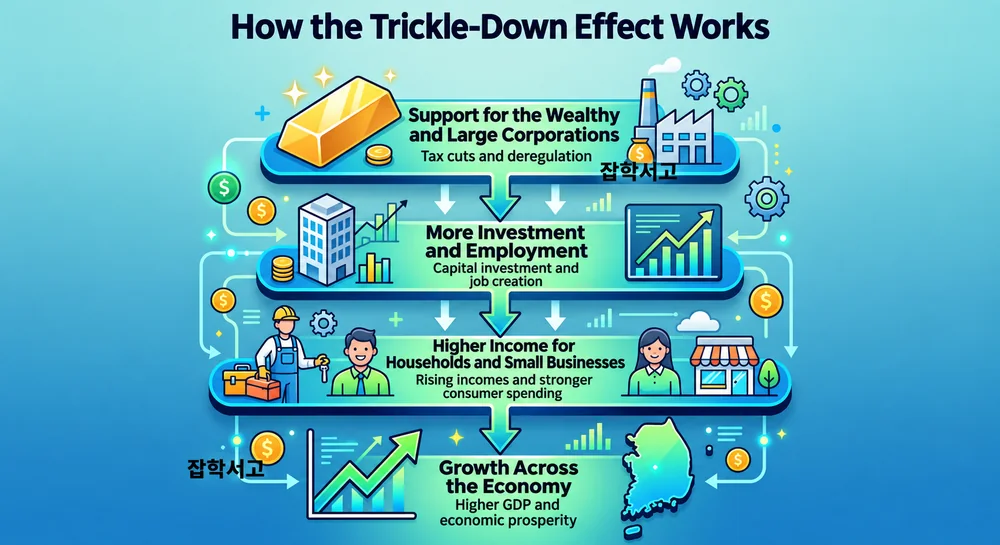
From the perspective of Supply-Side Economics, which advocates the trickle-down effect, the market's 'suppliers (businesses and capitalists)' are considered the main driving force of economic development. The process unfolds sequentially through the following stages.
- First, providing benefits: The government cuts corporate taxes, lowers income tax rates for high-income earners, and eases regulations that constrain business activities.
- Second, expanding investment and consumption: Businesses use their tax savings to increase investment in facilities and technology development, while high-income earners increase consumption with their higher disposable income.
- Third, job creation and spillover effects: Corporate investment leads to factory expansion and increased hiring. Sales also rise for small and medium-sized subcontractors that supply components.
- Fourth, increasing incomes for lower-income groups: The incomes of newly employed workers and workers at small and medium-sized enterprises rise, and the overall economic pie grows.
An Example to Aid Understanding
Suppose a large corporation builds a large semiconductor factory in a regional city. Local construction companies gain work building the factory (trickle-down stage 1), and thousands of engineers and employees are hired when the factory begins operating (trickle-down stage 2). As these employees eat at nearby restaurants after work, shop at local supermarkets, and look for housing, sales rise for nearby small business owners and self-employed people (trickle-down stage 3). Ultimately, benefits given to a single large corporation lead to the revitalization of the entire city's economy.
The Limitations the Trickle-Down Effect Faces in Practice

Although this virtuous cycle appears perfect in theory, the prevailing criticism is that the trickle-down effect does not work as expected within the modern economic structure of the 21st century. Returning to the wine-glass analogy, 'the upper glass keeps getting bigger without overflowing, or the pipe carrying the wine downward has become blocked midway.'
First, accumulation of retained earnings and flows into asset markets
Even when businesses receive tax cuts, if uncertainty about the future is high, they tend to accumulate cash (retained earnings) rather than build new factories or hire employees. In addition, the extra funds available to high-income earners can flow into asset markets, such as real estate and stocks, instead of translating into consumption in the real economy, producing the side effect of merely driving up asset prices.
Second, the impact of globalization and automation (AI and robots)
In the past, when manufacturing dominated the economy, expanding factories led directly to more employment. Modern industry, however, is centered on advanced technology and has a high degree of automation. Structural changes have occurred in which even large-scale investment by major corporations does not produce a substantial increase in jobs, or investment funds flow abroad to establish factories overseas rather than domestically.
Third, deepening economic polarization and warnings from research institutions
Major international economic organizations, including the International Monetary Fund (IMF) and the Organisation for Economic Co-operation and Development (OECD), have published a series of analytical reports based on large datasets stating that 'increases in income for the top 20% contribute little to overall economic growth, whereas increases in income for the bottom 20% directly drive national economic growth.' Because high-income earners have a lower propensity to consume (the proportion of income spent on consumption) than low-income earners, money circulates more slowly as more of it remains in the upper economic tiers.
The Opposite of the Trickle-Down Effect: The Fountain Effect

As the limitations of the trickle-down effect have been pointed out, its opposite, the 'Fountain Effect,' or 'income-led growth,' has also been proposed as an alternative.
- Trickle-down effect (Top-Down): Support for businesses and high-income earners -> Increased investment and employment -> Higher incomes for ordinary people (supply-focused)
- Fountain effect (Bottom-Up): Support for low-income groups and workers -> Increased consumption -> Higher corporate sales and investment (demand-focused)
The fountain effect follows the logic that, just as a fountain shoots upward from the ground, first raising the incomes of low-income groups and the middle class, who have a high propensity to consume, leads to immediate spending, which improves business performance and in turn leads to investment.
A Balanced Perspective Beyond a Simple Dichotomy
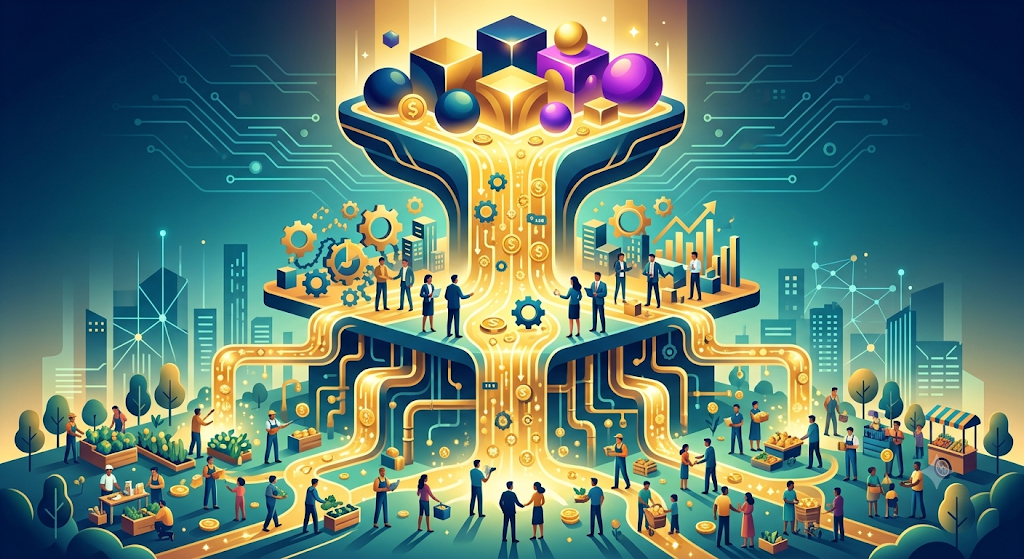
The trickle-down effect can serve as a powerful incentive for economic growth, but it is not a cure-all that automatically resolves economic polarization or guarantees benefits to every social group. Today's economic environment calls for the following balanced approach.
First, rather than offering unconditional tax cuts, policies must incorporate 'conditional policy design' that grants tax incentives when businesses actually channel the benefits of tax cuts into domestic employment and investment in facilities.
Second, 'supply-side policies' that stimulate businesses' willingness to innovate and their investment and 'demand-side policies' that protect ordinary people's disposable income to maintain a basic foundation for consumption must work in a mutually complementary way.
Ultimately, the success or failure of economic policy depends on appropriately coordinating these two wheels to suit the country's current economic structure and industrial characteristics, rather than simplistic factional divisions over 'whether the trickle-down effect or the fountain effect is right.'