A familiar scene repeats itself again and again: a large company making expensive premium products one day loses its customers to the cheap product of a small company that once looked crude. At first it laughs it off, thinking ‘our customers would never use something like that,’ but a few years later the entire market has moved. Business studies has a single concept for this reversal. It is ‘disruptive innovation.’
Put simply, disruptive innovation means ‘innovation that seems to perform worse at first, but captures a new customer base with a cheaper and simpler alternative and then gradually eats into the mainstream market.’ Clayton Christensen formalized it in the 1990s, and it became a key framework for explaining cases where ‘the strong lose to the weak,’ such as minicomputers, disk drives, digital cameras, and streaming.
This article lays out, in an easy-to-understand way, the definition of disruptive innovation and how it differs from sustaining innovation, how it works, easy examples, and the traps that established companies easily fall into.
The Structure of Disruptive Innovation and Market Shifts
What Is Disruptive Innovation?
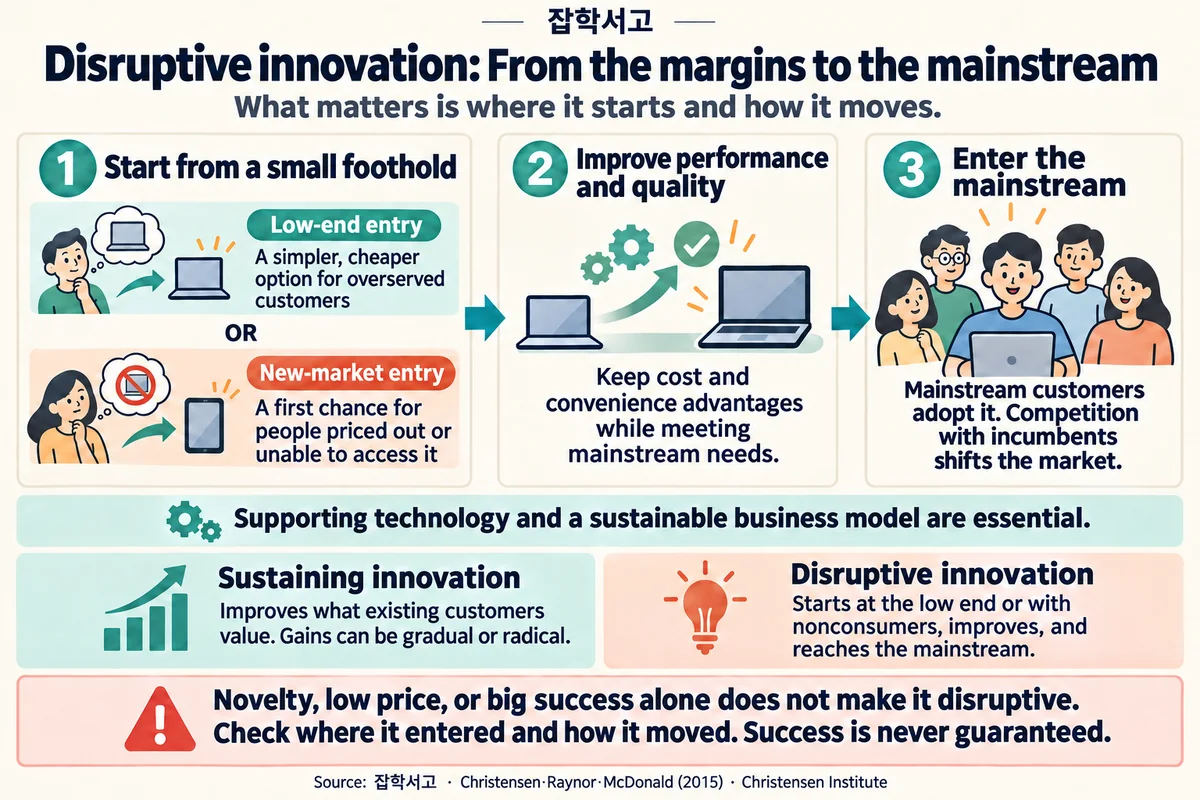

Disruptive innovation focuses less on ‘how flashy the technology is’ than on ‘which job, for which customers, it gets done more cheaply and more easily.’ Christensen divides innovation into two broad branches.
- Sustaining Innovation: improvements that make the performance existing customers want even better. Like faster processors or sharper screens, it is about scoring more points in ‘the same game.’
- Disruptive Innovation: at first it looks inadequate by existing standards of performance, but it has an edge in price, simplicity, and accessibility, and it creates a new context of use.
The key point is that ‘disruption’ does not mean something violent; it means rendering established companies’ formula for success (high margins, high performance, core customers) ineffective. This creates a paradox: the more rationally a large company behaves, the later it embraces the disruptive alternative.
The Three Stages in Which Disruptive Innovation Works

(1) It starts at the low end or in a new market
Disruptive products usually win over not mainstream customers but first the bottom tier of overserved customers (low-end) or non-consumers who never used the product at all (new-market). People who feel ‘this is good enough for now’ become the foothold.
(2) Its performance trajectory catches up with mainstream needs
As technology and learning accumulate, the performance of the disruptive alternative rises quickly. Meanwhile, the demands of mainstream customers rise relatively gradually. At some point, the disruptive product reaches a ‘good enough’ level.
(3) The mainstream market moves
Once price, convenience, and the ecosystem become attractive, existing customers switch over too. At this point, established companies often cling to their high-margin products and lose the entire market. The cause of failure is often not ‘incompetence’ but ‘rational choices bound to past metrics of success.’
These three stages are not a straight line. Regulation, brands, distribution, and complementary goods can slow them down or speed them up. Still, the habit of asking ‘where did it start, and whose standards is its performance heading toward?’ is a great help in strategic judgment.
Disruptive Innovation Through Easy Examples

The classic example is the personal computer. To minicomputer and mainframe makers, the PC was at first close to a ‘toy.’ Its performance was lower, but it let individuals and small offices use computers for the first time, and as its performance improved, it later took over the corporate market as well.
Digital cameras followed a similar path. Early image quality fell short of film, but they created new usage habits through the convenience of instant review, inexpensive shooting, and sharing without prints. While film companies stayed fixed on the sustaining metric of ‘image quality,’ the market itself moved to digital.
Streaming also shows the disruptive pattern. Its early picture quality and number of titles looked meager next to cable and DVD rentals, but it first opened up non-consumption and low-cost demand: ‘watch from home whenever you want.’ Once its performance and content caught up, mainstream viewing habits shifted.
[Key points from the examples]
- Initial ‘shortcomings’ may not be failures but conditions for entry.
- First look at who is delighted (non-consumers and low-price customers).
- Check whether established companies’ KPIs are masking disruptive signals.
Four Traps That Are Easy to Fall Into When Reading Disruptive Innovation

(1) Don’t call every new technology disruptive
A technology that is merely new or superior may be a sustaining innovation. Whether it is disruptive is determined by ‘its initial customers, its performance trajectory, and its conflict with existing revenue models.’
(2) Don’t see ‘low price’ alone as disruption
Price matters, but simplicity, accessibility, and a new context of use must come with it. A cheap imitation and a disruptive alternative are different things.
(3) Don’t interpret established companies’ ‘neglect’ merely as laziness
Core customers, distribution, and margin structures lead them to rationally rule out disruptive investments. That is why designs that experiment through a separate organization with a separate profit and loss are often discussed.
(4) Don’t pick winners only after the fact
Many experiments fail. The concept is a lens for explaining ‘why the strong lost in the past,’ not a prophecy that guarantees future winners. What is needed is an attitude of forming hypotheses and testing them in small markets.
Understanding disruptive innovation lets you move beyond the habit of seeing competition only as ‘doing it better’ and broaden your view to ‘who has come to get which job done more easily.’ The ability to catch the moment when the metrics of the strong hide the opportunities of the weak is exactly the practical value of this concept.
Listening first to the frustrations of customers at the bottom, and not being afraid to experiment with solving those frustrations cheaply enough, is the first step toward bringing disruptive thinking into management.