In modern society, a company's success depends heavily on the quality of its leadership. Leadership is an important factor in achieving organizational goals, going beyond simply giving instructions or exercising control to motivate members of the organization and guide them in the right direction.
This article examines the definition and importance of leadership, the core competencies required for successful leadership, the impact of leadership styles on organizations, and effective leadership development strategies and real-world examples in depth.
The Definition and Importance of Leadership
The Definition and Nature of Leadership
Leadership goes beyond simply exercising authority from a senior position; it is the ability to present an organizational vision and help members realize that vision. It is defined as the process of guiding individuals or groups to achieve organizational goals. Leaders set clear goals, communicate them effectively, and provide motivation and support so that members can achieve them.
The nature of leadership differs from simple management, and it is important to provide a consistent direction while respecting the autonomy of organizational members. Leaders play an important role within an organization by gathering members' diverse opinions and using them to redefine the organization's goals and values.
The Importance of Leadership
The importance of leadership is directly linked to organizational performance. Leadership shapes an organization's culture and atmosphere, thereby creating an environment in which members can immerse themselves in their work with confidence. Strong leadership contributes not only to improving organizational productivity but also to promoting cooperation among members and encouraging innovative thinking.
In particular, leadership is essential for setting clear goals for members and presenting concrete strategies for achieving them. Leaders play an important role in solving the various problems that may arise within an organization and establishing a long-term vision.
The Role of Leadership in Change Management
The role of leadership is even more important in today's rapidly changing business environment. As drivers of change, leaders must provide direction and lead the organization so that it can adapt to new environments. Leaders ease resistance that arises during the change process and help members embrace change.
During the change management process, leaders need to explain the necessity of change clearly, exert a positive influence on members, and explore new opportunities. Through these efforts, leaders can lay the foundation for the organization to respond successfully to change and continue to grow.
Setting Ethical Standards and Leadership
Leadership also plays an important role in establishing an organization's ethical standards and values. Leaders must determine what is right and wrong within the organization and guide members to follow those standards. A leader's ethical leadership contributes to building the organization's public image and credibility, thereby helping it pursue long-term success.
Transparent and responsible leadership within an organization plays an important role in helping members build trust in the organization and strengthening its overall ethical integrity. This ultimately has a positive impact on the organization's external reputation as well.
Human Resource Development and Leadership
Leadership also plays an important role in developing and utilizing human resources. Leaders must improve members' capabilities through mentoring and coaching and provide opportunities for them to realize their full potential. Through these efforts, the organization develops strong internal competitiveness and lays the foundation for delivering sustained performance in the external environment.
Leaders must identify each member's strengths and help them make the most of those strengths, and they also need the ability to place talent in the right roles within the organization. Through this process, the organization can develop the capacity to respond to change flexibly and proactively.
Leadership is essential not only for achieving organizational goals but also for sustainable growth. With strong leadership, an organization can respond flexibly to change and create an environment in which members can fully exercise their capabilities. Leadership that establishes ethical standards, plays a central role in change management, and draws out the potential of human resources is a key factor driving organizational success.
Core Competencies for Successful Leadership

Successful leadership requires a range of competencies, each of which plays an important role in achieving organizational goals. Leaders fulfill roles beyond those of a simple manager and must possess various competencies that positively influence the entire organization.
The Ability to Establish a Clear Vision
A leader's first core competency is the ability to establish a clear and compelling vision. Leaders must clearly present the organization's long-term goals and vision and enable members to understand and connect with that vision. A vision brings together the efforts of all members of the organization and helps align individual goals with organizational goals.
Leaders who excel at establishing a vision provide strong motivation to members and minimize confusion and create a cooperative atmosphere by presenting the organization's direction. This allows members to clearly understand their respective roles in achieving organizational goals and participate actively.
Effective Communication Skills
Successful leaders must have clear and effective communication skills. Leaders must be able to convey their thoughts and strategies accurately to members, thereby reducing confusion within the organization and enabling clear goals to be set. Communication must go beyond the one-way transmission of information and develop into a process of listening to members' opinions and exchanging feedback.
Effective communication is an important factor in strengthening teamwork. Leaders must engage in honest and transparent dialogue to build trust with members, thereby minimizing conflict within the organization and creating a cooperative environment. In addition, the process of solving problems and seeking improvements based on feedback contributes to better organizational performance.
The Ability to Make Quick and Accurate Decisions
Leaders must be able to make quick and accurate decisions even in complex and uncertain situations. Decision-making ability is a core leadership competency and includes the process of gathering various information, analyzing it, and making the best decision. Decisiveness and judgment are particularly essential in crises or when rapid change is required.
Successful decision-making plays an important role in maintaining an organization's competitive advantage in a changing environment, and leaders therefore need strategic thinking skills as well as intuitive judgment. It is also important to make balanced decisions by considering the impact of a leader's decisions on the entire organization.
The Importance of Emotional Intelligence
A leader's emotional intelligence plays an important role in building and maintaining positive relationships within the organization. Leaders with high emotional intelligence can not only regulate their own emotions effectively but also understand members' emotions and respond to their needs.
Leaders with strong emotional intelligence can create a positive atmosphere within the organization based on trust and cooperation. This creates an environment in which members can express their emotions freely, understand one another, and work together. Emotional intelligence strengthens teamwork and increases members' engagement, contributing to higher overall organizational performance.
The Importance of Change Management Skills
Modern organizations must respond quickly to rapidly changing environments, and leaders' change management skills are essential to this. Leaders must manage the change process so that the organization can move forward steadily amid changing circumstances and help members accept new situations.
Leaders with strong change management skills minimize resistance to change and guide the organization to adapt flexibly. To do so, it is important for leaders to explain the necessity of change clearly, present its direction to members, and explore new opportunities for growth.
Coaching and Mentoring Skills
The final important leadership competency is the ability to coach and mentor. Leaders must support members' growth and help them realize their full potential. This promotes new ideas and innovation within the organization and strengthens its competitiveness.
Coaching and mentoring focus on developing members' ability to solve problems independently rather than simply giving work instructions. Leaders must identify each member's strengths and weaknesses and create an environment in which they can fully exercise their capabilities. Through these efforts, the organization can pursue continuous growth and develop talent efficiently.
The Impact of Leadership Styles on Organizations

The Impact of Leadership Styles on Organizational Culture and Performance
Leadership styles have a profound impact on an organization's overall culture and performance. Members' attitudes, teamwork, and ultimately performance can vary depending on the style a leader uses to guide the organization. Each leadership style can have positive or sometimes negative effects depending on the organization's characteristics or goals. It is important for leaders to choose an appropriate leadership style by considering the organization's current situation and goals.
The Effects and Limitations of Authoritarian Leadership
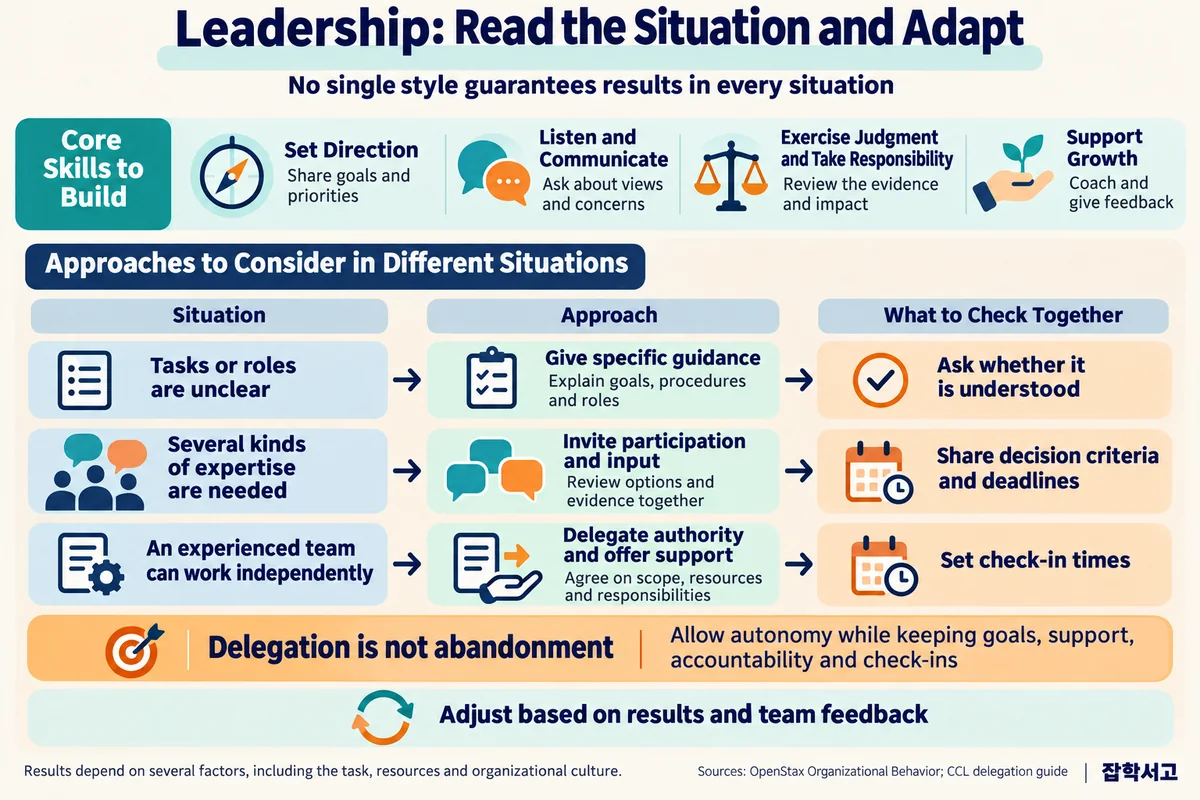
Authoritarian leadership is a style in which decision-making authority is concentrated in the leader and the organization operates primarily through control and commands. This style can be particularly effective in situations requiring quick decisions or during crises. Because authoritarian leaders give clear instructions and members follow them, this structure can reduce confusion and enable coordinated action.
However, authoritarian leadership has the disadvantage of limiting members' creativity and autonomy. Members may find it difficult to express their opinions freely or propose new ideas, which can also negatively affect the organization's long-term innovation performance. Authoritarian leadership may be effective in improving short-term performance, but flexible leadership is needed for continued growth and development.
The Advantages and Disadvantages of Democratic Leadership
Democratic leadership is a style that actively encourages members to participate in decision-making. Leaders gather diverse opinions and make decisions based on them, contributing to stronger trust and cooperative relationships within the organization. Democratic leadership increases members' satisfaction and motivation and plays an important role in improving organizational performance over the long term.
However, democratic leadership has the disadvantage that decision-making can be slow. Because gathering diverse opinions and reaching a consensus takes time, it may be unsuitable in rapidly changing situations. Nevertheless, its advantage of encouraging active participation among members is highly beneficial for improving long-term performance and building a positive organizational culture.
The Advantages and Risks of Laissez-Faire Leadership
Laissez-faire leadership is a style that gives members a high degree of autonomy. Leaders intervene minimally and create an environment of freedom in which members can make their own decisions and carry out their work. This style is suitable for organizations that need to generate creative ideas or for self-directed members.
However, a lack of clear direction can lead to confusion within the organization. Excessive autonomy creates a risk of losing sight of organizational goals and consistency, and performance management may also become difficult. Laissez-faire leadership is suitable for teams with strong self-management skills and must be accompanied by clear goal setting and the assignment of responsibility.
The Impact of Leadership Styles on Organizational Performance
Each leadership style is closely related to organizational performance. For example, authoritarian leadership can be advantageous for achieving short-term goals that require quick decisions and rapid execution. In contrast, democratic leadership is effective in promoting long-term performance improvement and teamwork and supports sustainable organizational growth.
Leaders must choose the most suitable leadership style by considering the organization's situation and goals. An authoritarian approach may be necessary in some situations, while a democratic or laissez-faire approach may be more effective in others. What matters is the ability to adjust leadership styles flexibly according to the situation.
The Relationship Between Leadership Styles and Innovation Capacity
An organization's capacity for innovation depends heavily on its leadership style. In organizations that prioritize innovation, democratic or laissez-faire leadership is more suitable than authoritarian leadership. An environment in which members can independently propose ideas and solve problems creatively contributes to innovative outcomes.
Democratic leadership gathers diverse opinions and provides opportunities to turn new ideas into reality based on them. Laissez-faire leadership creates an environment that maximizes creativity and independence, helping members drive innovation themselves. These styles play an important role in enabling organizations to continue changing and growing.
Strategies for Effective Leadership Development

Developing effective leadership requires a systematic and thorough strategy. Because leadership develops through continuous learning and reflection rather than being an innate ability, a concrete plan is essential. Leaders must continually improve their capabilities and make efforts on multiple fronts to expand their influence within the organization.
The Importance of Feedback and Reflection
The first stage of leadership development is the process of self-reflection through feedback. Leaders must clearly identify their strengths and weaknesses and work toward continuous improvement based on that understanding. Receiving regular feedback plays an important role in objectively understanding how their leadership style affects the organization. Through this reflection, leaders can learn better ways to communicate and more effective methods of decision-making.
Feedback also has a positive impact on improving relationships with members. When leaders openly accept feedback and use it to develop themselves, they inspire trust among members and can further strengthen their leadership role within the organization.
Using Mentoring and Coaching Programs
Mentoring and coaching are highly important tools in leadership development. Mentoring from experienced leaders provides practical advice and support that greatly help new leaders overcome difficult situations and develop leadership competencies. Mentors offer realistic and practical advice on problems that new leaders may face, boosting their confidence and accelerating their growth.
In addition, coaching programs help leaders focus on improving specific competencies. Coaching provides tailored guidance so that leaders can make better decisions and demonstrate stronger leadership. Through this process, leaders can align their own goals with organizational goals and establish themselves as effective leaders.
The Need for Leadership Education and Training
Systematic education and training are essential for strengthening leadership competencies. Leadership education programs help leaders learn the latest management techniques and apply them to real situations. Through education, leaders develop the ability to respond flexibly to changing environments, and simulation training based on various hypothetical situations allows them to develop practical skills.
Simulation training is particularly effective in strengthening the ability to respond to crises and developing the capacity to make better decisions at crucial moments that require leadership. Such training contributes to greater confidence and problem-solving ability as a leader.
Providing Opportunities for Diverse Experiences
Gaining new experiences through various tasks and projects is highly important for leadership development. Diverse experiences are essential for developing leaders' ability to respond to different situations and improving their decision-making competencies. New challenges can strengthen problem-solving skills and develop the ability to analyze situations from different perspectives and explore alternatives.
In particular, experiencing various roles across different departments or projects helps leaders understand the organization's overall structure and workflow, enabling them to demonstrate better leadership on that basis. Diverse experiences increase the flexibility of leadership styles and contribute to firmly establishing a leader's position within the organization.
Harmony Between Organizational Culture and Leadership
Leadership development must align with the organization's values and goals and harmonize with its culture. Leaders must thoroughly understand the organization's culture and goals and exercise leadership on that basis to have a positive influence within the organization. A leadership style consistent with organizational values inspires trust among members and plays an important role in maximizing organizational performance.
Leadership must be adjusted to suit the organization's atmosphere and structure, which can strengthen cooperation with members and improve organizational performance. In particular, it is highly important to reflect the organization's cultural characteristics and members' expectations in the leadership development process.
Examples of Effective Leadership Development
A representative example of effective leadership development is GE's Crotonville Leadership Development Center. Through various leadership development programs, this center has played an important role in cultivating successful leaders at GE. Leaders have strengthened their leadership competencies through various practical exercises and educational activities and developed through the process of applying them in their actual work.
Google's People Operations program is another example of continuously improving leadership development based on employee feedback. Google develops its leadership training and education by incorporating employees' opinions, thereby supporting more effective leadership within the organization.
These examples show that systematic and continuous leadership development serves as an important factor in organizational success.
Leadership is an important factor that determines organizational success, and a range of competencies, including establishing a clear vision, effective communication, emotional intelligence, and change management, are essential. Leadership styles have a major impact on organizational culture and performance, and it is important to choose an appropriate leadership style suited to the organization's goals and situation.
In conclusion, systematic leadership development strategies play a central role in an organization's sustainable growth and success, enabling leaders to bring about meaningful change and innovation within the organization.