Shake a sealed bottle of soda and then open the cap, and bubbles surge up all at once. Inside the bottle, carbon dioxide dissolved in the liquid and carbon dioxide floating as a gas were locked in balance, but the moment you open the cap, a condition called “pressure” changes and the equilibrium is shaken. Chemistry sums up in one sentence how a system responds to this kind of disturbance. That sentence is “Le Chatelier’s Principle.”
Put simply, Le Chatelier’s principle is an empirical rule stating that “when a change such as in concentration, pressure, or temperature is applied to a system in chemical equilibrium, the equilibrium shifts in the direction that offsets that change.” It was proposed in 1884 by Henri Louis Le Chatelier, and it is used widely, from industrial ammonia synthesis to acid–base equilibrium experiments in the classroom.
In this article, we lay out Le Chatelier’s principle in an easy-to-understand way, from its definition and the three kinds of stimulus (concentration, pressure, temperature) to simple everyday and industrial examples, and the misconceptions people easily fall into when applying the principle.
The structure and application of Le Chatelier’s principle
What is Le Chatelier’s principle?
Chemical equilibrium is a state in which the forward and reverse reactions proceed at the same rate, so that, on the surface, concentrations no longer change. It does not mean “the reaction has stopped”; it is a dynamic balance in which flows in the two directions cancel each other out and the composition stays constant.
Le Chatelier’s principle is a predictive rule saying that when an external stimulus enters this balance, the system rearranges itself “toward the side that eases the stimulus.” There are three main kinds of stimulus.
- Concentration: changes that add or remove reactants or products.
- Pressure/Volume: especially important in reactions involving gases.
- Temperature: decides the direction for exothermic and endothermic reactions.
The principle does not explain the whole microscopic mechanism of “why it shifts.” It is, however, a guide that lets you quickly predict which way the equilibrium will lean.
Concentration, pressure, temperature: the three stimuli that move equilibrium
(1) Changes in concentration
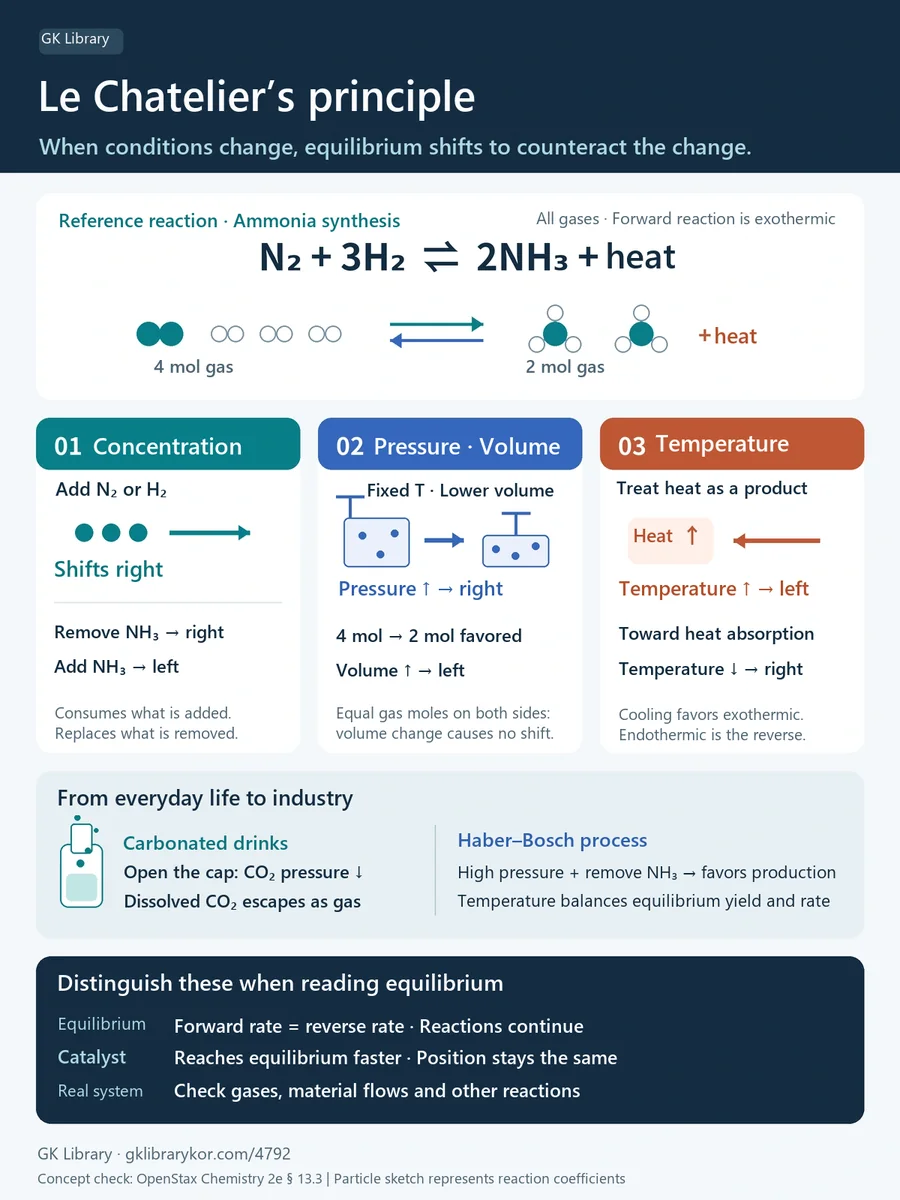
Adding a reactant shifts the equilibrium toward the forward reaction, and adding a product shifts it toward the reverse reaction. Conversely, removing a component shifts the equilibrium in the direction that “makes that component again.” For example, in N₂ + 3H₂ ⇌ 2NH₃, if you keep drawing off the ammonia, the system strengthens the forward reaction to replenish it.
(2) Changes in pressure and volume
Pressure has an effect when the number of gas molecules differs on the two sides. Raising the pressure (reducing the volume) shifts the equilibrium toward the side with fewer gas molecules, and lowering the pressure shifts it toward the side with more. In the ammonia synthesis above, there are 4 molecules on the left and 2 on the right, so high pressure favors the forward reaction.
(3) Changes in temperature
It helps to think of the product side of an exothermic reaction as “the side holding the heat.” When the temperature rises, the system shifts in the direction that absorbs heat (the endothermic side); when the temperature falls, it shifts in the direction that releases heat (the exothermic side). Because ammonia synthesis is exothermic, too high a temperature is unfavorable for the equilibrium yield.
Changing all three stimuli at once makes their effects overlap. To balance yield, rate, and cost at the same time, industrial processes design “compromises” that go beyond what the principle alone provides.
Le Chatelier’s principle through simple examples

The closest everyday example is soda. While the cap is closed, the high pressure keeps a lot of carbon dioxide dissolved in the liquid and the equilibrium holds. When you open the cap and lower the pressure, the system shifts in the direction that increases gas (the direction in which dissolved CO₂ escapes as gas). The reason bubbles appear “suddenly” is that the equilibrium is responding to that stimulus.
In classroom experiments, the equilibrium between nitrogen dioxide (NO₂, brown) and dinitrogen tetroxide (N₂O₄, colorless) often comes up. In N₂O₄ ⇌ 2NO₂, NO₂ increases on the endothermic side. Reducing the volume inside a syringe to raise the pressure shifts the equilibrium toward N₂O₄, which has fewer molecules, so the color fades; raising the temperature deepens the brown color. In this way, you can see the principle with your own eyes.
The representative industrial example is the Haber–Bosch process. High pressure pushes the equilibrium toward ammonia, the temperature is a compromise between yield and reaction rate, and the ammonia produced is condensed and removed to lower its concentration, which keeps driving the forward reaction. It is a scene in which “one line of principle” is translated into a plant’s operating conditions.
[Key points from the examples]
- First write down what the stimulus is (concentration, pressure, or temperature).
- For a gas reaction, check the difference in the number of molecules on each side.
- Don’t discuss temperature alone without knowing which direction is exothermic and which is endothermic.
Four pitfalls that are easy to fall into when using the principle
Le Chatelier’s principle is powerful, but misconceptions arise when it is pushed beyond its scope.
(1) Don’t confuse rate with equilibrium
What the principle tells you is “which way it will lean,” not “how fast it will get there.” A catalyst only speeds up the forward and reverse reactions together; it does not change the position of the equilibrium itself.
(2) Don’t try to push reactions with lots of solids using pressure
Pressure and volume effects depend mainly on the difference in moles of gas. Because the amounts of pure solids and liquids are usually excluded from the equilibrium constant expression, statements like “adding more solid always shifts the equilibrium” are often wrong.
(3) Distinguish between open and closed systems
Textbook applications of the principle often assume a closed system in which matter does not freely enter or leave. A process that keeps drawing off the product should be understood as a design that deliberately applies a “stimulus that lowers concentration.”
(4) Don’t forget multiple equilibria and side reactions
Real mixtures contain more than just the reaction you care about. Changing one condition can move other equilibria too, so a simple diagram can sometimes diverge from the actual yield in the field.
In the end, Le Chatelier’s principle is closer to “a way of thinking about equilibrium.” The safe order is to first ask how the system will try to hold out when conditions change, and only then layer on rate and equipment design. That is also why a single line in a textbook proves so powerful in plants and laboratories.
Rather than memorizing the numbers of an equilibrium, first asking “how will the system try to offset the stimulus I just applied?”—that is the first step in chemical thinking.