Chromatography has become an essential tool in chemical analysis and is widely used to separate and analyze a variety of substances. Thanks to its ability to accurately separate and identify the components within a substance, this technique plays an important role across research and industry.
In this resource, we will take an in-depth look at the basic principles and background of chromatography, its various techniques and fields of application, an analysis of separation mechanisms, and experimental considerations.
The Basic Principles and Background of Chromatography
The Basic Principles of Chromatography
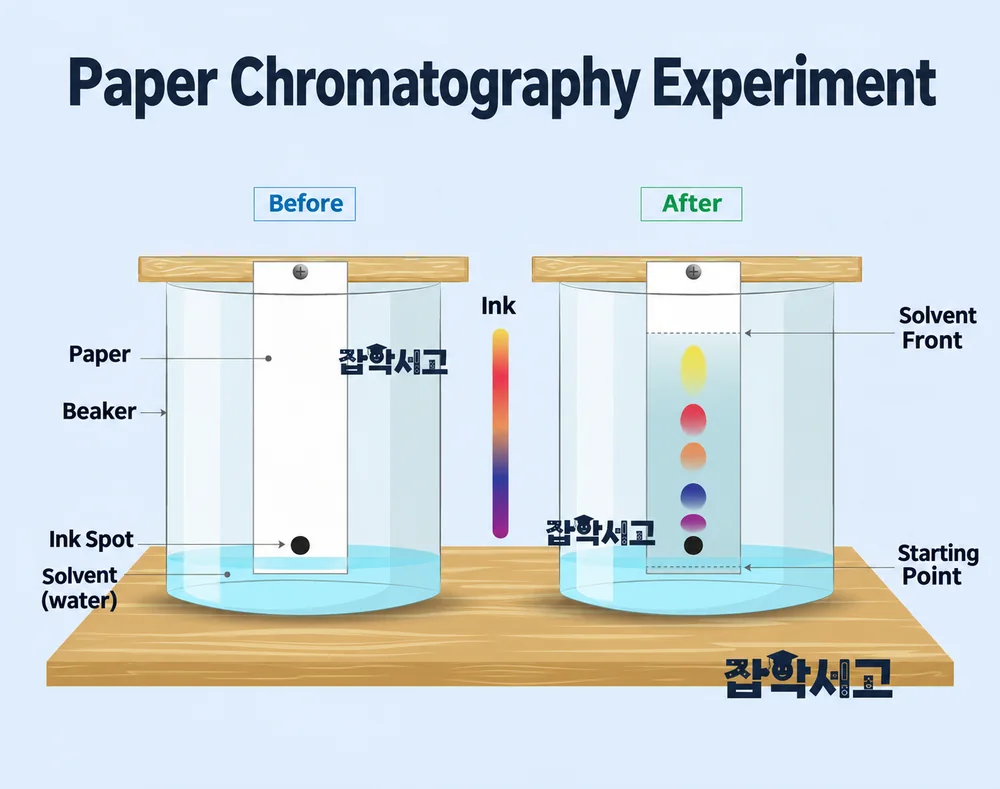
Chromatography is a powerful analytical tool that separates a substance into its individual components, and it separates them based on the interaction between a mobile phase and a stationary phase. The mobile phase carries the substance and exists as a liquid or a gas. The stationary phase, on the other hand, interacts with the moving substance and separates its components. In this process, each component moves at a different speed between the mobile phase and the stationary phase, so the components are separated individually.
For example, if substances differ in how much they are adsorbed onto or dissolved into the stationary phase from the mobile phase, differences in their speed of movement arise, and each component is separated at a different position. This makes it possible to analyze the components of a mixture individually. Because chromatography separates substances so efficiently, it is widely used in chemistry, biology, and environmental research.
The Historical Background of Chromatography
Chromatography was first developed in the early 1900s by the Russian botanist Mikhail Tsvet. Tsvet used the chromatography technique to separate plant pigments and succeeded in separating various pigments, including chlorophyll. This gave rise to the term "chromatography," and the technique was subsequently developed further by many scientists.
In the 1920s and 1930s in particular, chromatography gradually began to attract the attention of many scientists, and the range of applications for the technique widened. After World War II, it became established as an important analytical tool in a variety of industries, including pharmaceuticals, petrochemicals, and environmental analysis.
An Overview of Modern Chromatography Techniques
Modern chromatography is divided into several techniques, each of which is suited to separating particular substances. Representative techniques include high-performance liquid chromatography (HPLC), gas chromatography (GC), and ion chromatography (IC).
HPLC is a technique that uses a liquid mobile phase and excels at separating components quickly and accurately from complex mixtures. GC, on the other hand, uses a gaseous mobile phase and is advantageous for separating volatile substances. Ion chromatography is used to analyze substances in ionic form and plays an important role in water quality testing and environmental analysis.
These techniques are applied according to the properties of different substances and can meet a wide range of analytical needs. As a result, chromatography has become an indispensable technology in modern science.
Fields of Application of Chromatography
Chromatography is widely used not only in chemical analysis but also in the analysis of biological substances. It is used to precisely separate and purify biological substances such as proteins, peptides, and nucleic acids, and through this it makes an important contribution to life science research. Thanks to this technology, chromatography is applied in a variety of fields, including drug development, genetic research, and disease diagnosis.
Chromatography also plays an important role in environmental science in the analysis and detection of pollutants. Thanks to its ability to accurately detect and analyze pollutants in air, water, and soil, it also makes a major contribution to research related to environmental protection.
Experimental Considerations in Chromatography
In chromatography experiments, many factors must be carefully considered. First, choosing an appropriate mobile phase and stationary phase is important. Selecting a suitable combination according to the properties of the components makes accurate and efficient separation possible. In addition, the experimental environment, such as temperature, pressure, and the speed of the mobile phase, also has a major effect on the results. These factors are important variables that determine whether a chromatography experiment succeeds.
Care is also required in preparing the sample. If the sample is too concentrated or contains impurities, separation may not take place properly. It is therefore important to adjust the condition of the sample appropriately. Interpreting the results after the experiment is also an important step, and the ability to accurately analyze and interpret the properties of the separated components is required.
Various Chromatography Techniques
Chromatography is divided into several techniques to meet a range of analytical and separation needs. Each technique is designed to suit the properties of substances and is used as an essential tool in various fields of research and industry. The characteristics and applications of each technique are as follows.
High-Performance Liquid Chromatography (HPLC)
High-performance liquid chromatography (HPLC) is a technique that uses a liquid mobile phase and offers high resolution and fast analysis of complex mixtures. HPLC plays an important role mainly in drug development, environmental analysis, and the analysis of biochemical substances. In drug development, HPLC is essential for evaluating the purity and efficacy of drugs, and it is also widely used for impurity analysis.
It is also very useful in environmental science for analyzing air and water pollutants. For example, it is used to detect harmful chemicals in industrial wastewater or to monitor pollutants in the air. In biochemical research, it is an important tool for analyzing biological molecules such as proteins, peptides, and nucleic acids. In particular, it is widely used for separating and purifying proteins and analyzing their purity.
Gas Chromatography (GC)
Gas chromatography (GC) is a technique suited to separating volatile substances using a mobile phase in the gaseous state. GC is mainly used in the analysis of petrochemicals, perfumes, and food additives. It is strong at separating and quantifying volatile organic compounds, and GC-MS, which couples it with a mass spectrometer, is also used to confirm their structures. It is especially essential in the petrochemical industry for analyzing crude oil components and the constituents of gases. In addition, GC offers a high degree of sensitivity even with small amounts of sample, enabling precise analysis.
In the food industry it is used to analyze flavoring and preservative components, and in the cosmetics industry it is used to ensure product stability. Suited to the analysis of volatile substances, GC plays an important role not only in laboratories but also in quality control, environmental regulation, and forensic science.
Ion Chromatography (IC)
Ion chromatography (IC) is a technique specialized in separating substances in ionic form, and it is widely used mainly in environmental analysis and water quality testing. IC is useful for accurately measuring ionic substances such as acids, bases, and salts, and it plays an important role in evaluating the concentration of harmful ions in water. For example, IC is used in water quality testing to determine the concentration of harmful ions such as nitrate and fluoride ions.
Regulatory agencies concerned with environmental protection also use IC to analyze pollutants in the air and soil, which allows them to detect and regulate environmental pollution. IC has become an essential analytical technique particularly in water quality improvement projects and environmental regulation research.
Size Exclusion Chromatography (SEC)
Size exclusion chromatography (SEC) is a technique that separates substances based on molecular size, and it is mainly used to analyze large molecules such as polymers, proteins, and viruses. In biotechnology, SEC is widely used to test the purity of proteins or analyze the molecular weight of polymers. It is especially useful for determining the size and molecular weight distribution of proteins and polymers, and it is also applied to checking the size distribution of virus particles.
SEC is also essential in polymer science for measuring the molecular weight distribution of various polymers. As a size-based separation technique in which the speed of movement varies with molecular size, SEC plays an important role in evaluating molecular size and molecular weight.
Paper Chromatography and Thin-Layer Chromatography (TLC)
Paper chromatography and thin-layer chromatography (TLC) are relatively simple techniques, used mainly for educational purposes or basic experiments. Paper chromatography is used to separate compounds from simple mixtures and is mainly suitable for beginner experimenters. Thin-layer chromatography lets you check the migration pattern of compounds by applying a sample to a thin stationary layer, so the process of compound separation can be easily observed with the naked eye.
Both techniques make it possible to carry out relatively simple experiments at low cost, and they are used as basic analytical tools in educational and research settings. They are very useful for understanding and learning about the separation of compounds without complex equipment.
Fields of Application of Chromatography Techniques
Each chromatography technique has a variety of applications in specific industries and fields of research. They are essential in drug development, environmental analysis, life science research, and the food and cosmetics industries. By choosing the best technique according to the properties of the substance being analyzed, researchers can obtain reliable and accurate analytical results. Chromatography has a very wide range of applications and great potential for further development in the future.
An Analysis of Separation Mechanisms in Chromatography
The separation mechanisms of chromatography describe the process of separating substances according to how they interact between the mobile phase and the stationary phase. Based on these interactions, an appropriate separation method suited to the properties of the substance is chosen for each mechanism. The main separation mechanisms are adsorption, partition, ion exchange, and size exclusion, and each is applied differently depending on the nature of the substance. In this process, the substance's speed of movement, strength of interaction, size, and so on have an important effect on separation.
Adsorption Chromatography
Adsorption chromatography is a method that separates substances by using their tendency to be adsorbed onto the surface of the stationary phase. Solid materials are mainly used as the stationary phase, and how strongly a substance interacts with the stationary phase determines its speed of movement. Components with strong adsorption stay on the stationary phase longer and move more slowly, while components with weak interactions move faster and are separated.
For example, when a solid stationary phase such as activated carbon is used, organic compounds move at different speeds depending on how strongly they adsorb onto the surface of the activated carbon. In this way, adsorption chromatography can separate organic compounds effectively. It is especially suited to separating individual components from non-volatile substances or complex mixtures, and it can greatly increase the precision of analysis.
Partition Chromatography
Partition chromatography separates components by using the way substances distribute themselves between the mobile phase and the stationary phase. In this process, the stationary phase is generally made up of a liquid, and substances move while reaching equilibrium between the stationary phase and the mobile phase. When more of a substance partitions into the stationary phase, it moves more slowly, and when more of it remains in the mobile phase, it moves faster.
This method is mainly used for liquid-liquid partitioning and is often used in the analysis of organic compounds. For example, components can be separated according to how a substance partitions between water and an organic solvent. Partition chromatography is very effective at precisely separating individual components within a mixture and is often used in the analysis of complex organic compounds.
Ion Exchange Chromatography
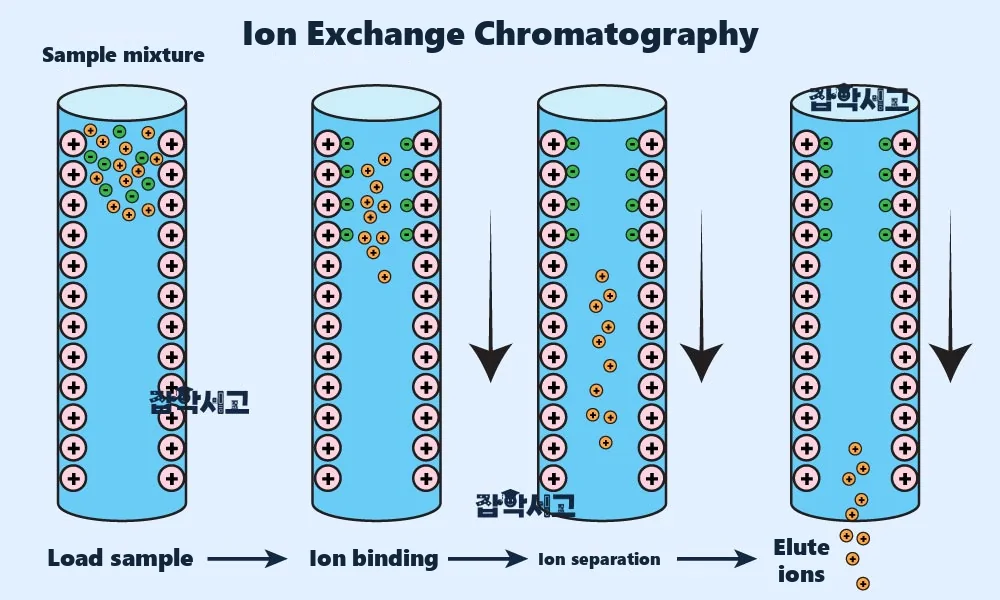
Ion exchange chromatography is a technique that separates ionic substances by using their charge properties. This method uses an ion exchange resin as the stationary phase and achieves separation through ion exchange with the ionic substances in the mobile phase. As the ions attached to the ion exchange resin are exchanged with the ionic substances in the mobile phase, the components move at different speeds.
It is divided into cation exchange and anion exchange, and the strength of binding to the stationary phase differs depending on the charge. In cation exchange chromatography, positively charged substances bind strongly to the stationary phase, and in anion exchange chromatography, negatively charged substances are separated. This technique is very useful for analyzing substances such as inorganic ions, amino acids, and peptides, and it is used especially often in water quality analysis and environmental analysis. For example, it can precisely measure the concentration of harmful ions in water.
Size Exclusion Chromatography
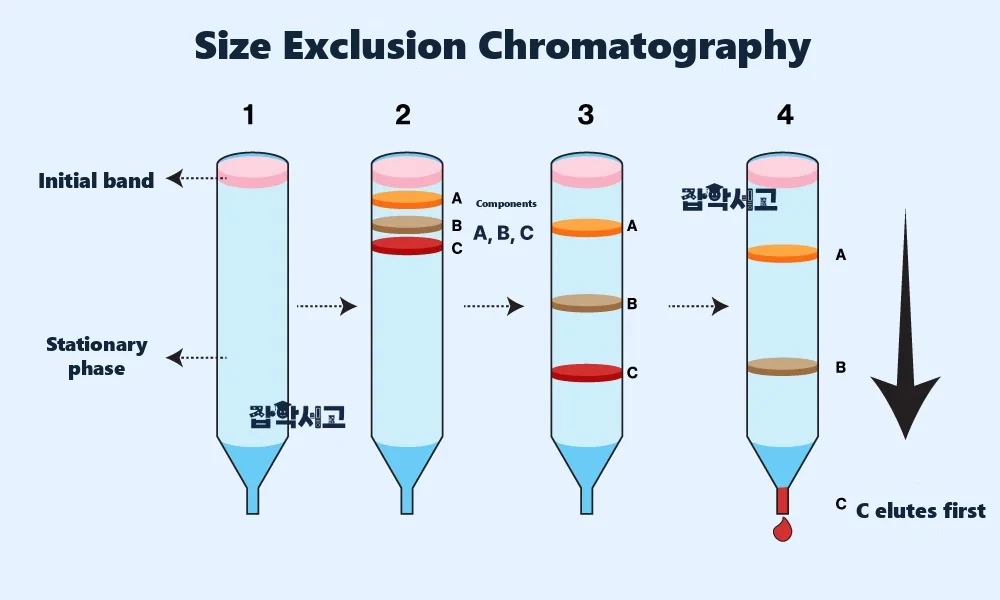
Size exclusion chromatography is a technique that separates substances according to the size of their molecules. In this method, the pore size of the stationary phase determines how easily molecules can pass through; large molecules cannot enter the pores and move quickly, while small molecules move in and out of the pores and travel more slowly.
This technique is suited to separating large molecules such as proteins, polymers, and viruses. Because it separates according to molecular size, size exclusion chromatography is very effective for molecular weight analysis. In the life sciences, it is often used for testing protein purity and analyzing the size of virus particles, and it also plays an important role in checking molecular size characteristics such as whether aggregates have formed.
The Importance of Different Separation Mechanisms
Each separation mechanism used in chromatography must be chosen carefully according to the properties of the substance to be analyzed and the purpose of the analysis. For example, ion exchange chromatography is suitable for analyzing the charge properties of a substance, while size exclusion chromatography is suitable for analysis based on molecular size.
By understanding well how substances interact with the mobile phase and the stationary phase, researchers can obtain more precise and reliable analytical results. In addition, a deep understanding of each mechanism can be a great help in controlling the variables that may arise during an experiment and in accurately interpreting the experimental results.
Ensuring Accuracy and Reproducibility in Chromatography Experiments

One of the important goals in chromatography experiments is to ensure the accuracy and reproducibility of the experiment. To do this, various details must be thoroughly considered at every stage of the experimental process, and these factors directly affect the quality of the experimental results. Here, we cover the factors that require particular attention in chromatography experiments.
Choosing the Mobile Phase and Stationary Phase
The key to a chromatography experiment lies in the appropriate choice of mobile phase and stationary phase. The mobile phase and stationary phase must be set differently depending on the properties of the analyte, and this choice directly affects the separation efficiency of the experiment. The mobile phase generally exists in liquid or gaseous form and carries the substance to be analyzed. The pH, concentration, and flow rate of the mobile phase have an important effect on the separation of components. For example, if the pH of the mobile phase is not appropriate, the analyte may not separate in the desired way.
The stationary phase, in turn, interacts with the mobile phase to separate substances. The interaction between the material chosen for the stationary phase and the analyte is the key to separation. If a particular component binds more strongly to the stationary phase, that component moves more slowly in the mobile phase, and separation ultimately takes place. To make the most of these interactions, a deep understanding of the properties of the mobile and stationary phases is needed, and choosing phases suited to the substance being analyzed determines the success or failure of the experiment.
Maintenance and Calibration of Chromatography Instruments
To ensure reproducibility in chromatography experiments, instrument maintenance and periodic calibration are essential. If an instrument does not work properly, there is a high chance that the analytical results will be distorted or errors will occur. The condition of chromatography equipment should therefore be checked regularly, and if there is a problem, its performance should be maintained through immediate repair.
Equipment such as gas chromatography (GC) and high-performance liquid chromatography (HPLC) is particularly sensitive to the sensitivity of the detector and the condition of the column. If the detector is not sensitive enough, the sample may not be detected properly, and if the column is in poor condition, separation efficiency can drop sharply. Columns are easily damaged as samples pass through them frequently, so they should be replaced or cleaned at regular intervals.
Periodic equipment calibration is also essential. Calibration makes it possible to confirm whether the equipment's performance is being maintained to standard. Calibration is especially essential for obtaining the same results across multiple experiments. For the equipment to provide reliable data, this maintenance and calibration work must be carried out consistently.
The Importance of Sample Preparation
Sample preparation is an important part of a chromatography experiment, and if it is not managed properly, it has a major effect on the experimental results. The sample concentration, choice of solvent, filtration process, and so on can affect the accuracy of the experiment. For example, if the sample concentration is too high, the column may become saturated during separation, and if it is too low, detection becomes difficult. Maintaining an appropriate concentration is therefore very important.
The choice of solvent also plays an important role. If the sample does not dissolve properly, the mobile phase cannot carry the sample properly, and separation efficiency may decrease. Removing impurities from the sample through filtration is another important step. A sample containing impurities can contaminate the column and distort the experimental results, so it must go through a thorough filtration process. Sample pretreatment is especially essential when analyzing complex mixtures, and in this process the sample must be prepared in a state suitable for the experiment.
Recording Experimental Conditions and Managing Data
Accurately recording the conditions used during an experiment is one of the key factors in ensuring reproducibility. If experimental conditions are not recorded properly, it is difficult to obtain the same results when repeating the same experiment. All experimental variables, such as the composition, flow rate, temperature, and pressure of the mobile phase, should be recorded in detail in the lab notebook, which allows other researchers to reproduce the experiment under the same conditions.
Data management is another important part. The data obtained from experiments must be managed thoroughly, and care must be taken to prevent mistakes or errors during analysis. If data is stored or interpreted incorrectly, the reliability of the experiment may decline, and problems may arise for follow-up research. It is therefore essential to manage experimental data systematically and to draw accurate interpretations based on it.
Statistical Analysis and Minimizing Error
Using statistical analysis tools is very useful for reducing the errors and variability that can arise during experiments. Statistical methods make it possible to evaluate the range of error in an experiment and, based on that, increase the reliability of the experimental results. It is important to analyze the data obtained by repeating an experiment several times and to derive consistent results from it.
Statistical methods are especially effective under highly variable experimental conditions. Comparing multiple experimental results and determining through statistical analysis whether the differences are significant plays an important role in verifying the reliability of the results. Using statistical tools appropriately can increase the reproducibility of experiments and allow data obtained under various conditions to be interpreted more effectively.
Thoroughly managing the experimental considerations in chromatography experiments makes it possible to obtain accurate and reliable results. This is an essential element in research and industrial settings and contributes to providing high-quality data.
Chromatography is an essential tool for separating, analyzing, and identifying a wide variety of compounds, and it is widely used in modern science and industry. Advances in this technology enable more precise and efficient analysis and are constantly expanding its potential applications in many new fields.
With a deep understanding of the basic principles of chromatography, its various techniques, and its experimental considerations, this powerful tool can be used more effectively. Chromatography will continue to play an important role in scientific discovery and progress in the future.