This time, I would like to write about MARC, which is used in libraries. MARC and cataloging cover such an extensive range of material that I plan to divide the discussion into several posts, and in this installment, I would like to share an overview of the tags used in cataloging.
1. The Concept and Understanding of Catalogs

A catalog uses a book's title, bibliographic information, and other details to distinguish it from other works and provide a means of searching. A catalog can broadly be divided into headings (titles), the descriptive section, added-entry headings, and so on.
Every library has countless books arranged on its shelves. However, if libraries holding the same books catalog them differently, users will become confused when searching for and locating books.
To resolve this problem, all libraries must catalog (create catalog records) consistently using the same rules, and the Korean Cataloging Rules (KCR) provide guidelines for this.
KORMARC, which is used in libraries, is a digitized format based on KCR and uses tags (TAG) to distinguish information in detail.
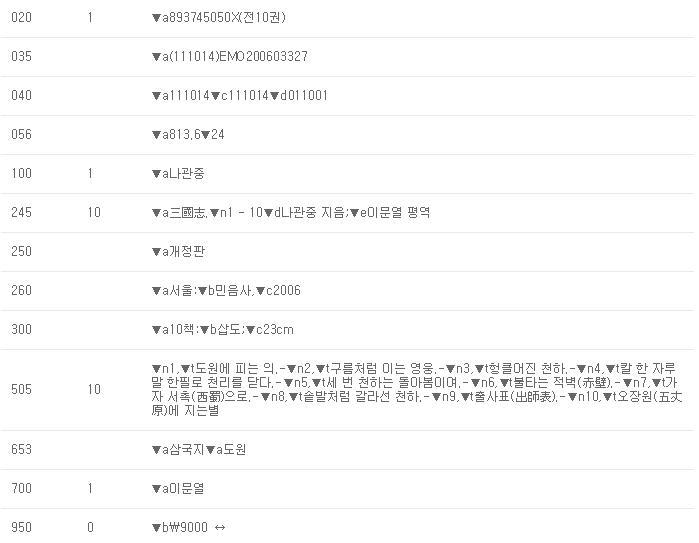 Example of MARC (Yi Mun-yol's Romance of the Three Kingdoms)

Visit the National Library of Korea website, search for the book you want, and click the [View MARC] button to see information like that shown above.
With the basic concepts of catalogs covered, please now take a look at the KORMARC TAG information I have compiled below.
2. KORMARC Tags
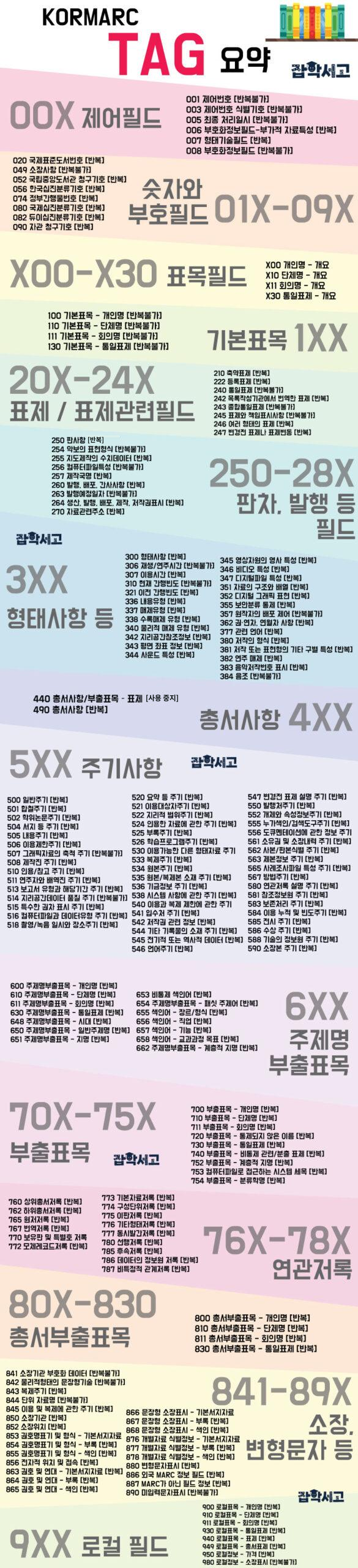 KORMARC (Korean Machine-Readable Cataloging) Tag Reference
Tags are grouped by number range from 001 to 9XX and consist of 001~ control fields, number & code fields; 100~ main entries; 200~ titles, edition & publication information; 300~ physical description; 400~ series statements; 500~ notes; 600~ subject added entries; 700~ added entries; 800~ linking entries, series added entries, holdings & alternate graphic representations; and 900~ local fields.
Please refer to the image for details on each item. To work with MARC, you also need to know the detailed guidelines for each item. Since the guidelines for individual items are so extensive, it would be helpful to consult the National Library of Korea's Korean Machine-Readable Cataloging website, where you can check the guidelines for each item. Search for 'Korean Machine-Readable Cataloging Format'.
For reference, tags commonly used in libraries are listed separately below. Of course, this is only a general overview, so use it as a reference and follow your own library's standards when preparing detailed records.
★ Frequently Used Tags
- 020 International Standard Book Number [Repeatable]
- 049 Holdings Information [Nonrepeatable]
- 056 Korean Decimal Classification Number [Repeatable]
- 082 Dewey Decimal Classification Number [Repeatable]
- 090 Local Call Number [Repeatable]
- 245 Title and Statement of Responsibility [Nonrepeatable]
- 246 Varying Forms of Title [Repeatable]
- 250 Edition Statement [Repeatable]
- 260 Publication, Distribution, and Printing Information [Repeatable]
- 300 Physical Description [Repeatable]
- 490 Series Statement [Repeatable] — Field 440 is obsolete. When a series added entry is needed, set the first indicator of field 490 to 1 and record the corresponding 800–830 field as well.
- 500 General Note [Repeatable]
- 505 Contents Note [Repeatable]
- 600 Subject Added Entry - Personal Name [Repeatable]
- 610 Subject Added Entry - Corporate Name [Repeatable]
- 611 Subject Added Entry - Meeting Name [Repeatable]
- 653 Uncontrolled Index Terms [Repeatable]
- 700 Added Entry - Personal Name [Repeatable]
- 710 Added Entry - Corporate Name [Repeatable]
- 711 Added Entry - Meeting Name [Repeatable]
- 740 Added Entry - Uncontrolled Related/Analytical Title [Repeatable]
- 950 Local Information - Price [Repeatable]
- Indicators and Subfield Codes
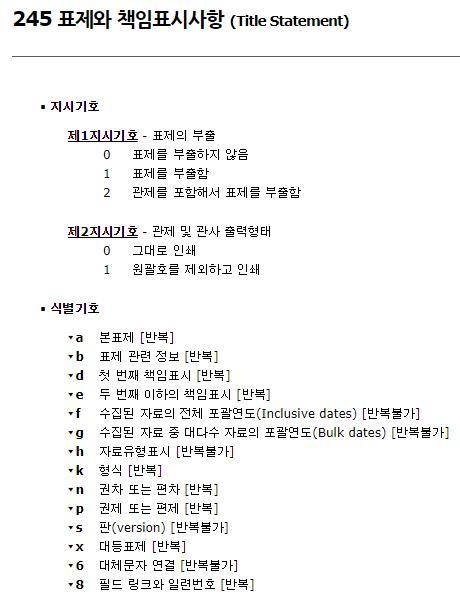 Example of Indicators and Subfield Codes
On the National Library of Korea's Librarian Support Service website, you can click each individual tag, as shown above, to find detailed instructions on entering indicators and subfield codes.
This concludes my discussion of KORMARC (Korean Machine-Readable Cataloging) tags. The information compiled in this post is useful for a quick overview, and when you begin working in earnest, please visit the website mentioned earlier and check the details as you proceed.