When you hand a young child a pitcher full of water, adults usually reach out first, afraid it will spill. But if you prepare a small pitcher and cup that fit the child’s hands and wait, the child may spill a few times but eventually learns how to pour water on their own. The child learns more when the person teaching takes a step back. The educational approach that helps children learn by choosing and trying things for themselves in this way is “Montessori education.”
Simply put, Montessori education means “an educational method that sees children as beings born with the drive to learn and helps them grow by choosing their own activities and learning with their hands in a well-prepared environment.” It was created in the early 20th century by Italian physician and educator Maria Montessori, and today it is used in public and private schools around the world.
In this article, we will look in turn at the background from which Montessori education emerged, the core principles that make up its classrooms, its view of children’s development, and how this education is assessed today.
A Classroom That Builds the Power to Do It Yourself: Montessori Education
How Did Montessori Education Begin?
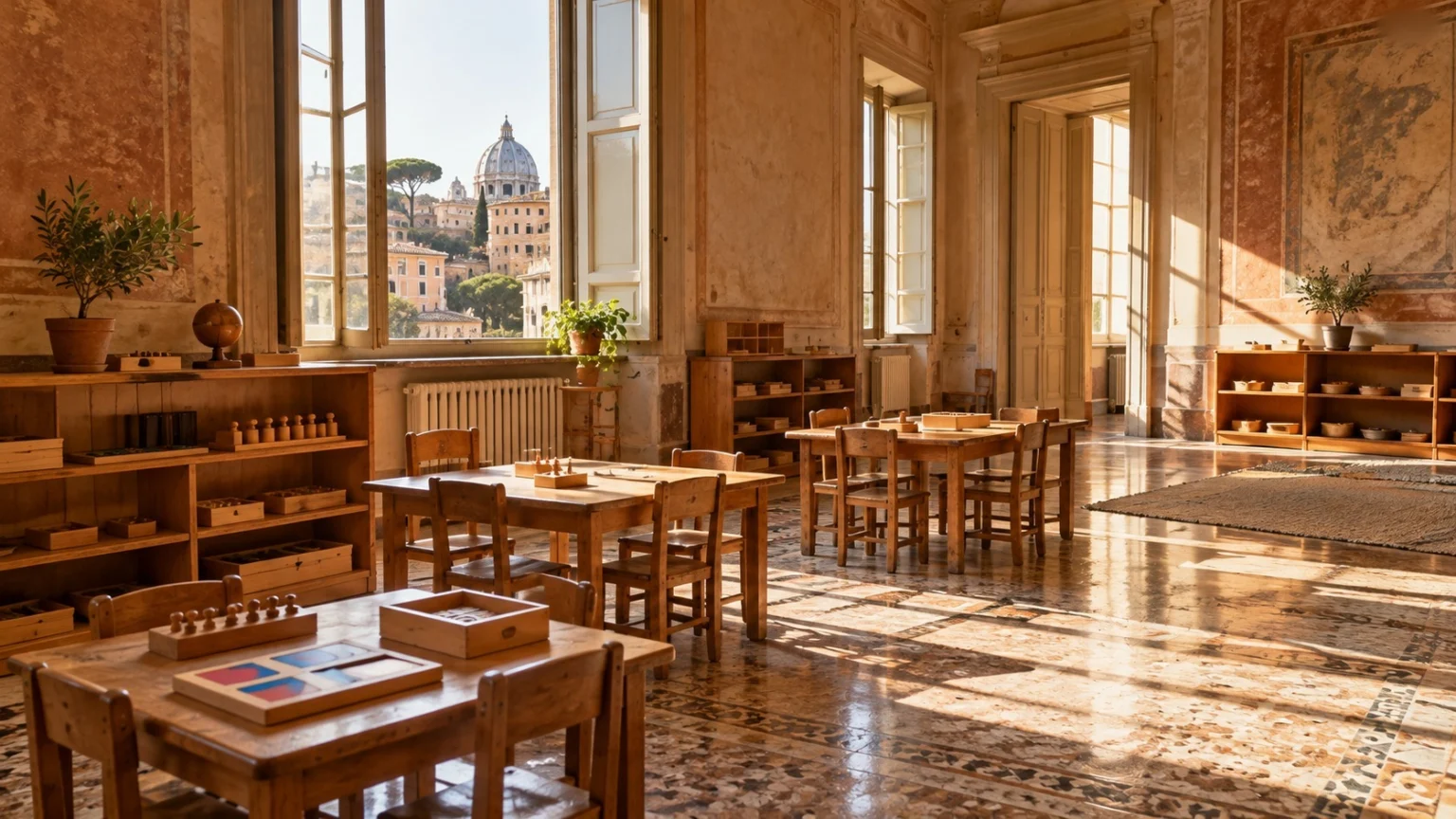
Montessori education started not in a classroom but in a hospital and in observation. That is why Montessori often called her method “scientific pedagogy.”
(1) From physician to educator
In late 19th-century Italy, Maria Montessori became a physician, something very rare for a woman at the time, and specialized in psychiatry and pediatrics. When she visited a psychiatric asylum in Rome, she noticed that the children confined there needed much more stimulation.
(2) The Children’s House
In 1907, Montessori opened her first classroom, the “Children’s House (Casa dei Bambini),” in a working-class apartment building in the San Lorenzo district of Rome. Taking in children from poor families who were thought to have difficulty learning, she observed them and kept refining her materials and activities.
(3) Spreading around the world
In 1909, she published her theory as a book, which was translated into English in 1912 under the title The Montessori Method. After that, Montessori education spread rapidly to the United States, Europe, India, and elsewhere.
The Core Principles of the Classroom
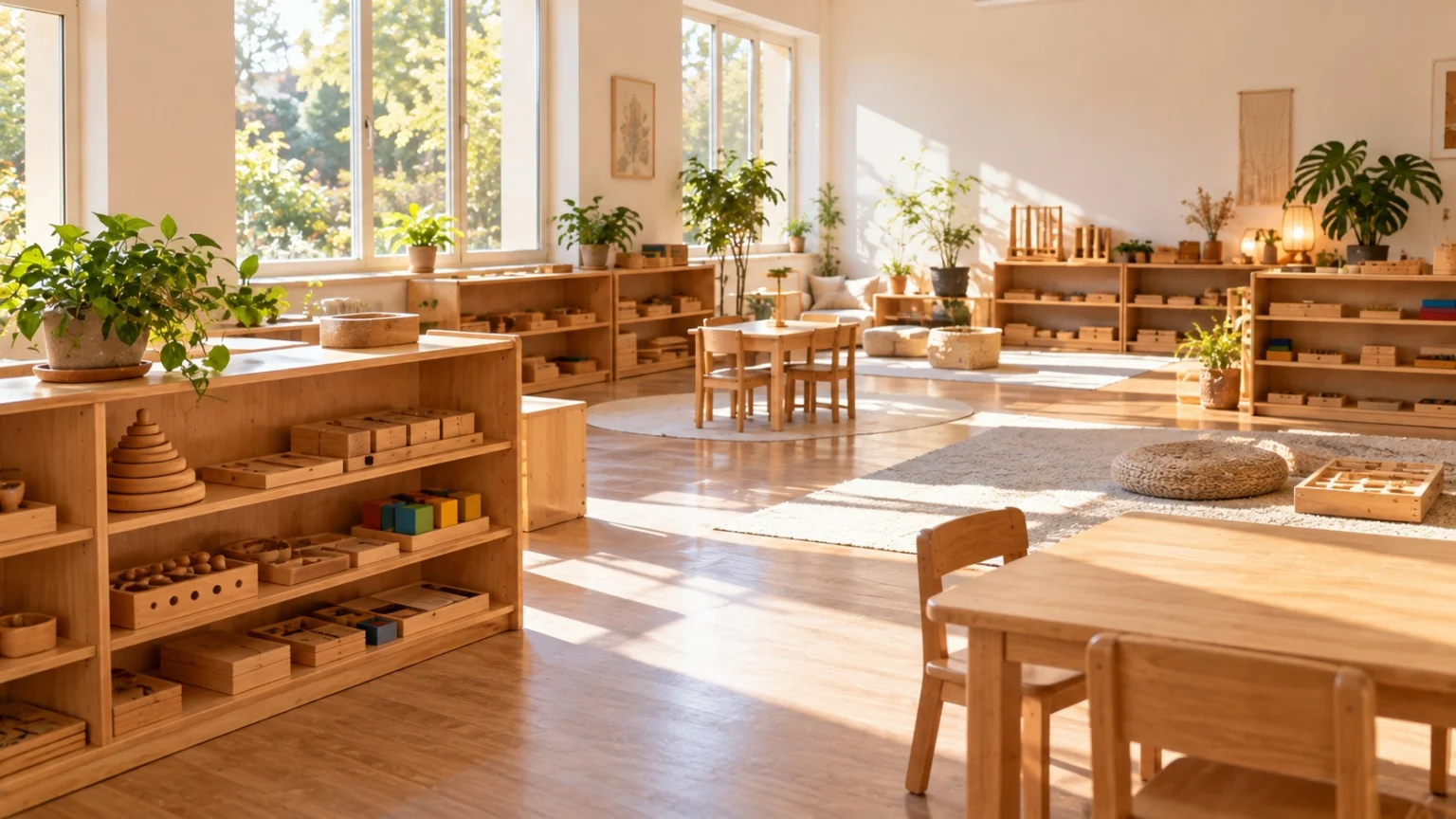
A Montessori classroom looks different from an ordinary classroom from the outset. Learning materials are neatly arranged on low shelves at a child’s height, and children each do different activities wherever they like, at a table or on the floor.
(1) The prepared environment
The classroom is furnished to fit children’s bodies, and the materials are organized by area so children can take them out and use them at any time. This is because an environment with order, beauty, and naturalness is itself believed to teach the child.
(2) Freedom of choice and long work periods
Within set limits, children choose their own activities and stay absorbed in them for a long time without interruption. Ideally, there is one uninterrupted work period of about three hours a day.
(3) Mixed ages and the teacher as a guide
Children of several ages, typically from 3 to 6, spend time together in one class; younger children learn by watching older ones, and older children learn by helping younger ones. Rather than teaching from the front, the teacher’s role is to observe the children and guide them toward suitable activities.
(4) The joy of the activity itself instead of grades and prizes
External rewards such as grades or praise stickers are not used; instead, children are guided to learn through the joy of accomplishing an activity.
Learning Materials for the Hands and the Stages of Development

In Montessori education, concepts come in through the hands rather than through words. The materials are mostly made of natural materials such as wood and appeal to the child’s senses.
- Practical Life: children learn everyday skills such as pouring water, transferring with a spoon, washing dishes, and sweeping the floor.
- Sandpaper Letters: children trace letters made of sandpaper with their fingers while learning the sounds of the letters.
- Golden Bead Material: with single beads, bars of 10, squares of 100, and cubes of 1,000, children understand the decimal system and arithmetic with their eyes and hands.
Montessori divided human development into four stages: ages 0–6, 6–12, 12–18, and 18–24. She believed that children in the first stage in particular have an “Absorbent Mind” that soaks up the language and culture around them like a sponge, and go through “Sensitive Periods” in which they are especially drawn to particular things such as language or order.
Montessori Education Today
Today, there are estimated to be about 60,000 Montessori schools worldwide. Although it is that widely used, there are also points worth examining.
(1) What the research shows
Several studies have reported that children who received Montessori education showed good results in reading, concentration, and social skills. However, because it is hard to separate out other factors such as home environment, there are also studies with mixed results.
(2) Montessori in name only
In 1967, the U.S. Patent and Trademark Office ruled that “Montessori” is a generic term that anyone may use. As a result, places that do not faithfully follow the original principles can also use the same name, and studies say that the closer a program is to the original approach, the greater the effects.
(3) Ideas you can use at home
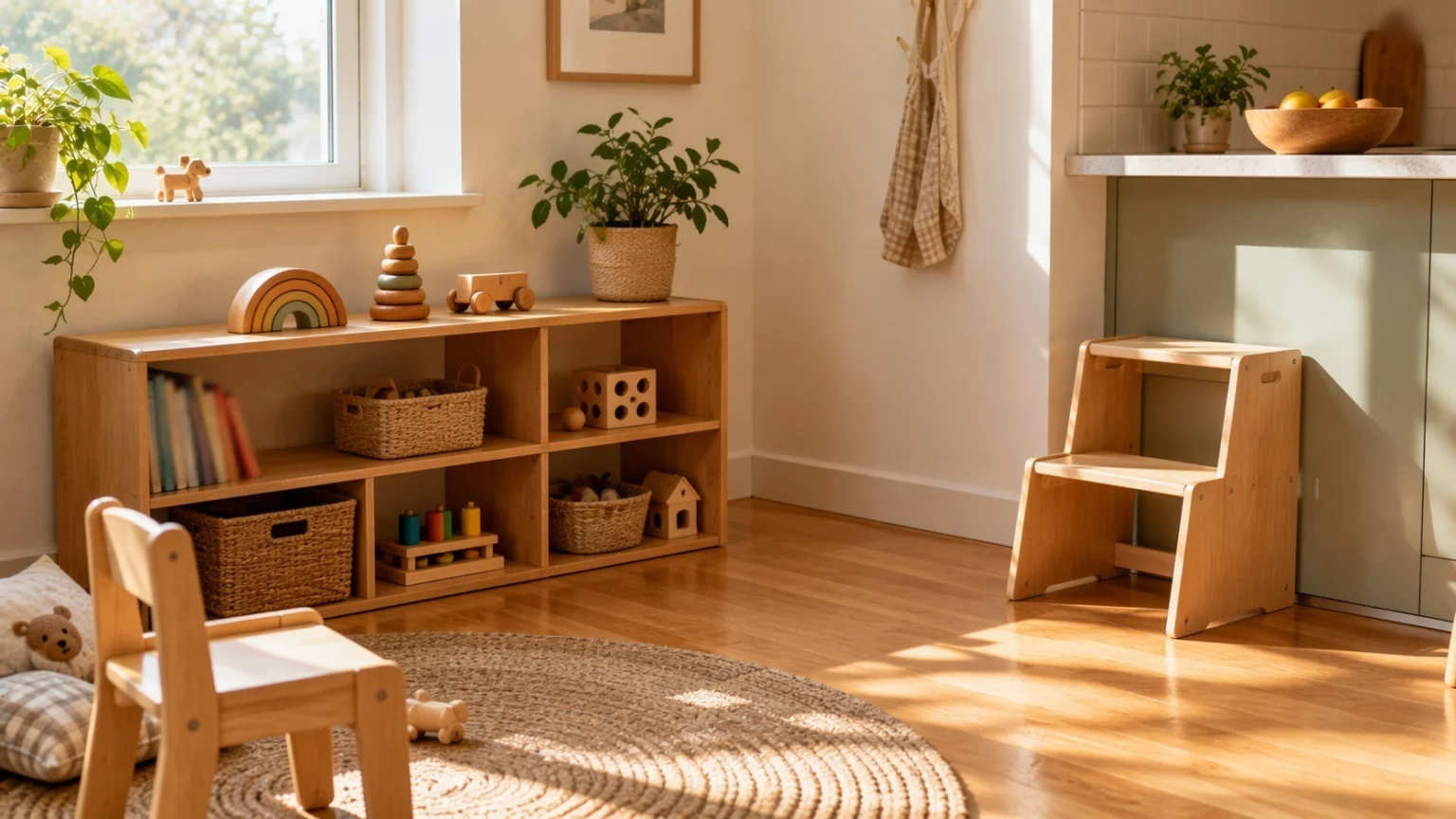
The heart of Montessori education lies less in special materials than in attitude. Simply placing things where a child can reach them, giving the child time to try things alone, and watching without rushing can bring its spirit into everyday life.
Montessori education lets us see a child not as an empty vessel to be filled but as a person with the power to grow on their own. It is a method more than a hundred years old, but its ideas of a prepared environment, freedom of choice, and learning with the hands still influence many classrooms and homes today. Stepping back and waiting until a child can do it alone is the first step in raising a child who learns independently.