Educational philosophy is an academic field that identifies the nature and values of education and offers practical direction through systematic, in-depth inquiry into its purposes, methods, and content. It provides the ideological foundations of education while also exerting an important influence on the formulation of educational policy and the design and implementation of teaching methods.
This material examines the definition and academic foundations of educational philosophy, its historical development, and its major theories, and seeks to discuss in depth its applications in contemporary educational settings and its influence on educational policy and teaching methods.
Understanding the Definition and Academic Foundations of Educational Philosophy

The Definition and Role of Educational Philosophy
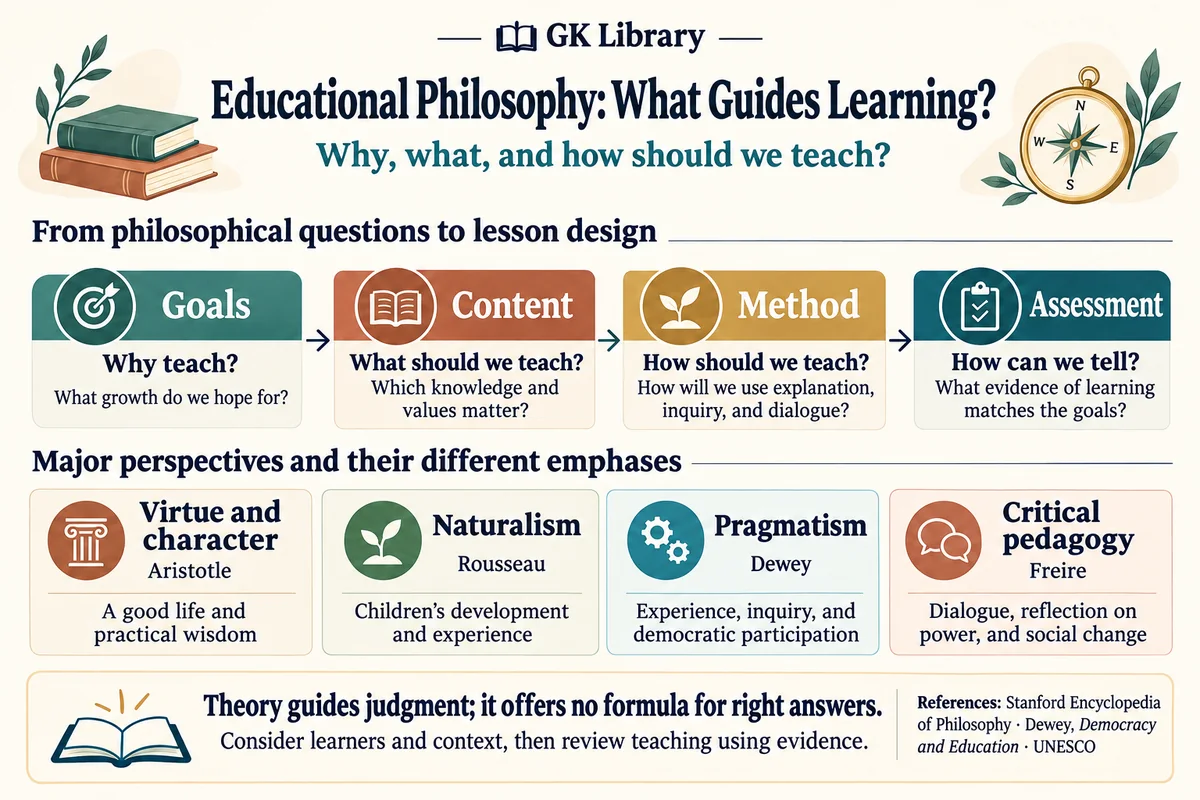
Educational philosophy is an academic discipline that philosophically investigates the purposes, methods, and content of education. Its purpose is to examine in depth education's effects on human beings and society, as well as its ideological foundations, recognizing that education is more than a process of transmitting knowledge. Educational philosophy provides important criteria for designing educational policies and practical educational methods, and plays a significant role in defining the nature and direction of education.
The Philosophical Foundations of Educational Philosophy
The foundations of educational philosophy originate in the ideas of ancient philosophers. For example, Plato aimed to cultivate rational and moral individuals through education, while Aristotle emphasized the importance of education centered on practical wisdom and virtue. Their ideas provided a substantial foundation for establishing the subsequent direction of educational philosophy. In modern philosophy, various philosophical traditions, including Descartes's rational thinking, Kant's cultivation of autonomy, and Rousseau's naturalistic education, have also contributed to the development of educational philosophy.
Modern Philosophers' Contributions to Educational Philosophy
In the modern era, philosophers such as Descartes, Kant, and Rousseau had a profound influence on the development of educational philosophy. Descartes emphasized the importance of critical thinking in education, while Kant regarded human autonomy as the core of education. Rousseau brought significant changes to educational philosophy by valuing children's spontaneity and creativity through naturalistic education. These philosophical ideas provided substantial guidance in establishing the purposes and methods of education.
Educational Philosophy and Interdisciplinary Connections
Educational philosophy extends beyond philosophical reflection alone and is closely connected to disciplines such as psychology, sociology, and anthropology. For example, Piaget's developmental psychology greatly helped redefine educational methods according to the stages of children's cognitive development, while Vygotsky emphasized the importance of learning through social interaction. Dewey also had an important influence on contemporary educational philosophy by exploring how education should be connected to practical experience through his theory of experiential education.
The Relationship of Educational Philosophy to Ethics and Political Philosophy
Educational philosophy is also deeply connected to ethics and political philosophy. From an ethical perspective, education is understood as a means of cultivating moral individuals, while from a political philosophy perspective, education is seen as playing an important role in cultivating citizens of a democratic society. These perspectives provide a foundation for important philosophical discussions about establishing the purposes and direction of education. One of the major tasks of educational philosophy is to foster a sound sense of citizenship through education and cultivate individuals capable of fulfilling their social responsibilities.
The Practical Application of Educational Philosophy
Educational philosophy plays an important role in analyzing practical problems in educational settings from a philosophical perspective and seeking solutions to them. In particular, the formulation of educational policy and the design of teaching methods become more systematic and effective when grounded in the philosophical reflection of educational philosophy. Therefore, a deep understanding of educational philosophy is essential to improving the quality of educational practice, and this can also make an important contribution to social development.
Ultimately, educational philosophy is an important discipline for establishing the theoretical foundations of education and solving practical problems. Exploring educational philosophy plays a central role not only in improving the quality of education but also in creating a democratic and ethical society. Educational philosophy will continue to develop in response to changing social demands and contribute to clearly establishing the purposes and direction of education.
The Historical Development and Major Theories of Educational Philosophy

The Origins of Educational Philosophy: Ancient Greece
The origins of educational philosophy lie in ancient Greece. Plato discussed the importance of education in "The Republic," making the cultivation of rational and moral individuals the ultimate goal of education. He believed that education had a significant influence on the development of individuals and society. Aristotle also discussed the purposes and methods of education in depth in "Politics" and "Nicomachean Ethics," emphasizing the importance of education that cultivates practical wisdom and virtue. They established the foundations of educational philosophy and profoundly influenced its development over the centuries that followed.
The Middle Ages: The Development of Theological Educational Philosophy
During the Middle Ages, theologians such as Augustine and Thomas Aquinas made important contributions to educational philosophy. Drawing on a Christian worldview, Augustine viewed education as a means of faith and emphasized its importance for human moral maturation. Thomas Aquinas combined Aristotle's philosophy with Christian theology to systematize the purposes of education further and proposed a view of education that harmonized human rational capacities and faith. During this period, religion played a central role in educational philosophy, and education was understood as a means of moral and spiritual development.
The Modern Era: The Emergence of Empiricist and Naturalistic Educational Philosophy
With the advent of the modern era, educational philosophy began to be systematized from various philosophical perspectives. John Locke proposed an empiricist educational philosophy, emphasizing the view that children learn and grow through experience. He viewed education as a process that respects children's individual experiences and builds knowledge through them. Rousseau developed a naturalistic educational philosophy in "Emile," valuing children's spontaneity and natural development. Rousseau argued for the need for education that respects the inherent goodness of human beings and the natural process of growth, and this greatly influenced subsequent progressive educational thought.
The 19th and 20th Centuries: The Expansion of Educational Philosophy
In the 19th and 20th centuries, educational philosophy expanded within various social and philosophical contexts. John Dewey valued experience and practice, arguing that education should take place through social experience. He believed that education should be a process of learning through actual experience rather than merely transmitting knowledge, and this greatly influenced the progressive education movement. In addition, the developmental psychology theories of Piaget and Vygotsky provided psychological foundations for education by emphasizing that children's cognitive development and social interaction play important roles in education.
Contemporary Educational Philosophy: Pluralism and Critical Approaches
Contemporary educational philosophy continues to develop through various theoretical approaches. Marxist educational philosophy argues that education plays an important role in eliminating social inequality and resolving class conflict. This offers the perspective that social change can be pursued through education. Critical educational philosophy analyzes how education reflects and reproduces power structures and ideologies, exploring how education can reinforce or transform the existing social order. Feminist educational philosophy also proposes ways to address inequality in education and create inclusive educational environments, focusing on issues of gender discrimination and inequality. Postmodern educational philosophy emphasizes pluralism and diversity in education, stressing the need to move beyond uniform educational methods and recognize and embrace diverse educational approaches.
The Contemporary Significance of Educational Philosophy
The historical development and major theories of educational philosophy form the foundations of contemporary educational philosophy and offer a range of discussions about the purposes, methods, and content of education. These philosophical traditions and theories provide important foundations for designing educational policies and teaching methods in today's educational settings. In particular, education in contemporary society plays an important role in cultivating individuals who fulfill their social and ethical responsibilities, extending beyond the mere transmission of knowledge. Therefore, understanding the development and theories of educational philosophy is essential to promoting improvements in educational quality and social development.
Applying Educational Philosophy in Educational Settings

The Role of Educational Philosophy in Educational Settings
Amid rapid social and technological changes, the importance of educational philosophy is becoming increasingly apparent in contemporary educational settings. Technological advances, globalization, and environmental issues bring changes to the methods and purposes of education, and educational philosophy plays an important role in guiding education amid these changes.
Digital Technology and Educational Philosophy
Advances in digital technology are transforming educational methods and accessibility in revolutionary ways. Online education and distance learning break down educational boundaries and provide diverse learning opportunities. Dewey's empiricist educational philosophy supports these technological changes and emphasizes environments in which learners acquire knowledge through diverse experiences. However, technological changes also affect human relationships and social interaction, so they must be examined closely from the perspective of educational philosophy. Education must go beyond simply introducing technology and maintain a balance between its human dimensions and social experience.
Globalization and Changes in Education
Globalization has brought significant changes to the content and methods of education. Multicultural education and global citizenship education reflect new educational values and goals suited to the global era. This aligns with educational philosophy that emphasizes human diversity and interdependence, suggesting that education should go beyond the mere transmission of knowledge to emphasize social responsibility and ethical values. Cultivating learners with a sense of responsibility as global citizens is becoming an important task of contemporary education.
Environmental Education and Sustainable Development
Environmental issues and sustainable development are emerging as important topics in contemporary education. Environmental education focuses on teaching ecological values and the importance of sustainable development, and this is deeply connected to naturalistic educational philosophy. Education that pursues harmonious coexistence between human beings and nature helps future generations solve environmental problems and build sustainable societies. Educational philosophy provides theoretical support for these educational goals and proposes curricula that enable learners to fulfill their environmental responsibilities.
Personalized Learning and Tailored Education
Personalized learning and tailored education are becoming increasingly important issues in contemporary education. The developmental psychology theories of Piaget and Vygotsky emphasize the need for education that considers learners' individual characteristics and developmental processes. This suggests that tailored education reflecting learners' needs is necessary to optimize their cognitive and social development. Educational philosophy provides theoretical foundations so that these personalized educational approaches can maximize learners' capacity for self-direction and their abilities.
Emphasizing Critical Thinking and Problem-Solving Skills
Contemporary education increasingly emphasizes the importance of critical thinking and problem-solving skills. Influenced by critical educational philosophy, this aims to develop learners' ability to critically analyze their own thinking and creatively solve complex problems. Learners must be able to participate actively in the learning process and direct their own learning rather than merely receiving knowledge passively. These abilities are becoming established as essential educational goals in contemporary society.
Postmodern Educational Philosophy and Pluralism in Education
Postmodern educational philosophy emphasizes pluralism and diversity in education. It seeks education that goes beyond traditional educational paradigms and reflects diverse cultural and social backgrounds. Education should aim to respect diverse voices and experiences and recognize learners' plural identities. This suggests that learners in contemporary society have diverse identities and that education must reflect them. Postmodern educational philosophy focuses on creating educational environments in which every learner's unique background and experiences can be respected.
In contemporary educational settings, educational philosophy plays an important role in analyzing diverse challenges and opportunities and proposing educational goals and methods. Topics such as advances in digital technology, globalization, environmental issues, personalized learning, the need for critical thinking, and pluralism can be understood more deeply through reflection grounded in educational philosophy. These philosophical perspectives are essential to improving the quality of contemporary education and identifying the direction education should take in a changing society.
The Influence of Educational Philosophy on Educational Policy and Teaching Methods

The Influence of Educational Philosophy on Educational Policy
Educational philosophy plays an important role in forming the foundations of educational policy. Educational philosophy clearly defines the purposes and values of education and formulates policies on that basis. For example, if providing equal educational opportunities is established as an important value, this leads to policies that guarantee equal learning opportunities for all students. Educational philosophy provides direction so that policies fulfill their social responsibilities and education can serve the public interest.
The Interrelationship Between Educational Philosophy and Teaching Methods
Educational philosophy also greatly influences the design of teaching methods. For example, empiricist educational philosophy emphasizes learning methods that enable learners to acquire knowledge through diverse experiences. This leads to teaching methods such as project-based learning and problem-solving learning, helping students deepen their learning by solving problems in real situations. These teaching methods create environments in which students can participate actively in learning and develop their capacity for self-directed learning.
The Influence of Educational Philosophy on Assessment Methods
Traditional assessment methods focused mainly on whether knowledge had been acquired, but contemporary educational philosophy emphasizes the comprehensive assessment of diverse competencies, including critical thinking, problem-solving skills, and creativity. This leads to a shift toward assessing students' overall abilities through portfolio assessments and performance assessments rather than relying solely on test results. Educational philosophy plays an important role in diversifying assessment methods and designing systems that can better reflect learners' growth.
Teacher Education and Educational Philosophy
Educational philosophy is also deeply reflected in teacher education and professional development programs. Since teachers must understand educational philosophy and be able to apply it to teaching methods, teacher education courses cover various theories of educational philosophy and methods of practice. Educational philosophy plays an essential role in helping teachers form their own educational beliefs and guide students' learning on that basis. In addition, ongoing professional development and education are necessary to improve teachers' professional expertise, and educational philosophy serves as an important standard in these processes.
The Design of Educational Environments and Educational Philosophy
Educational philosophy also influences the design of physical educational environments. For example, naturalistic educational philosophy emphasizes interaction with nature, leading to the creation of nature-friendly learning environments that reflect this emphasis. These philosophical foundations are reflected not only in classroom spaces but also in the design of the various educational activities and programs that learners experience. Educational environments are therefore designed to improve students' learning efficiency and enable them to experience the essence of education naturally.
The Influence of Educational Philosophy on Social Roles
Educational philosophy promotes discussion of education's social roles and responsibilities. Education must go beyond merely transmitting knowledge to perform a role that reflects social justice, ethical values, and sustainable development. These social goals significantly influence educational policy and teaching methods, establishing direction so that education can contribute to creating a fair and sustainable society. Educational philosophy defines education's role so that it can positively influence not only individuals but also communities and society as a whole.
Ultimately, educational philosophy has an important influence on educational policy and teaching methods and provides essential guidance in every aspect of education, including its purposes, methods, assessment, and environmental design. Through educational philosophy, education can move beyond the mere transmission of knowledge toward an approach that emphasizes social values and ethical responsibilities.
Educational philosophy plays a significant role in identifying the nature and values of education and using them as a basis for designing and implementing educational policies and teaching methods. Developing a deep understanding of educational philosophy's definition and academic foundations, historical development, major theories, applications in contemporary educational settings, and influence on policy and teaching methods is an essential process for improving educational quality and contributing to social development.
Educational philosophy will continue to develop amid changing social and educational environments and play an important role in establishing the purposes and direction of education.