The relationship between supply and demand is an important factor in a market economy and is closely tied to the process by which the prices of goods and services are determined. Understanding this relationship is essential for grasping the basic principles of economic activity.
This article begins with the basic concepts of supply and demand and then looks at market equilibrium and how price changes affect the economy. It also analyzes in depth how the supply and demand curves shift and the economic meaning and implications of those shifts.
Basic Concepts of Supply and Demand
The Core Concepts of Supply and Demand: The Starting Point of Economic Activity
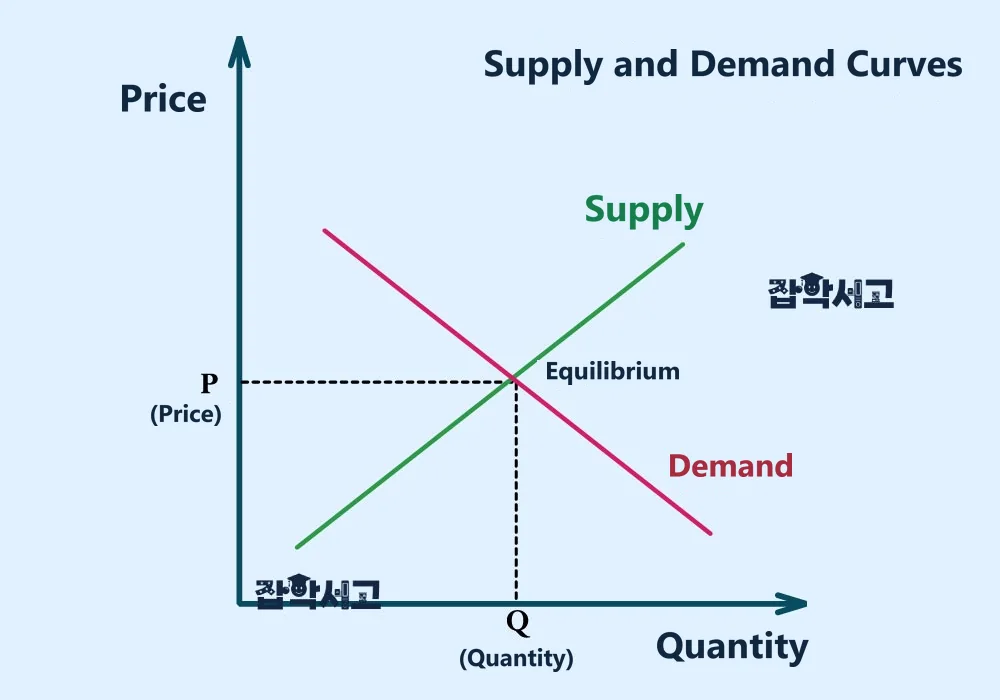
Supply and demand are the two basic elements that form the foundation of economic activity, and they play an important role in determining prices and the allocation of resources in a market. Demand represents how much consumers want a particular good or service and their purchasing power for it, and the lower the price, the stronger consumers' tendency to buy more. Supply, on the other hand, refers to producers' willingness to bring goods or services to market, and the higher the price, the more suppliers tend to offer.
The demand curve shows demand increasing as price falls and generally slopes downward to the right. The supply curve, by contrast, takes the form of an upward-sloping curve in which supply increases as price rises. Market transactions take place where these two curves meet, and this interaction is essential in determining the price and quantity traded of a good.
Market Equilibrium: The Intersection of Supply and Demand
The intersection of supply and demand represents market equilibrium, the point at which the appropriate price of a good or service is determined. At the equilibrium price, transactions take place that satisfy both consumers and producers. When equilibrium breaks down, excess demand or excess supply arises in the market and prices adjust.
Excess demand occurs when demand for a good exceeds supply; in this case the price rises, which has the effect of reducing the quantity demanded by consumers and increasing the quantity supplied by suppliers. Excess supply, on the other hand, occurs when the quantity of a good offered on the market exceeds demand; as the price falls, the quantity supplied decreases and the quantity demanded increases. This process explains the market's self-correcting mechanism for returning to equilibrium.
The Effects of Price Changes: Shifts in the Supply and Demand Curves
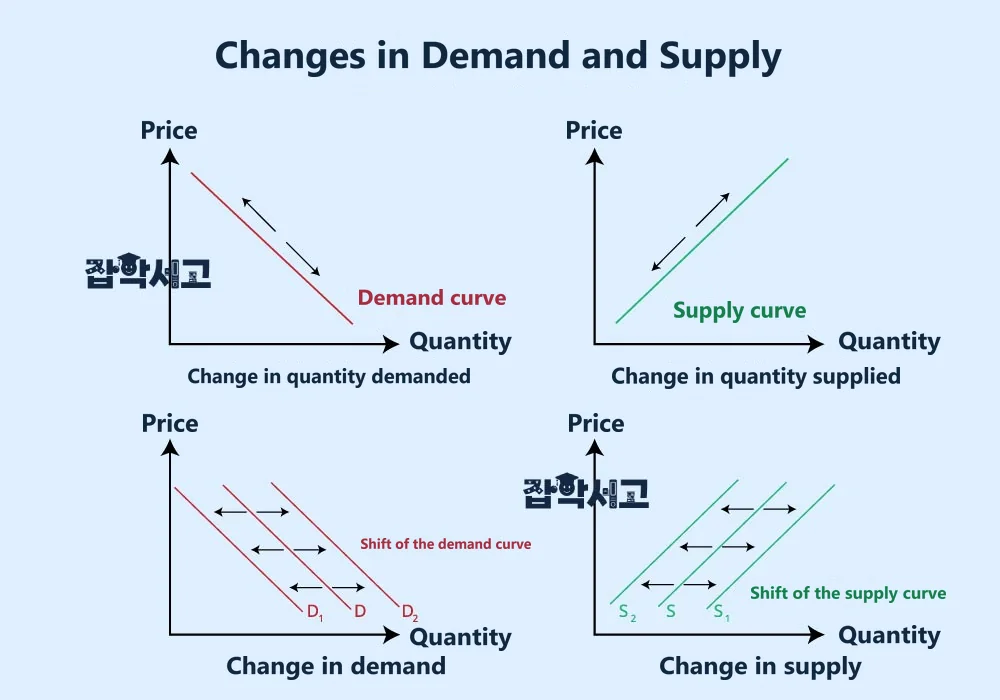
Supply and demand can shift because of external factors, and these curve shifts have a major impact on the market as a whole. The demand curve is affected by changes in consumers' income, changes in tastes, and changes in the prices of substitutes or complements. For example, when the price of a particular good falls, demand for its substitutes decreases, and the demand curve for those substitutes may shift to the left.
The supply curve can also shift because of various factors, such as changes in production costs, technological progress, and government policy. For example, if technological innovation lowers production costs, the supply curve shifts to the right and a larger quantity of goods is offered on the market.
These shifts in the supply and demand curves directly affect market prices and quantities traded and play an important role in how businesses and governments formulate economic policy.
The Interaction of Supply and Demand: Economic Implications
The interaction of supply and demand means more than simply setting prices. Through it, market participants can trade efficiently and optimize the allocation of resources. Changes in supply and demand affect businesses' production plans, consumers' purchasing decisions, and even governments' economic policies, providing important clues for understanding how the economy as a whole moves.
This interaction also makes market forecasting and policy decisions possible, providing essential information especially when governments formulate economic policy or businesses develop strategies. Beyond that, it also plays an important role in promoting the growth and stability of the national economy.
Supply and Demand in Everyday Life
The concept of supply and demand is not confined to academic theory; it also plays a very important role in everyday life. The purchasing decisions we make every day and the way businesses bring products to market all follow the principles of supply and demand. For example, goods available only in certain seasons become more expensive because of limited supply and high demand. Conversely, mass-produced goods become cheaper because supply exceeds demand.
The concept of supply and demand therefore acts as an important factor in decision-making across all economic activity, and through it we can understand more clearly how the national economy moves.
Market Equilibrium: Analyzing the Interaction of Supply and Demand

The Meaning and Importance of Market Equilibrium
Market equilibrium is the point where supply and demand match, meaning a state in which prices and quantities traded in the market are stable. In this state, neither excess demand nor excess supply occurs, and the outcome satisfies all market participants. The equilibrium price forms at this market equilibrium and acts as an economic signal that helps resources be allocated efficiently.
The equilibrium price is a price acceptable to both consumers and producers, at which transactions take place at a level where buyers can purchase the goods they want at a reasonable price and suppliers can make a sufficient profit. As a result, trade within the market proceeds naturally and smoothly.
The Formation and Role of the Equilibrium Price
The equilibrium price forms naturally at the point where supply and demand meet, and through it resources within the market are allocated to where they are needed. This price sends signals to producers and consumers and plays an important role in preventing shortages or surpluses of goods.
If excess demand occurs in the market, it drives prices up, causing the quantity demanded to fall and the quantity supplied to rise. Conversely, if excess supply occurs, prices fall, the quantity supplied decreases, and the quantity demanded increases, so the market naturally returns to equilibrium. This price adjustment mechanism is a key element that helps the market function efficiently.
Changes in Market Equilibrium Caused by External Factors
Market equilibrium is not fixed and can change because of various external factors. For example, changes in consumers' income, fluctuations in production costs, or the introduction of new government policies shift the demand or supply curve and create a new equilibrium. These changes directly affect prices and quantities traded in the market and show the dynamism of the economy.
When income rises, consumers tend to buy more goods, so the demand curve shifts to the right. When production costs rise, on the other hand, the supply curve shifts to the left, resulting in a smaller quantity supplied and higher prices. These fluctuations form a new market equilibrium and require market participants to adapt to new economic conditions.
Market Self-Correction and Resolving Disequilibrium
Market equilibrium may not be maintained perfectly, and the market can fall temporarily into disequilibrium. Excess demand puts upward pressure on prices because of a shortage of goods, which reduces consumers' purchasing power or gives suppliers an incentive to produce more. Conversely, excess supply puts downward pressure on prices because of overproduction, which leads producers to cut production and encourages consumers to buy.
Through these price fluctuations, the market has a self-correcting ability to restore equilibrium on its own. The process by which the market returns to equilibrium by itself makes efficient resource allocation and economic optimization possible and acts as an important principle in maintaining market stability.
Analyzing Market Equilibrium and Implications for Economic Policy
Analyzing market equilibrium is an important way to assess the stability and sustainability of an economic system. Through it, we can understand the economic phenomena that occur in markets and grasp more accurately how policies affect the market.
For example, when a government pays subsidies to a particular industry or adjusts tax rates, it can judge the effectiveness of the policy by analyzing how the policy shifts the supply and demand curves and forms a new equilibrium. This makes it possible to design and adjust policies across the whole economy and lays the groundwork for building a more stable and sustainable economic system.
Market equilibrium is not merely a theoretical concept but an important principle applied in real economic activity. Through it, resources can be allocated efficiently, economic inefficiency can be reduced, and healthy market growth can be achieved.
How Price Changes Affect Supply and Demand
The Relationship Between Price Changes and Demand
A change in price has an immediate effect on demand. In general, when prices rise, consumers buy less of the good or service, and when prices fall, more consumers seek out the good. This is a natural phenomenon that occurs as consumers' purchasing power changes. For example, demand for luxury goods drops sharply when their prices rise, whereas demand for necessities may change little despite a price increase.
Price changes show how elastically demand responds. In other words, the size of the change in demand can vary depending on how sensitive it is to price. When demand is inelastic, it is not greatly affected by price fluctuations, whereas when demand is elastic, the quantity demanded can change significantly even with a small price change.
The Relationship Between Price Changes and Supply
Price changes also have an important effect on supply. In general, when prices rise, suppliers can expect more profit and so increase production. Conversely, when prices fall, suppliers tend to cut production out of concern about lower profits. This is an important factor that leads suppliers to adjust their output according to price signals in the market.
Supply can also respond differently depending on its price elasticity. In the case of inelastic supply, natural disasters or technical limits prevent suppliers from responding immediately to a price increase, and they cannot raise output quickly. In industries with elastic supply, by contrast, production increases quickly as prices rise and can meet demand.
The Role of Price Changes in Resource Allocation
Price changes do not simply affect the behavior of consumers and producers; they also play an important role in the efficient allocation of resources in the market. When prices rise, demand for the good falls and resources move elsewhere, and when prices fall, resources become concentrated on that good again. In this process, price acts as a signal that optimizes the allocation of resources within the market.
In this way, prices provide important information to market participants, helping to adjust the balance of supply and demand and to allocate resources where they are needed most. Price changes thus contribute to increasing efficiency across the economy and to the market's self-correction.
Price Changes from Long-Term and Short-Term Perspectives
Price changes can work differently in the short term and the long term. In the short term, supply and demand can fluctuate sharply in response to price changes, but over time market participants adapt to the new prices and things gradually stabilize. For example, prices may spike in the short term because of a supply shortage, but over time supply recovers and the market regains equilibrium.
In the long term, both consumers and producers are likely to adapt to the new price level, keeping the market in a more stable state. This shows the market's adaptability, as the shock of a price change eases over time.
Economic Implications of Price Changes
Price changes have a major impact not only on transactions within the market but on the economy as a whole. Consumers change their consumption habits in response to price changes, and businesses adjust their production and investment decisions. These changes affect the overall structure of the market and the allocation of resources, and beyond that, they play an important role in the growth and stability of the national economy.
Understanding patterns of price change is therefore a very important element in analyzing markets and formulating economic policy. With it, governments can design appropriate policies to maintain economic stability, and businesses can develop strategies suited to market conditions.
Shifts in the Supply and Demand Curves and Their Economic Implications

Shifts in the Demand Curve and Their Causes
Shifts in the demand curve occur in response to changes in consumer behavior and are an important factor in forming a new market equilibrium. A shift of the demand curve to the right means that consumers tend to buy more of the good, and it may be caused by rising income, changes in consumer preferences, a rise in the price of substitutes, or a fall in the price of complements. Conversely, a shift of the demand curve to the left means a decrease in demand, which may be caused by falling income, changes in preferences, a fall in the price of substitutes, or a rise in the price of complements.
These changes bring about changes in the quantity demanded of a particular good or service, which have a major impact on the market as a whole. When the demand curve shifts, a new equilibrium price and quantity traded form, directly affecting the decisions of market participants.
Shifts in the Supply Curve and Their Factors
Shifts in the supply curve are determined by external factors such as producers' cost structures and technological progress. For example, when production costs fall, the supply curve shifts to the right and more goods are supplied to the market. This can lead to lower prices and larger quantities traded. On the other hand, when production costs rise, the supply curve shifts to the left, prices rise, and the quantity supplied decreases.
Technological innovation and regulatory changes also have an important effect on shifts in the supply curve. When new technology is introduced, productivity improves so that more goods can be produced at lower cost, which acts as a factor that increases supply.
How Shifts in the Supply and Demand Curves Affect the Market
Shifts in the supply and demand curves reflect the dynamism of the market and play an important role in forming a new equilibrium. These shifts change the equilibrium price and quantity traded, which brings about major changes in the behavior of market participants. For example, when supply increases, prices fall and consumers can buy more goods, so the quantity traded in the market rises.
Conversely, when demand decreases, prices fall and suppliers cut production, resulting in a smaller quantity traded in the market. This process promotes the market's movement to a new equilibrium and plays an important role in maintaining economic stability.
Implications for Economic Decision-Making
Shifts in the supply and demand curves offer important implications for formulating economic policy and business strategy. Policymakers can maximize economic efficiency by forecasting changes in supply and demand in the market and designing policies accordingly. For example, if a government pursues policies that encourage technological innovation or lower production costs, the supply curve can shift and contribute to economic growth.
Businesses can also develop strategies by analyzing changes in supply and demand. When they detect signs that market demand is growing, businesses can seize the opportunity to increase output or enter new markets. This provides important information that helps businesses respond flexibly to market changes.
The Market Adjustment Process and Self-Correcting Ability
Shifts in the supply and demand curves are an important element that shows the market's self-correcting ability. When the market is in disequilibrium, changes in supply and demand naturally drive adjustment toward a new equilibrium. For example, if supply increases in a situation where prices have spiked, the market can return to a stable state.
This process is an important example that explains the market's self-correcting ability and plays an important role in maintaining economic stability and sustainability. This process of restoring equilibrium provides essential information for market participants making economic decisions and contributes to increasing efficiency across the economy.
Long-Term Economic Growth and Strategic Use
Shifts in the supply and demand curves provide an important foundation for long-term economic growth. By analyzing these shifts accurately, businesses and policymakers can respond quickly to market changes and, on that basis, create better economic results. This provides essential information for economic forecasting and strategy development and plays an important role in promoting long-term economic growth and stability.
The relationship between supply and demand serves as an important principle for understanding how markets work. Through it, we can grasp market equilibrium more clearly and analyze how price changes affect economic activity.
Shifts in the supply and demand curves play an important role in interpreting economic phenomena, and on that basis, policy and business strategy can be planned more efficiently. Through this kind of analysis, we can lay the foundation for building a sustainable and efficient economic structure.