The phenomenon in which an asphalt road you walk along every day or a yard in a quiet residential neighborhood suddenly collapses into an enormous hole is called a sinkhole. You have probably seen the strange sight in the news at least once: a large hole opening in the middle of a road and a car falling into it.
Why do sinkholes, in which the ground collapses without warning, occur? Are they simply disasters caused by bad luck, or are they the result of earth science mechanisms that have been unfolding deep underground over a long period? This article systematically explores the principles behind naturally occurring sinkholes and human-induced ground collapse in urban areas.
What Is a Sinkhole?
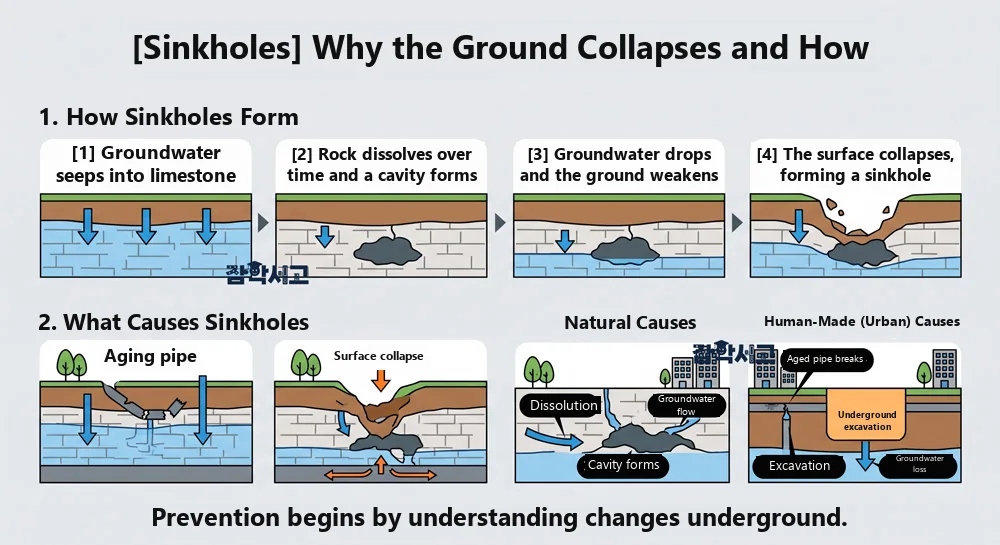
A 'Sinkhole' literally means 'a hole formed by the sinking of the ground.' In earth science and geology, it is also referred to academically as a 'Dissolution Depression' or a 'Doline.'
Sinkholes vary enormously in size, from small ones a few meters in diameter to large ones more than a hundred meters across that can swallow dozens of buildings. Because the empty space beneath the surface cannot be seen until the ground collapses, sinkholes are among the geological hazards that are particularly difficult for humans to predict.
How Do Sinkholes Form?
The fundamental causes of sinkholes are the 'formation of underground spaces (cavities)' and a 'decrease in the groundwater pressure that had supported those spaces.' To make this easier to understand, we will divide them into two types: natural sinkholes and human-induced sinkholes.
(1) Natural Sinkholes: Chemical Reactions Between Limestone and Acid Rain
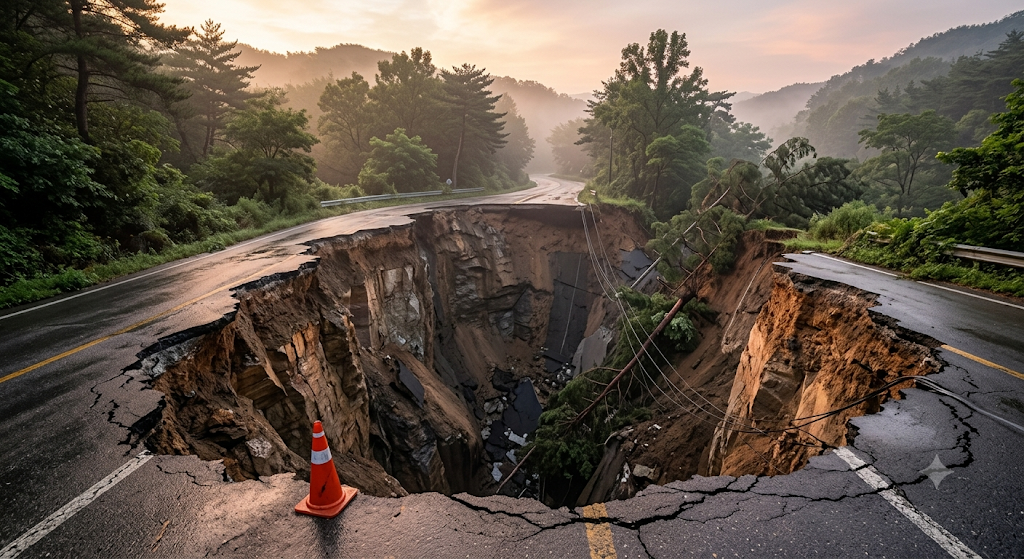
Large sinkholes that occur under natural conditions are mainly observed in karst topography (Karst Topography). Areas with rock layers composed primarily of limestone (calcium carbonate) are typical examples.
How Rainwater Dissolves Rock
First, the infiltration of acidic rainwater
As rain falls from the sky, it absorbs carbon dioxide from the atmosphere and becomes mildly acidic because of carbonic acid.
Second, the chemical dissolution of rock
When this carbonic acid-containing water flows into limestone layers, it gradually dissolves the rock over many years.
(Chemical equation: calcium carbonate + water + carbon dioxide -> calcium ions + bicarbonate ions)
Third, the formation of underground caves
Long waterways and large underground caves form where the rock has dissolved.
An Easy-to-Understand Example: A Balloon and a Sandcastle
Imagine a large, inflated balloon (groundwater) beneath the ground surface, firmly supporting a sandcastle (the ground surface) above it. When rain falls or a drought occurs and groundwater drains away, it is like air escaping from the balloon. The sandcastle piled above loses the force (water pressure) that supported it from below and suddenly collapses.
(2) Human-Induced Sinkholes in Cities: Uncontrolled Development and Groundwater Outflow
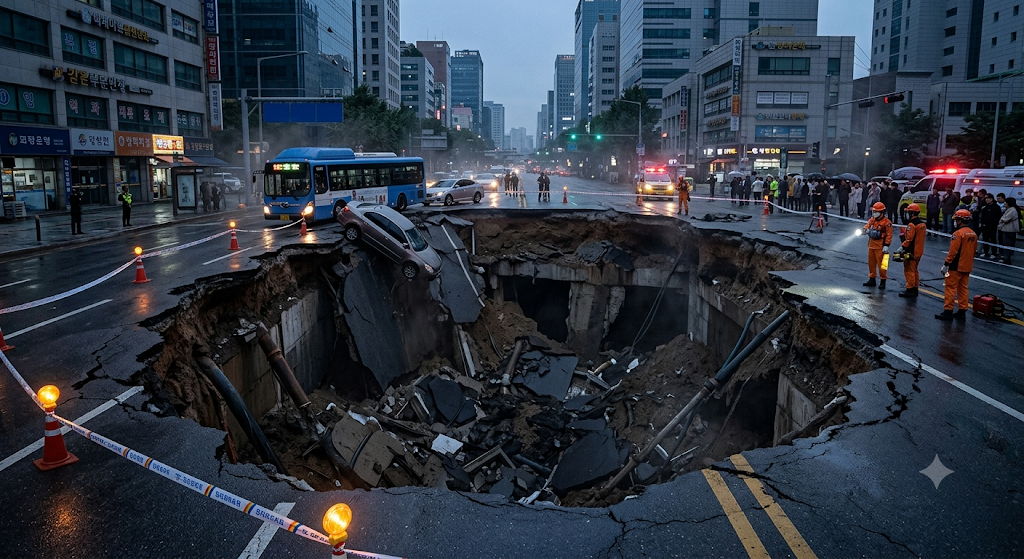
Sinkholes occurring in urban areas in recent years are caused not by limestone dissolution, but mostly by soil being washed away as a result of human development activities. Strictly speaking, they are distinguished from limestone sinkholes in the academic sense and are sometimes called 'Ground Subsidence' or 'ground collapse.'
3 Main Causes of Urban Ground Subsidence
First, ruptures in aging water supply and sewer pipes
When cracks form in old sewer pipes buried underground, water gushes out, eroding and washing away the surrounding soil.
Second, large underground excavation projects
When soil is excavated deep underground for subway or high-rise construction, surrounding groundwater and soil flow into the construction site, leaving empty spaces underground.
Third, excessive asphalt coverage
Because road paving prevents rainwater from being naturally absorbed into the ground, the moisture balance and supporting capacity of urban ground are weakened.
Sinkhole Risks and Future Countermeasures
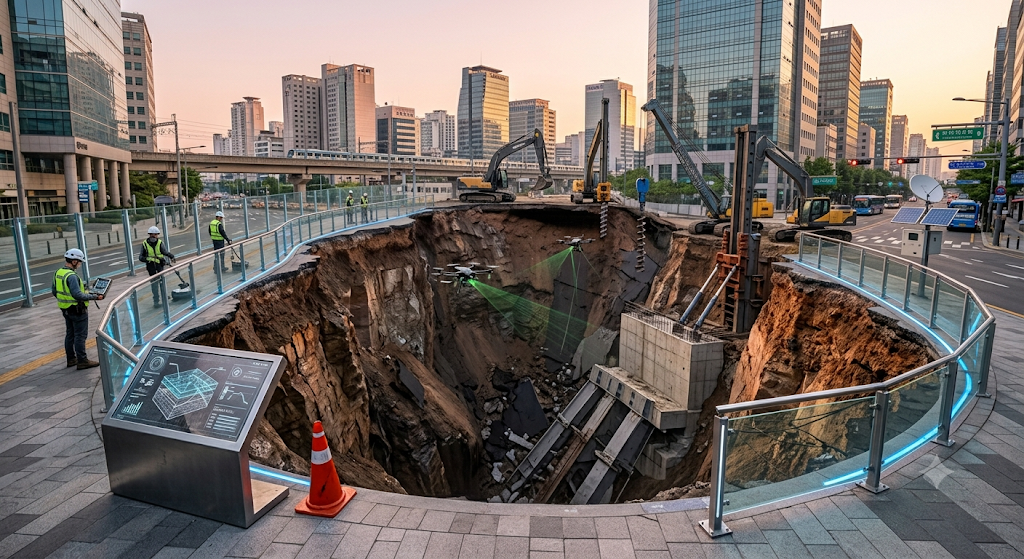
Sinkholes are a complex phenomenon arising from the combined effects of natural chemical weathering and indiscriminate urban development by humans. Recent conditions, in which torrential rain and drought alternate rapidly due to climate change, cause extreme fluctuations in groundwater levels, further increasing the frequency of sinkholes.
To prevent these problems and address their shortcomings, the following advanced technologies and management systems are being introduced.
First, ground-penetrating radar (GPR) surveys
This technology sends electromagnetic waves into the ground through the road surface to identify underground empty spaces (cavities) in advance.
Second, smart groundwater management systems
These systems monitor rapid drops in urban groundwater levels in real time to detect areas at risk.
Third, timely replacement of aging pipes
Aging water supply and sewer pipes, the leading cause of urban ground collapse, are systematically repaired and replaced.
Although we cannot see beneath the ground, it is a delicate space where hydrological and geological balance must be strictly maintained. By combining scientific understanding of unseen underground spaces with advance surveys, we can create safer urban environments.