Drop a strong neodymium magnet into a copper pipe and something strange happens. Copper is a metal that magnets do not stick to, yet the magnet drifts down slowly, as if it were passing through honey. Something invisible is holding the magnet back. That something is the ‘eddy current.’
Simply put, an eddy current is ‘an electric current that swirls in loops inside a conductor such as metal because of a changing magnetic field.’ It is named after the eddies that form when water flows around a rock, and it is also called a Foucault current after the French physicist who studied the phenomenon in depth.
In this article, we will look in turn at how eddy currents arise, the trouble they cause inside transformers, and their uses in brakes, induction cooking, and metal inspection.

Electric Whirlpools Inside Metal: How Eddy Currents Work and What They Are Used For
What Is an Eddy Current?

When the magnetic field around a conductor changes, an induced electromotive force, a force that pushes electricity, arises inside the conductor. This is electromagnetic induction, revealed by Michael Faraday in 1831. In a wire, the current would follow a fixed path, but inside a wide metal sheet or block the current has no set route and instead circles round and round in small loops. These currents circling inside the metal are eddy currents.
Eddy currents arise when a magnet moves near a metal, when a metal passes through a magnetic field, or when the strength of a magnetic field keeps changing, as with alternating current. The stronger the magnetic field, the faster it changes, and the better the metal conducts electricity, the stronger they flow.
To make this easier to picture, imagine putting a stick into a still pond and stirring. Wherever the stick passes, the water spins in small whirlpools, and the stick feels the water's resistance. The electrons in a metal are likewise stirred into whirlpools by the stick of a changing magnetic field, and those whirlpools in turn hold back the magnet's motion.
Historically, in 1824 the Frenchman François Arago first observed a compass needle being dragged along near a rotating copper disk. Then in 1855 Léon Foucault confirmed that a copper disk spun between magnets becomes much harder to turn and heats up.
A Force That Resists Change: Lenz's Law

The direction in which eddy currents flow follows a clear rule. This is Lenz's law, formulated in 1834 by Heinrich Lenz, a physicist working in the Russian Empire.
- Lenz’s Law: An induced current flows in the direction that opposes the change in the magnetic field that created it.
- Drag Force: As a result, a force arises between the magnet and the metal that slows each other's motion.
- Joule Heating: Because of the metal's resistance, the energy of the current turns into heat.
The magnet in the copper pipe can be explained the same way. As the magnet falls, the magnetic field increases in the pipe wall below the magnet and decreases in the wall above it. Eddy currents then form in the pipe wall, pushing the magnet away from below and pulling it back from above. In the end, the magnet's kinetic energy escapes as heat that warms the pipe ever so slightly, and the magnet falls slowly. Put the same magnet in a plastic pipe and, since no current can flow, it simply drops straight through.
When Eddy Currents Become a Nuisance
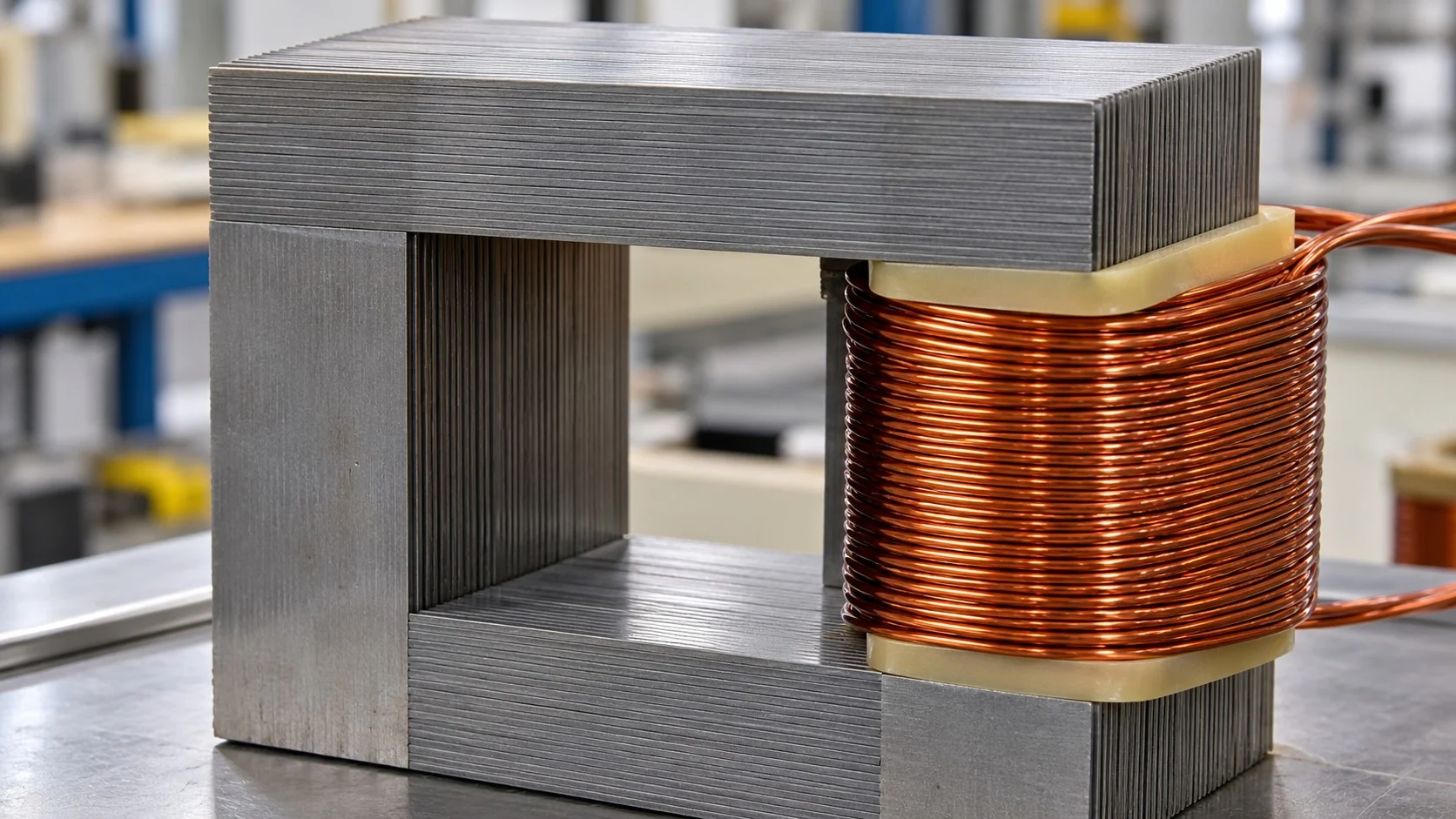
Eddy currents are not always welcome. Inside transformers, motors, and generators are iron cores whose magnetic fields change constantly because of alternating current. If a core were a single solid block, large eddy currents would circulate inside it, wasting electricity as heat and making the machine hot. This is called eddy current loss.
(1) Slice It Thin and Stack It
That is why transformer cores are made by stacking many thin silicon steel sheets coated with an insulating film. Since current cannot cross from one sheet to the next, the whirlpools are broken up into small ones and the loss drops sharply. In theory, eddy current loss is proportional to the square of the sheet thickness, so halving the thickness cuts the loss to roughly a quarter. This is why real transformer sheets are much thinner than 1 millimeter.
(2) Use Materials That Conduct Poorly
In electronic devices that handle high frequencies, cores are made from materials such as ferrite, which are easily magnetized yet conduct electricity poorly, to block eddy currents. Because eddy current loss grows rapidly as frequency rises, this choice of material matters more the higher the frequency of the device.
Technologies That Use Eddy Currents on Purpose

Conversely, there are many technologies that turn the drag force and heat of eddy currents into something useful.
(1) Brakes That Never Touch
An eddy current brake slows things down by passing a metal plate between magnets. With no friction, it has almost no parts that wear out, so it is used on roller coasters, some high-speed trains, auxiliary brakes on heavy trucks, and to stop the blades of electric circular saws quickly. However, its force weakens as speed drops and it cannot hold a stopped object in place, so it is used together with friction brakes.
(2) Induction That Heats the Pot Directly
An induction cooktop runs a rapidly changing current through a coil to create eddy currents in the bottom of the pot. This is how the pot itself gets hot without any flame. That is why pots whose bottoms are made of a material that sticks to magnets, like iron, work well.
(3) Eyes That Sort Out Metals
Vending machines weed out fake coins by how much they slow down as they roll past a magnet, and recycling plants use eddy currents to fling aluminum cans away from other waste. Eddy current testing, which finds tiny cracks in aircraft wings and pipes without taking them apart, uses the same principle. If there is a crack in the metal, it blocks the path of the whirlpools and changes their flow, and the inspection equipment picks up that small change.
(4) Sensors That Measure Vibration
Next to fast-spinning shafts, such as the turbines in power plants, proximity sensors that use eddy currents are installed. Because even a slight change in the distance between the shaft and the sensor alters the strength of the eddy currents, they can monitor tiny vibrations of around 0.1 millimeter without touching the shaft.
An eddy current is a metal's small resistance to a changing magnetic field. Inside machines it is a nuisance that eats up energy, but once you understand the principle, it becomes a reliable tool that makes possible brakes that do not wear out, fast cooking, and precise inspection.
First understanding the nature of an invisible force, then wisely choosing whether to block it or use it: that is the first step in learning the physics of everyday life.