When you walk into the central hall of a science museum, you may see a heavy bob slowly swinging at the end of a long wire hung from the ceiling. Watch it for a while and it seems to go back and forth along the same line, but come back a few hours later and the direction of the swing has changed from where it started. No one touched it, so what changed its direction? The answer to this puzzle is the ‘Foucault Pendulum’.
Put simply, the Foucault Pendulum is ‘a device that hangs a heavy bob on a very long wire and lets it swing for a long time, so that the plane of swing slowly turns relative to the ground, showing with your own eyes that the Earth rotates on its own axis’. It is counted as the first experiment to prove the Earth's rotation indoors, without looking at the sky.
In this article, we will look in turn at how the Foucault Pendulum came about, why its plane of swing turns, how the rotation speed changes with latitude, and how science museums keep pendulums moving today.
The Foucault Pendulum: Showing the Earth's Rotation Before Our Eyes
1851: Come and See the Earth Turn
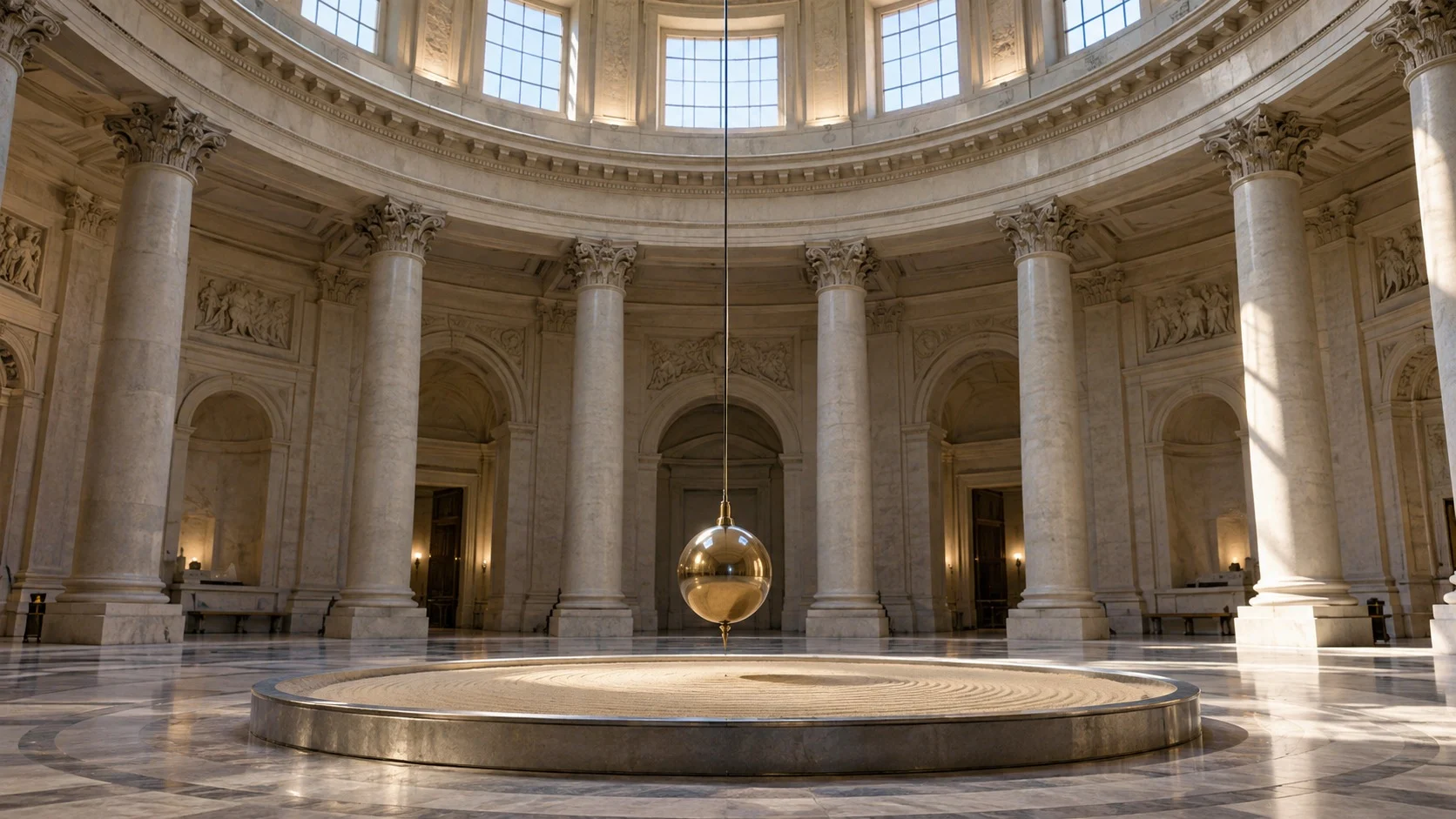
The experiment was devised by the French physicist Léon Foucault. In February 1851, Foucault first demonstrated his pendulum in the Meridian Room of the Paris Observatory, and a few weeks later he hung a much larger pendulum beneath the dome of the Panthéon in Paris. The invitation at the time is said to have read, ‘You are invited to come and see the Earth turn.’
The Panthéon pendulum was built on the following scale.
(1) A 67-meter steel wire
The longer the wire, the longer each swing takes and the longer the motion lasts.
(2) A 28-kilogram bob
Made of lead and covered in brass, the heavy bob did not easily lose its swing to air resistance.
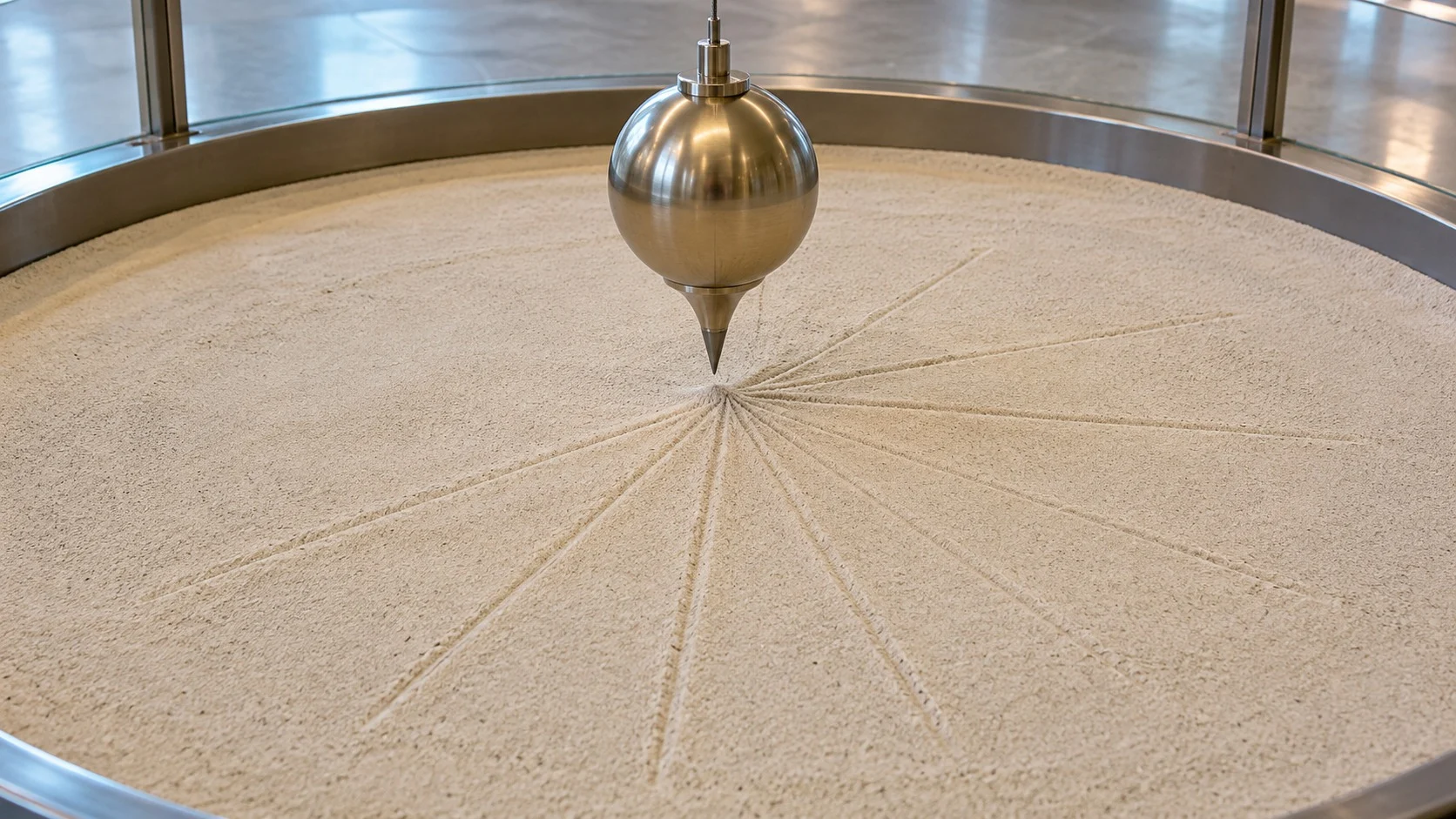
(3) A sand bed on the floor
A pointed stylus under the bob left a mark in the sand each time it passed, so anyone could see the direction of the swing gradually changing.
There was a reason this experiment caused such a stir. The idea that the Earth turns had been widely accepted since Copernicus, but the evidence had mostly been inferred from observing the motions of stars and planets. Because the Foucault Pendulum showed the ground turning right inside a building, without looking up at the sky, crowds of Parisians flocked to see it.
Why Does the Plane of Swing Turn?
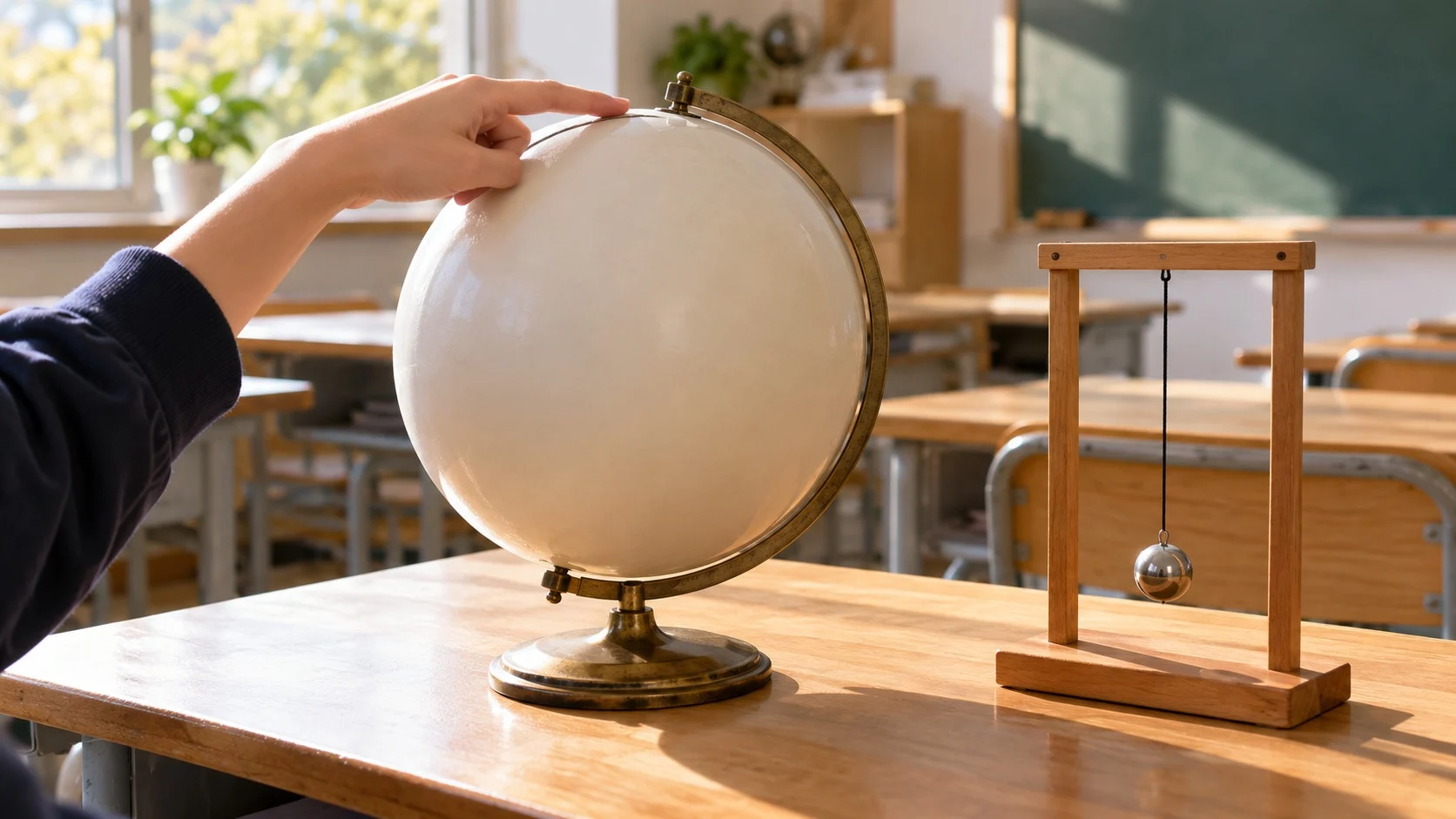
Once a pendulum starts swinging, it tends to keep going back and forth in the same plane unless an outside force twists it. If the point where the wire is attached is made so it can turn freely, the pendulum keeps its original plane of swing even as the building turns.
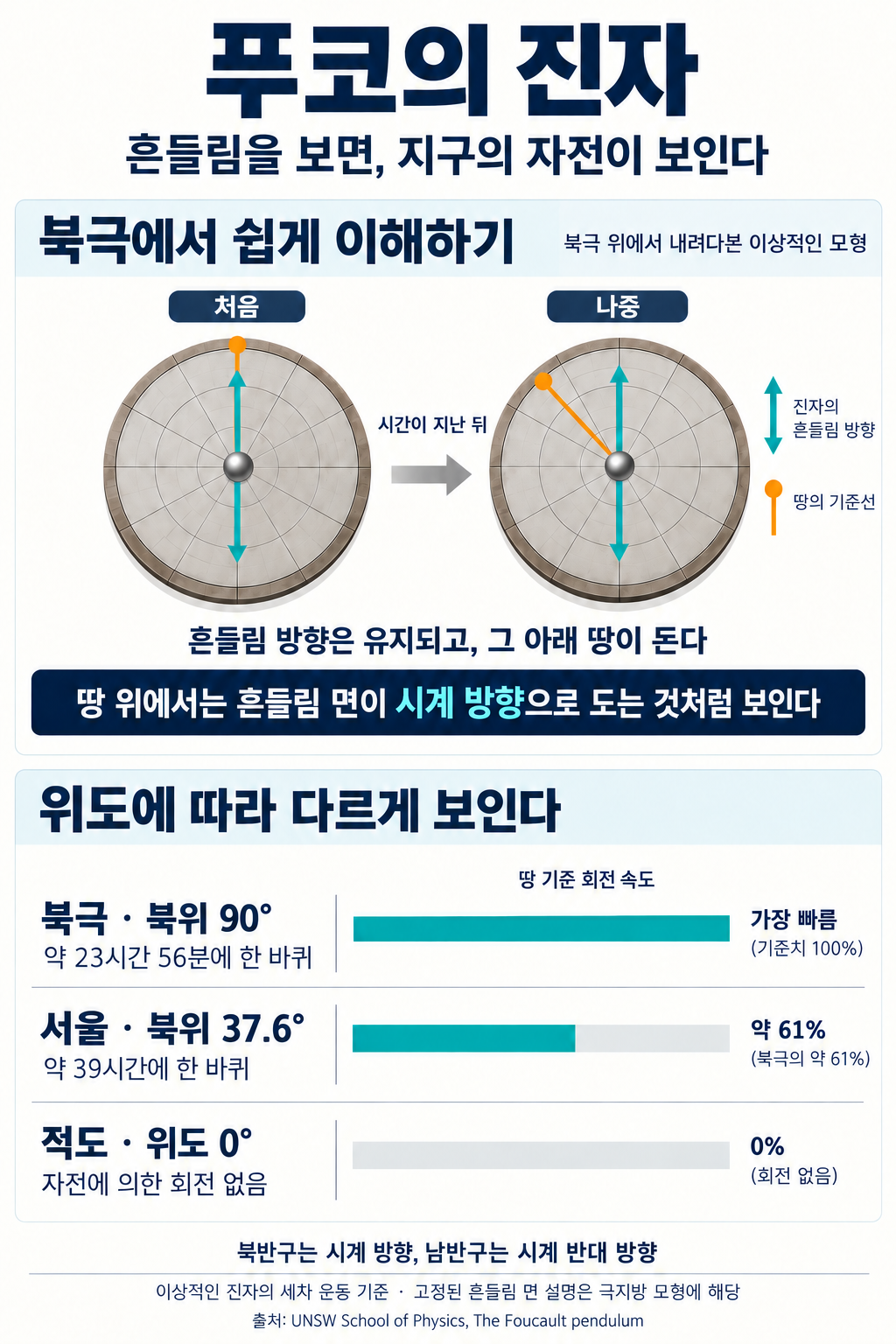
The easiest place to understand this is the North Pole. If you hang a pendulum at the North Pole, its plane of swing stays fixed relative to space, while the ground beneath it turns once a day. So to a person standing on the ground, the pendulum's plane of swing appears to turn backward once a day.
- Northern Hemisphere: Seen from above, the plane of swing turns clockwise.
- Southern Hemisphere: It turns the opposite way, counterclockwise.
In the end, it is not the pendulum that turns; it is we, watching the pendulum, who are turning along with the Earth.
Rotation Speed Changes with Latitude
The time it takes for the plane of swing to make one full turn depends on the latitude where the pendulum hangs. At the poles it takes about 23 hours and 56 minutes, the time the Earth takes to rotate once, and it gets slower closer to the equator. The formula is ‘time for one turn = 23 hours 56 minutes ÷ sin(latitude)’.
- Panthéon (Paris): At a latitude of about 48.9 degrees north, it turned about 11.3 degrees per hour and took about 31 hours and 50 minutes for one full turn.
- Seoul: At about 37.6 degrees north, one full turn takes about 39 hours.
- Equator: The plane of swing does not turn at all, so the rotation cannot be confirmed with a pendulum.
How much the plane of swing turns is determined only by latitude, regardless of the wire's length or the bob's weight. The length of the wire only sets how long each swing takes; the Panthéon pendulum took about 16 seconds for one round trip.
This rotation shares the same root as the Coriolis Effect, the phenomenon in which moving objects appear to curve sideways because of the Earth's rotation. However, the effect is so small that the swing must last a long time for the change to show, so a pendulum with a long wire and a heavy bob is used and watched for hours.
Foucault Pendulums Today
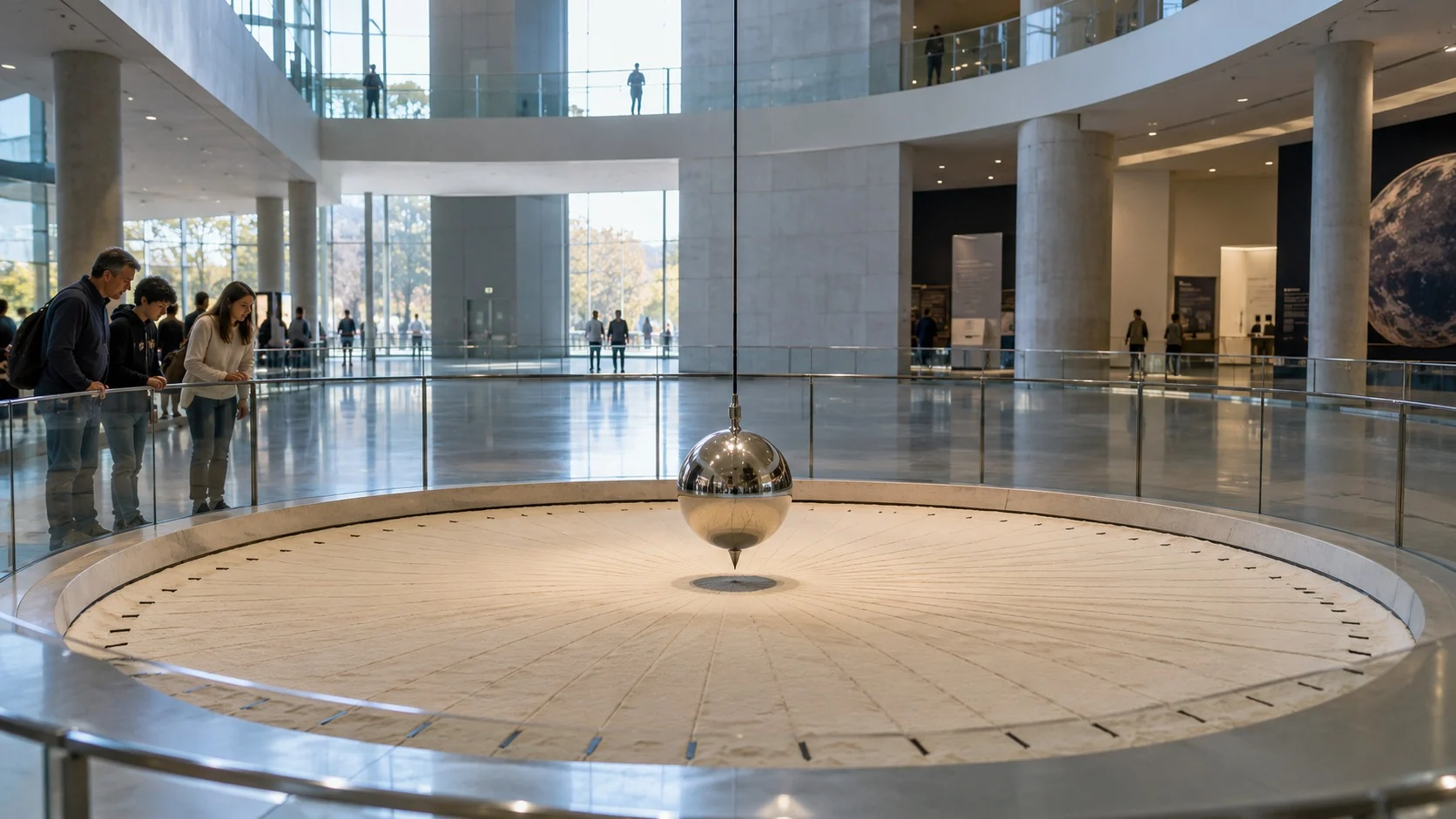
Foucault Pendulums still swing today in science museums, universities and public buildings around the world. Actually building one, however, is trickier than you might think.
How to Keep a Pendulum Swinging for a Long Time
- Air Resistance: Because the swing shrinks little by little as the bob pushes against the air, the bob is made heavy and smooth.
- Elliptical Motion: If the bob is nudged slightly sideways at release, it traces a stretched-out circle and turns in the wrong way, so in the past the bob was tied with a thread and released quietly by burning through the thread.
- Electromagnetic Drive: In today's display pendulums, an electromagnet in the floor gives the bob a slight push each time it passes, keeping it swinging at the same size all day long.
The original bob used at the Panthéon was moved to the Musée des Arts et Métiers in Paris for display, but in 2010 its wire snapped and it fell, causing serious damage.
Without complex telescopes or calculations, the Foucault Pendulum showed with just one wire and one bob that the ground we stand on never stops turning. A rotation that had only been inferred from the motions of the stars and the Sun could now be confirmed by anyone through marks in the sand.
The vast motion hidden in a slow swing reveals itself only to those who watch patiently. Patiently observing what seems obvious is the first step in science toward discovering the hidden order of nature.