Have you ever seen unfamiliar names such as “EDTA” or “iron chelate” on a detergent ingredient list or the back of a fertilizer bag? Some molecules grab metal ions dissolved in water and hold them so tightly that they can no longer move freely, and in chemistry a compound in which a metal is held this way is called a chelate.
A chelate is, simply put, “a ring-shaped compound in which one molecule wraps a single metal ion with several arms, like a claw.” The name was first used in 1920 by the British chemists Gilbert T. Morgan and H. D. K. Drew, who took it from the Greek word chēlē, meaning the large claw of a crab or lobster.
In this article we will look in turn at the name and structure of chelates, the chelate effect that makes binding at several points stronger, chelates in our bodies and in nature, and chelates used in daily life and medicine.
Molecules That Wrap Metal Ions in a Ring: The World of Chelates
1. A Name from a Crab’s Claw: The Structure of a Chelate
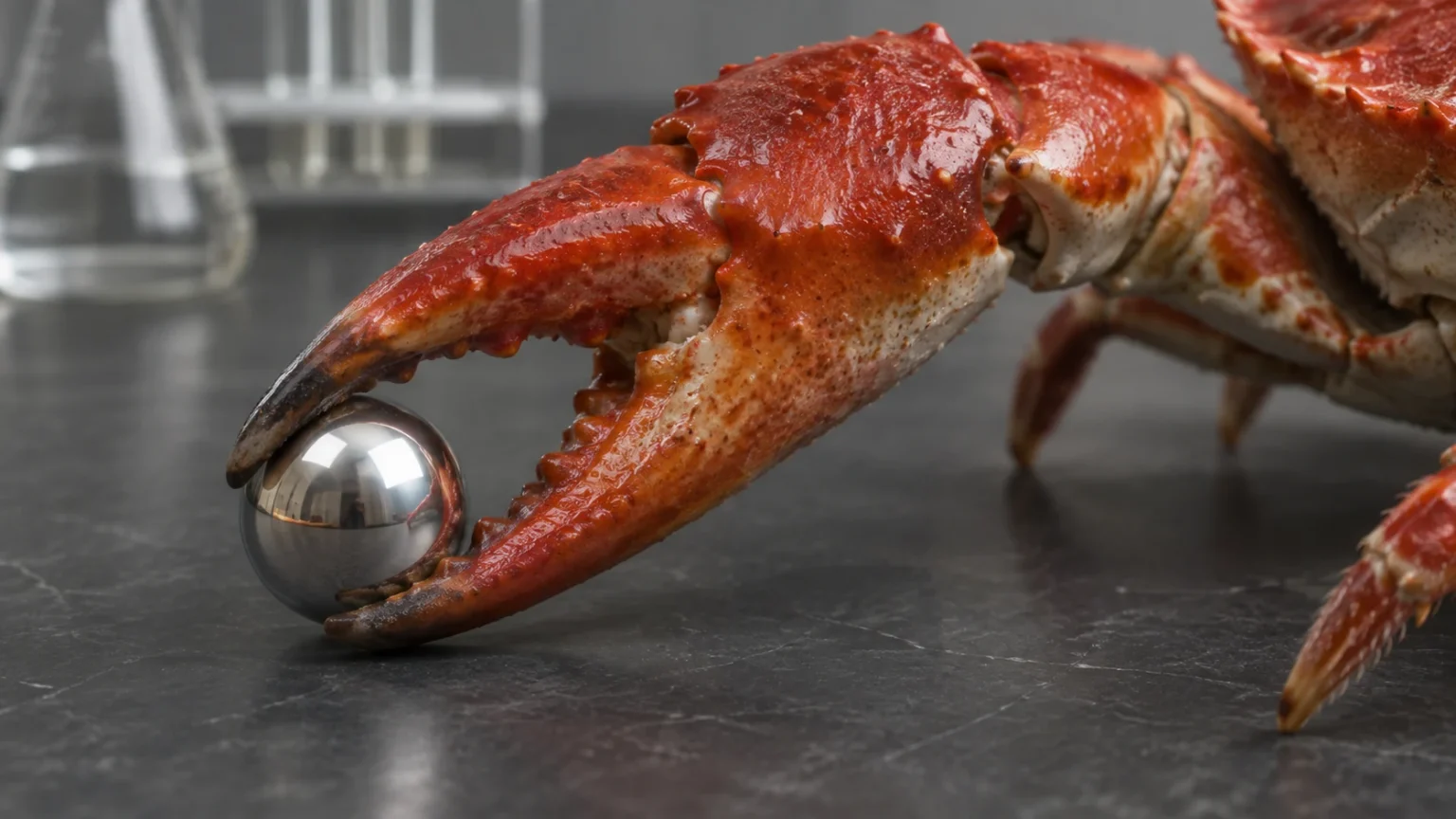
Metal ions tend to bond by accepting electron pairs from nearby molecules. A molecule or ion that donates an electron pair and attaches to a metal is called a ligand, and whether a chelate forms depends on how many points the ligand uses to hold the metal.
(1) Ligands and coordinate bonds
A ligand bonds to a metal ion through atoms that carry electron pairs, such as nitrogen or oxygen. A bond in which one side supplies both electrons is called a coordinate bond, and water molecules and ammonia also attach to metal ions this way.
(2) One point or many points
A ligand that attaches at only one point, like ammonia, is called a monodentate ligand, while one that attaches at two or more points, like ethylenediamine, is called a polydentate ligand. A chelate forms exactly when such a polydentate ligand holds a single metal.
(3) How the ring forms
When a polydentate ligand grips a metal with two arms, the metal and the ligand’s atoms link up into a ring. Ethylenediamine forms a five-membered ring together with the metal, and this ring looks just like a claw holding an object.
2. Once It Grips, It Rarely Lets Go: The Chelate Effect
Even when the same kinds of atoms attach to a metal, a ligand that grips with several arms at once binds far more tightly than ligands that attach one by one. This is called the chelate effect.
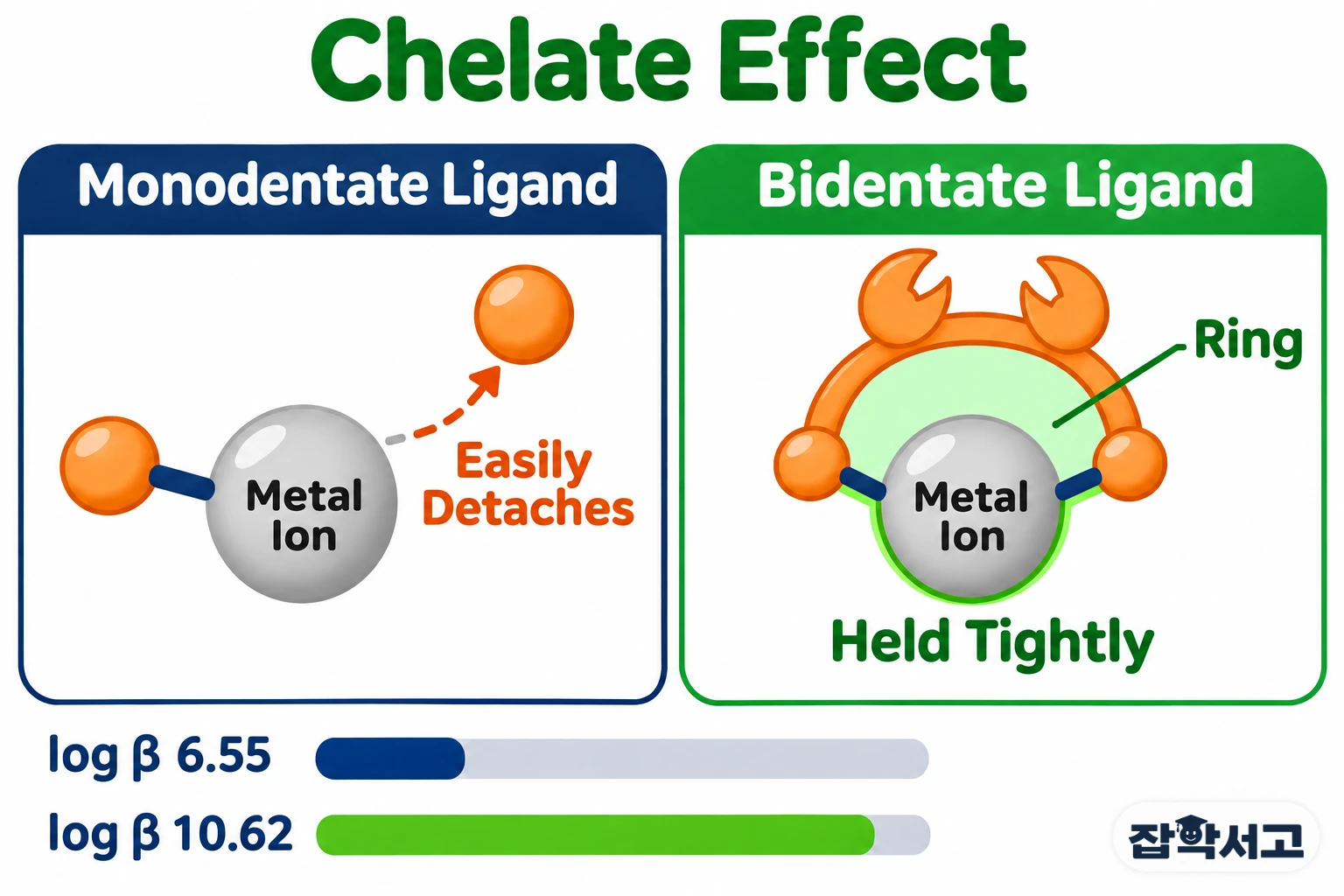
- Ligand: A molecule or ion that bonds to a metal ion by donating an electron pair.
- Polydentate ligand: A ligand that can attach to one metal at two or more points at the same time.
- Chelate effect: The tendency of polydentate ligands to form more stable compounds with metals than monodentate ligands do.
(1) Similar bond strength, yet
If we compare two methylamine molecules binding to a cadmium ion with one ethylenediamine molecule binding to it, the heat released by bonding (the enthalpy change) is almost the same. Even so, the logarithms of the stability constants are 6.55 and 10.62, so the chelate is more than 10,000 times more stable.
(2) The difference lies in entropy
When the water molecules attached to the metal are released, a bidentate ligand occupies two positions with a single molecule, so the number of particles in the solution decreases less. The side that loses less disorder (entropy) is favored, so the chelate forms more easily.
(3) One arm loosens, the other holds
Even if one arm of a chelate briefly comes off, the other arm still holds the metal, so it can easily rebind. That is why a chelate can keep holding a metal ion for a long time without losing it, even in a dilute solution.
3. Chelates Hidden in Blood and Leaves

Chelates are not made only in the laboratory. Living things have long used chelate structures to keep essential metals in place.
(1) Heme in the blood
The hemoglobin in red blood cells contains heme, in which a ring molecule called porphyrin holds an iron ion from four directions. Because this iron binds oxygen, blood can carry oxygen throughout the body.
(2) Chlorophyll in leaves
Plant chlorophyll also has a structure in which a porphyrin-like ring holds a magnesium ion at its center. This ring absorbs light and opens the first step of photosynthesis.
(3) Iron hunters among microbes
Many bacteria release chelating molecules called siderophores, which grab iron from their surroundings before being taken back in. Enterobactin is a typical example, and this is how they survive where iron is scarce.
4. From Detergents to Antidotes: Chelates in Daily Life and Medicine

The ability to pick out and hold metal ions is widely used in daily life, industry and medicine. The key is to bind and remove unwanted metals while delivering needed metals in dissolved form.
(1) Detergents and fertilizers
Citric acid and EDTA in detergents grab calcium and magnesium ions in hard water and reduce soap scum. In fertilizers, EDTA holds trace elements such as iron, zinc and copper in dissolved form so that they reach plants instead of settling out when they meet phosphate.
(2) Heavy-metal detoxification
Chelation therapy binds toxic metals in the body into chelates and flushes them out in the urine. Calcium disodium EDTA is approved by the U.S. Food and Drug Administration (FDA) for treating severe lead poisoning, and dimercaprol was first synthesized in 1940 by researchers at the University of Oxford as an antidote to the arsenic-based war gas lewisite.
(3) MRI contrast agents
Gadolinium ions make MRI images clearer, but on their own they are toxic. That is why gadolinium is wrapped tightly by a ligand with many arms, such as DTPA, and used as a contrast agent in chelate form. The simple idea that something held by many arms is hard to drop is the first step toward understanding chelates.