Scenarios are important tools that play a central role in various fields. They are widely used not only in films, television dramas, and theater, but also in areas such as business strategy simulations. Writing a scenario involves more than simply listing events; it means constructing a story with a logical, systematic structure to achieve a specific purpose.
This material covers the basic concepts and definitions of scenarios and explains the essential elements and methods of structuring an effective scenario. It also discusses in detail how to review and revise a completed scenario. Through this material, readers will gain an in-depth understanding of the importance of scenario writing and specific ways to approach it.
What Is a Scenario: Basic Concepts and Definitions
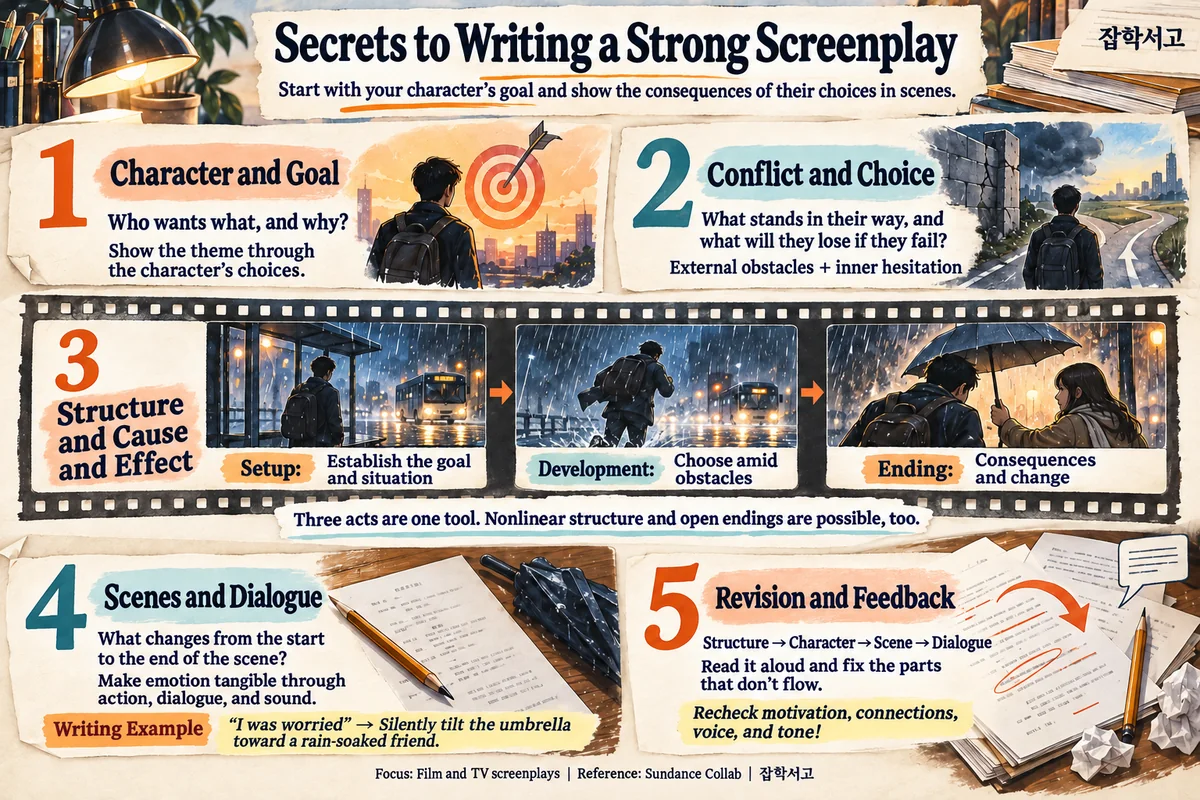
What Is a Scenario: Basic Concepts and Definitions
A scenario is a narrative structure that systematically organizes and presents the progression of events. Although it is familiar in the form of scripts commonly used in films and television dramas, it can also serve as a blueprint for developing business strategies or be adapted in various ways as a learning tool in educational settings. Thus, although scenarios take different forms to suit each field, they share the characteristics of arranging events chronologically and clarifying cause-and-effect relationships.
The key to scenario writing lies in setting clear goals. Rather than merely listing events, a scenario helps events unfold around a theme that readers or viewers need to understand. To achieve this, the writer must plan thoroughly so that the entire story maintains a coherent flow. This process lays the foundation for readers to become immersed in the story and understand its message deeply.
Elements of a Scenario: Characters and Conflict
Characters and conflict are among the core components of a scenario. Characters are the main figures who drive the story and allow readers or viewers to connect with it emotionally. Conflict acts as an important driving force that heightens tension and advances events. The course of the story is determined by how characters change through conflict and what choices they make. These elements bring the story to life and play an important role in helping readers or viewers become immersed in it.
The Structural Definition of a Scenario
From a structural perspective, a scenario must clearly distinguish the beginning, middle, and end of events. These three elements must work in harmony for the story to function as a complete narrative. The beginning establishes the situation that readers or viewers need to understand, the middle intensifies the conflict, and the end concludes by resolving all events. This structural definition helps a scenario move beyond a list of ideas to become a complete story.
Uses of Interactive Scenarios
Scenarios can include interactive elements. In particular, in business simulations and educational scenarios, users shape the story by directly participating in decisions. These interactive scenarios encourage user participation and play an important role in maximizing learning effectiveness. For example, a scenario may proceed in a way that allows a user's decision in a particular situation to influence the story and produce a different outcome accordingly. This shows that scenarios can go beyond simple reading materials to serve as tools that provide practical experiences.
The Diversity and Practical Value of Scenarios
A scenario is more than a simple story. It is a powerful tool that explains complex concepts in accessible ways and presents methods for achieving specific goals, making it widely useful across many fields. Scenarios fulfill their roles in various areas, including business strategy development, curriculum design, and content planning, helping users reach their goals more efficiently.
Essential Elements and Structure for Scenario Writing
Several essential elements must be considered when writing a scenario. These elements are central to determining the scenario's direction and overall quality.
Establishing a Clear Theme
The most fundamental and important element of a scenario is establishing its theme. The theme determines the scenario's overall direction and defines what readers or viewers will feel and gain from the story. It must remain consistent throughout the scenario and be closely connected to every component of the story. This provides an important foundation that both maintains the story's natural flow and gives the scenario unity.
Developing Strong Characters
Characters form the central axis of a scenario. The characters who drive the story are themselves important vehicles for establishing an emotional connection with readers or viewers. Each character must have individual goals and conflicts, and their growth and changes create important turning points in the story. The more realistic and multidimensional the characters are, the more deeply readers can become immersed. The situations they face and their resulting actions greatly influence the scenario's development, and these actions and decisions ultimately drive the story forward.
Conflict and Problem Solving
Conflict is the central driving force of a scenario. It consists of external or internal obstacles that characters face, and the process of overcoming them becomes the scenario's main content. Without conflict, a story can easily lose its appeal, and its development lacks tension. By establishing strong conflict and developing the process of resolving it, a scenario therefore gives readers a sense of immersion. Conflict creates the climax, and the subsequent resolution of problems gives readers or viewers a sense of satisfaction.
Establishing the Setting in Time and Space
The setting is an important element that determines a scenario's atmosphere and tone. The story's temporal and spatial settings greatly influence the characters' actions and the development of events, giving the story logical coherence and plausibility. For example, the historical period or geographical environment in which events occur can impose many constraints on characters' behavior and decisions or expand their possibilities. The writer must therefore consider these settings very carefully and structure them so that they blend naturally into the story and give readers a sense of realism.
Dialogue and Narration
Dialogue and narration play important roles in bringing a scenario to life. Through interactions between characters, dialogue reveals their personalities and relationships and adds variety to events. Narration complements dialogue by explaining the context of events and conveying the story's meaning. If dialogue and narration do not flow naturally, readers find it difficult to focus on the story. These elements must therefore be structured consistently and clearly within the scenario, providing readers with clear information without disrupting the story's flow.
Scenario Format and Structure
Scenarios generally follow a particular format and structure. This makes the story easier for readers to understand and helps communicate information efficiently. Each scene must have a clear purpose and develop in a way that contributes to the progression of events. The writer must carefully plan the arrangement of scenes and how they unfold. This allows the scenario to have a systematic, logical structure as a complete story.
How to Write Effective Scenarios

A Systematic Approach to Writing Effective Scenarios
Writing an effective scenario requires several stages, starting with a simple idea and progressing through detailed plot construction, character development, visual elements, and dialogue writing. This entire process must be guided by systematic, thorough planning, and repeated review and revision are essential to improving the scenario's overall quality.
Clarifying Ideas: Creative Thinking and Development
The first step in scenario writing is clearly organizing ideas. After freely gathering a variety of ideas through brainstorming, the writer must identify the central theme and message. What matters at this stage is not simply finding an interesting theme, but clarifying the story's purpose. Because a scenario conveys specific emotions, thoughts, or lessons to readers or viewers, its goal must be clear from the outset for the story to flow consistently. During this process, ideas need to be both creative and concrete, and they must be examined from various perspectives.
For example, if the theme is simply defined as "courage," the writer must specify which character will demonstrate courage and in what situation. This stage establishes the story's broad framework, and the subsequent details also develop within that framework.
Plot Construction: The Flow of Events and Structural Completeness
Once the idea is clear, it must be developed into a specific plot. The plot forms the backbone of the story, and constructing it involves arranging events chronologically and planning how each event will connect with the others. Plot construction must clearly distinguish the story's beginning (introduction), middle (development), and end (conclusion), and design the conflicts and processes of resolution that occur at each stage.
In particular, plot construction must clarify the cause-and-effect relationships between events. The logical connection in which event B occurs because event A has taken place is important. If the story unfolds randomly or proceeds illogically, it interferes with readers' immersion. The plot needs a progression in which tension gradually builds toward the climax and all conflicts are resolved in the conclusion. This allows readers to become naturally absorbed in the story's flow.
Character Development: Multidimensional, Realistic People
Characters are at the center of a scenario's story. The story comes to life only when its characters are portrayed vividly and with multiple dimensions. Each character must have a distinct personality, goals, and conflicts. The effects of their internal motivations and external actions on the story must also be established in detail. Characters' goals and the conflicts that arise in the process of achieving them become important driving forces in the scenario's development.
For example, the process of a protagonist confronting obstacles to achieve a particular goal encourages readers or viewers to empathize with the character. In addition, supporting characters, as well as the protagonist, must have their own distinct roles and personalities for the story to develop with depth. Each character must be more than a figure who merely supports the protagonist's narrative; they must have an independent story of their own.
Natural Dialogue and Narration
Dialogue is an important tool for revealing characters' personalities and giving concrete shape to the development of events in a scenario. Dialogue between characters must be realistic and natural, reflecting each character's manner of speaking and personality. It plays an important role not only in explaining events, but also in showing conflict, tension, and relationships between characters. Dialogue must also be effective in advancing events or creating an atmosphere.
Narration supplements dialogue, explaining the context of events and revealing a scene's atmosphere or a character's inner thoughts and feelings. Dialogue and narration must work in harmony, effectively conveying necessary information while avoiding unnecessary explanations as the story develops.
Visual Description and Stimulating the Imagination
A scenario consists of more than words alone. Visual elements stimulate readers' or viewers' imaginations and make the story more vivid. The setting of a scene, characters' appearances and actions, and the environment in which events occur must all be capable of being pictured visually. During this process, it is important to use specific, clear descriptions to help readers or viewers easily picture scenes in their minds.
For example, if the protagonist is in a dark, tense environment, detailed descriptions are needed to convey that atmosphere vividly. Rather than simply writing "a dark room," a specific description such as "a quiet room where dust floats in the faint light coming through the window" stimulates the reader's imagination.
Feedback and Repeated Revision
Finishing the writing of a scenario does not mean the work is complete. Receiving feedback and improving the scenario through repeated revisions are essential parts of the process. Listening to other people's opinions and identifying weaknesses in the scenario are very important for improving its overall quality. The writer must also review it several times independently, carefully checking the story's flow, character development, the naturalness of dialogue, and other aspects. Revising based on feedback is a process that improves the scenario's overall quality and creates a more powerful story.
The Importance of Reviewing and Revising Scenarios

Reviewing and revising a completed scenario is an important stage that determines the quality of the final result. At this stage, the scenario's flow, characters, dialogue, visual descriptions, and tone and style must be examined closely, allowing its quality to be improved further.
Reviewing the Overall Structure and Flow
The first important review process is examining the scenario's overall structure and flow. The writer must check whether scenes connect logically and consistently and whether events develop naturally. What matters here is that every scene must have a clear purpose and be structured in a way that contributes to the story's development. The overall flow must be reviewed carefully to prevent the scenario from going off track midway or developing logical errors.
Checking Character Consistency and Psychological Depth
Second, the development of the characters must be checked. The writer must examine whether each character adequately fulfills their role in the story and whether their actions and decisions contribute appropriately to the development of events. Characters' psychological depth and consistency are particularly important. Their personalities and internal motivations must be reviewed carefully to make them feel realistic, and revisions must ensure that the conflicts and changes they experience connect logically. Clearly revealing each character's individuality and purpose is essential to helping readers or viewers become emotionally invested in them.
Reviewing the Naturalness and Effectiveness of Dialogue
Third, the naturalness of dialogue must be checked. Dialogue is more than a means of communicating information; it is an important element that expresses characters' personalities and emotions and advances the story. The writer must check for forced or unnecessary dialogue and examine whether each character's voice and manner of speaking remain consistent. If necessary, dialogue must be revised so that it communicates more clearly and effectively. This is because dialogue is an important tool not only for developing events, but also for revealing relationships and conflicts between characters more vividly.
Checking Visual Descriptions and Environmental Settings
Fourth, visual descriptions and environmental settings must be checked. Visual elements play an important role in helping readers or viewers become immersed in the story. Scene settings, characters' actions, and the environments in which events occur must all be portrayed specifically and vividly. Because insufficient visual description makes it difficult for readers to imagine scenes clearly, the writer must check whether the descriptions are sufficiently clear and detailed. This allows readers to become more deeply immersed in the story.
Checking the Overall Tone and Style
Fifth, the scenario's overall tone and style must be checked. It is important to verify whether the story's theme and message are clearly expressed and whether the scenario maintains a consistent atmosphere. This directly influences the emotions and atmosphere that readers or viewers experience through the scenario. If the overall tone and style are inconsistent, the story can become unfocused or cause confusion, so they must be reviewed carefully.
Revising and Refining Through Feedback
Finally, it is important to use external feedback. Feedback provides an opportunity to look objectively at aspects that the writer may overlook. Outside opinions can help clearly identify the scenario's strengths and weaknesses, providing a basis for addressing shortcomings and further highlighting strengths. Revising the scenario by actively incorporating feedback is an important stage that greatly improves the work's overall quality.
Scenario writing is a complex and creative task that requires clear goals and systematic planning. This material has explored the basic concepts and core elements of scenarios, writing methods, and the processes of review and revision.
A scenario completed through these processes can go beyond a simple story to serve as a powerful tool in various fields. We hope that this material helps readers develop a deep understanding of scenario writing and a practical approach to it.