Learning theories are an important element that forms the foundation of education as a field of study, aiming to explain human learning processes and thereby propose effective teaching methods. Learning theories have developed over time through the work of various scholars, and these theories are applied in a variety of ways in educational settings.
This material provides an in-depth introduction to the historical development and key concepts of learning theories and examines their modern interpretations and applications in detail. It also systematically analyzes how each learning theory is applied in educational settings and its effects, and further examines the directions and challenges of learning theories for future education. Through this, it aims to suggest ways for educators and learners to approach learning effectively.
The History of Learning Theories: An Introduction to Their Development and Key Concepts
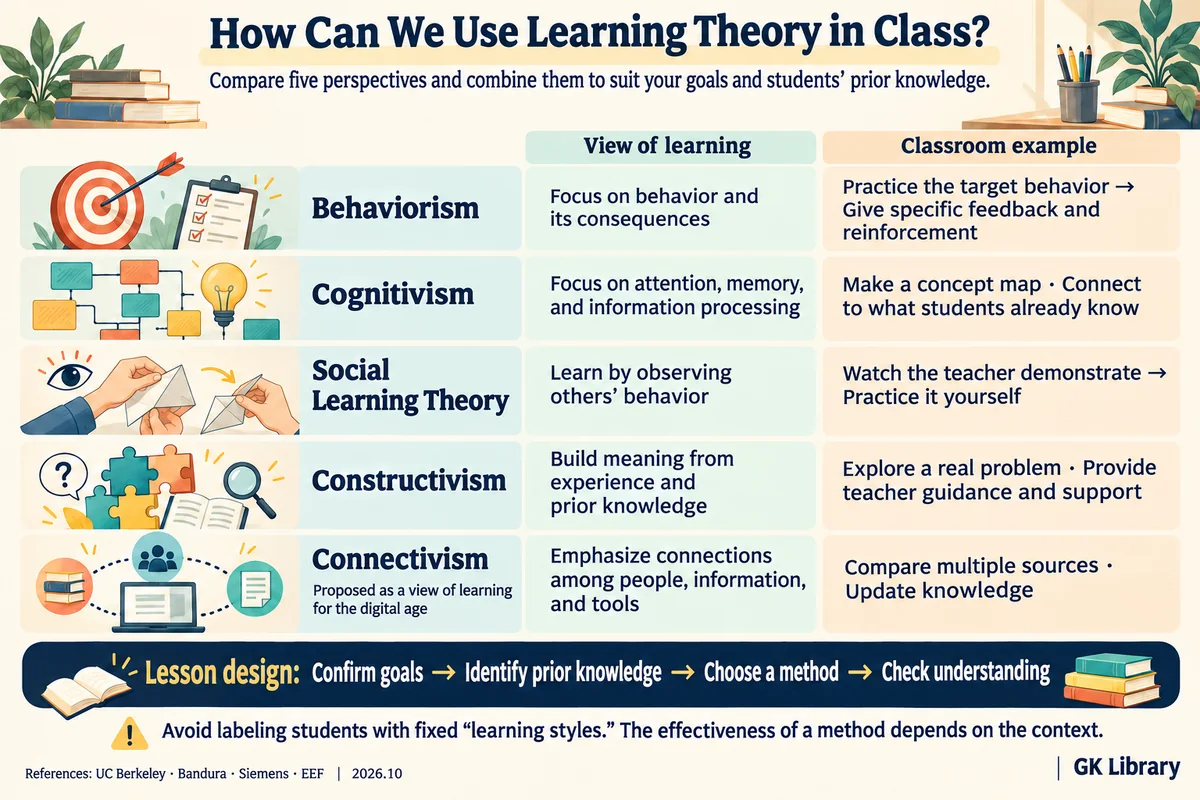

Behaviorist Learning Theory
Learning theories began to be systematically organized in earnest alongside the development of psychology in the late 19th century. Early learning theories were primarily based on behaviorism, with the research of John Watson and B.F. Skinner serving as prominent examples. Behaviorism viewed learning as a chain of stimuli and responses and used reinforcement and punishment to enhance the effectiveness of learning. These theories were usefully applied in educational settings to regulate students' behavior and develop desirable attitudes toward learning.
Cognitivist Learning Theory
In the mid-20th century, cognitivism emerged, adding a new perspective to learning theories. Cognitivism regarded learning as a process of information processing and focused on human thought processes, memory, problem-solving abilities, and related aspects. Jean Piaget's theory of cognitive development emphasized that teaching methods should vary according to learners' stages of cognitive development, thereby helping learners experience learning suited to their individual developmental levels. This approach made a significant contribution to effectively developing students' thinking and problem-solving abilities.
Social Learning Theory
Social learning theory was developed by Albert Bandura and emphasized the importance of learning through observation and imitation. Bandura argued that people learn through the process of observing and imitating others' behavior, which was particularly useful in explaining learning in social environments. This theory played an important role in providing opportunities for students to learn by observing and imitating one another's behavior in the classroom. Social learning theory also contributed to increasing learners' motivation and self-efficacy.
Constructivist Learning Theory
Learning theories subsequently developed into constructivism. Constructivism understands learning as an active process in which learners construct knowledge themselves and views educators as supporting learners in this process. Rooted in the theories of John Dewey and Lev Vygotsky, constructivism was reflected in teaching methodologies such as cooperative learning and problem-based learning. Constructivist approaches create learner-centered educational environments that allow students to experience in-depth learning through the process of solving real-world problems. This plays an important role in learners' construction of new knowledge based on their own experiences and prior knowledge.
Connectivist Learning Theory
Recently, new learning theories suited to the digital age have been emerging. Connectivism argues that information is connected through online networks and that learning takes place through these connections. This plays an important role in developing a new understanding of the nature of learning in modern society, where digital devices and the internet have become widespread. Connectivism emphasizes environments in which learners connect with diverse information sources and engage in self-directed learning based on these connections, providing a theoretical foundation for learning through online learning platforms and social media.
As such, learning theories have continued to develop in response to changes in the times and social environments, with each theory explaining the learning phenomena of its time and providing various methodologies for improving them. This process of development forms the foundation of education as a field of study today and will continue to play an important role in educational settings.
Modern Interpretations and Applications of Major Learning Theories

Modern Applications of Behaviorist Learning Theory
Behaviorist learning theory, which reinforces learning through patterns of stimuli and responses, remains widely used in many educational settings. It is particularly effective in behavior modification programs and foundational education, playing an important role in encouraging students to repeat specific behaviors. For example, many programs reinforce correct behavior and increase learning motivation by providing praise or rewards to students who answer questions correctly. This approach contributes greatly to improving concentration and developing positive attitudes toward learning, particularly in elementary education.
Modern Interpretations of Cognitivist Learning Theory
Cognitivist learning theory focuses on gradually developing thinking abilities through educational programs tailored to students' stages of cognitive development. A key approach is to develop problem-solving abilities by providing tasks suited to students' levels. Methods that enable students to evaluate and regulate their own learning processes through metacognitive strategies are also emphasized. This approach greatly helps students engage more actively in learning and develop learning methods tailored to their own learning styles. In modern education, metacognitive strategies have become a key element in strengthening self-directed learning abilities.
Modern Applications of Social Learning Theory
Based on the concept that learning takes place through observation and imitation, social learning theory is applied in cooperative learning, programs to enhance self-efficacy, and other settings. For example, group activities and team projects provide opportunities for students to learn by observing and imitating one another's behavior. Through this, students can develop problem-solving abilities in a collaborative learning environment and maximize the effectiveness of learning through interactions with their peers. Programs to enhance self-efficacy also help students believe in their abilities and maintain a positive attitude during the learning process.
Modern Applications of Constructivist Learning Theory
Constructivism places importance on the process through which learners construct knowledge themselves, and examples of its application can be found in project-based learning (PBL) and problem-based learning (PBL). Students construct new knowledge while solving real-world problems, thereby experiencing in-depth learning. These learning methods are used particularly effectively in science, technology, engineering, and mathematics (STEM) education, contributing to the enhancement of students' creative thinking and problem-solving abilities through the resolution of real-life problems. Constructivist approaches provide learner-centered educational environments that encourage students to take an active role in their learning.
The Use of Connectivism in the Digital Age
Connectivism is a learning theory that places importance on connections between information and learners in digital learning environments. Through online learning platforms and social media, learners can access various resources and construct new knowledge based on them. Connectivism plays a particularly important role in distance education and lifelong learning, providing a suitable theoretical framework for learners to find the information they need themselves and use it to continue learning. In self-directed learning environments that use digital devices, connectivism plays an important role in increasing the flexibility of learning and expanding learners' learning experiences.
Methods and Effects of Applying Learning Theories in Educational Settings

Using Reward Systems in Behaviorist Learning Theory
Behaviorist learning theory is frequently used in educational settings to motivate students to learn through systematic reward systems. Teachers present clear goals and reinforce the effectiveness of learning by providing immediate feedback and rewards when students achieve them. For example, students can be motivated to learn by receiving praise or an increase in their scores each time they answer a question correctly. This approach is particularly effective in foundational learning that requires repeated practice or in the process of learning rules. By focusing on reinforcing specific behaviors, behaviorism creates an environment in which students can expect clear outcomes and continue learning.
Applying Instructional Strategies from Cognitivist Learning Theory
Cognitivist learning theory proposes various instructional strategies to support students' cognitive processes. Teachers help students connect new information with existing knowledge and facilitate understanding by presenting learning content through visual materials or in a structured form. An important part of this process is metacognitive activities that enable students to reflect on and regulate their own learning processes. Through these activities, students can receive support in understanding learning content more deeply and transferring it into long-term memory. For example, commonly used methods include breaking complex concepts into simple steps when presenting them or visually representing relationships between concepts to stimulate students' thinking.
Cooperative Learning and Modeling in Social Learning Theory
Social learning theory emphasizes the process through which students learn by observing and imitating others' behavior. Cooperative learning and group activities are frequently used to put this into practice in educational settings. Students can expand their thinking by exchanging opinions and engaging in discussions within their groups. They can also learn the behaviors needed in specific social situations through activities such as modeling and role-playing. These approaches are effective in developing students' social skills and ability to cooperate, and they also contribute to improving learning outcomes through teamwork. Teachers appropriately coordinate these cooperative processes to support students in learning through interactions with one another.
Project-Based Learning in Constructivist Learning Theory
Constructivism emphasizes the active process through which learners construct knowledge themselves and is frequently implemented in educational settings through project-based learning or inquiry-based learning. Students investigate various materials to solve real-world problems and analyze them to develop new knowledge. In this process, teachers support students in learning autonomously and provide the necessary materials and tools. For example, conducting inquiry activities on a particular topic and having students present their results is a constructivist approach. These learning methods play an important role in developing students' critical thinking and self-directed learning abilities.
Applying Connectivism in Digital Learning Environments
Connectivism emphasizes learning in digital learning environments and plays an important role in online learning and network-based learning environments. Students use the internet and digital devices to search for the information they need and build their own learning systems based on it. In this process, teachers provide the materials students need at the appropriate time and create environments in which they can learn through digital networks. The learning model of connectivism is particularly effective in distance learning and self-directed learning. By providing flexible environments in which students can learn anytime and anywhere, it is possible to offer learning experiences suited to the digital age.
The Educational Value and Effects of Learning Theories
Applying various learning theories contributes to increasing students' motivation to learn and their levels of achievement. When used appropriately for specific educational situations, each theory can provide learners with an optimal educational experience. This improves the quality of education and creates an environment in which learners can realize their individual potential to the fullest.
Directions and Challenges of Learning Theories for Future Education

The Need for Integrated Learning Theories in Future Education
In future education, an integrated approach that combines various learning theories to provide education tailored to learners' individual characteristics, without relying on a single learning theory, will become important. Learners have different backgrounds and learning styles, and personalized education that takes these into account is needed. Existing learning theories, such as behaviorism, cognitivism, and constructivism, should be combined cohesively to propose educational approaches optimized for various situations and environments. Integrated approaches to learning contribute to maximizing the effectiveness of learning by providing students with richer and more comprehensive learning experiences.
The Importance of Digital Technology and Connectivism
With the arrival of the digital age, the importance of connectivism, which emphasizes the spread and connection of information, is growing by the day. In digital learning environments, learners must develop the ability to access various information sources through the internet and construct new knowledge based on them. Future education requires methods for effectively using these digital learning environments, and through them, it is important to cultivate learners' ability to explore information independently and learn by making connections. Connectivism is particularly essential in supporting learners' active learning and self-directed learning in a changing information society.
The Development of Artificial Intelligence and Personalized Learning Environments
Creating personalized learning environments using artificial intelligence (AI) and machine learning technologies will be an important challenge in future education. Artificial intelligence can analyze learners' learning data and provide learning materials and feedback suited to their tendencies, levels, and needs. Through this, students can follow learning paths optimized for them, making education that meets individual learning needs possible. Educators should actively embrace these technologies and study and apply methods for integrating them effectively to enhance the effectiveness of learning.
Multicultural Learning Environments and Educational Equity
In a globalized society, the development of learning theories that consider multicultural perspectives is essential. In modern educational environments, where the number of learners from different cultural backgrounds is increasing, theories and methods should be developed to understand and support their learning processes and needs. This contributes to improving educational equity and accessibility, allowing students from different cultural backgrounds to enjoy equal learning opportunities. Education in multicultural learning environments should go beyond simply transmitting knowledge and focus on developing the ability to respect and understand diverse cultural perspectives.
The Need to Develop Learning Theories That Consider Emotions and Motivation
Learners' emotions and motivation profoundly affect the continuity and quality of learning. Positive emotions and high motivation give learners a strong drive to learn and make the learning process feel enjoyable and meaningful. Future education therefore requires new learning theories that take learners' emotional aspects into account. These theories help students develop an interest in learning on their own and gain a sense of achievement during the learning process. Through this, students can go beyond simply acquiring knowledge to find meaning in learning itself and continue learning.
Challenges for Future Education and the Direction of Learning Theories
Integrating and developing these various learning theories will be a key challenge in future education. Advances in digital technology, multicultural educational environments, and the introduction of learning theories that consider emotions and motivation will play important roles in improving the quality of education. Through these developments, it will be possible to meet the needs of individual learners and provide more effective educational experiences in changing educational environments.
Learning theories provide a fundamental framework for education and are essential in exploring ways to respond to various educational challenges. The development and application of learning theories make an important contribution to improving the quality of education and also play a major role in setting the direction of future education.
Learning theories will continue to develop and play an important role in providing students with the best possible educational experiences. Educators need to pursue educational innovation based on these learning theories and create optimal learning environments that respond to changes in educational settings.