Education is not simply about conveying knowledge; it is a complex process of bringing out students' full potential. Educational psychology plays an important role in this process.
Educational psychology provides the psychological principles and methods needed to understand interactions between learners and teachers and create effective learning environments.
This resource will begin with the basic concepts of educational psychology and explore learning theories, students' development and cognitive processes, effective teaching methods, and teachers' roles in detail.
It aims to explore how the principles of educational psychology can be used to improve the quality of education.
Basic Concepts of Educational Psychology
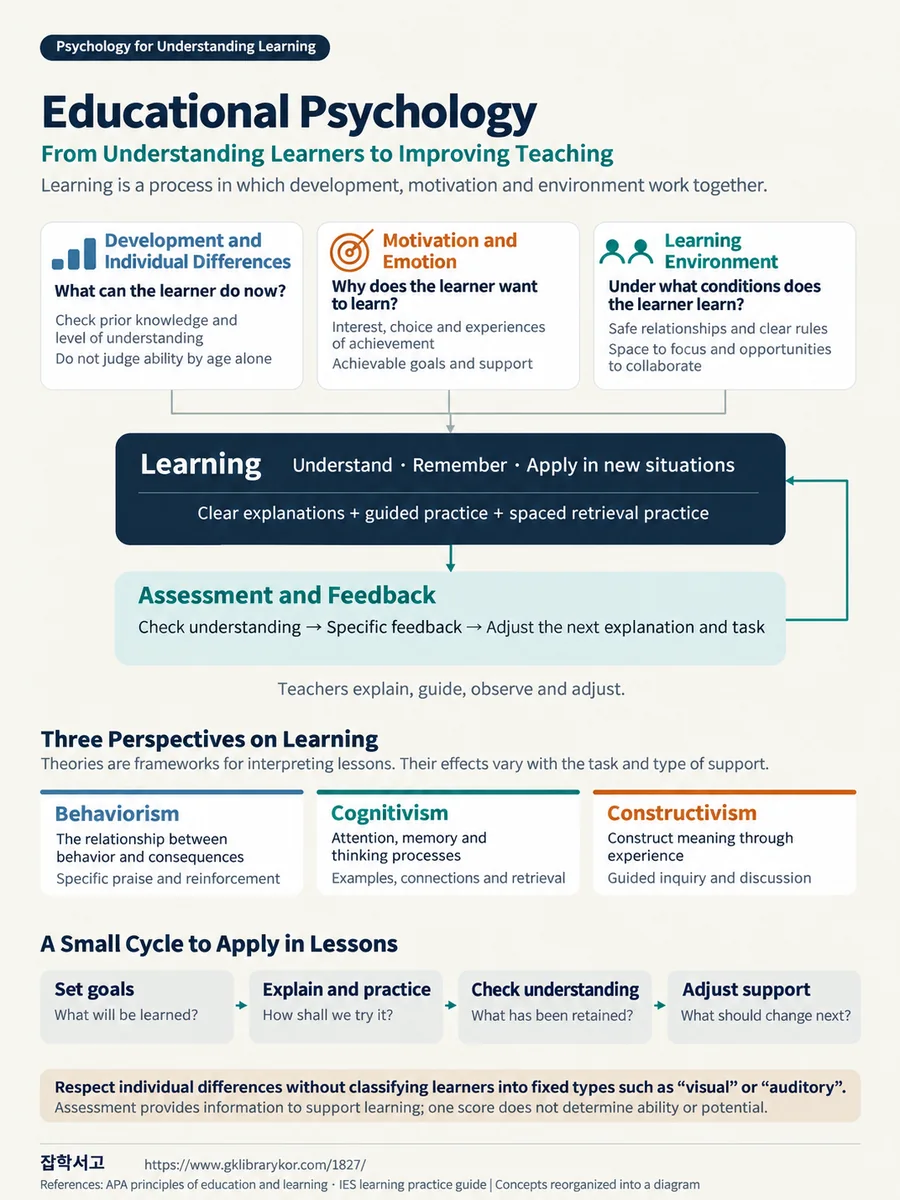
 What Are the Basic Concepts of Educational Psychology?
Educational psychology is a branch of psychology that studies and seeks to understand interactions between learners and teachers in the educational process.
This field aims to analyze students' learning processes and the various factors that influence them, and to use this analysis to develop more effective teaching methods. Its basic concepts include the following elements.
1. Definition and Purpose
Educational psychology is a discipline that seeks to improve the quality of education through a scientific understanding of learners and learning environments. Its main purpose is to find ways to optimize the learning process and maximize the effectiveness of education.
2. Major Theories
- Behaviorism views learning as the result of external stimuli and responses. Skinner's theory of operant conditioning is a representative example.
- Cognitivism views learning as taking place through internal mental processes, namely information processing and problem solving. The theories of Piaget and Vygotsky fall into this category.
- Constructivism holds that learners construct knowledge through their own experiences. This theory focuses on the process through which learners actively build knowledge.
3. Learner Characteristics
Educational psychology considers individual differences among learners, such as cognitive abilities, learning styles, motivation, and emotional states. These characteristics directly affect learning outcomes and are therefore important when designing effective teaching methods.
4. Educational Environment
The environment in which learning takes place is also an important factor. Both the physical environment, including classroom layout, lighting, and noise, and the social environment, including relationships between teachers and students and interactions among peers, influence learning.
5. Assessment and Feedback
Educational psychology also studies methods of assessing students' learning progress and providing feedback based on those assessments. Assessment and feedback play an important role in increasing students' motivation to learn and their achievement.
Educational psychology aims to understand learners and educational environments scientifically and use this understanding to develop more effective teaching methods. Research in this field greatly helps teachers understand students' learning processes and characteristics and provide tailored education based on that understanding.
Learning Theories and Motivation to Learn
 How Are Learning Theories Classified?
Learning theories and motivation to learn are among the central topics of educational psychology, helping us understand how and why students learn. This understanding allows teachers to develop effective teaching strategies and maximize students' engagement in learning.
Learning Theories
Learning theories offer various theoretical perspectives that explain the processes and methods of learning. Major learning theories include the following.
1. Behaviorist Learning Theory
- Basic concept: Behaviorism explains learning as the result of external stimuli and responses. Learning is reinforced or weakened by environmental factors.
- Key theorists: B.F. Skinner's theory of operant conditioning explains the process of shaping behavior through reinforcement and punishment. Ivan Pavlov's theory of classical conditioning is also included.
- Educational application: Rewards and punishments are used to reinforce or modify learning behaviors. For example, students are praised when they give the correct answer.
2. Cognitivist Learning Theory
- Basic concept: Cognitivism views learning as the result of internal mental processes, namely information processing and problem solving. Learners actively process information and develop understanding.
- Key theorists: Jean Piaget explains the learning process through stages of cognitive development, viewing learning as occurring gradually through these stages. Lev Vygotsky argues that social interaction plays an important role in learning.
- Educational application: Teaching methods are used that help learners solve problems and investigate on their own. Examples include inquiry-based learning and cooperative learning.
3. Constructivist Learning Theory
- Basic concept: Constructivism holds that learners construct knowledge through their own experiences. Learning is a process of constructing personal meaning.
- Key theorists: Jerome Bruner and John Dewey are representative theorists who emphasize that learning is an active and social process.
- Educational application: Teaching methods are used that encourage learners to solve real-world problems and construct knowledge through their own experiences. Examples include project-based learning and problem-based learning.
Motivation to Learn
Motivation to learn explains the reasons and desires behind why students learn. Motivation to learn can be divided into intrinsic motivation and extrinsic motivation.
1. Intrinsic Motivation
- Basic concept: Intrinsic motivation stems from interest in and enjoyment of learning itself. The learning activity itself serves as a reward.
- Educational application: Intrinsic motivation can be increased through activities that stimulate learners' interests and curiosity. For example, students can be encouraged to explore topics they choose themselves or carry out creative projects.
2. Extrinsic Motivation
- Basic concept: Extrinsic motivation is shaped by external rewards or punishments. Examples of extrinsic motivation include good grades, praise, certificates of recognition, and the desire to avoid negative outcomes.
- Educational application: Extrinsic motivation can be encouraged through test scores, reward systems, and competition. However, increasing intrinsic motivation is important in the long term.
Learning theories and motivation to learn are essential for understanding students' learning processes and the various factors that influence them. Teachers can use these theories and motivational factors to help students learn more effectively and develop positive attitudes toward learning.
Students' Development and Cognitive Processes
 Teaching Methods Appropriate to Development Are Needed.
Students' development and cognitive processes are important topics in educational psychology that explain how students learn and understand. These topics address how learning abilities and cognitive processes change according to students' ages and developmental stages.
Developmental Stages
Students develop physically, cognitively, socially, and emotionally. Here, we will examine major theories specifically related to cognitive development.
1. Jean Piaget's Theory of Cognitive Development
- Sensorimotor stage (ages 0-2): Children explore the world through their senses and movements and acquire object permanence, the concept that objects continue to exist even when they cannot be seen.
- Preoperational stage (ages 2-7): Children begin to think using language and images, but their logical thinking is limited. Egocentric thinking is characteristic of this stage.
- Concrete operational stage (ages 7-11): Logical thinking develops, and children can think logically about concrete objects and situations. They understand the concept of conservation.
- Formal operational stage (age 11 and older): Abstract and hypothetical thinking become possible. Children can solve complex problems logically.
2. Lev Vygotsky's Sociocultural Theory
Vygotsky argues that cognitive development occurs through social interaction. Language and culture play important roles in cognitive development.
- Zone of proximal development (ZPD): This refers to the range of tasks students cannot perform alone but can perform with an adult's help. Appropriate support and feedback are important.
Cognitive Processes
Cognitive processes are the ways students process and understand information. Major cognitive processes include attention, memory, and problem solving.
1. Attention
- This is students' ability to concentrate on learning activities and select relevant information. Attention is the first stage of learning and is essential for effective learning.
- Teachers should provide engaging materials and create an environment that minimizes distractions to help students focus their attention.
2. Memory
- This is the process of storing and retrieving learned information. Memory is divided into sensory memory, short-term memory (working memory), and long-term memory.
- Repeated study, summarization, and the use of visual materials can help students remember information effectively.
3. Problem Solving
- This is the process of identifying problems and finding solutions in new situations. It requires critical thinking and creative thinking.
- To develop problem-solving abilities, teachers should present problems related to real life and help students explore a variety of solutions.
Educational Applications of Development and Cognitive Processes
Understanding students' developmental stages and cognitive processes allows teachers to design more effective instructional strategies.
1. Applying Developmentally Appropriate Teaching Methods
Providing learning activities and materials appropriate to students' developmental stages helps them understand. For example, concrete examples and hands-on activities are effective for students in the concrete operational stage.
2. Promoting Social Interaction
Cooperative learning and discussions allow students to learn through interaction. According to Vygotsky's theory, interactions with peers can promote cognitive development.
3. Teaching Cognitive Strategies
Students are taught learning strategies to improve metacognition, the ability to recognize and regulate their own thinking processes. Examples include strategies such as planning, monitoring, and evaluating.
Understanding students' development and cognitive processes is essential for effective education. Based on this understanding, teachers can develop instructional strategies suited to students' developmental stages and cognitive characteristics to support learning more effectively.
Effective Teaching Methods and Teachers' Roles
 What Roles Should Teachers Fulfill?
Effective teaching methods and teachers' roles are essential for maximizing the effectiveness of students' learning and creating a positive learning environment. To achieve this, teachers should use various instructional strategies and serve as facilitators of learning and mentors.
Effective Teaching Methods
Effective teaching methods focus on increasing students' motivation to learn, improving understanding and memory, and developing critical thinking and problem-solving abilities. Major teaching methods include the following.
1. Direct Instruction
- Basic concept: This is a method in which teachers clearly present learning objectives, explain material step by step, and help students understand.
- Application: It includes clear explanations, examples, step-by-step demonstrations, feedback, and assessment. It is particularly effective when teaching new concepts or skills.
2. Inquiry-Based Learning
- Basic concept: This is a method in which students formulate their own questions and find answers through inquiry.
- Application: Teachers act as guides, supporting students as they investigate and solve problems. This includes project-based learning and experimental activities.
3. Cooperative Learning
- Basic concept: This is a method in which students work in small groups to learn together and support one another's learning.
- Application: It includes dividing tasks, emphasizing interdependence, assigning individual responsibility, and teaching social skills. Cooperative learning promotes learning through social interaction.
4. Differentiated Instruction
- Basic concept: This is a method of providing tailored education that considers students' diverse learning styles, abilities, and interests.
- Application: A variety of materials and activities are provided to suit students' learning needs, and learning is supported through individual feedback.
5. Metacognitive Strategies
- Basic concept: These are methods that help students recognize and regulate their own learning processes.
- Application: Students are taught strategies such as setting learning goals, self-monitoring, self-assessment, and planning. This helps students learn independently.
Teachers' Roles
Teachers should fulfill various roles that support students' holistic development, going beyond simply conveying knowledge.
1. Knowledge Provider
Teachers should convey learning content clearly and systematically. To do so, they need a deep understanding of the subject as well as effective communication skills.
2. Facilitator
Teachers should create an environment that enables students to learn on their own, provide the necessary resources, and support the learning process. They stimulate students' thinking through questions and guide the inquiry process.
3. Mentor
Teachers provide ongoing feedback and advice throughout students' learning processes to help them reach their full potential. Through personal attention and support, they increase students' motivation and self-esteem.
4. Manager
Teachers should manage the learning environment, guide students' behavior, and maintain order through rules and procedures. To create a positive learning environment, teachers should treat students fairly and consistently.
5. Role Model
Teachers should serve as positive role models for students. This includes enthusiasm for learning, ethical behavior, and social skills. Students learn to imitate learning attitudes and behaviors through their teachers.
6. Assessor
Teachers should assess students' learning progress and provide feedback on it. They use various assessment methods to evaluate students' achievement fairly and offer guidance for future learning.
Effective teaching methods and teachers' roles directly influence students' learning outcomes. Teachers should use various instructional strategies appropriately and support learning by considering each student's characteristics and needs.
Teachers should also help students learn in a self-directed manner and build positive learning experiences through their roles as facilitators, mentors, and role models. This approach will contribute to increasing students' motivation to learn and their achievement and promoting holistic development.
Educational psychology allows us to gain a deep understanding of the nature of education and effective teaching methods. Understanding learners' motivation and developmental processes and applying appropriate teaching methods based on this understanding enables students to participate more actively in learning.
Teachers can also use their knowledge of educational psychology to meet students' diverse learning needs and optimize learning environments to provide every student with opportunities to succeed.
Educational psychology goes beyond being an academic discipline; it is a powerful tool that can bring about practical changes for both teachers and students. We hope that the principles and methods presented in this resource will serve as a foundation for creating more effective and meaningful educational settings.