The influence of cryptocurrencies, particularly digital assets centered on Bitcoin and Ethereum, on global financial markets and economic structures is gradually expanding. These cryptocurrencies have the potential to replace existing financial systems, and many companies and governments are therefore paying attention to them.
This article will explore in depth the background and need for analyzing the economic impact of cryptocurrency, the major changes digital assets bring to financial markets, the advantages and disadvantages of cryptocurrency adoption for economic structures, and its future prospects.
The Background and Need for Analyzing the Economic Impact of Cryptocurrency
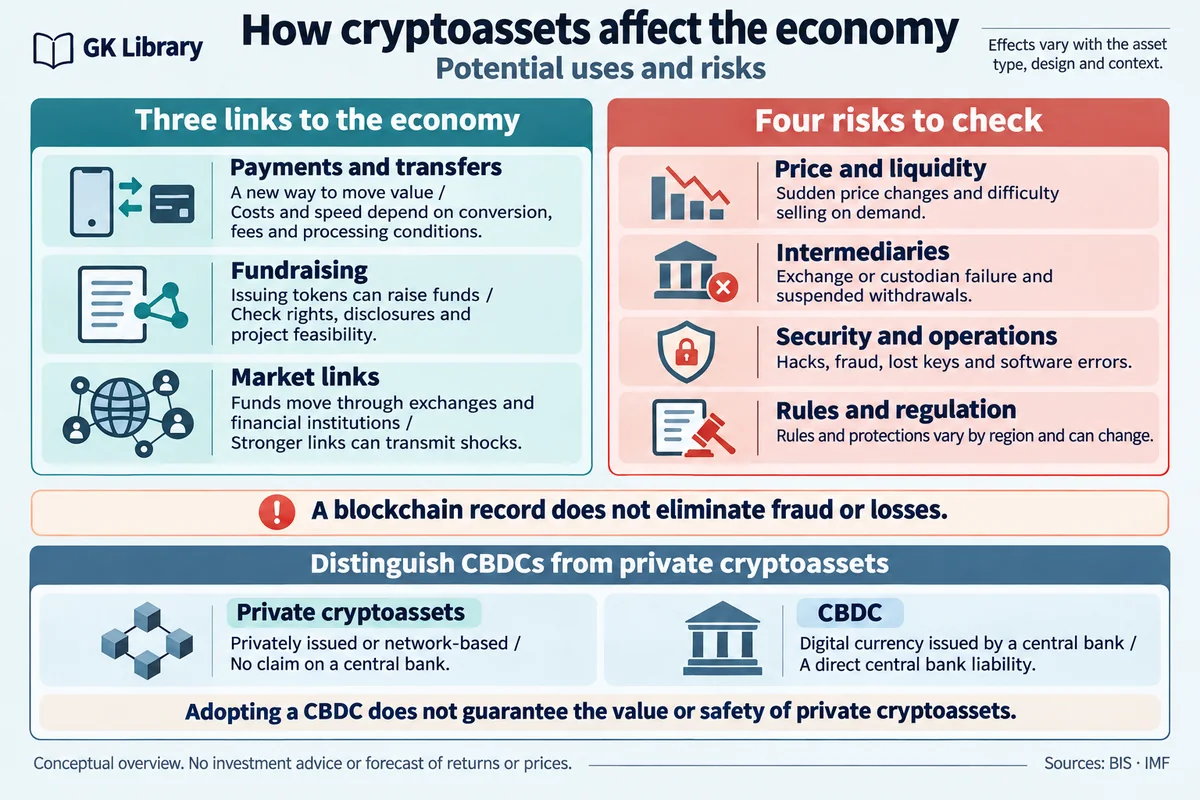

The Emergence and Importance of Cryptocurrency
Cryptocurrency began with the emergence of Bitcoin in 2009, and its influence gradually expanded as various altcoins subsequently appeared. Initially, it attracted attention only among technology enthusiasts and a small number of investors, but financial institutions and companies now recognize cryptocurrency as an important investment asset. This is the main background that has raised the need to analyze the impact of cryptocurrency on financial markets and economic structures. In particular, the unique structure and growth of cryptocurrency present both new possibilities and challenges for traditional financial systems.
Distinctions from Traditional Financial Systems
Cryptocurrency differs from traditional financial systems in that it is based on decentralized networks and allows transactions without the involvement of a central institution. This gives it the potential to address high transaction fees and delays in international money transfers. By simplifying the complex procedures of traditional financial systems and providing faster, cheaper ways to transact, it can bring innovative changes to the global economy.
Blockchain Technology and the Transparency and Security of Cryptocurrency
Blockchain, the core technology behind cryptocurrency, is establishing itself as a tool that can instill trust in financial markets through its transparency and security. Blockchain technology works by transparently recording all transactions and having multiple nodes within the network verify them. These characteristics help cryptocurrency enhance reliability in financial transactions, which can ultimately have a positive impact on economic stability as well.
The Importance of Regulatory and Legal Aspects
As cryptocurrency spreads, governments and regulatory agencies around the world are introducing various regulations to control it. These regulations significantly affect the use and adoption of cryptocurrency and are an important factor in analyzing its economic impact. Because the value and uses of cryptocurrency can vary according to each country's regulatory policies, an in-depth analysis of these policies is essential. Regulation serves as an important mechanism that ensures market stability while helping cryptocurrency establish itself as a legitimate and sustainable economic tool.
Cryptocurrency as a New Investment Opportunity
Cryptocurrency is recognized as a new asset class distinct from traditional stocks and real estate, providing new opportunities for many investors. However, because the cryptocurrency market is highly volatile, analyzing its economic impact is necessary to anticipate and prepare for this volatility. As cryptocurrency is still a relatively new asset, its economic impact is likely to continue changing, offering investors both new challenges and opportunities.
Since its emergence, cryptocurrency has brought major changes to financial markets and economic structures, and analyzing its economic impact is very important for predicting its future. The decentralization, transparency, security, and regulatory aspects of cryptocurrency are all key factors that determine its economic value. Examining these factors allows us to understand how cryptocurrency will affect the economy and financial systems in the future and accurately assess its potential and risks.
Major Changes Digital Assets Bring to Financial Markets

Innovation in Transaction Methods
Unlike existing financial systems, cryptocurrency allows transactions without a central institution through a P2P (peer-to-peer) network. This differs significantly from existing banking systems and enables fast, efficient transactions without the involvement of central banks or intermediaries. As a result, transaction costs are greatly reduced and processing times are shortened, offering advantages distinct from the services provided by existing financial systems.
The Emergence of New Investment Instruments
Major cryptocurrencies such as Bitcoin and Ethereum are establishing themselves as new investment instruments with characteristics different from those of traditional stocks, bonds, and gold. They therefore contribute to investment portfolio diversification, and the high volatility of cryptocurrency in particular is bringing significant changes to investment strategies. Because cryptocurrency carries substantial risks alongside the potential for high returns, it also serves to amplify volatility in financial markets.
Changes in Financial Market Liquidity
The emergence of cryptocurrency has also changed financial market liquidity through decentralized exchanges (DEX). Decentralized exchanges allow assets to be converted more quickly and efficiently without going through traditional financial institutions. This creates an environment in which assets can be managed faster and more cheaply than by using traditional banks or stock exchanges. At the same time, however, these changes also bring new forms of risk, so care is needed to maintain market stability as liquidity increases.
Greater Transparency in Financial Transactions
Cryptocurrency makes all transaction records public through blockchain technology. This provides a high level of transparency that is difficult to find in existing financial systems and greatly reduces the possibility of financial fraud or manipulation. Because blockchain technology records all transactions in a public ledger, it can further strengthen trust in financial markets.
Changes in the Role of Central Banks
The spread of cryptocurrency has led central banks to begin taking an interest in innovation in monetary systems, including exploring digital currencies (CBDC). Central banks around the world are considering the introduction of digital currencies as a policy measure to prepare for coexistence with cryptocurrency and the resulting economic changes, which will provide an important opportunity to redefine existing monetary systems and the role of central banks. CBDC in particular is attracting attention as a way to improve financial stability and economic efficiency.
Breaking Down Boundaries in Global Financial Markets
Cryptocurrency can be used anywhere, transcending national boundaries. Digital assets such as Bitcoin and Ethereum cross borders and promote the integration of the global economy, presenting a major challenge to existing financial systems centered on individual countries. These characteristics of cryptocurrency are driving the globalization of financial markets and accelerating changes in economic structures.
The Advantages and Disadvantages of Cryptocurrency Adoption for Economic Structures

Improved Transaction Efficiency
Cryptocurrency significantly improves transaction efficiency compared with existing financial systems. Based on blockchain technology, it enables fast, secure transactions without the involvement of a central institution, and fees are also low because no intermediaries are involved. These advantages are particularly pronounced in international transactions, where the complex procedures and time requirements of existing financial systems can be minimized. This provides major benefits not only for transactions between companies but also for money transfers between individuals, making flows in the global economy more flexible.
Greater Financial Inclusion
Cryptocurrency also provides new opportunities for people who have difficulty accessing financial services. While traditional financial systems require bank accounts or credit histories, anyone with a smartphone can use cryptocurrency. This has the potential to promote universal access to financial services, particularly in developing countries. Cryptocurrency adoption greatly improves financial inclusion by giving financially excluded groups opportunities to participate in economic activities.
Stronger Security and Transparency
Blockchain technology provides a high level of security and is difficult to hack because it stores transaction records in a distributed manner. Because all transaction details are transparently disclosed, the possibility of financial fraud or data manipulation is reduced, helping increase trust in financial markets. This security and transparency enhance stability throughout the economic structure, and cryptocurrency may see more active use, particularly in areas with strong demands for transparency in financial transactions.
Volatility Issues and Economic Instability
One of the biggest disadvantages of cryptocurrency is its high volatility. The prices of major cryptocurrencies such as Bitcoin and Ethereum fluctuate significantly according to market supply and demand, negatively affecting stable economic activity. Cryptocurrency price volatility can deliver substantial profits to investors, but it also carries the risk of major losses. In particular, this volatility issue will need to be resolved for cryptocurrency to become widely used in everyday economic activities.
Regulatory Uncertainty and Trust Issues
The adoption and use of cryptocurrency are significantly affected by the responses of governments and regulatory agencies in different countries. With cryptocurrency regulations still unclear, market confidence and investor sentiment can change according to the direction of regulation. Regulatory uncertainty is one of the main factors that make people hesitate to adopt cryptocurrency, and it carries the risk of sharp market fluctuations in response to changes in government policy.
Energy Consumption and Environmental Issues
Cryptocurrencies such as Bitcoin consume enormous amounts of electricity during mining. This negatively affects the environment and can become an obstacle to building a sustainable economic structure. With environmental protection and energy conservation becoming important challenges worldwide, the high energy consumption of cryptocurrency has become an important topic of discussion. Addressing this requires improvements in mining methods or more environmentally friendly alternatives.
Cryptocurrency adoption brings various positive effects to economic structures while also posing serious challenges. Although it offers many advantages, including improved transaction efficiency, greater financial inclusion, and stronger security, its disadvantages, such as volatility, regulatory uncertainty, and energy consumption, cannot be ignored. Solutions to these problems will need to be developed for cryptocurrency to establish itself as a stable economic tool.
The Sustainability and Development Potential of Cryptocurrency

The Impact of Technological Advances on Cryptocurrency
The sustainability and development potential of cryptocurrency depend heavily on advances in blockchain technology. Blockchain technology is continually improving the transaction speed, security, and efficiency of cryptocurrency. These technological advances enhance trust in cryptocurrency and can help it establish itself as a more stable asset in financial markets. In addition, the introduction of innovative technologies such as smart contracts is expected to further expand the range of cryptocurrency applications.
The Introduction of Central Bank Digital Currency (CBDC) and the Development Potential of Cryptocurrency
Many countries are considering the introduction of central bank digital currency (CBDC). This can lay the groundwork for existing financial systems and cryptocurrency to coexist. CBDC is a digital currency issued by a country and serves to enhance the credibility and legal status of cryptocurrency. The harmonious operation of cryptocurrency and CBDC can strengthen cryptocurrency's position in financial markets and act as a catalyst for increasing its use. In particular, when countries recognize and manage digital currencies, widespread cryptocurrency adoption will accelerate.
The Importance of the Regulatory Environment
The sustainability of cryptocurrency is strongly influenced by the regulatory environment. Governments around the world are strengthening cryptocurrency regulations or establishing new legal frameworks, which play an important role in securing market confidence and safety. Clear regulations provide safety for investors and are essential for cryptocurrency to establish itself as a more trusted asset in financial markets. As regulatory transparency increases, companies and individual investors will also become more likely to use cryptocurrency.
Changes in Public Perception and Cryptocurrency Adoption
The sustainability of cryptocurrency is also affected by changes in public perception. Many people still know little about cryptocurrency or hold negative views of it. Education and outreach are essential to help people develop an accurate understanding of cryptocurrency, and these efforts must create an environment in which the public accepts it positively. As public perception improves, more people will adopt cryptocurrency, and the range of its uses will also expand.
Environmental Issues and the Sustainability of Cryptocurrency
Cryptocurrency mining, particularly Bitcoin mining, consumes enormous amounts of electricity and negatively affects the environment. If these problems are not addressed, they could become a major obstacle to the sustainability of cryptocurrency. Developing energy-efficient mining methods or introducing alternative technologies is essential, and addressing environmental issues can improve the sustainability of cryptocurrency. In particular, the introduction of environmentally friendly technologies will lay the groundwork for wider cryptocurrency adoption.
The Impact of Global Economic Conditions on Cryptocurrency
Global economic conditions also have an important influence on the sustainability and development potential of cryptocurrency. When the economy is stable, investors may show greater interest in new assets such as cryptocurrency. Conversely, when the global economy is unstable, the cryptocurrency market may also experience significant volatility. Therefore, it is important to examine global economic trends carefully when discussing the development potential of cryptocurrency. A stable economic environment will encourage cryptocurrency adoption and enable sustainable development over the long term.
Since its emergence, cryptocurrency has had a major impact on financial markets and economic structures around the world, and its importance continues to grow. By closely analyzing its economic impact and examining the changes digital assets bring to financial markets, the advantages and disadvantages of cryptocurrency adoption, and its future prospects, we can assess its sustainability and development potential.
Technological advances, changes in the regulatory environment, shifts in public perception, and solutions to environmental issues will serve as major factors determining the future of cryptocurrency. Continued attention and research are essential to understand what changes cryptocurrency will bring to our economic structures and how its future will unfold.