Pension funds play an important role in the economy as key financial assets. Understanding their nature, main functions, and economic significance is essential to maintaining the growth and stability of a national economy.
This material will examine in depth the role pension funds play in a national economy through their definition, main functions, economic significance, investment strategies, and global case studies.
The Definition and Main Functions of Pension Funds
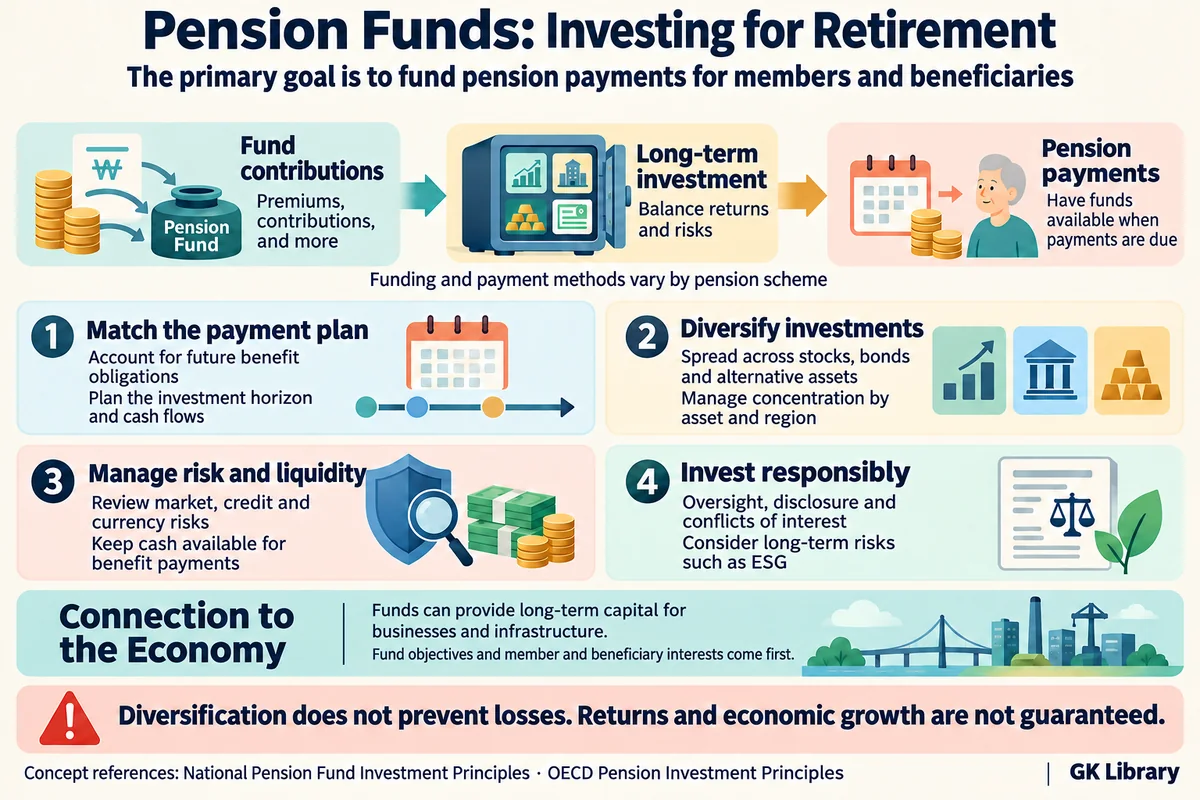

The Definition of Pension Funds: What Does the Term Mean?
Pension funds are asset management institutions established by governments, companies, or other organizations to manage funds over the long term and pay pensions to retirees. They manage finances so that workers can enjoy stable lives in retirement, aiming for long-term financial stability. These funds are built up by deducting a certain proportion of workers' salaries, through which they accumulate and manage assets.
The Main Functions of Pension Funds: Managing Assets and Securing Financial Stability
One of the most important functions of pension funds is to generate long-term financial returns by managing assets effectively. To achieve this, they invest in various financial products, including stocks, bonds, and real estate, maximizing returns and diversifying risk through these investments. This asset management enables them to provide reliable pension payments to members.
The Economic Role of Pension Funds: Market Stability and Long-Term Investment
Pension funds play an important role in providing stability across the economy. By managing large amounts of assets in financial markets, pension funds help reduce market volatility. In particular, as long-term investors, they contribute to market stability by responding less sensitively to short-term fluctuations in financial markets. Through this, pension funds promote stability throughout the economy and have a positive impact on the national economy.
Pension Funds and Public Policy: Contributing to National Economic Growth
Pension funds can serve as an important tool for implementing public policy. For example, governments can stimulate economic growth by directing funding through pension funds into infrastructure investments or public projects. In this way, pension funds go beyond supporting life in retirement to play an important role in supporting the development and growth of the national economy.
ESG Investing and Pension Funds: Responsibility for a Sustainable Society
In recent years, pension funds have also played a role as important participants in socially responsible investing (SRI) that adheres to ESG (environmental, social, and governance) criteria. ESG investing, which aims for sustainable development, adopts investment strategies that consider environmental protection, social responsibility, transparent governance, and other factors. Through this investment approach, pension funds contribute to building a more sustainable society and can bring about positive change for future generations.
The Multifaceted Roles of Pension Funds and Their Importance
Pension funds play important roles that extend beyond supporting individuals in retirement. They perform several interconnected functions: generating long-term financial returns through asset management, maintaining stability across the economy, and contributing to national economic growth. They also contribute to building a sustainable society through ESG investing. A thorough understanding of these roles and functions of pension funds is essential to enhancing the stability and sustainability of the economy and society.
The Economic Significance of Pension Funds: Contributing to Growth and Stability

The Economic Role of Pension Funds: Industrial Growth and More Active Capital Markets
Pension funds make an important contribution to national economic growth. With their substantial assets, pension funds can invest in a variety of industries, positively influencing industrial development and economic growth. By supplying capital to companies at home and abroad, pension funds make capital markets more active and enable companies to obtain the funding they need smoothly. This establishes a foundation for growth across industries.
Contributing to Financial Market Stability: The Role of Long-Term Investment Strategies
Pension funds also play an important role in maintaining the stability of financial markets. Pension funds that maintain long-term investment strategies respond less sensitively to short-term market volatility. This helps their assets remain relatively stable even when financial markets fluctuate sharply. By contributing to financial market stability even in uncertain situations such as financial crises, pension funds reduce risks across the economy.
Positive Effects on the Labor Market: Job Creation and Stability
The investment activities of pension funds also have an important impact on the labor market. By investing in various sectors, including infrastructure, real estate, and new and renewable energy, they create new jobs and increase the stability of existing jobs. This increases national income and consumers' spending capacity, adding vitality to the economy as a whole. As a result, pension funds play an important role in promoting continued growth in the labor market.
Connections with Government Fiscal Policy: Strengthening Social Welfare and Public Services
Pension funds are closely connected with government fiscal policy. Stably managed pension funds allow governments to reduce the burden of pension payments, enabling them to allocate more public funding to other areas. For example, more resources can be directed to public services that directly affect people's lives, such as education, healthcare, and social welfare. This plays an important role in improving people's quality of life.
Their Role in Global Financial Markets: Promoting the International Economy and Capital Flows
Pension funds also play an important role internationally. By investing in global financial markets, they promote capital flows between countries and increase the interdependence of the international economy. This promotes global economic stability and contributes to maintaining balance in international financial markets. By investing in assets across different countries, pension funds promote global economic growth and diversify risks in financial markets.
The Diverse Economic Contributions of Pension Funds
In conclusion, pension funds play an essential role in economic growth and stability. Their investment and management contribute to capital markets and industrial growth, enhance financial market stability, and provide job creation and stability in the labor market. They also ease governments' fiscal burdens and have a positive impact on the international economy, ultimately making an important contribution to raising people's living standards.
Pension Fund Investment Strategies: Portfolio Management and Profitability

Pension Fund Investment Strategies: Minimizing Risk and Maximizing Profitability
Pension fund investment strategies focus on minimizing risk and maximizing profitability by diversifying investments across various assets. To achieve this, pension funds construct portfolios spanning multiple asset classes, including stocks, bonds, real estate, and alternative investments. This portfolio management is an important means of securing their long-term financial stability.
Stock Investment: Stable Dividends and Geographic Diversification
In stock investing, pension funds primarily focus on large-cap blue-chip stocks and companies that provide stable dividends. These stocks tend to offer relatively stable returns despite market volatility. By investing in global stocks as well as domestic stocks, pension funds also reduce risk through geographic diversification and further increase their potential returns.
Bond Investment: The Key to Generating Stable Returns
Bonds play an important role in generating stable returns for pension funds. Investing in various bonds, including government, corporate, and municipal bonds, strengthens portfolio stability. Government bonds, in particular, are essential investments for pension funds because they have low credit risk and provide stable returns. In addition, pension funds invest in inflation-linked bonds to secure real returns that protect against inflation.
Real Estate Investment: Long-Term Returns from Physical Assets
Real estate investment is also one of the main investment strategies of pension funds. They seek long-term returns by investing in various real estate assets, including commercial properties, residential properties, and infrastructure. Because real estate is based on physical assets, it is a stable investment vehicle and provides a particularly strong hedge against inflation.
Alternative Investments: Expanding Portfolio Diversity
Alternative investments include private equity funds, hedge funds, infrastructure funds, and venture capital. These alternative investment assets have return structures that differ from those of traditional asset classes, helping to increase portfolio diversity and maximize overall profitability. Venture capital, in particular, is an area where high returns can be expected from investing in innovative startups.
ESG Investing: Social Responsibility Through Sustainable Investment
Recently, investment strategies incorporating ESG (environmental, social, and governance) criteria have attracted attention. Through ESG investing, pension funds secure long-term returns while fulfilling their social responsibilities, which also helps improve their credibility and image. ESG investing is becoming established as an important strategy that guarantees stable returns while pursuing a sustainable future.
Long-Term Financial Stability and Guaranteed Pension Payments
In conclusion, pension fund investment strategies focus on minimizing risk and maximizing profitability through diversified investment across various asset classes. These strategies allow pension funds to maintain long-term financial stability and establish a foundation for providing reliable pensions to members.
Global Pension Fund Cases: Analyzing the Factors Behind Success and Failure

Norway's Pension Fund: A Success Story Based on Oil Revenues
Norway's Government Pension Fund (Global Pension Fund of Norway) is a leading success story, having grown into one of the world's largest pension funds by effectively managing national assets derived from oil revenues. This pension fund primarily invests in stocks and bonds, generating stable returns through a long-term investment strategy. In particular, it promotes sustainable growth through investments that adhere to ESG (environmental, social, and governance) criteria and diligently fulfills the social responsibilities of pension fund management. The factors behind the success of Norway's pension fund are its long-term perspective and rigorous risk management.
Canada's Pension Fund: An Active Global Investment Strategy
Canada's pension fund (CPPIB, Canada Pension Plan Investment Board) is a successful example of generating high returns through diversified investment across various asset classes and active portfolio management. CPPIB actively invests in alternative assets as well as global markets, minimizing risk and maximizing profitability through these investments. Rigorous risk management and continuous market analysis are the key factors behind this pension fund's success. These strategies have guaranteed stable returns even amid global economic volatility.
Japan's Public Pension Fund: Lessons from Failures in Risk Management
Japan's public pension fund (Public Pension Fund of Japan) sought stability by investing most of its assets in government bonds, but its profitability declined significantly in a prolonged low-interest-rate environment. To overcome this, it increased investment in stocks and alternative assets, but suffered substantial losses because it lacked adequate risk management for market volatility. This case clearly demonstrates the problems that can arise when assets are excessively concentrated in a particular area and the importance of risk management. The failure of Japan's public pension fund left a lesson emphasizing the need for rigorous risk management and portfolio diversity.
Ireland's Pension Fund: Real Estate Investment and the Impact of the Financial Crisis
Ireland's national pension fund (Sovereign Pension Fund of Ireland) is a leading example of failure, having suffered substantial losses during the financial crisis. In particular, excessive concentration of investment in real estate and financial stocks resulted in enormous losses when the real estate market bubble burst. These losses extended beyond the pension fund, negatively affecting the Irish economy as a whole. This case clearly illustrates the dangers that can result from excessive concentration in a portfolio and a lack of risk diversification.
The Key Factors Behind Success and Failure: Risk Management and Portfolio Diversification
Risk management and portfolio diversification are the key factors that consistently emerge from examples of success and failure among global pension funds. Successful pension funds generate long-term returns through rigorous risk management and diversified investment across various asset classes, maintaining relatively stable asset management even amid market volatility. By contrast, unsuccessful pension funds experience substantial losses as a result of excessive concentration in particular assets or neglect of risk management.
The Formula for Successful Pension Fund Management
Through case studies of global pension funds, we can clearly understand the important factors behind success and failure in pension fund management. Risk management and appropriate portfolio diversification are essential strategies in pension fund management and provide a basis for generating stable returns. Through such analysis, pension funds in different countries can develop their own investment strategies more effectively and promote long-term economic stability and growth.
Pension funds do more than simply support individuals in retirement; they make a major contribution to national economic growth and the maintenance of stability. Through their definition, main functions, economic significance, investment strategies, and global cases, we can gain a deeper understanding of the multifaceted roles of pension funds and their importance.
This understanding is very important for enhancing both the national economy and individuals' financial stability. We look forward to continued research and discussion on the effective management and investment strategies of pension funds.