Imagine that the person who supports your household is badly injured one day and can no longer work. Next month's rent and food become an immediate worry, yet most welfare programs take time while you gather documents and wait for a review.
Emergency Welfare Support was created to fill this gap. It first provides living, medical and housing costs to households whose livelihood has suddenly been shaken by a crisis, and leaves the detailed investigation for later. It is based on the Emergency Welfare Support Act, in force since 2006.
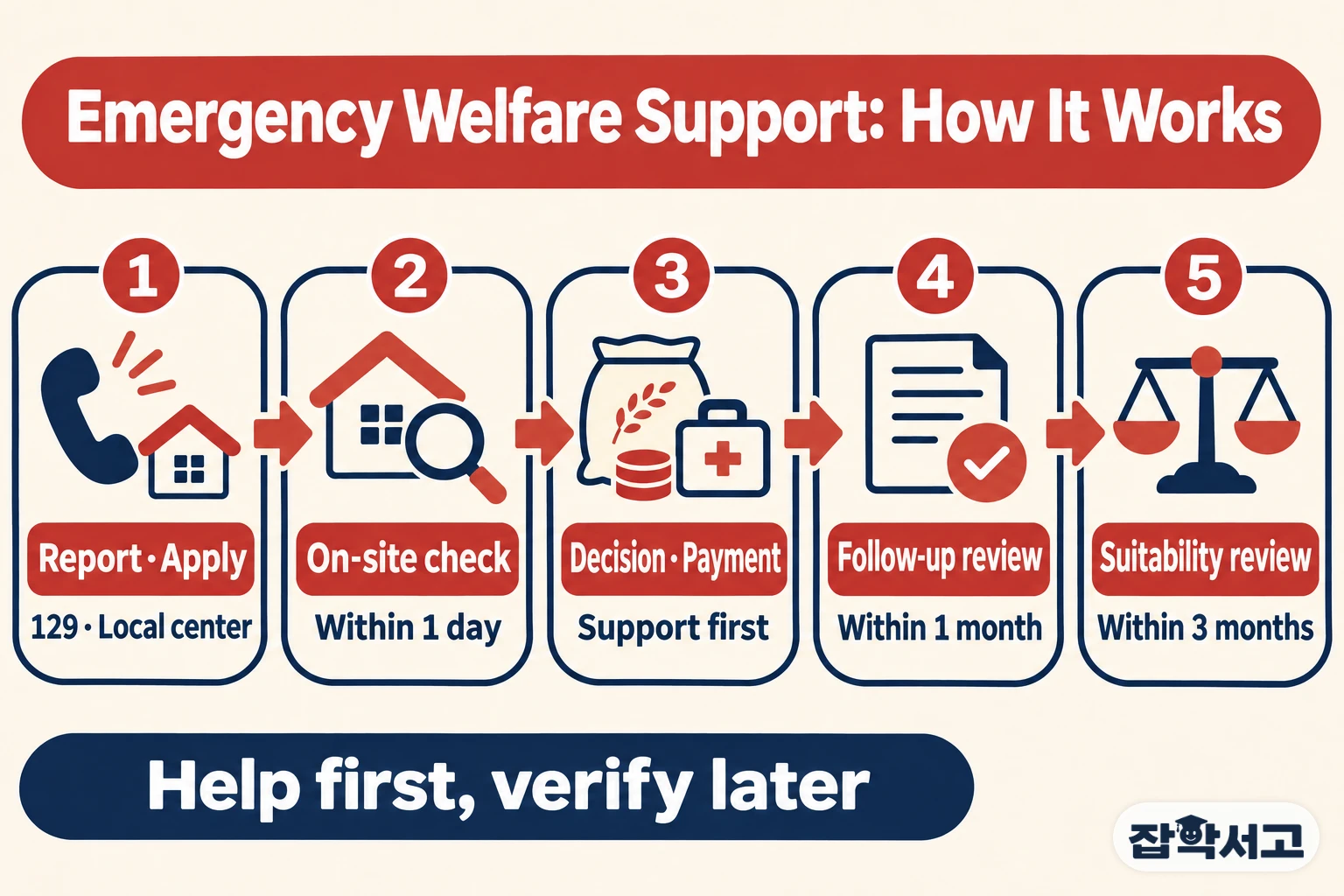
If ordinary welfare follows the order “investigate, then support,” Emergency Welfare Support follows “support, then investigate.” Let us first look at who is eligible, then follow the five steps from the report to the final review.

This Is How Emergency Welfare Support Works
To receive support, a household must meet two conditions at the same time: a crisis situation defined by law, and income and asset criteria.
Crisis situations include losing income because the main earner has died, left home, gone missing or been detained; a serious illness or injury; neglect, abandonment or abuse by a household member; domestic or sexual violence; being unable to stay at home because of a fire or natural disaster; the temporary or permanent closure of a business; and job loss.
There are also situations designated by the Minister of Health and Welfare, such as a sharp drop in income after divorce or a power cut caused by lost income, and local governments may add further situations by ordinance.
Income must be 75% or less of the standard median income. As of 2026, that is 1,923,719 won a month for a one-person household and 4,871,054 won for a four-person household. Assets must be 241 million won or less in large cities, and financial assets must not exceed the living-reserve amount for the household size plus 6 million won.
Step 1: Reporting the Crisis and Applying
It all begins with asking for help. The person or a family member can visit the local community service center or the city, county or district office, or simply call 129, the Health and Welfare Call Center, with no area code. A neighbor who knows the situation may also report it on their behalf.
The law also names people who must report when they learn of someone in crisis, such as medical staff, teachers and social welfare facility workers. The training these mandatory reporters receive is one reason the term appears so often in searches.

Step 2: An On-Site Check Within One Day
Once a report comes in, the official in charge visits the home to see whether the crisis is real. As a rule, the on-site check is carried out within one day.
At this stage, income and assets are not examined in detail. If the crisis is clear and help is urgent, the case moves straight to a support decision, and detailed verification is postponed to Step 4.
On the other hand, if no crisis is confirmed or another program seems more suitable, the household is guided to that program instead. The on-site check is, in effect, the first gate that decides whether support is given.
Step 3: Deciding and Paying Support First
Once the city, county or district decides to help, the necessary support goes out right away. It may be paid in cash or provided in kind, such as temporary housing. The amounts for 2026 are as follows.
Main Support for Getting Through the Crisis
- Living support: one month of living costs such as food and clothing, 1,994,600 won a month for a four-person household (783,000 won for one person), up to 6 times
- Medical support: out-of-pocket costs and non-covered items for tests and treatment, up to 3 million won, up to 2 times
- Housing support: temporary housing or its cost, up to 662,500 won a month for a four-person household in a large city, up to 12 times
- Welfare facility use: the cost of entering or using a social welfare facility, up to 1,494,100 won a month for a four-person household, up to 6 times
Additional Support
- Education support: 127,900 won for elementary, 180,000 won for middle and 214,000 won for high school students, plus tuition and admission fees
- Other support: heating costs of 150,000 won a month in winter (October to March), a childbirth allowance of 700,000 won, a funeral allowance of 800,000 won and electricity bills of up to 500,000 won
Linking the household to emergency programs run by private organizations such as the Community Chest of Korea and the Korean Red Cross is also part of this step.
Living support is a fixed amount set by household size, and since 2021 it has also included summer cooling costs. The number of times shown above is not paid all at once; it is the maximum reached by extending support after the first month if the crisis continues.

Step 4: A Follow-Up Investigation Within One Month
Only after support has been paid does the full investigation begin. Within one month, the city, county or district examines the household's income and assets to confirm that it meets the criteria.
Because support comes first and verification later, this approach is often called “support first, investigate later.” The results become the basis for the review in the next step.
Step 5: A Suitability Review Within Three Months
Based on the follow-up investigation, the authorities review within three months whether the support was appropriate. If the results exceed the criteria, the Emergency Support Review Committee decides whether it was appropriate or not.
If the support is judged appropriate, it ends, or it is extended if the crisis continues. If it is judged inappropriate, support stops and the costs already paid may be recovered. Anyone who received support through false or other improper means must return the amount received.
Common Sticking Points at Each Step
The first is the application. If it is hard to judge the crisis situation and the income and asset criteria on your own, you can consult 129 or the community service center before preparing all the documents. However, households already receiving the same kind of support under another law are excluded.
The second is differences in criteria. Asset limits vary with the size of the area you live in, and some local governments run their own expanded programs, such as Seoul's emergency welfare program. The Seoul program covers households at or below 100% of the standard median income with assets of 409 million won or less.
The third comes after support ends. Emergency support is a bridge to get across the crisis, so it is wise to look into and apply for longer-term programs such as the National Basic Livelihood Security System while support is still running.
A crisis arrives without warning, but the number to call for help can be learned in advance. Remembering the three digits 129 can open a way out not only for your own family but also for the household next door.
Recommended reading