
Why does your body slide outward when you ride a spinning swing at an amusement park? The swings are tied to a central pole, yet the seats keep lifting outward at an angle.
Two terms always come up in this scene: centrifugal force and centripetal force. The names sound alike, but they point in opposite directions and belong to opposite points of view. Let us compare them one by one.

Centrifugal vs. Centripetal Force: What Is the Difference?
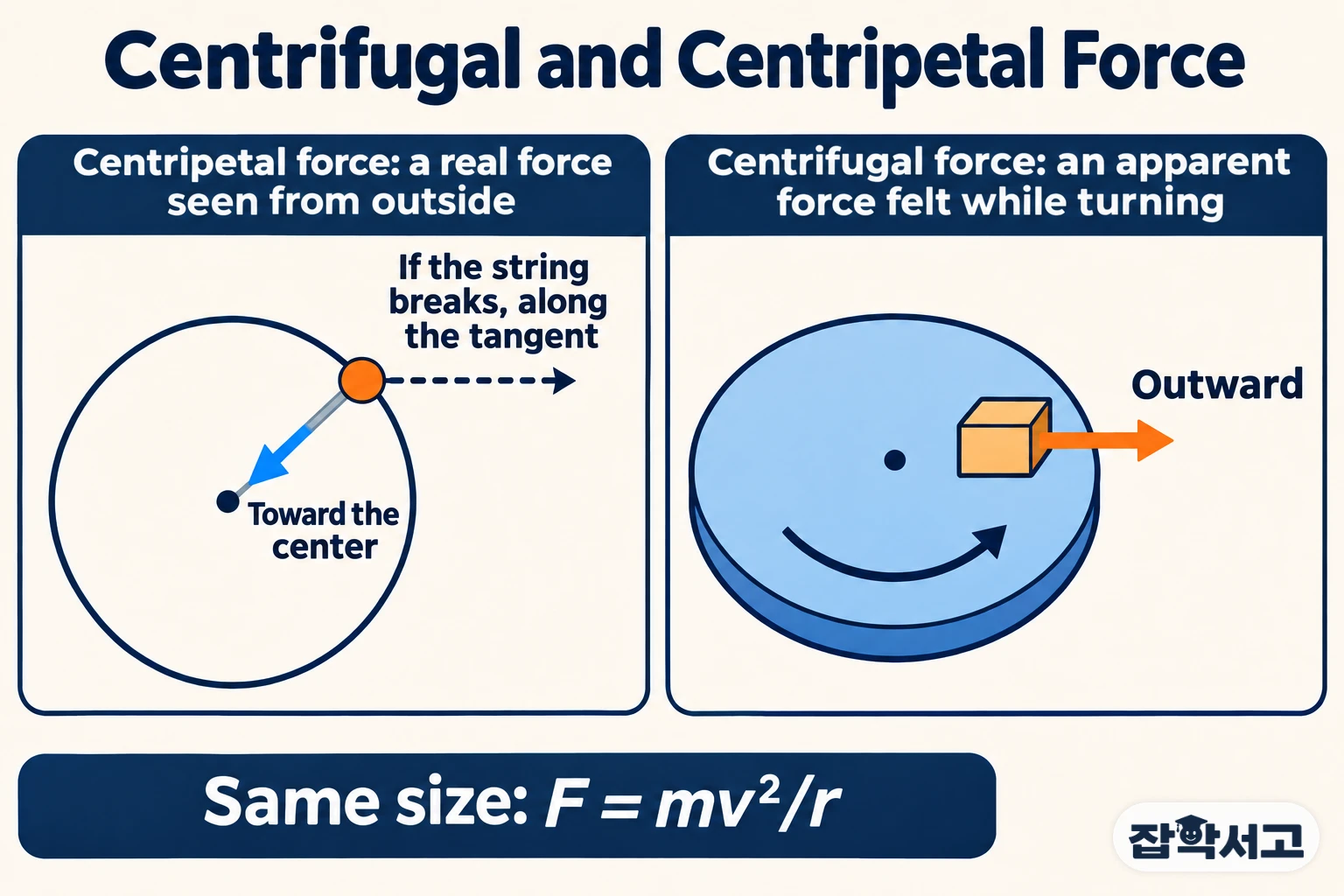
In one sentence, centripetal force is a real force that pulls an object toward the center of its circle, while centrifugal force is an apparent force felt outward only by someone turning along with it. The explanation changes depending on whether you watch the rotation from outside or from inside.
That is why the two are written with the same size and opposite directions. But you never add both to the same description. An outside observer uses centripetal force alone, while someone turning with the object adds centrifugal force; each point of view uses only one.
What Is Centrifugal Force?
Centrifugal force appears when you look through the eyes of someone rotating with the object. A rider on a swing feels at rest, so being pushed outward feels like a force pulling the body away.
Physicists call this an inertial force, or an apparent force. Nothing is actually pushing you out. It is inertia, the tendency to keep moving in the same direction, showing up as an outward push when you are inside the turning frame.
Even the roots of the names are opposite. The term centrifugal was coined in the 17th century by the Dutch scientist Christiaan Huygens while studying circular motion, and centripetal was first used by Newton in the Principia (1687). In Latin, centrifugal means “fleeing the center,” and centripetal means “seeking the center.”
Being apparent does not make it useless. For machines that spin to gather heavier material outward, such as centrifuges that separate blood components or extractors that spin honey out of the comb, the math is much simpler in the rotating frame using centrifugal force.
What Is Centripetal Force?
Centripetal force is the force that keeps pulling an object in circular motion toward the center. It is not a new kind of force but a name for an existing force, such as string tension, friction or gravity, when it plays that role. For a ball on a string, the tension pulling the ball is the centripetal force.
Its size is written F = mv²/r, with mass m, speed v and radius r. Swinging a 1 kg ball on a 1 m radius at 2 m per second takes 4 N, and doubling the speed makes the required force four times larger, 16 N.
The radius matters too. At the same speed, a smaller radius needs a larger centripetal force. That is why drivers are told to slow down on tight curves such as highway ramps. If the required force exceeds friction, the car cannot follow the circle and slides outward.
Side-by-Side Comparison
The two are easy to confuse because the same formula gives their size. Placing direction, nature and point of view side by side makes the difference clear.
| Item | Centrifugal force | Centripetal force |
|---|---|---|
| Direction | Outward from the circle | Toward the center |
| Nature | Apparent force felt by someone turning along | Force that actually acts |
| Point of view | Inside the rotating frame | Watching from outside |
| What provides it | Nothing separate (a result of inertia) | Tension, friction, gravity, etc. |
| Size | mv²/r (same size) | mv²/r |
Telling Them Apart with Confusing Cases
The easiest way to tell them apart is to imagine where an object goes when the string is cut. It does not fly straight outward; it leaves along the tangent of the circle at the moment the string breaks.
Washing machine spin cycle
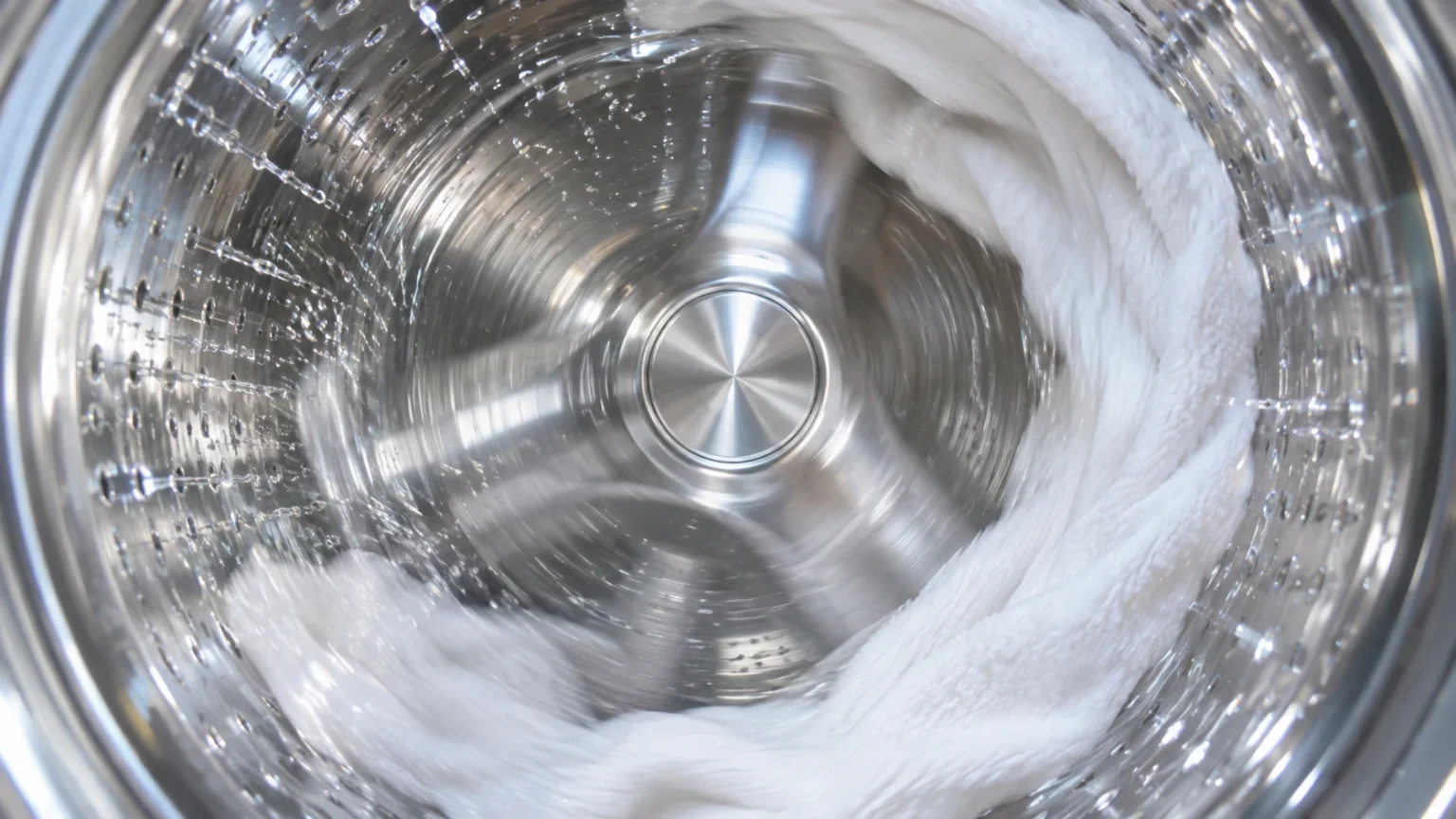
When the drum spins fast, clothes are pressed against the wall and turn with it. The wall pushing the clothes toward the center is the centripetal force. Water droplets, however, lose that support when they reach a hole and escape in a straight line. The water seems to be pulled out by centrifugal force, but in fact the force holding it has simply disappeared. That is also why the laundry is stuck flat against the drum after the spin.
A bus going around a curve
When a bus turns left, passengers lean to the right. Inside the bus it feels like centrifugal force, but from the roadside, the body is simply trying to go straight while the bus turns left beneath it. Friction between the tires and the road provides the centripetal force for the whole bus.
For the same reason, curved highway sections and racetracks are built with the road tilted slightly inward. Part of the force supporting the wheels then points toward the center, adding to the centripetal force that friction alone cannot supply.
A roller coaster’s 360-degree loop
Passengers do not fall at the top of a roller coaster loop, even upside down, because the train is fast enough. At the top, gravity and the force of the rails pushing on the seats both point down, toward the center of the circle, and together act as the centripetal force. If the speed is too low, gravity becomes larger than the needed centripetal force and the train starts to sag away from the circle, so it builds up enough speed before the loop.
A satellite orbiting the Earth
A satellite circles the Earth with its engines off. The International Space Station flies about 400 km above the ground at around 7.7 km per second and completes one orbit in about 90 minutes. Earth’s gravity provides the centripetal force: the satellite keeps falling toward Earth but moves sideways fast enough to keep missing it. Astronauts float inside for the same reason: they are falling together with the station.
Next time your body leans on a spinning swing or a curving road, try explaining the same scene twice: from inside with centrifugal force, and from outside with centripetal force and inertia.
Recommended reading