Have you ever had a piano piece that flowed perfectly when you practiced alone fall apart on the recital stage, or noticed that you ran a faster time when someone was running beside you? The same person doing the same task can get different results depending on who is around, and psychology calls this phenomenon social facilitation.
Social facilitation, simply put, means “the tendency for familiar tasks to go better and unfamiliar tasks to go worse when other people are present or watching.” Research on it began with an experiment by the American psychologist Norman Triplett in 1898, and in 1924 Floyd Allport gave it its current name in his book.
In this article, we will look in turn at how research on social facilitation began, why the effect works in opposite directions for easy and difficult tasks, why the presence of others makes us tense, and how to turn this effect to your advantage in everyday life.
How the presence of others changes performance: social facilitation at a glance
1. An experiment that began with bicycle races

Research on social facilitation started with a study often introduced as one of the first experiments in social psychology. Norman Triplett of Indiana University noticed that cyclists rode faster when racing alongside other riders than when racing only against the clock.
(1) Children winding fishing reels
Triplett had children wind a small fishing reel as fast as they could and compared their speed when working alone with their speed when competing side by side with another child. In the results published in 1898 in The American Journal of Psychology, about half of the 40 children he examined closely reeled faster when paired.
(2) Not everyone sped up
Some of the remaining children actually slowed down, and the rest showed almost no difference. Triplett interpreted the presence of a competitor as releasing hidden energy that is not normally used, but when Michael Strube reanalyzed the original data in 2005, no statistically clear difference was found.
(3) Before it got its name
Later studies went on to report that people wrote more or lifted heavier weights when others were present. In 1924, Floyd Allport called this phenomenon “social facilitation” in his book Social Psychology, and the name is still used today.
2. Easy tasks go better, hard tasks get tangled

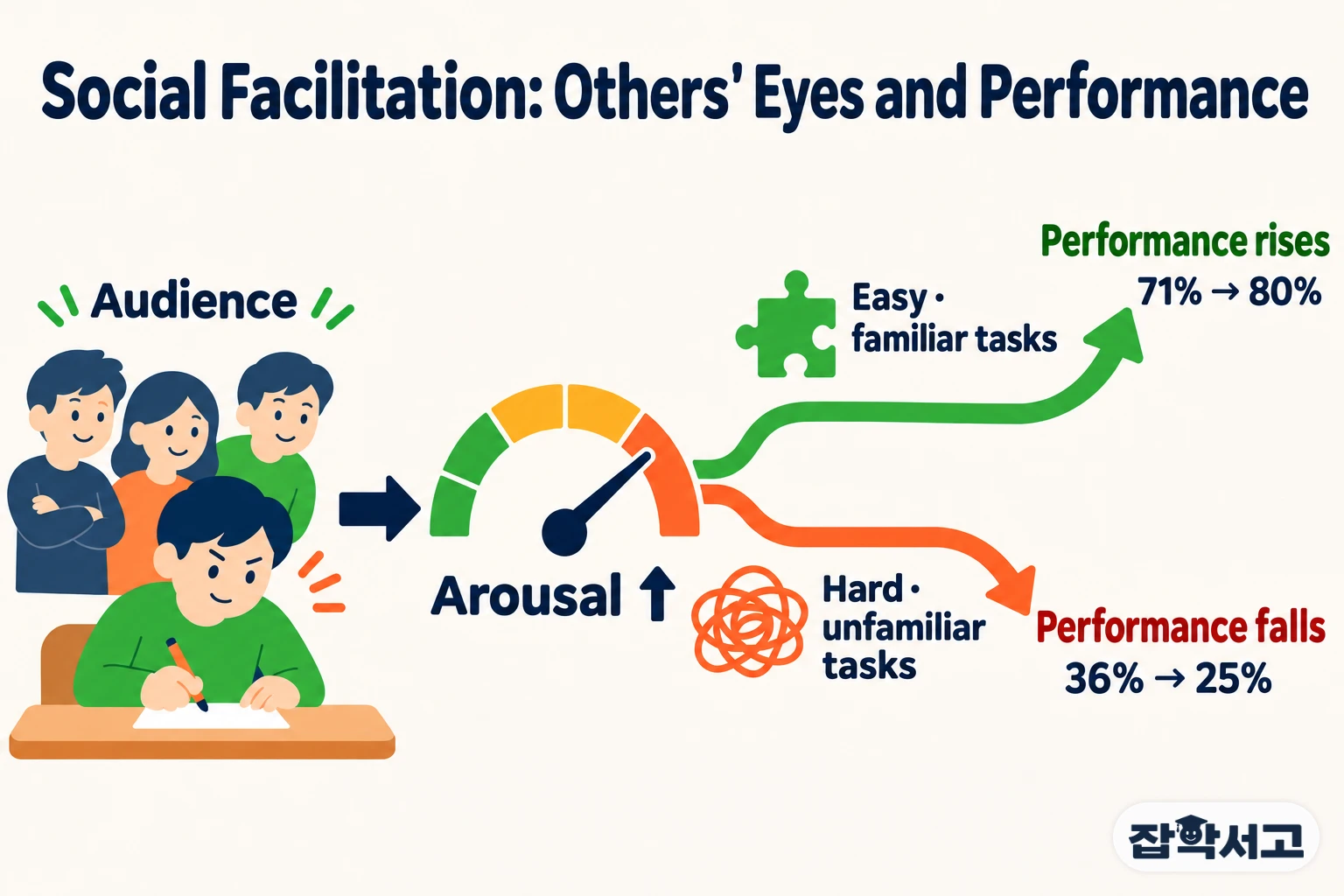
As studies piled up, a puzzle emerged. Some studies found that performance improved in front of others, but quite a few found that it declined. In 1965, Robert Zajonc resolved this contradiction in a paper published in the journal Science. The presence of others raises arousal, and higher arousal makes a person’s most familiar response more likely to come out. If the task is well learned, the familiar response is the right one, so performance rises; if the task is unfamiliar, the familiar response is more likely to be wrong, so performance falls.
- Dominant Response: The familiar response that comes out first and most easily in a given situation.
- Arousal: A state of physical and mental excitement in which the heart beats faster and tension rises.
- Coaction Effect: Social facilitation that appears when someone doing the same task is nearby.
- Audience Effect: Social facilitation that appears when someone is only watching rather than working alongside.
An observation carried out in 1982 by Michaels and colleagues in a pool hall at an American university student union illustrates this principle well. When four onlookers stood by the table, skilled players’ shot success rose from 71% to 80%, while less skilled players’ fell from 36% to 25%. The same audience became wings for some and a burden for others.
3. Why do we get tense when others are around?

Zajonc believed that the mere fact that others are nearby is enough to raise arousal. As for why, however, several explanations are still used side by side.
(1) Mere presence alone
In 1969, Zajonc and his colleagues tried to show this with an experiment on cockroaches. In a straight runway, the cockroaches ran faster when other cockroaches were watching, but in a maze with a turn, they ran more slowly. However, a 2020 replication using the same method did not find this effect, so the result should be interpreted with caution.
(2) Worry about being judged
In 1968, Nickolas Cottrell and colleagues reported that when the observers were blindfolded, performance was similar to working alone. This explanation holds that the worry “that person might be judging me” raises arousal more than the mere fact that someone is there.
(3) The conflict of divided attention
Robert Baron argued that arousal comes from the conflict between paying attention to other people and having to concentrate on the task at the same time. From this perspective, distractions other than people can have a similar effect.
4. How to turn others’ eyes to your advantage

In 1983, Charles Bond and Linda Titus combined the results of 241 studies published between 1898 and 1980, involving about 24,000 participants, and confirmed that the presence of others makes simple tasks faster and complex tasks slower. The effect was not large, however, explaining only about 0.3 to 3% of the differences in performance.
(1) Master it alone before taking the stage
For things you must do in front of people, such as presentations or performances, it is best to practice them alone first until they become second nature. A thoroughly learned action becomes a dominant response and actually gains strength in front of an audience.
(2) Learn new things in a quiet place
When you are first learning an unfamiliar formula or a new skill, an environment with few observers is an advantage. If you become conscious of being evaluated at a stage when mistakes are frequent, arousal can rise too high and slow your learning even further.
(3) Borrow the power of togetherness
Exercise you are already used to or simple repetitive work is easier to speed up when done with friends or in places where other people are around, such as a library. If you cannot avoid other people’s eyes, the best strategy is to turn what you must do in front of them into something familiar ahead of time.
In the end, what matters is not getting rid of the audience but practicing thoroughly before you stand in front of it. The simple idea that other people’s eyes make you even better at what you already do well is the first step toward understanding social facilitation.