This time, I would like to put together some material on the concept of memory as an element of psychology. Understanding the content of this material may help with studying and learning work-related tasks.
Memory is a term that describes the cognitive processes through which we take in information, store it, and retrieve it for use. These processes occur across various parts of the brain and allow us to retain and refer to everyday experiences and knowledge. Memory can be broadly divided into sensory memory, short-term memory, and long-term memory.
Principles of Memory
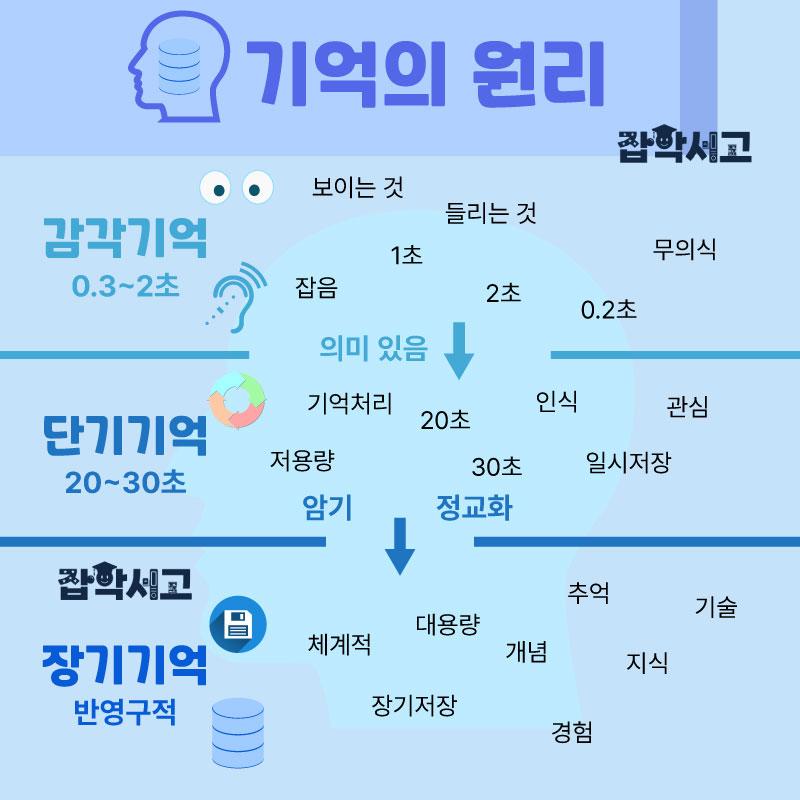 Principles of Memory and Conceptual Diagram
The image above shows how information enters a person's mind, is processed, and is remembered.
Countless pieces of information enter sensory memory through our eyes and ears, but meaningful information is selected from among them and stored in short-term memory, after which some of it is stored in long-term memory through a series of processes.
Now, let us examine the concept of each stage in turn.
Sensory Memory
 Everything we see and hear in everyday life
Sensory memory refers to memory that unconsciously holds vast amounts of information for a very brief time, such as something flashing through our field of vision or a sound we hear in passing.
At this point, visual information is remembered for 0.25 seconds, and auditory information for about 1 seconds. Because this information is not meaningful to us, it is held only briefly before disappearing without being stored.
The countless people, noises, signs, natural surroundings, and other things we encounter while walking enter unconsciously and immediately disappear, making this a sensory concept that can be too fleeting even to call memory.
Short-Term Memory
 Information of interest is briefly stored, but most of it disappears without effort
Short-term memory is a limited form of memory and a process that selects and processes meaningful information from the countless pieces of information that enter sensory memory.
This is temporary memory that disappears after about 20–30 seconds unless we make a special effort to remember it, and its storage capacity is limited. Generally, even when we remember well, we can retain about 7–9 chunks of information.
If you want to remember this information for a long time, you can convert it into long-term memory and store it through rote memorization, which involves repeatedly rehearsing it, or elaboration (association), which involves connecting it to information you already know.
Long-Term Memory
 Once information enters long-term memory, it is stored for a long time
Long-term memory is the final stage of memory, with a vast capacity, in which information can be remembered for a long time after undergoing processes such as memorization or elaboration in short-term memory.
Information is stored (remembered) systematically and can be appropriately retrieved and used as needed. Because this information is stored for a long time, the memory can even last a lifetime if used occasionally.
Since many kinds of information are remembered for a long time, long-term memory can also be divided into different types.
These include recollective memory of personal experiences or events, semantic memory that stores general knowledge, and procedural memory that remembers skills (specialized skills) or habits (such as cycling and swimming) for performing actions.
However, even after something is stored in long-term memory, it may become difficult to remember later, which is the concept of 'forgetting,' and since I have prepared separate material on this, you may find the material below helpful.
 Principles of Forgetting (Learn More)
Methods and Strategies for Remembering Well
The Storytelling Method
 Identify the key words and create your own story
The storytelling method is a technique for remembering information by organizing it in the form of a story. It involves selecting the key words you need to memorize and remembering things you can associate with similar words by weaving them into your own story.
Visualization and Association
 Turn complex formulas into charts and draw concepts as pictures
Visualization is a technique for converting information into visual images, with methods such as diagrams that illustrate mathematical relationships and mind maps that branch out by connecting concepts.
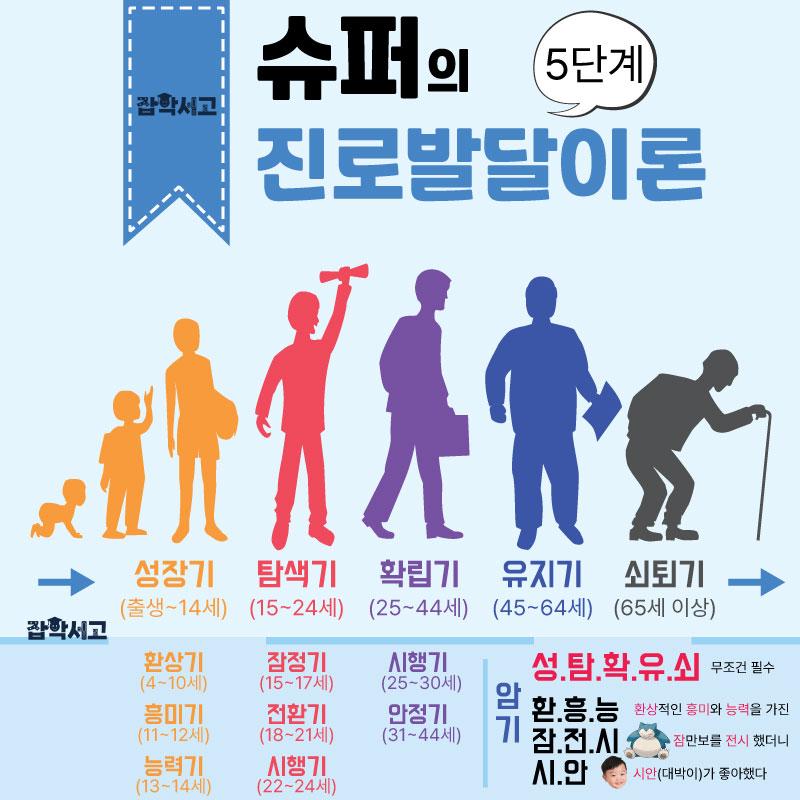 Example of Associative Memorization
Association is a method of remembering by connecting new information with information or concepts you already know, and you can think of it as converting information into a form that is easy to remember. The image above is an example of associative memorization that I used when creating other material.
Assuming you are memorizing the 5 stages of Super's theory of career development, this is an example of memorizing only about 5 essential characters and remembering the detailed items by taking just their key characters and associating them with information you already know. The storytelling method described earlier can also be used in a similar way.
Creating rhythmic mnemonics using initial syllables is also a good method, as in the familiar 'Ppal-Ju-No-Cho-Pa-Nam-Bo♬' used to memorize the colors of the rainbow or 'Tae-Jeong-Tae-Se-Mun-Dan-Se♬' used to memorize the succession of Joseon kings.
Review and Spaced Practice
 Repeating information periodically to memorize it also helps
Review and spaced practice are strategies for reviewing information at regular intervals to firmly store what you want to memorize in long-term memory. Although this is also a rote method, it is one of the widely used memory techniques for storing information in long-term memory.
What matters here is reviewing what you have learned several times at regular intervals, rather than repeating it dozens of times all at once.
Rest and Health
 Getting proper rest is also important
Getting enough rest is also a strategy for remembering well. Take regular breaks to help the brain process information effectively.
A balanced diet, regular exercise, and sufficient sleep can also help improve memory.
We have now examined the concept of memory from a psychological perspective and its categories: sensory memory, short-term memory, and long-term memory. In addition, I introduced some ways to strategically use these concepts to remember information.
Of course, applying memory techniques requires consistent practice. Repeated memorization is a familiar habit, but I recommend applying the methods introduced in this material and making them a habit to remember more efficiently.