Have you ever heard of a company that brought in an excellent new internal document search system, only for employees to keep asking the colleague at the next desk or working the old way? The search is fast and the materials are plentiful, so why does nobody use it? The answer an information scientist offered to this question more than 60 years ago is “Mooers’ Law.”
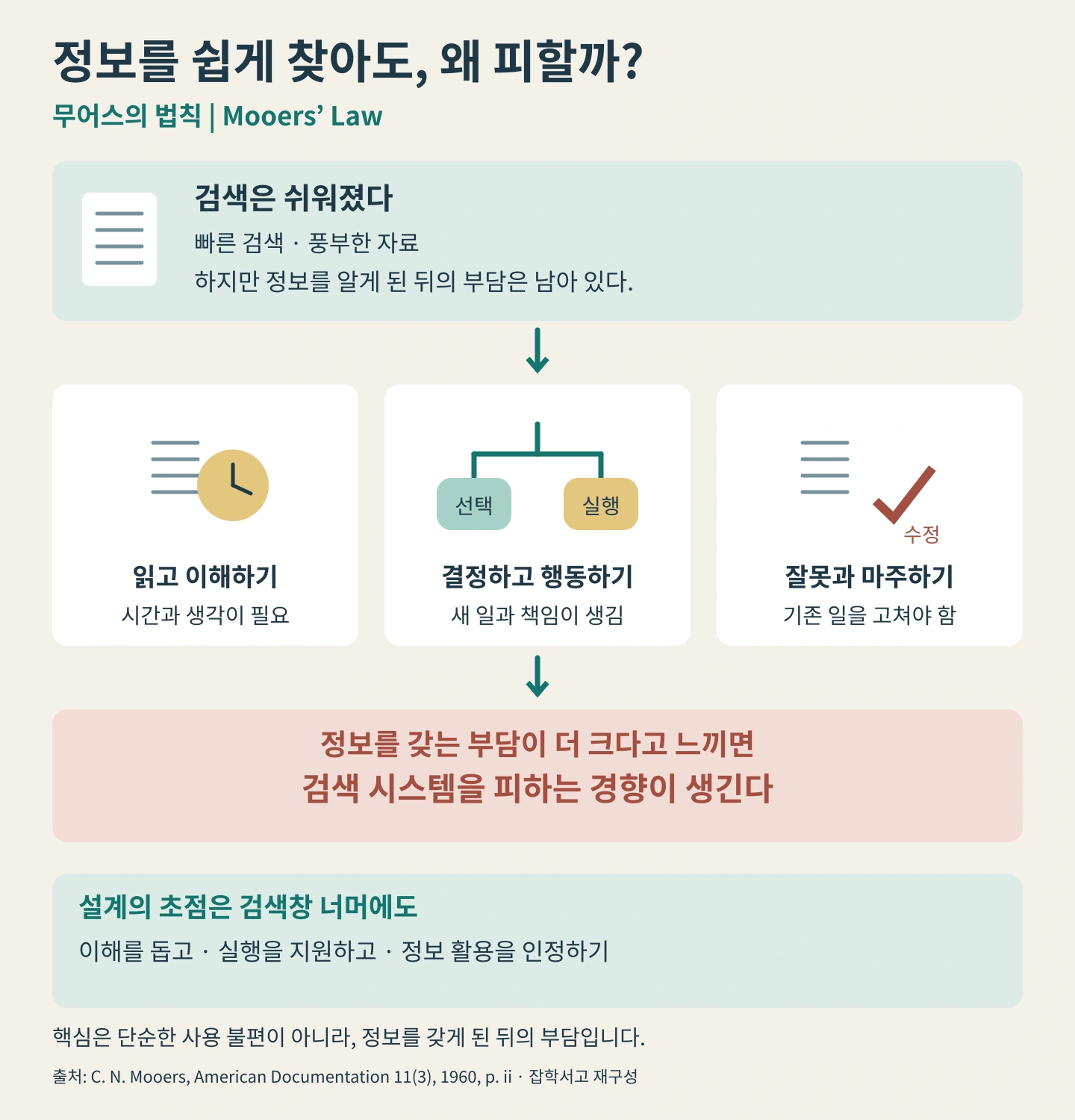
Put simply, Mooers’ Law is the principle that “where having information is more painful and troublesome than not having it, even the best information retrieval system will not be used much.” Its name resembles Moore’s Law, which says semiconductor performance keeps doubling, but it is a completely different story.
In this article, we will look in turn at the background of Mooers’ Law, the precise meaning of the law, common misunderstandings, and the lessons libraries and organizations can take from it.
The Psychology of Avoiding Information and System Design
Where Did Mooers’ Law Come From?

The person who formulated this law was the American information scientist Calvin N. Mooers. He is well known as the man who coined the term “Information Retrieval” in 1950, using it to define the task of finding information whose location or even existence cannot be known in advance. He also created Zatocoding, a method of finding documents by superimposing multiple subject codes on cards.
In October 1959, during a discussion session at the annual meeting of the American Documentation Institute held at Lehigh University in the United States, Mooers raised a question. Why is it that a technically rather crude retrieval system gets used heavily, while a far superior system is hardly used at all? To explain this phenomenon, he put forward a law bearing his own name, modeled on “Parkinson’s Law,” which mocked the expansion of bureaucratic organizations, and his remarks were published the following year, 1960, in the journal American Documentation.
What the Law Precisely Says

Mooers’ original sentence reads: “An information retrieval system will tend not to be used whenever it is more painful and troublesome for a customer to have information than for him not to have it.” He admitted himself that this conclusion might sound pessimistic and cynical, but stressed that it came from long experience. The key point here is not that searching is difficult, but that “having” information is itself a burden.
Mooers explained step by step why having information is painful.
(1) The burden of reading and understanding
When you receive information, you first have to read it, and to understand it you have to think hard. This alone takes time and effort.
(2) The burden of demanding decisions and action
Information you learn demands new decisions, and those decisions can lead to actions such as tedious work, business trips, or awkward meetings.
(3) The burden of exposing mistakes
Looking into information may reveal that your work was wrong or that someone else has already done it. In a sense, not knowing is more comfortable.
Mooers believed that in organizations where finding and using a lot of information earns no praise and only adds to one’s workload, people deliberately avoid searching.
Common Misunderstandings and Real-World Cases

Mooers’ Law is often passed along in altered form to mean “people only use systems that are easy to use.” In fact, in 1987 a reworded version appeared, along the lines of “an information system will be used only when it is more troublesome not to use it than to use it.” However, ease of use is a problem mainly addressed in library and information science by the “principle of least effort,” whereas Mooers’ original concern was the consequences and responsibilities that information brings.
This pattern is easy to find in everyday life, too.
- Health Checkup: Because bad results mean having to change their lifestyle, some people put off opening their checkup report.
- Knowledge Management: Finding an existing report might mean redoing a project that was already finished, so some people start from scratch without searching.
- Literature Review: Some researchers hesitate to dig deeply for fear that a paper identical to their own research already exists.
Nobel laureate in Physiology or Medicine Joshua Lederberg summed up the law briefly: “People will reject information unless the cost of not knowing is far greater than the cost of learning.”
The Lessons of Mooers’ Law

The biggest lesson of Mooers’ Law is that improving a retrieval system’s performance alone does not increase its use. Mooers himself said there was no guarantee that people would use a system more just because it was faster and bigger. To increase use, an environment must first be in place where people who find and use information are not penalized but instead recognized. For example, we need a culture that praises employees who find existing materials and prevent duplicated work, and that does not shift blame onto people who report inconvenient facts.
Information scientist Eugene Garfield added a corollary: “the more relevant the information a retrieval system provides, the more it will be used.” This is why libraries and information services must select and deliver only the information that is truly needed, tailored to users’ actual needs and ways of working.
Mooers’ Law directly challenged the belief that more information is always better. People do not welcome information unconditionally, and when the burden information brings is large, they sometimes choose not to know.
That is why a good information service must design not only the technology but also the mindset and environment of the people who will receive the information. Creating an environment where knowing is more beneficial than not knowing is the first step toward an information system people love.