Have you ever seen a sensational ad or a piece of fake news and thought, “I won't fall for this, but other people easily will”? It is also common to hear people say of violent content, “I'm fine, but it's dangerous for children or less mature viewers.” The concept that explains this tendency to believe that ‘the media has a weak effect on me but a strong effect on others’ is the third-person effect.
Put simply, the third-person effect is ‘the phenomenon in which people judge persuasive or negative messages to have little effect on themselves while estimating their effect on others to be large.’ It is a classic hypothesis frequently cited in journalism and political communication studies to explain media effects, public opinion, support for censorship, and more.
This article explains, in easy-to-understand terms, what the third-person effect means and Davison's classic study, why people believe they themselves are not influenced, how that perception leads to support for censorship and regulation, and the common misconceptions and everyday uses of the concept.
The Perception and Behavior of the Third-Person Effect
What Is the Third-Person Effect?
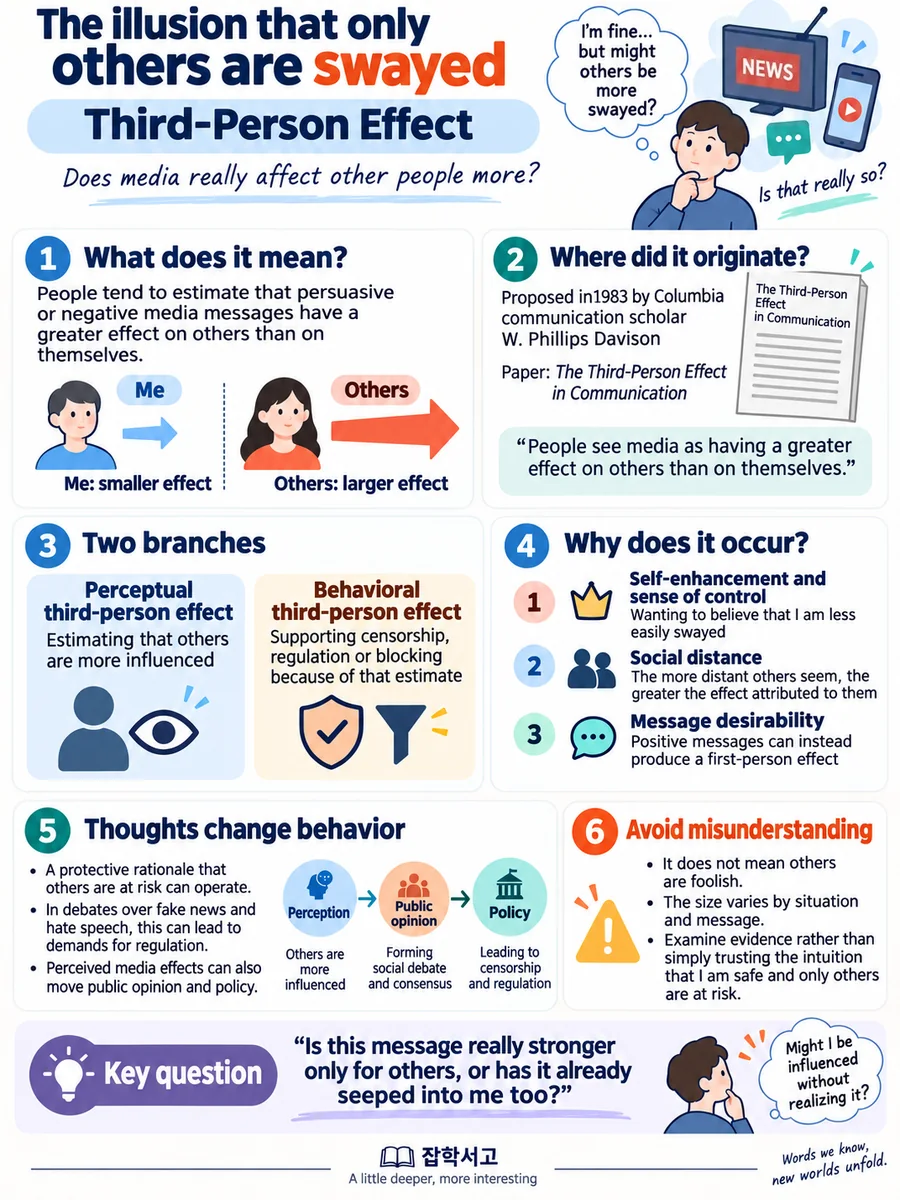
In 1983, W. Phillips Davison, a communication scholar at Columbia University in the United States, put forward an intriguing hypothesis in “The Third-Person Effect in Communication.” It holds that people believe persuasive messages in the mass media will have a greater effect not on ‘me’ or ‘you’ but on ‘them,’ that is, on third persons.
Starting from an anecdote about propaganda leaflets used on Iwo Jima during World War II and from his experience of observing journalists, he supported this tendency with several small experiments. Since then, the same pattern has been repeatedly confirmed for a wide range of messages, including advertising, violent content, pornography, and fake news.
- Perceptual third-person effect: The tendency to estimate that a message has a greater influence on others than on oneself.
- Behavioral third-person effect: The process by which that estimate leads people to support actions such as censorship, regulation, and blocking.
The key point is not ‘whether others were actually influenced more’ but that ‘the perception of believing so’ itself changes attitudes and behavior. It was also a turning point that broadened the focus of media effects research from the direct persuasive power of messages to how people interpret the media and respond to it.
Why Do I Feel Fine While Others Are at Risk?

The third-person effect appears so often because self-protection and a sense of social distance overlap. The stronger our motivation to see ourselves as rational, independent beings, the more easily the victims of negative messages get pushed off onto ‘others.’
(1) Self-enhancement and a sense of control
People tend to see themselves as smarter and more critical than average. When the belief that “I know the tricks of advertising” is strong, it is easy to assume that the same message would be devastating for others.
(2) Social distance
The further the comparison group moves away from ‘people like me’ toward ‘people who know less,’ ‘the younger generation,’ or ‘other groups,’ the larger the third-person effect often becomes. The greater the distance, the sharper the image of “they are easily swayed.”
(3) The desirability of the message
The third-person effect is especially pronounced for messages regarded as socially undesirable, such as violence, incitement, and false information. Conversely, for desirable messages such as public-interest campaigns, a ‘first-person effect’ sometimes appears, in which people see themselves as more influenced.
In the end, the third-person effect is not a simple illusion but a perceptual bias that arises from the interplay of self-image, evaluations of the message, and assumptions about others.
From Perception to Action: Support for Censorship and Regulation
The third-person effect matters because that perception can lead to action in the form of ‘we have to protect other people.’ Davison himself pointed out that censors say they are not influenced themselves, yet still try to shield others.
(1) The protective logic at work
Once the judgment “I'm fine, but vulnerable others are at risk” takes hold, it becomes easy to justify measures such as content blocking, age restrictions, and platform regulation. The intention may be protection, but if it rests on exaggerated estimates of influence, it can slide into overregulation.
(2) Public opinion and policy debates
The third-person effect is often observed in debates over fake news, hate speech, and sensational content. While trusting their own judgment, people turn their fear that the public will be easily stirred up into demands for policy.
(3) The power of presumed influence
Even when the actual effect is small, the mere expectation that “others will be swayed” can prompt media companies, politicians, and citizens to act first. In effect, what is called ‘presumed media influence’ ends up changing reality.
The third-person effect is therefore a key to understanding not only the direct persuasive power of news and advertising but also how society tries to control the media.
Misconceptions and Everyday Uses

The third-person effect is widely known, but misconceptions have spread along with it.
(1) It does not mean “only other people are fools”
The concept is not a way of belittling others; it points out that anyone can, defensively, estimate influence differently for themselves and others. Even experts can show the same bias when it comes to unfamiliar platforms or other generations.
(2) It does not always appear to the same degree
The size and direction of the effect vary with the type of message, ego involvement, the comparison group, and the culture. It is also worth remembering that desirable messages can produce a first-person effect.
(3) How to use it in everyday life
When talking about media regulation, it is worth questioning, at least once, the intuition that “I'm fine and only others are at risk.” We need the habit of checking whether our desire to protect our children, colleagues, or fellow citizens rests on exaggerated estimates of influence, and of looking at the actual evidence and the scale of harm together.
When you read news, ads, or social media feeds, simply asking “Is this message really powerful only for others, or has it already seeped into me as well?” takes your media literacy one step deeper.
The third-person effect shows that it is not only ‘what the media did’ but also ‘how people imagine the media’ that moves the world. The stronger the conviction that we ourselves are the exception, the more easily regulation for the sake of others is justified.
An attitude of checking your own estimates of influence against the evidence and the trap of social distance: that is the first step toward being a healthy media citizen.