
At 20°C and 50% humidity, one cubic meter of room air holds about 8.6 g of water vapor. The moment this air touches anything colder than about 9°C, it gives up part of that vapor as water droplets.
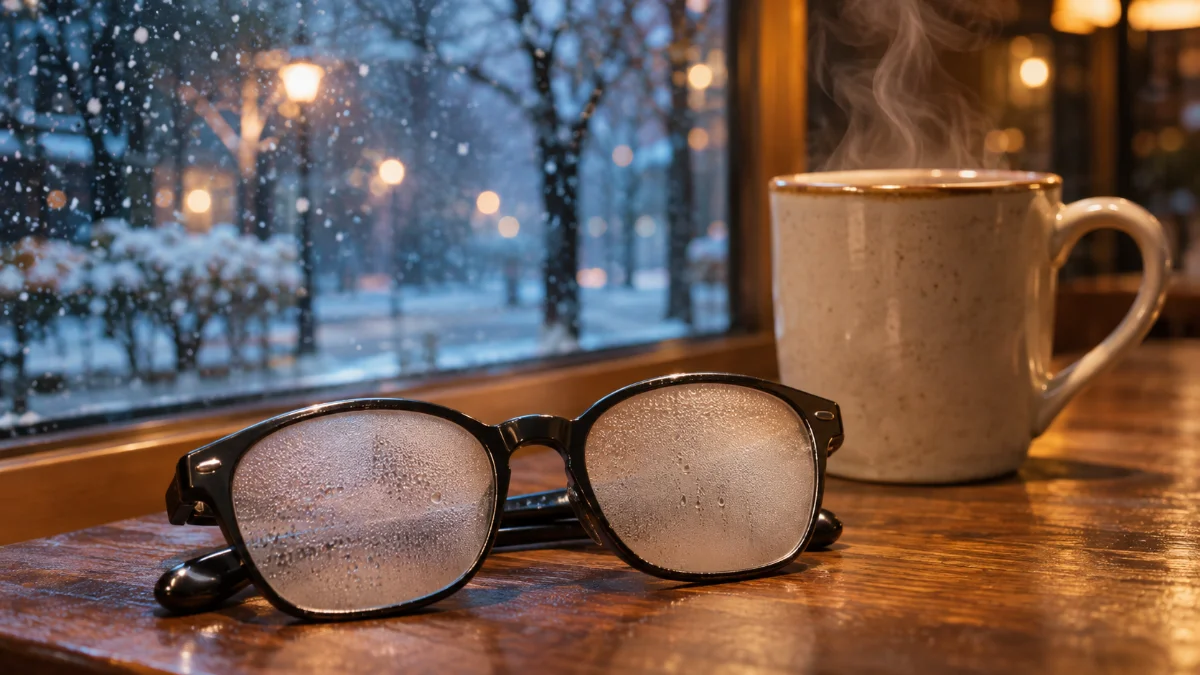
That is exactly why your glasses turn white the instant you step indoors in winter. The phenomenon is called fogging, and once you understand the single principle behind it, the ways to prevent it become obvious.
3-Minute Summary
- Fogging happens when water vapor in the air settles on a cold surface as extremely tiny droplets.
- It occurs when the surface is colder than the dew point of the surrounding air, and the droplets scatter light so the surface looks white.
- You can reduce it by warming the lens in advance, keeping humid air away from it, or making a thin film of water form instead of droplets.
What Is Fogging?
Air always contains invisible water in gas form, called water vapor. The amount of vapor air can hold rises with temperature and falls as it gets colder. For every 10°C drop in temperature, that amount falls to roughly half.
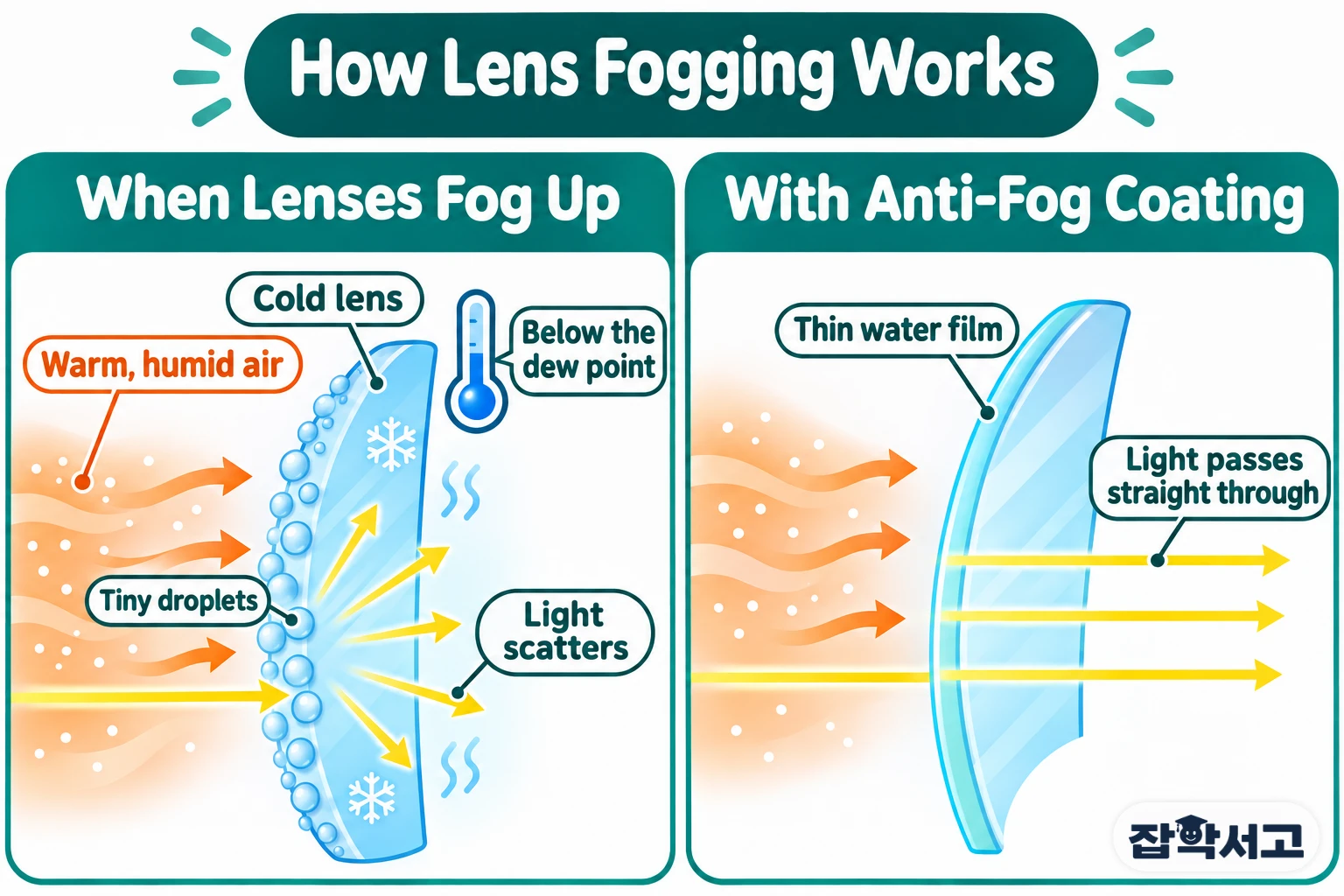
So when warm, humid air touches a cold surface and cools down, the vapor it can no longer hold collects on that surface as water. In the 20°C, 50% humidity room mentioned above, the dew point is about 9°C, and a lens that has been outside in sub-zero weather is far colder than that.
This change from gas to liquid is called condensation, and the temperature at which it begins is called the dew point. Dew on grass at dawn and droplets on the outside of a cold glass follow the same principle. When the same thing happens on a pair of glasses, we call it fogging.
We often call the white steam rising from a kettle spout “vapor,” but water vapor itself is invisible. The white steam we see is a cloud of tiny droplets formed as the vapor cools. Fog on your glasses is the same kind of tiny droplets settling on the lens surface.
Why Does It Look White?
Under magnification, a fogged lens is covered with countless tiny droplets packed closely together. Each droplet bulges like a tiny convex lens, bending and scattering incoming light in all different directions. Clouds and morning mist look white for the same reason.
Because light cannot pass straight through, you see a milky film. Once the lens warms up to room temperature, the droplets evaporate back into vapor and the fog disappears on its own. In the end, fogging needs two things together: a temperature difference between the lens and the air, and moisture in the air.
The colder the lens and the more humid the air, the thicker and faster the fog forms. That is also why the same glasses fog up more and stay foggy longer on a rainy day or in a crowded, warm room than on a clear, dry day.
Where Does It Happen, and How Can You Prevent It?
A car windshield on a winter morning, the bathroom mirror after a shower, and glasses over a bowl of hot soup all share the same conditions. When you wear a mask, warm, moist breath escapes upward and hits the lenses directly, so they fog up more often. Goggles clouding up during a winter hike or after exercise are also caused by warm moisture from the body reaching cold lenses.
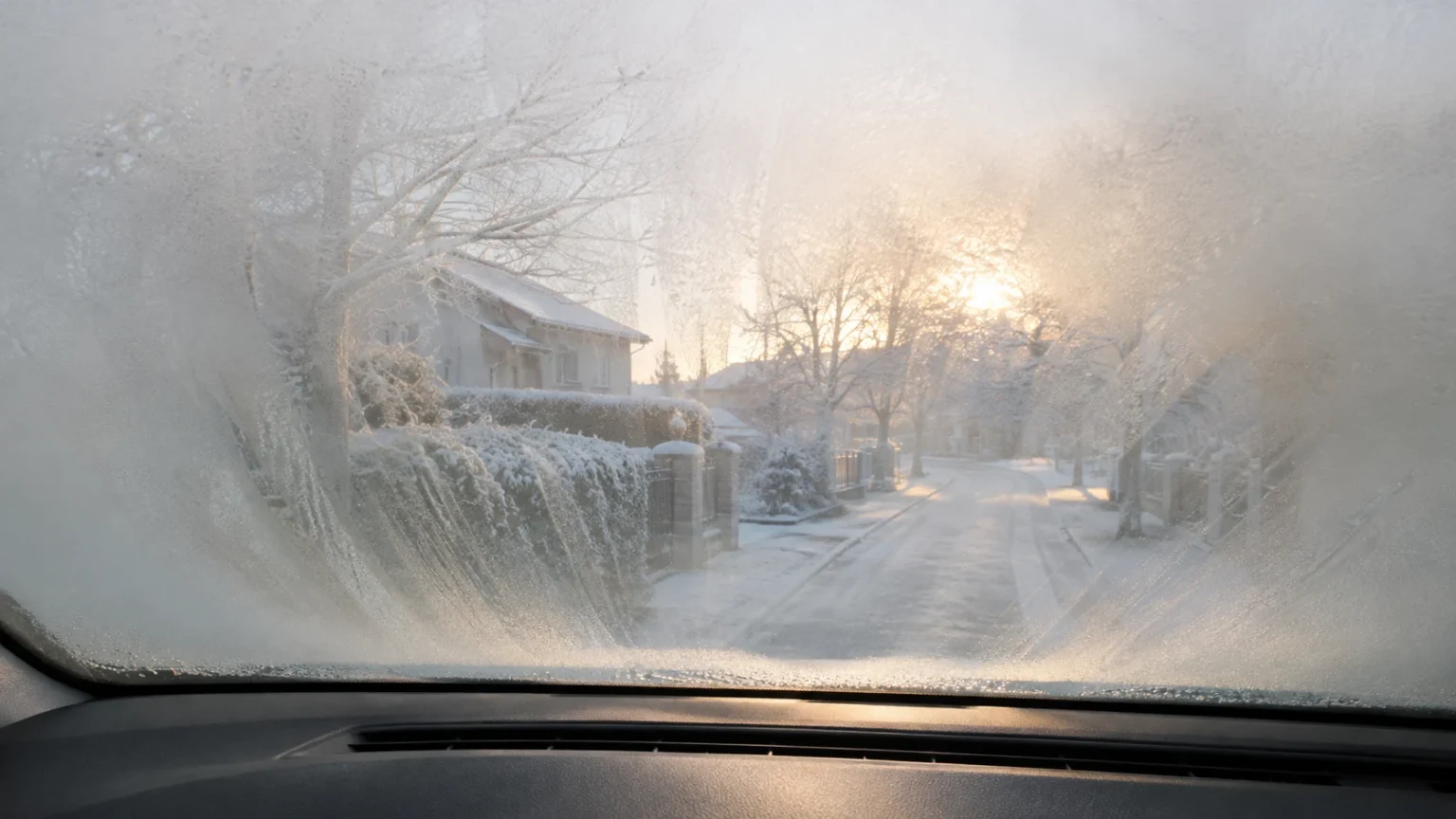
The ways to prevent it come straight from the principle. Press the wire in the nose of your mask so it fits snugly and your breath does not escape upward, and in the car, turn on the air conditioner to remove moisture from the air.
Anti-fog products help water spread easily over the lens, so a thin, even film forms instead of droplets. The film does not scatter light, so the lens stays clear. Lenses with an anti-fog coating are based on the same idea of making water spread evenly over the surface.
In the bathroom, running the exhaust fan or leaving the door slightly open during a shower lets moisture out, so the mirror fogs less. In a car, direct the airflow toward the windshield and switch to outside-air mode; the humid air inside is pushed out and the fog clears quickly.
However, rubbing anything abrasive such as toothpaste on your lenses can scratch the coating, so it is safer to use products made for eyeglasses. If your glasses have already fogged up, wait a moment instead of rubbing them hard with your sleeve: as the lens warms, it clears on its own.
Simply tucking your glasses into an inside coat pocket for a while before coming in from the cold keeps them from fogging up as much. Remember that reducing either the temperature difference or the moisture is enough to make the lens clear again, and winter outings become a little less frustrating.
Recommended reading