Many of the AI technologies we encounter today operate on the basis of deep learning. Deep learning is always behind the most innovative changes in modern information technology (IT), including smartphone facial recognition, generative AI services, self-driving cars, and real-time translators.
However, when asked, "What exactly is deep learning?" many people find it difficult to explain readily. This material explains the essentials in an accessible way, from the basic concept of deep learning to its differences from machine learning, how it works, and real-world applications.
The Concept of Deep Learning: Technology That Mimics the Human Brain
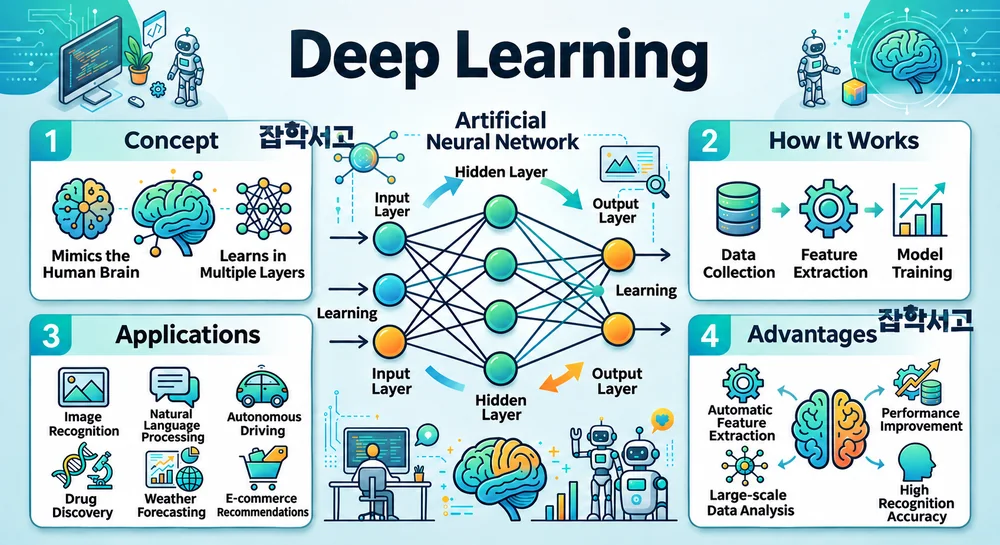
Deep learning is a branch of machine learning, which falls within the broader category of artificial intelligence (AI).
The human brain receives external stimuli and makes judgments through a complex network of tens of billions of nerve cells, or neurons. Deep learning operates on the basis of an artificial neural network, a mathematical model that mimics this neural network structure in the human brain.
The word "deep" is used here because the layers of the artificial neural network that process the input data are stacked across many stages to form a very deep, multilayered structure.
The Decisive Difference Between Machine Learning and Deep Learning
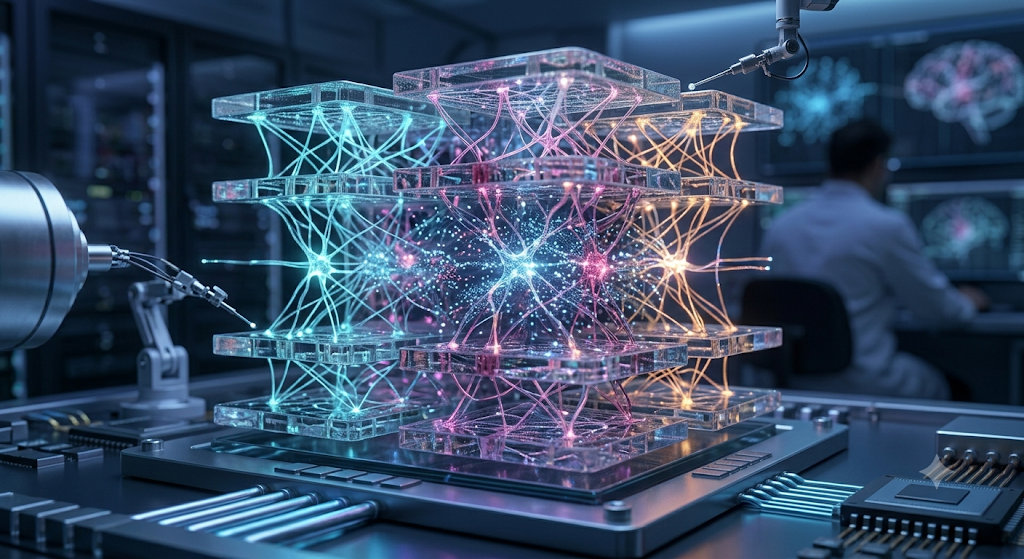
Many people use machine learning and deep learning interchangeably, but there is a key difference between the technologies. Deep learning is a branch of machine learning that learns feature representations using neural networks with multiple layers. Traditional methods often use human-designed features, but feature learning is not exclusive to deep learning.
- An Example of Traditional Machine Learning: A person designs image features, and the model learns classification rules from those features and training data.
- Deep Learning: All you need to do is give the computer tens of thousands of cat and dog photos. The deep learning algorithm analyzes the photos on its own, discovers patterns and features unique to cats, and learns them.
[Understanding Through a Simple Analogy: Traditional Programming vs. Deep Learning]
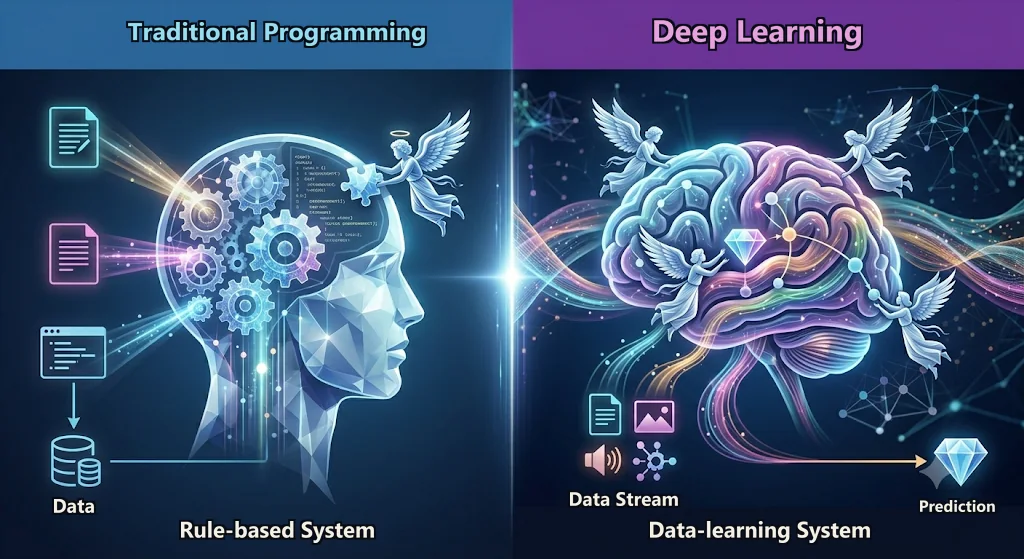
- Traditional Programming: A method that executes human-specified rules, like a person cooking according to recipes in a cookbook
- Deep Learning: An expert who, after tasting hundreds of dishes, independently figures out ingredient combinations and rules for controlling heat, then creates new dishes
How Does Deep Learning Learn? (How It Works and Examples)
The internal structure of deep learning is broadly divided into 3 types of layers.
a. Input Layer: The stage that receives raw data, such as images, audio, and text
b. Hidden Layer: The stage that extracts features from the data and performs computations step by step (multiple layers are present)
c. Output Layer: The stage that produces the final judgment or prediction
[The Step-by-Step Learning Process of Deep Learning for Recognizing Cat Photos]
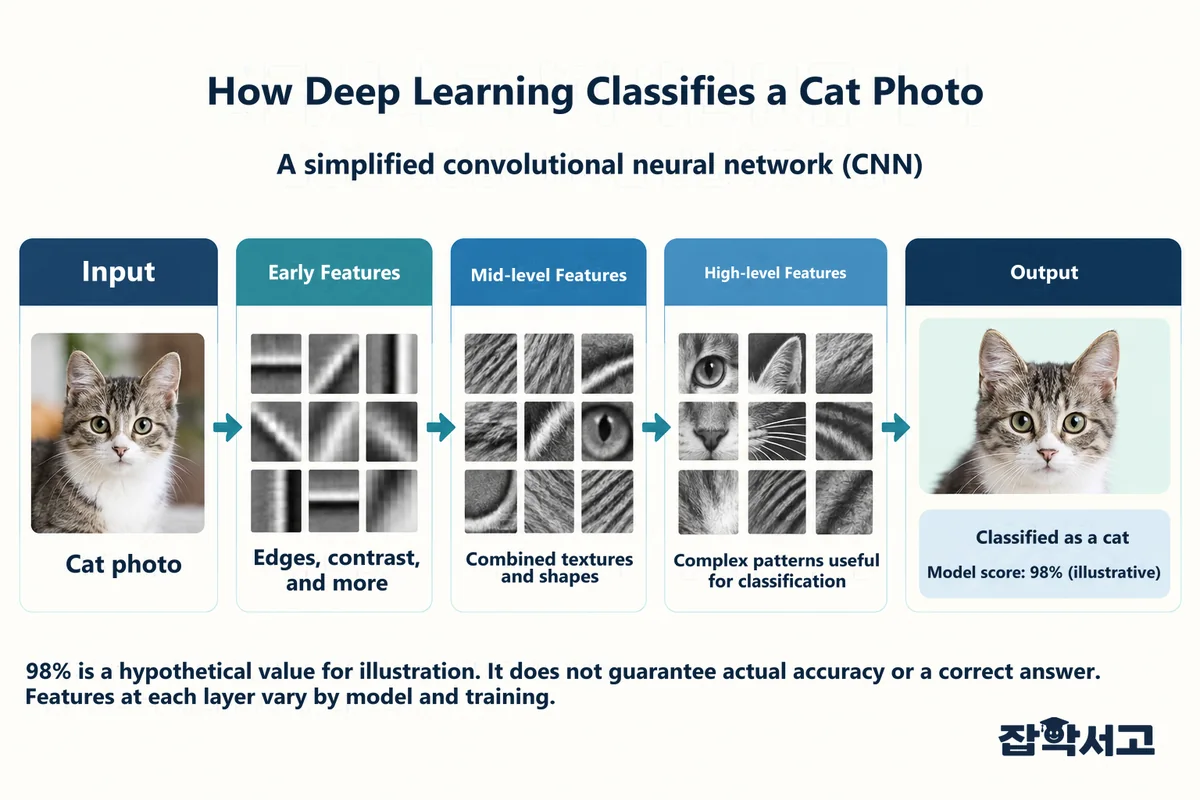
When a computer receives a cat photo, the following takes place in the hidden layers.
- Early Hidden Layers: Detect the simplest elements of the image, such as lines, light and shade, and edges.
- Intermediate Hidden Layers: Combine the extracted lines to form textures, curves, and simple shapes, such as ear shapes and pupil shapes.
- Higher Hidden Layers: Combine the shapes to complete a complex structure representing "the overall shape of a cat's face."
- Output Layer: Reaches the conclusion, "There is a 98% probability that this photo shows a cat."
In the early stages of learning, the computer also makes many incorrect predictions. However, after calculating the error between its prediction and the actual correct answer, it adjusts the connection strengths, or weights, within the neural network to reduce that error, tracing backward from the end toward the beginning. This is called the backpropagation algorithm, and by repeating this process millions of times, the AI gradually develops the ability to make accurate judgments.
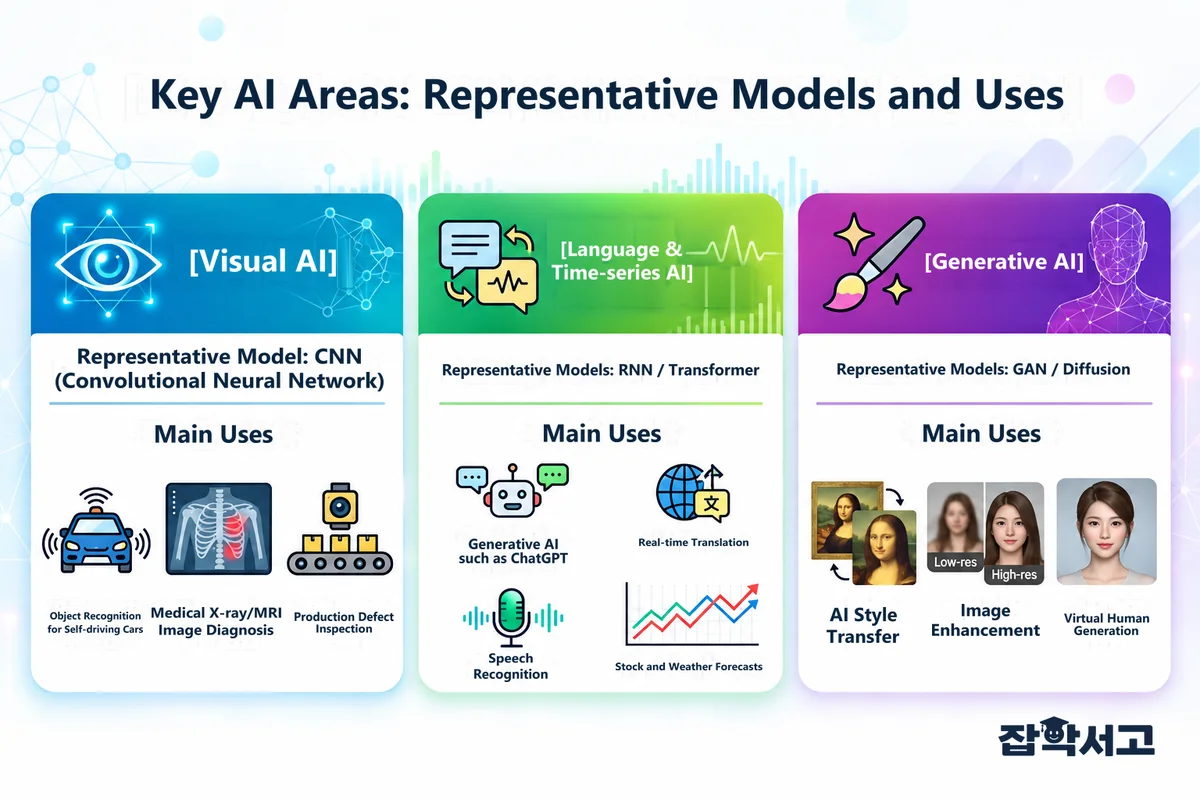
Major Areas Where Deep Learning Is Used
Deep learning has evolved into model architectures optimized for the types of data they handle.
The Limitations and Challenges of Deep Learning

Deep learning boasts powerful performance, but it also faces clear challenges that must be overcome.
The Black Box Problem (Explainability)
Because deep learning reaches conclusions using hundreds of millions of weights, it is difficult for people to trace the process backward and explain "why it reached that conclusion." This becomes a major obstacle in fields such as medicine, finance, and law, where accountability for explanations is important.
Vast Amounts of Data and Resource Consumption
Training a high-performance deep learning model consumes large-scale computing resources (GPU/NPU) and enormous amounts of electricity, and high-quality datasets are essential.
A Key Force Changing the Future of Information Technology
Deep learning goes beyond advances in computer technology to fundamentally change how people analyze the world and solve problems. Beyond automating simple repetitive tasks, it has established itself as a key tool for addressing complex problems facing humanity, including hyperpersonalized services, new drug development, and climate change prediction.
Understanding deep learning from an information technology perspective goes beyond simply keeping up with the latest trends; it will be a first step toward understanding the mechanisms of the coming data-driven society.