Network technology is at the heart of modern society's information and communications infrastructure and has become an indispensable part of the business environment. In a rapidly changing technological landscape, a deep understanding of networks and practical skills are valuable assets that strengthen an individual's expertise.
This material covers a broad range of topics, from the basic concepts of networking to the practical application of the latest technologies, aiming to provide the essential knowledge needed to develop into an expert. Each topic focuses on building practical capabilities by exploring both its theoretical background and its application in real situations in depth.
Understanding Network Fundamentals: Key Concepts and Terminology

Basic Concepts of Networking
A network is a system in which multiple devices are interconnected to exchange data. Networks have become essential in modern society, and understanding them is very important. The essence of a network lies in how connected devices, or nodes, exchange information. Nodes are the various devices connected to a network, such as computers, smartphones, and servers, which exchange data with one another to enable efficient information delivery.
A network means more than simply connecting devices; it also includes the various technologies and rules that help ensure efficient and reliable data transmission through those connections. The basic concepts of networking must therefore be understood alongside these various technical elements.
IP Addresses and Network Addressing Systems
Each device on a network is identified by a unique IP address. An IP address indicates a device's location on the network and plays an essential role in exchanging data. The addressing systems most commonly used in networking practice are IPv4 and IPv6. Although IPv4 has been widely used, limitations in its address space are driving a gradual transition to IPv6. IPv6 provides more addresses, which is essential for network environments that will continue to expand.
The IP address assigned to each device plays an important role in delivering data to the correct location on the network. Network practitioners must clearly understand this addressing system and have in-depth knowledge of IP address allocation and management.
Links: Paths for Data Transmission
In a network, a link is a path through which data is exchanged, referring to a physical path or wireless connection between devices. Network connections can be wired or wireless, and transmission speed and reliability differ depending on the method used. In wireless networks in particular, the frequency band and transmission distance have a significant impact on performance.
Wired connections are stable and support high-speed transmission, but installation and maintenance can be time-consuming. Wireless networks, on the other hand, are easy to install and offer excellent mobility, but their performance can vary with signal strength and obstacles. Network practitioners must understand these different connection methods and be able to choose the best method for the situation.
Protocols: Rules for Network Communication
In a network, a protocol is a set of rules that governs data transmission between devices. These rules ensure that data is delivered securely and accurately and also include processes for detecting and recovering from errors in real time. A representative protocol is TCP/IP, which divides data for transmission and checks that it arrives correctly.
Protocols are necessary to facilitate smooth communication over a network, enabling the various devices within it to exchange information with one another. Network experts must have an in-depth understanding of how protocols work and how to use them in practice.
Network Structure and Scope
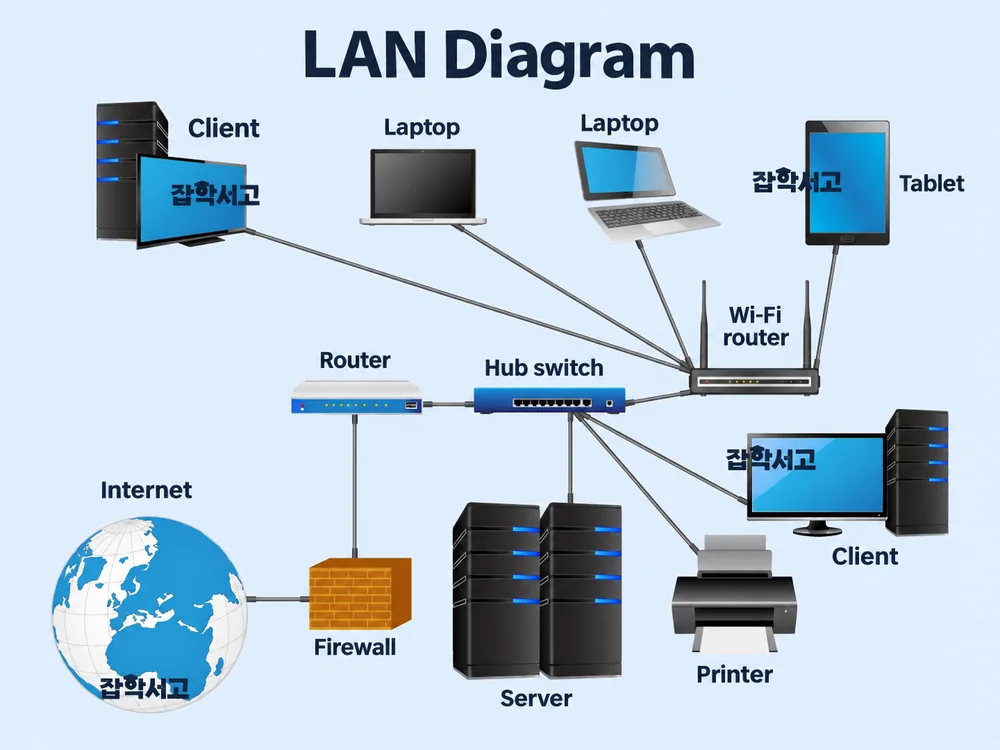
Networks can be divided into LANs (local area networks) and WANs (wide area networks) according to their scope of use. A LAN forms a network by connecting devices within a limited area and is primarily used in small areas such as homes or offices. LANs can be implemented at high speeds and low cost, enabling efficient network operation.
A WAN, on the other hand, connects areas much larger than those covered by a LAN and handles network connections between countries or continents. WANs support long-distance transmission and are primarily used in large-scale network environments. Network practitioners must understand network design and management approaches suited to each environment and have the ability to optimize them.
Network Security: Data Protection and Integrity
In a network environment, security is an important factor in ensuring data confidentiality and integrity. Various security technologies, including firewalls, encryption, and intrusion detection systems, are used to protect against threats such as information leaks through networks, hacking, and data corruption.
Firewalls block unauthorized access from outside the network, while encryption protects transmitted data to maintain confidentiality. Intrusion detection systems play an important role in detecting potential attacks early by monitoring unusual activity on the network. Network security requires the ability to understand these various technologies and apply them appropriately in practice.
Network practitioners must recognize that designs which do not account for security can always be exposed to risk and must thoroughly review security in every aspect of the network.
Network Design and Implementation
The Importance of Network Design
Efficient network design is essential to supporting an organization's business goals. This requires planning an optimal network structure that takes into account the organization's requirements, budget, and long-term operational plans. A network must be stable and scalable to continue performing in a changing business environment.
Network design goes beyond simply establishing physical connections. A comprehensive plan must be developed that considers efficient resource management, highly reliable data transmission, and scalability.
Choosing a Network Topology
Network topology is an important factor that determines how a network's nodes and links are arranged. The main topology types include bus, star, ring, and mesh, each with its own advantages and disadvantages.
A star topology is easy to manage centrally, making maintenance straightforward, but a problem with the central hub can affect the entire network. In a mesh topology, by contrast, nodes are interconnected, allowing communication through alternative paths even when a failure occurs, but its design and implementation are complex. Understanding these characteristics and choosing a topology that meets the organization's needs is important.
Equipment Selection and Performance Optimization
Network performance is directly affected by the equipment used. Equipment such as switches, routers, and access points must be selected carefully according to their respective functions and capacities. In large-scale network environments in particular, equipment compatibility, processing performance, and interoperability must all be considered for the network to maintain its reliability and performance.
When selecting equipment, priority should be given not only to cost efficiency but also to scalability, ease of maintenance, and the ability to handle network traffic reliably. It is also advisable to plan ahead so that equipment can be easily upgraded as technology advances.
Planning for Scalability
Over time, networks must accommodate more users and process more data. To prepare for this, scalability must be considered from the initial design stage. A scalable network allows capacity to be increased through simple upgrades or additional equipment when needed, making resource management efficient.
In particular, a network must be able to adapt flexibly as the organization grows and technology advances. This requires a modular design that allows additional equipment to be integrated easily or a structure that makes it easy to expand network capacity.
The Network Implementation Process
Network implementation requires careful planning and execution in stages. It includes various tasks, such as physical installation, network software setup, and protocol configuration. All of these processes must be carried out accurately for the network to provide a stable and reliable environment.
During implementation, it is important to thoroughly review each stage and identify unexpected problems or failures in advance. This minimizes problems that may arise during network implementation and enables them to be resolved quickly. Once implementation is complete, performance testing must be conducted to verify that actual performance matches the design goals.
Considering Network Security
Security must be considered from the initial stages of network implementation. Networks in which security is overlooked can become vulnerable to serious problems such as data leaks and hacking. To prevent this, clear security policies must be established during implementation, and security checks must be performed at each stage to minimize vulnerabilities.
Various measures can be used to strengthen security, including installing firewalls, introducing encryption technologies, and operating intrusion detection systems. These measures can prevent external attacks or internal information leaks that may occur during network operation and ensure the organization's safety over the long term.
Network design and implementation require thorough planning, security considerations, and a long-term strategy that allows for expansion. On this foundation, the network supports the organization's growth and provides a stable environment.
Practical Network Troubleshooting Techniques

Basic Principles of Network Troubleshooting
A systematic, step-by-step approach is essential to effectively resolving problems that arise during network operation. Resolving a problem begins with clearly identifying its symptoms and determining how often it occurs and the scope of its impact. This makes it possible to trace the cause more accurately and respond quickly. Attempting to resolve a problem while leaving its cause unclear can make a fundamental solution difficult, so identifying the problem is the most important first step.
Using Diagnostic Tools
Various network diagnostic tools are used to analyze the causes of problems. Network monitoring tools can detect network conditions in real time and immediately identify failures or abnormal traffic occurring on the network. Packet analyzers allow in-depth analysis of the details of data transmission, making them useful for tracing errors or delays during transmission. These tools help identify the root cause of a problem quickly and enable appropriate action.
A Step-by-Step Approach to Troubleshooting
The troubleshooting process requires forming hypotheses about the cause and conducting experiments in stages to verify them. Instead of seeking a solution all at once, the problem needs to be broken down into multiple stages, with its causes reviewed and addressed at each stage. To reduce mistakes and errors, it is advisable to begin by examining small steps. Recording the results of each stage and using them to plan the next stage makes the troubleshooting process more systematic and faster.
The Importance of Documentation After Troubleshooting
Once a problem has been resolved, documenting the process is essential. This documentation can serve as a reference for responding quickly when similar problems occur. Recording the approaches used and the tools that proved effective during troubleshooting is very helpful for improving future problem-solving capabilities. It also provides important reference material for planning preventive measures to keep the problem from recurring. Systematic documentation can also be shared within the team to develop better ways of responding.
The Role of Teamwork and Communication
Cooperation and smooth communication among team members play a very important role in network troubleshooting. The more complex a problem is, the more effective it is to approach it from different perspectives instead of solving it alone. Exchanging opinions and collaborating with team members allows the causes of a problem to be analyzed from more angles, helping the team develop a fast and accurate solution. Clearly communicating changes and progress during troubleshooting also enables the entire team to continue working efficiently.
The Need for Continuous Learning and Technical Development
Developing network troubleshooting skills requires consistent learning. Network technology continues to advance, and new types of problems may arise whenever new technologies are introduced. To prepare for this, it is important to learn about the latest technologies and trends and understand new tools and approaches. Continuous research and learning can strengthen one's capabilities as a network expert and help maintain competitiveness in a changing technological environment.
Ways to Apply the Latest Network Technologies and Tools

The Importance of the Latest Network Technologies
In a rapidly changing network environment, adopting the latest technologies is a key factor in strengthening an organization's competitiveness. Today's networks are evolving beyond simply providing connectivity into a technological foundation that supports flexible and efficient management. This can enable better performance, lower costs, and faster responses. In particular, technologies such as software-defined networking (SDN), network functions virtualization (NFV), and cloud networking are transforming the way networks are operated.
The Flexibility of Software-Defined Networking (SDN)
SDN is a technology that makes network operation more flexible by separating the network's control plane from its data forwarding plane. This allows administrators to easily change network settings through programming and quickly deploy new services and applications. The greatest advantage of SDN is its ability to respond quickly to changing requirements, which can greatly improve the efficiency of network operation. Organizations that adopt SDN can allocate resources flexibly and monitor and optimize network conditions in real time.
Cost Savings from Network Functions Virtualization (NFV)
NFV is a technology that replaces traditionally hardware-dependent network functions with software. This reduces dependence on physical equipment and can lower operating costs. NFV allows network functions to be deployed and adjusted flexibly as needed, enabling rapid responses to a fast-changing business environment. In particular, it can reduce the time required to set up hardware and is efficient because various network functions can be operated simultaneously in a virtualized environment.
The Global Scalability of Cloud Networking
Cloud networking is an approach to managing and operating network resources in a cloud environment and has become essential for many businesses today. Cloud networking allows network resources to be allocated dynamically as needed and application performance to be optimized. Networks that use the cloud offer excellent global scalability and are highly flexible, allowing resources to be expanded or reduced immediately when necessary. This enables businesses to provide stable services and manage resources efficiently at the same time.
Integrating the Latest Technologies and Tools
Integrating SDN and NFV further accelerates the automation of network operation. This can reduce routine operating costs and minimize human error. For example, tasks such as setting up alternative routes when a network failure occurs or optimizing traffic flow are performed automatically. Cloud-based networking solutions also make it possible to build network environments that can scale worldwide, making them highly effective for handling large volumes of traffic.
Integrating these latest technologies enables businesses to operate their networks quickly and flexibly and, as a result, contributes significantly to strengthening their competitiveness.
The Need to Adopt and Experiment with New Technologies
When adopting and using the latest technologies, organizations must assess their practical applicability through continuous learning and experimentation. Simply adopting a new technology is not enough; a process is needed to verify in advance, through pilot projects, whether it can be applied in an actual operating environment. This allows organizations to build an optimal network environment that meets their needs and achieve continuous improvement and development.
Ultimately, using the latest network technologies and tools transforms an organization's network operations, providing benefits such as cost savings, improved operational efficiency, and global scalability. Achieving this requires ongoing learning and optimization efforts.
Network technology continues to advance, and its importance is also growing. This material provides an in-depth understanding of networking practice, from the fundamentals to advanced applications, and will thereby contribute to strengthening expertise.
From acquiring fundamental networking knowledge to using the latest technologies, thorough learning and preparation are required at every stage. These consistent efforts will consolidate one's capabilities as a network expert and lay the foundation for playing an important role in the organization's success.