In modern society, the internet has become an essential part of our lives. However, as internet use increases, problems such as personal information leaks and invasions of privacy are also growing. VPNs (virtual private networks) are gaining attention as a way to address these problems, enabling safe internet use that guarantees anonymity.
This article takes a detailed look at the concept of a VPN, how it works, its main features, and the benefits those features provide.
What Is a VPN

What Is a VPN
A VPN (virtual private network) is a technology that helps users connect securely over a public network through the internet, as though they were using a private, dedicated network. This allows users to communicate securely without exposing their data to 3rd parties when they connect to a network remotely and exchange data. Businesses primarily use VPNs to let employees securely access their internal networks from outside the office, while individual users are also increasingly using VPNs to protect their privacy and strengthen security. A VPN serves an important role beyond simply providing a connection, protecting users' information and guaranteeing their anonymity.
Main Features and Roles of a VPN
The most fundamental feature of a VPN is data encryption. All data that users send over the internet is encrypted before transmission, preventing attackers who attempt to eavesdrop or hack from reading it. Unencrypted data can easily be exposed, particularly on public Wi-Fi or networks accessible to anyone. Using a VPN can greatly reduce these risks and offer stronger protection when conducting important financial transactions or transmitting sensitive personal information. In addition, a VPN keeps users' internet activity anonymous, making it difficult for outsiders to track or monitor their actions.
Strengthening Anonymity and Protecting IP Addresses
Using a VPN hides the user's actual IP address and exposes the VPN server's IP address instead. This is very useful when someone is trying to track the user's location online or when the user wants to bypass internet censorship in a particular country. For example, even in countries where governments monitor or restrict internet activity, users can browse the internet freely by connecting to a server in another country through a VPN. It also makes it difficult for hackers or advertising trackers to analyze users' locations or behavior, making it an important tool in situations that require personal information protection. When a VPN guarantees online anonymity, users can use the internet without worrying about their activities being exposed.
Bypassing Geographic Restrictions
Internet services are often available only in certain countries or regions. For example, some streaming services restrict access to particular countries, making their content unavailable in other countries. However, a VPN can bypass these geographic restrictions. By choosing a VPN server located in the relevant country, users appear to be connecting from that country and can access the content without geographic restrictions. This provides global access to information and makes it easy to find information from various countries. VPNs are also becoming essential tools for users who frequently travel abroad for business or need information from different countries.
Strengthening Security When Using Public Wi-Fi
Free Wi-Fi provided in public places is convenient, but it can also be vulnerable to security threats. There is a risk that hackers can easily infiltrate the network and steal other users' information. Public Wi-Fi is often unencrypted, so passwords or sensitive information entered by users may be exposed as they are. However, using a VPN encrypts and protects all data transmitted over public Wi-Fi. Strengthening security with a VPN is especially essential when using free Wi-Fi in places such as cafés, airports, and hotels. This keeps personal information secure because hackers cannot decrypt the encrypted data even if they gain access to the network.
Various VPN Use Cases
VPNs are used for a variety of purposes in addition to security and privacy protection. First, in countries with heavy internet censorship, VPNs serve as an important means of accessing the internet freely. Certain websites or services may be blocked in these countries, but a VPN can bypass this censorship. Second, VPNs are also useful when users who frequently travel abroad for business want to access services or content from their home countries. Streaming services or financial websites in their home countries often allow only certain IP addresses, so connecting to a server in their home country through a VPN can resolve this problem. Finally, VPNs securely protect important information within companies and help employees carry out their work safely from remote locations. The need for VPNs is growing even further in modern society, where working from home is becoming more common.
The Development of VPNs: The Evolution of Internet Security

The Emergence and Early Development of VPNs
The concept of a VPN emerged in the early 1990s and was initially used mainly by corporate IT departments as a means of securely connecting internal networks to the outside world. At the time, it was developed to help employees working remotely or traveling for business securely access their company networks, and it relied on tunneling and encryption technologies to protect data. This early VPN technology was used primarily within companies and had not yet spread widely among individual users. The widespread adoption of VPNs came later.
The Emergence of PPTP and the Popularization of VPNs
In 1996, PPTP (Point-to-Point Tunneling Protocol), developed by Microsoft employees Geokeu Ferguson and Bruce Lear, became an important turning point in the popularization of VPNs. PPTP was the first technology to enable private connections over the internet, creating an environment in which more users could use VPNs. Individual users, as well as businesses, became able to maintain secure connections over the internet. PPTP later became the foundation for the development of various VPN protocols, opening a new chapter in internet security.
Internet Security Issues and the Development of Protocols
As internet use grew explosively in the 2000s, security issues also came to the forefront. Various VPN protocols were developed to address these problems. Among them, L2TP, IPsec, and OpenVPN are considered representative protocols. L2TP and IPsec greatly improved VPN security and stability, with IPsec in particular becoming an important technology for guaranteeing data encryption and integrity. OpenVPN, developed as open-source software, also offered significant advantages in flexibility and security, becoming a protocol favored by many users. These technological advances greatly increased demand for VPNs among both individual and business users.
Cloud Technology and the Evolution of VPNs
As the 2010s began, advances in cloud technology also had a major impact on VPNs. Integrating VPNs with cloud-based services made VPN deployment and management much easier in business environments, enabling companies to strengthen network security more efficiently. It also created an environment in which individual users could easily use VPNs across various devices. The ability to use a VPN simultaneously on multiple devices, such as smartphones, tablets, and laptops, greatly improved convenience and accessibility for users. This helped further expand the scope of VPN use.
Personal Information Protection and the Necessity of VPNs
As the importance of personal information protection has gained considerable attention in recent years, VPNs have become essential tools. In particular, the introduction of international regulations such as the GDPR (General Data Protection Regulation) has made personal data protection an important issue worldwide. Using a VPN protects users' internet activity and keeps their data safe from external intrusions or surveillance. In countries where internet censorship and access restrictions are intensifying, VPNs are sometimes used as the only means of accessing information. Under these circumstances, VPNs are becoming increasingly important as key tools that guarantee security and free internet use.
The Future and Continued Development of VPNs
VPNs have become essential technologies that form the foundation of internet security, extending beyond simple network connectivity. As internet environments are expected to become more complex and various security threats continue to grow, VPN technology is likely to keep advancing. In particular, integration with next-generation network technologies will further improve VPN security and functionality, allowing VPNs to continue serving as more powerful internet security solutions. VPNs will remain important tools for both individuals and businesses, continuing to generate new features and use cases through research and innovation.
How VPNs Work: Data Encryption and Anonymity
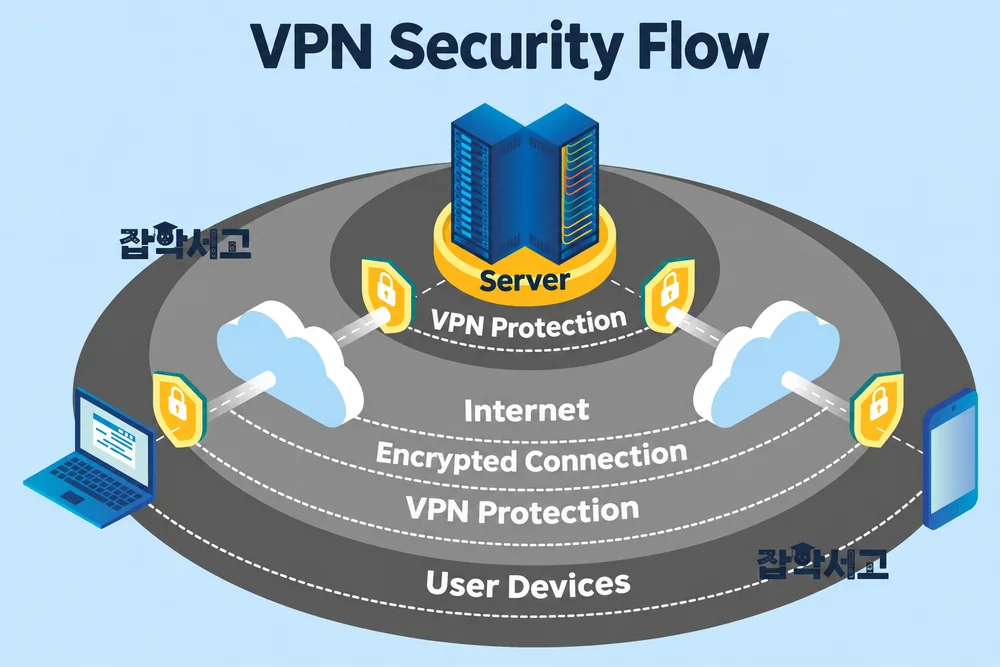
Installing a VPN Client and Initial Setup
The first step in using a VPN is for the user to install a VPN client on their device. This client is software that helps establish a secure connection to a VPN server, allowing the user to build a secure internet connection. VPN clients are supported on various operating systems and devices, including Windows, Macs, and smartphones, and users can easily install them with just a few clicks.
After installing the client, users can manage their connection to the VPN server and change settings as needed. In particular, enabling automatic connection allows the VPN to start automatically and maintain security even on public Wi-Fi or in network environments with weak security. This step is very important because it is the first step toward safe internet use.
Encrypted Data Transmission: Ensuring Secure Communication
The second step is that all data is encrypted and transmitted during the process of requesting a connection to the server through the VPN client. A VPN protects the data users send and receive over the network with strong encryption algorithms such as AES-256. This encryption method provides military-grade security and safely protects all activities users perform on the internet.
When unencrypted data is transmitted, hackers or eavesdroppers can easily steal it, but using a VPN keeps the data securely protected. Using a VPN when exchanging sensitive information, such as in banking transactions or email communications, can greatly reduce security threats on the network.
Hiding IP Addresses: The Key to Online Anonymity
After connecting to a VPN server, the user's actual IP address is replaced with the VPN server's IP address. This process is an important step in guaranteeing the user's online anonymity, protecting their actual location and identity from being exposed to outsiders. An IP address is important information that can be used to track where a user is connecting from, so hiding it strengthens anonymity on the internet.
This feature is particularly useful in countries where governments or institutions monitor or censor internet activity. Through a VPN, users can hide their locations and use the internet freely while thoroughly protecting their online privacy.
Relaying Requests Through a VPN Server: Secure Internet Browsing
A VPN server connects to the internet services requested by the user on the user's behalf. When a user visits a website or uses an online service, the request is relayed through the VPN server. During this process, the user's actual location or IP address is not exposed to outsiders, who can see only the VPN server's information.
Because the VPN server transmits the user's data in encrypted form, it minimizes the possibility of the data being stolen or altered in transit. This is especially useful in network environments with weak security, such as public Wi-Fi, allowing users to browse the internet safely.
Decrypting Response Data: Secure Delivery of Information
Responses received from the website or service requested by the user are sent back to the user through the VPN server. The received data is encrypted again before being transmitted to the user, and the VPN client decrypts it and presents it in a form the user can understand. Because the decrypted data is delivered to the user in a fully protected state, there is almost no possibility of information being leaked or altered along the way.
This process takes place in real time, minimizing any slowdown or delay experienced by the user. VPNs therefore offer the advantage of guaranteeing safe internet use without degrading the user experience.
The Importance of Data Encryption and VPN Security Technologies
Data encryption is one of a VPN's core features, protecting all data users send and receive. In particular, advanced encryption technologies such as AES-256 prevent hackers from decrypting data even if they steal it. Financial institutions and government agencies also use these encryption methods to protect data, indicating that VPNs provide a very high level of security.
Beyond simply protecting data, VPNs allow users to browse the internet with peace of mind. This enables users to securely protect important data, including personal information, business information, and financial transaction records, from external threats.
Choosing VPN Servers in Various Locations: Expanding Access to Content
In addition to strengthening security, VPNs allow users to choose servers in various regions and access content without geographic restrictions. For example, when users want to access a streaming service or news website available only in a particular country, choosing a VPN server in that country lets them freely access its content.
This feature is especially useful for users who frequently travel abroad for business or live overseas. Through a VPN server, users can access services or content from their home countries, maximizing their access to a wide range of information.
Bypassing Internet Censorship and Restrictions: Free Internet Use
VPNs guarantee free internet use even in countries where governments or institutions block or monitor access to certain websites. Through a VPN, users can bypass these restrictions to find a wide range of information and access censored content.
In particular, VPNs serve as important tools when users living abroad want to access news or content from their home countries. Users can connect to servers in their home countries through a VPN and access the information they want without restrictions. In this way, VPNs bypass internet censorship and restrictions, enabling free access to information.
Main VPN Features and Benefits: Safe Internet Use

Strengthening Security Through a VPN
One of the most important features of a VPN is stronger security. When users access the internet, all data is transmitted in encrypted form, preventing 3rd parties from decrypting or intercepting it. Even when using networks with weak security, such as public Wi-Fi, users can securely exchange data through a VPN, protecting their personal information from hackers or eavesdropping attempts. A VPN's encryption feature is especially important when handling financial information or personal files.
Encryption methods primarily use advanced technologies such as AES-256 to maximize security. This technology is recognized as providing military-grade security and is highly effective at keeping data safe. Through these encryption features, users can handle important information securely and greatly reduce security threats.
Strengthening Online Privacy and Anonymity
A VPN makes users' online activities more secure by hiding their actual IP addresses. When users connect to the internet through a VPN server, the VPN server's IP address is exposed instead of their actual IP addresses, making it very difficult to track their locations or identities. This is particularly useful in regions where internet surveillance or censorship takes place.
A VPN's ability to provide anonymity is very helpful both for individual users who want to keep their internet usage history from being tracked and when handling important corporate information. In addition, using a VPN can prevent advertisers or marketing companies from tracking users' online behavior, further strengthening privacy protection.
Free Access to Geographically Restricted Content
A VPN allows users to freely access geographically restricted content. It helps users connect to a server in a particular country and access content available only there, even when they are not physically in that country. For example, users can access streaming services or news websites available only in certain countries and easily access content from their home countries while traveling or living abroad.
This feature increases global access to information by overcoming geographic constraints. It is particularly useful when many users want to access content from their home countries while abroad or view restricted information from other countries. By guaranteeing the freedom to access content through a VPN, users can enjoy the right to access the information they want from anywhere in the world.
Secure Network Access in Remote Work Environments
VPNs have become essential tools in remote work environments. When remote employees connect to their company's internal network through an external network, they are likely to be exposed to security threats. Using a VPN in this situation can securely encrypt the network and protect data.
Through a VPN, companies can safely protect important confidential information or data from outsiders and enable remote employees to carry out their work securely. This has received greater emphasis as remote work has become widespread following the COVID-19 pandemic. Employees working outside the office are provided with the same security environment as the office's internal network through a VPN, allowing them to address security problems.
Optimizing Internet Speeds and Bypassing Restrictions
VPNs can also help optimize internet speeds. Some internet service providers may restrict certain traffic or regulate speeds, but a VPN can bypass these restrictions. For example, internet service providers may restrict traffic for streaming services or large downloads, but using a VPN lets users avoid these restrictions and use the services at smooth speeds.
Bypassing speed restrictions imposed by an ISP (internet service provider) through a VPN greatly improves the internet experience. This is especially useful for tasks that require large data transfers, allowing users to experience faster and more stable internet speeds through a VPN.
Providing a Safe and Free Internet Environment
VPNs help users enjoy a safe and free internet environment. Users can securely exchange data even over public networks and access a variety of content without geographic restrictions. These features have established VPNs as key technologies that guarantee freedom of internet use, extending beyond simple security tools.
In addition, VPNs can bypass internet censorship or surveillance, allowing users to explore information and communicate more freely. Thanks to VPN security and anonymity, users' privacy is protected, and they can use the internet safely from anywhere in the world. These benefits further highlight the importance of VPNs and are the main reasons why increasing numbers of people are adopting them.
The Continuing Need for VPNs and Their Outlook
VPNs are important technologies that go beyond simple security tools to help users around the world use the internet safely. Through various features, including privacy protection, bypassing geographic restrictions, and stronger security, they greatly improve the internet experience. Their importance will continue to grow as VPN technology advances.
In particular, as remote work becomes widespread, VPNs will become even more essential tools and remain key technologies for guaranteeing freedom and security on the internet. VPNs will continue to provide users with safer and freer internet environments, establishing themselves as essential foundations of internet security.
VPNs have become essential tools in today's internet environment, playing an important role in guaranteeing security, privacy, and anonymity. They enable users to browse the internet more safely and gain the freedom to access a wide range of online content.
As technology advances, the features and scope of VPN use will expand further, and their importance as essential elements of internet security will continue to grow.