With advances in modern agricultural technology and the widespread use of protected cultivation (greenhouse growing), we live in an era when lettuce, cucumbers, and tomatoes are available at supermarkets 365 days a year. However, there are substantial biological and nutritional differences between vegetables grown year-round under state-of-the-art temperature and humidity controls and seasonal vegetables that have endured the full force of nature's seasonal rhythms.
Unlike animals, plants are organisms that cannot move from place to place. They must therefore confront harsh changes in their external environment themselves, including intense sunlight, sudden cold snaps, dry winds, and attacks by insects or pathogens. The chemicals that plants synthesize themselves to survive are called 'secondary metabolites' or 'phytochemicals.'
Seasonal vegetables are particularly nutritious and strongly flavored because these phytochemicals and antioxidants reach their highest levels as the plants endure nature's trials.
The magic of natural light levels and day–night temperature differences: For example, shepherd's purse and Korean wild chives grown outdoors in spring undergo repeated freezing and thawing in the winter soil, concentrating carbohydrates and producing intensely aromatic compounds (organic sulfur compounds) to survive. By contrast, greenhouse vegetables grown at a constant temperature under artificial lighting experience the 'Dilution Effect': their cells grow quickly, but their internal concentrations of vitamins and minerals become relatively diluted.
Ultimately, eating seasonal vegetables goes beyond simply eating fresh food: it is a scientific approach to managing health that allows us to absorb the biological defense substances and optimal nutritional balance that plants have accumulated over an entire season.
Seasonal Vegetable Mechanisms & a Four-Season Nutrition Map
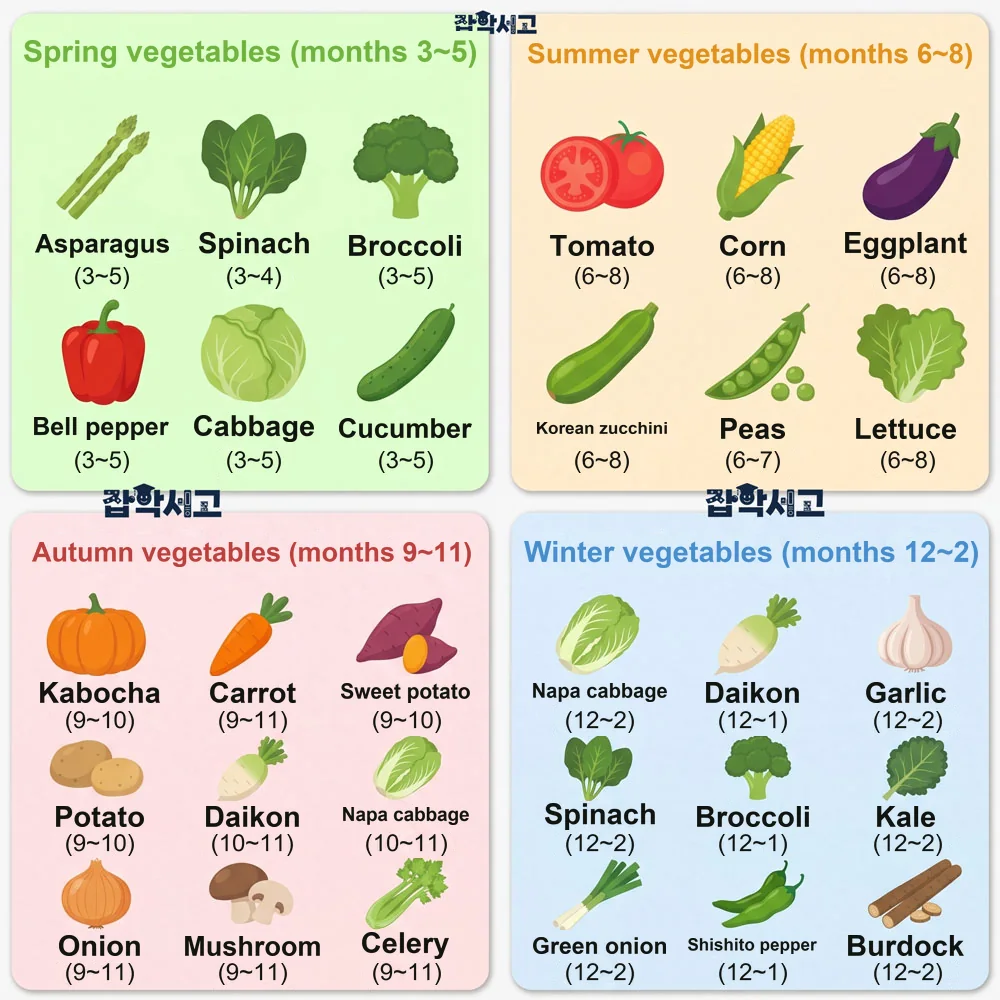
Spring Vegetables in Season (Months 3–5): A Remedy for Spring Fatigue That Shakes Off Lethargy

Spring is the time when frozen ground thaws and plant life bursts into growth. The key themes of spring vegetables are 'metabolic activation' and 'restoration of liver function.' As the body's metabolic rate, which slowed during winter, rises sharply, consumption of B vitamins and vitamin C increases to 3–5 times the usual level. A characteristic physical adaptation that occurs at this time is 'spring fatigue.'
① Korean Wild Chives (Months 3–4)
Key components: Allicin, vitamin C, calcium
Nutritional mechanism: Allicin, which gives Korean wild chives their distinctive pungent taste, prevents blood clot formation and promotes blood circulation. In combination with vitamin C, it stimulates the autonomic nervous system and quickly relieves the tiredness caused by spring fatigue.
② Shepherd's Purse (Months 3–4)
Key components: Choline, vitamins A, B1, and C, zinc
Nutritional mechanism: Its protein content is exceptionally high among vegetables, and it is rich in choline, which helps prevent liver cirrhosis and fatty liver. In traditional Korean medicine, it is also regarded as a key medicinal vegetable for 'protecting eyesight and strengthening liver function.'
③ Chwinamul (Wild Aster Greens) (Months 3–5)
Key components: Potassium, coumarin, beta-carotene
Nutritional mechanism: Its abundant potassium helps the body excrete sodium, while coumarin promotes smooth blood circulation and prevents blood vessel constriction caused by temperature fluctuations in spring.
④ Aralia Shoots (Months 4–5)
Key components: Saponin, vitamin K, phytosterols
Nutritional mechanism: The slightly bitter taste of aralia shoots, known as the 'king of mountain vegetables,' comes from saponin. Saponin activates immune cells, regulates blood sugar, and has a powerful effect on restoring vitality in both men and women.
⑤ Cabbage (Spring Cabbage: Months 3–5)
Key components: Vitamin U (S-methylmethionine), vitamin K, sulforaphane
Nutritional mechanism: Spring cabbage has thin leaves and a high sugar content. It is rich in vitamin U, which helps regenerate the stomach lining, and sulforaphane, a substance that fights cancer and suppresses inflammation, improving gastrointestinal problems during seasonal transitions.
⑥ Water Dropwort (Months 3–5)
Key components: Quercetin, kaempferol, isorhamnetin
Nutritional mechanism: It is the quintessential vegetable for heavy metal elimination and detoxification. Flavonoids such as quercetin activate the action of enzymes that break down toxic substances in the liver.
Summer Vegetables in Season (Months 6–8): The Science of Replenishing Fluids and Releasing Heat

Summer is a season when intense ultraviolet radiation and high temperatures maximize the loss of body fluids and cause excessive production of reactive oxygen species. Summer vegetables are characterized by 'high water content,' 'body temperature regulation (yin food properties),' and 'antioxidant compounds that protect against ultraviolet radiation.'
① Potatoes (Months 6–9)
Key components: Resistant starch, vitamin C, potassium
Nutritional mechanism: The vitamin C in potatoes is surrounded by starch granules, so a markedly smaller proportion is destroyed even when heated. Potatoes are also a source of potassium, which regulates water metabolism and stabilizes the heartbeat.
② Corn (Months 7–9)
Key components: Maysin, lutein, dietary fiber
Nutritional mechanism: Maysin, which is abundant in corn silk, promotes diuresis to eliminate summer swelling, while the unsaturated fatty acids in the germ improve blood cholesterol levels.
③ Eggplant (Months 5–8)
Key components: Nasunin, anthocyanins, chlorogenic acid
Nutritional mechanism: Nasunin in the purple skin of eggplant is a powerful antioxidant that eliminates skin cell damage caused by ultraviolet exposure and oxidative stress in the body. With a water content of more than 93%, eggplant is excellent for lowering body heat.
④ Young Squash (Months 6–8)
Key components: Carotenoids, vitamin A, lecithin
Nutritional mechanism: Rich in easily digested and absorbed carbohydrates and vitamin A, it protects digestive organs exhausted by summer heat and supports brain cell metabolism.
⑤ Cucumbers (Months 4–7)
Key components: Isoquercitrin, eculin, water (95%)
Nutritional mechanism: Their abundant water and diuretic compounds help the body eliminate waste. When used to quench thirst after exercise, they provide a higher rate of electrolyte absorption than purified water, making them effective in preventing heatstroke.
⑥ Young Radishes (Months 6–8)
Key components: Vitamins A and C, isothiocyanates
Nutritional mechanism: They replenish essential minerals and vitamins that are easily lost through sweat in summer, while the isothiocyanates responsible for their pungent, spicy taste stimulate appetite.
Autumn Vegetables in Season (Months 9–11): Roots, Nourishment, and Nutrient Storage for Winter

Autumn is the time when plants concentrate nutrients from their stems and leaves into their roots and fruits in preparation for frost. Seasonal autumn vegetables therefore consist mainly of 'root vegetables' and specialize in 'improving the gut microbial environment (prebiotics)' and 'stabilizing blood sugar.'
① Radishes (Months 10–12)
Key components: Diastase, isothiocyanates, vitamin C
Nutritional mechanism: Autumn radishes reach such a peak in sugar and water content that they are called 'ginseng from the fields.' Rich in the natural digestive enzymes diastase and amylase, they provide complete digestive support for carbohydrate-heavy diets.
② Napa Cabbage (Months 11–12)
Key components: Glucosinolates, pectin, vitamin C
Nutritional mechanism: Autumn napa cabbage used for winter kimchi making develops thick leaves and tightly filled heads, with the highest concentrations of the anticancer compounds glucosinolates. Pectin, a water-soluble dietary fiber, feeds beneficial gut bacteria.
③ Mature Pumpkin (Months 10–12)
Key components: Beta-carotene, lecithin, glucose
Nutritional mechanism: Rich in beta-carotene, which is converted into vitamin A in the body, it protects mucosal health and boasts unrivaled effectiveness in promoting diuresis and reducing postpartum swelling.
④ Sweet Potatoes (Months 8–10)
Key components: Yaponin, serapin, dietary fiber
Nutritional mechanism: Yaponin, a component of the white liquid released when sweet potatoes are cut, prevents colorectal cancer and promotes intestinal motility. Their low glycemic index (GI) makes them suitable for providing sustained energy.
⑤ Burdock Root (Months 1–3, Months 9–12)
Key components: Inulin, lignin, arginine
Nutritional mechanism: It is rich in 'inulin,' a water-soluble dietary fiber known as natural insulin, which reduces the burden on the pancreas and maintains blood sugar levels without sharp increases. Lignin has antibacterial effects.
⑥ Lotus Root (Months 9–11)
Key components: Dietary fiber, tannin, vitamin C
Nutritional overview: Lotus root contains dietary fiber, vitamin C, and other nutrients. It is inaccurate to call its mucilaginous substances mucin. Mucins are glycoproteins found in mucus secreted by animals and should be distinguished from plant mucilage. Eating lotus root cannot be claimed to coat the stomach wall or relieve gastric ulcers or inflammation. See the terminology correction from the Japanese Society for Food Science and Technology and the correction from Kyoto University Hospital.
Winter Vegetables in Season (Months 12–2): Exceptional Sweetness and Nutrition Forged by Bitter Cold

Vegetables growing in fields or outdoors in winter must prevent their cells from freezing in subzero temperatures. Water freezes at 0℃, but a high solvent concentration, as in sugar water, lowers the freezing point. Plants use this principle too.
💡 [A Simple Science Example: Spinach's Antifreeze Mechanism]
Principle: Pure water freezes at 0℃ and destroys cell membranes. However, when bitter cold arrives, spinach growing outdoors in winter rapidly breaks down its internal starch into organic acids and sugars (glucose).
Result: As the sugar concentration in the cell sap increases, it enters a nonfreezing 'natural antifreeze state.' This is why winter spinach, bomdong cabbage, and broccoli have exceptional sweetness and crispness compared with those grown in other seasons, as though they had been sprinkled with sugar.
① Spinach (Months 11–3)
Key components: Lutein, folate, iron, chlorophyll
Nutritional mechanism: Winter spinach has thick leaves, and the red pigments in its roots (manganese and soluble iron) become more intense. It is rich in folate, which is essential for preventing anemia and activating brain function.
② Bomdong (Spring Cabbage) (Months 1–3)
Key components: Vitamin A precursor, sinigrin, calcium
Nutritional mechanism: This is a cabbage with a cotyledon-like form whose leaves spread broadly sideways to receive as much sunlight as possible as it grows. Rich in amino acids, it develops a nutty flavor the more it is chewed and is excellent for strengthening immunity.
③ Broccoli (Months 10–1)
Key components: Sulforaphane, indole-3-carbinol, vitamin C
Nutritional mechanism: Ranked among the world's top 10 superfoods, it has the highest concentration of sulforaphane, a compound that targets cancer, among cruciferous vegetables. Its vitamin C content is 2 times that of lemons.
④ Kohlrabi (Months 11–1)
Key components: Vitamin C, glucosinolates, anthocyanins
Nutritional mechanism: A vegetable bred by crossing cabbage with turnip, it combines the crispness of turnip with the sweetness of cabbage. Extremely low in calories but concentrated in dietary fiber and vitamin C, it is suitable as a food for weight loss.
A Guide to Smart Eating in Tune with the Seasons
The seasonal vegetables that nature gives us mean more than mere ingredients. Over millions of years, the human body has adapted its metabolic rate, hormone secretion, and temperature regulation systems to seasonal changes. Nature's narrative of spring detoxification, summer hydration, autumn nutrient storage, and winter immune maintenance aligns perfectly with human biological rhythms.
📌 Tips for Maximizing Nutrition from Seasonal Vegetables

- Spring vegetables: Prepare raw vegetables as geotjeori, a freshly seasoned vegetable dish, or briefly blanch them and eat them as namul, seasoned vegetable dishes, to minimize the destruction of heat-sensitive vitamin C and enzymes.
- Summer vegetables: Vegetables such as eggplant and squash are best lightly stir-fried in good oils (olive oil or perilla oil) to increase the absorption of fat-soluble vitamins and phytochemicals.
- Autumn root vegetables: Because the antioxidant compounds lignin and tannin are concentrated in the skins of burdock and lotus root, it is beneficial to gently scrape them with the back of a knife and cook them with their skins on.
- Winter cruciferous vegetables: Boiling broccoli or kohlrabi in water causes their active components to leach out because they are water-soluble, so the best approach is to cook them in a steamer for no more than 3 minutes.
In modern society, where the environment and the dining table have become disconnected, checking 'Which vegetables has the soil produced in this season?' during your monthly supermarket visit is one of the easiest yet most powerful investments in health. How about putting a plate of fresh seasonal vegetables that embody the rhythm of the season on your dinner table tonight?