This time, I would like to prepare material on the PDCA cycle for achieving goals and improving organizations. PDCA (plan–do–check–act) is a method for managing production, quality, and other aspects of business and organizational activities, and is a 4-step management method used for continuous product improvement.
The Concept of the PDCA Cycle
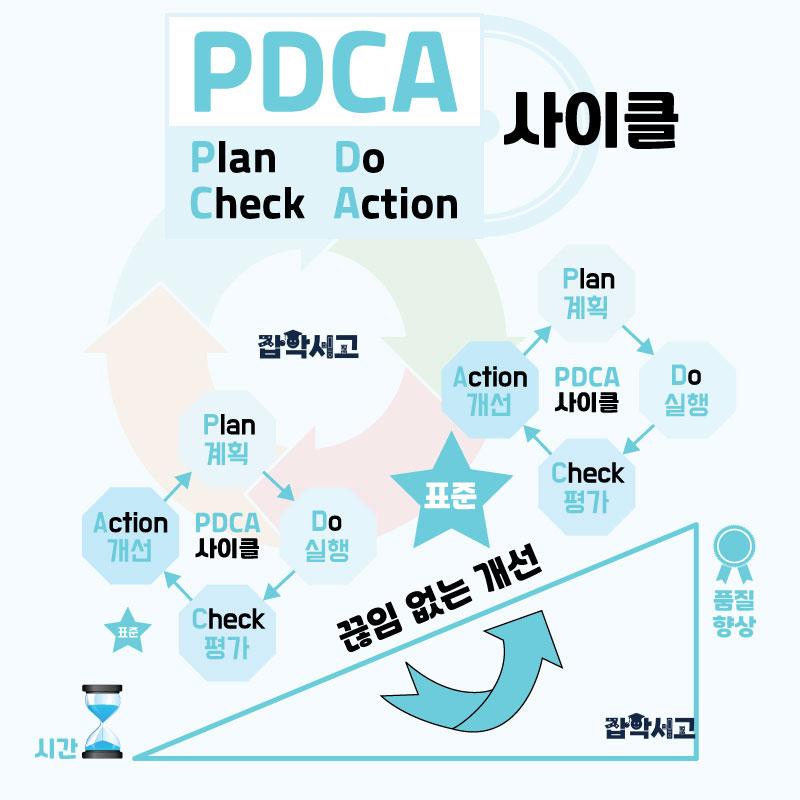 Conceptual Diagram of the PDCA Cycle
This technique is used to achieve set goals by repeatedly carrying out the 4 steps of [Planning → Implementation → Evaluation → Improvement], and is one of the main models used by many organizations to produce products or provide services.
The PDCA cycle is useful for quality management and process improvement in organizations that aim for continuous improvement. This cycle is iterative, and its continued rotation allows organizations to improve and develop continuously.
In addition to the existing 4 steps, there is also a 5-step version called OPDCA, which adds 'O' = Observe (observation) as a preliminary step for observing the current state.
Each Stage of PDCA
1. Planning Stage
 Planning Stage
In the initial planning stage, the current workflow or a new workflow is evaluated to determine how it can be improved. This includes setting goals, identifying and analyzing problems, and developing improvement methods and strategies.
Detailed items are measured and plans are developed through SWOT analysis of planning, budgets, personnel and organizational inputs, and other factors, and planning small changes first without being overly ambitious not only makes monitoring easier but also makes results easier to predict.
For information on SWOT analysis, please refer to the material below.
 Marketing Strategies in Business Administration
2. Implementation Stage
 Implementation Stage
The implementation stage is the stage in which the plan developed for change in the previous stage is tested, and data is collected to determine how effective that change is.
This includes various management activities, quality development, the provision of optimal services, and the systematic management and analysis of information.
3. Evaluation Stage
 Evaluation Stage
The evaluation stage is the stage in which the data and results collected in the preceding stage are evaluated and compared with the expected results to identify similarities and differences.
When the PDCA cycle is carried out multiple times, trends can be identified more easily, and this process makes it possible to determine which changes are more effective and make improvements.
The evaluation stage covers performance and whether goals have been achieved, whether work has been carried out efficiently, the degree of policy attainment, and other factors.
4. Improvement Stage
 Improvement Stage
The improvement stage calls for establishing a new standard and moving forward if implementing the planning stage has led to improvements over the previous state. However, if implementing the planning stage in the preceding stages has not brought about adequate improvement, it would be better to maintain the existing standard (criteria).
And in both cases, if something different from expectations has emerged (whether better or worse), there will be more learning to do. This stage includes improving management activities, reviewing work and assigning priorities, reform, improvement, and incorporating new management plans.
We have now explored the PDCA cycle for achieving goals and making continuous improvements. The more the 4-step PDCA cycle is repeated, the closer users can get to the goals they have set, allowing flawless operation to be achieved.
By applying these principles, an organization can be made to grow continuously, and by identifying and addressing its problems, it can be transformed into a valuable organization over time.