With the digital revolution, the way information circulates is changing faster than ever, and social media lies at the center of these changes. Today, social media has a profound influence on communication and the structures of news production and consumption, while also bringing major changes to the flow of information throughout society.
This article discusses the rise of social media and the resulting changes in traditional media, the structure of information distribution in the digital environment, the multifaceted effects of social media on news production and consumption, and a new turning point in the communication paradigm.
The rise of social media and changes in traditional news media

The rise of social media and changes in communication methods
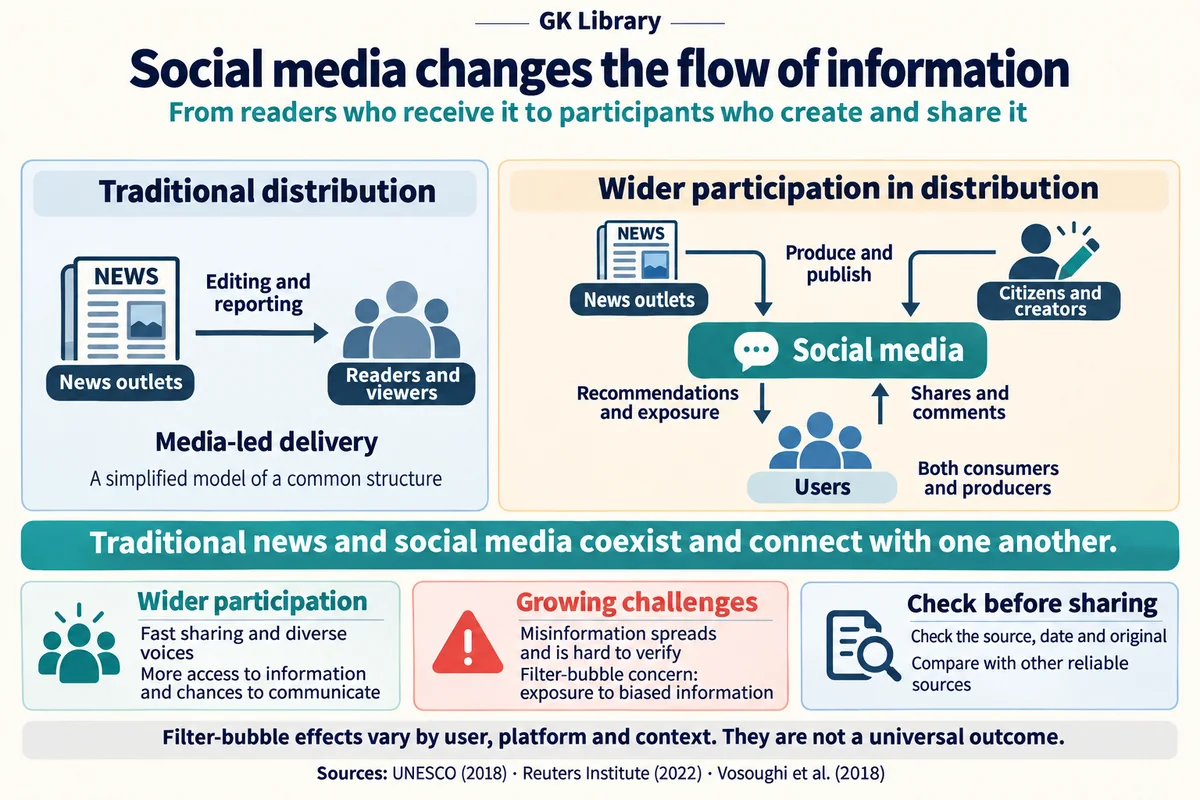
Social media has grown rapidly since the early 21st century, fundamentally transforming the communication paradigm. Social media platforms such as Facebook, Twitter, and Instagram have completely changed how people consume and produce information. Whereas information once flowed in one direction, the emergence of social media has enabled information to circulate through two-way communication between users. Individuals have now moved beyond being consumers who simply receive information and have also taken on the role of producing and spreading it.
The development of social media has rapidly accelerated the speed at which information circulates. With just a few clicks, information can now spread around the world in an instant, driving a broad movement toward the democratization of information. In the past, particular groups controlled information distribution through a limited number of channels, but social media has become a channel through which individual voices can readily be heard in society. It provides a forum where diverse social voices can be expressed and particular issues can be discussed widely.
Traditional news media's digital transformation and adaptation strategies
The rapid spread of social media has brought major changes to traditional news outlets, ushering in an era in which survival is difficult without adaptation. Traditional media such as newspapers, television, and radio are exploring various strategies to respond to the digital information environment. To strengthen communication with readers, news organizations actively use social media to distribute articles and collect readers' reactions through comment and sharing features. By strengthening interaction with readers in this way, they are working to increase their credibility.
The digital transformation of traditional news media goes beyond simply changing platforms. Because online articles allow immediate feedback from readers, pressure to provide more timely information is increasing. News organizations are therefore adopting various approaches suited to the digital age, such as strengthening real-time breaking news services and introducing algorithms that provide information tailored to readers. These changes have become essential tasks that traditional news media must undertake to survive and remain competitive.
The spread of citizen journalism and changes in news production
The development of social media has spread the concept of citizen journalism and brought major changes to news production. In the past, news was produced by professionals such as reporters, but ordinary citizens can now also serve as important news sources. The widespread availability of smartphones and social media platforms has ushered in an era in which anyone can record scenes of events and share them in real time. These changes are prompting a reconsideration of the traditional reporter's role in the news production process.
The growth of citizen journalism contributes to greater diversity and accessibility of information, but it also raises issues concerning information's reliability and accuracy. As an environment in which anyone can produce news has emerged, the likelihood of inaccurate reporting or false information spreading rapidly has also increased. Traditional news media must therefore embrace the strengths of citizen journalism while strengthening information verification procedures and working to provide accurate information. Cooperation and coordination between traditional news media and citizen journalism can play an important role in this process.
The challenge of spreading information while maintaining reliability
Social media enables information to spread rapidly while also creating an environment in which distorted information or inaccurate reports can spread quickly. This poses a major challenge to ensuring the reliability and accuracy of information. For example, if incorrect information about a particular event spreads through social media, its effects may be difficult to reverse. The dissemination of information and the maintenance of its reliability are therefore emerging as highly important tasks in the social media environment.
Traditional news media are making various efforts to address these problems. One approach is to focus on verifying the accuracy of information spreading on social media and providing authoritative information. They also seek to maintain reliability by operating dedicated fact-checking departments or establishing systems that promptly provide corrections and explanations for incorrect information. These efforts play an important role in further strengthening traditional news media's credibility and sense of responsibility in a digital environment where information overload and distortion are intensifying.
Coexistence and complementarity between traditional news media and social media
The rise of social media presents both a crisis and a new opportunity for traditional news media. Social media enables information to spread rapidly and widely, but it has limitations in maintaining information reliability. Traditional news media, meanwhile, follow systematic verification procedures to ensure accuracy and reliability, but they can struggle to match social media's speed and reach. It is necessary to explore ways for the two to coexist by compensating for these limitations.
To this end, traditional news media should actively use social media's speed and accessibility to expand their points of contact with readers, while social media should improve information quality by drawing on traditional news media's credibility and verification systems. For example, news organizations can attract readers by providing previews of articles or key information through social media, while social media can play a complementary role by sharing news organizations' fact-checking results. When social media and traditional news media cooperate by making use of each other's strengths in this way, they can create a more efficient and reliable information distribution environment.
Information distribution and social media in the digital environment

Changes in information distribution in the digital environment
The development of the digital environment has transformed information distribution as a whole, moving beyond the previous structure in which information was simply conveyed in one direction. In the past, information was delivered one way through traditional media such as newspapers, radio, and television, and the flow of information was largely determined by these media. However, as social media has become widespread, this structure has changed fundamentally, establishing a new paradigm in which information circulates through two-way communication. Individuals can now produce and share information themselves rather than merely receive it, making the forms and roles of communication more diverse.
Expanding information accessibility and diversity
In the digital environment, access to information has become much freer and more varied than before. An environment has emerged in which anyone can easily access a wide range of information through the internet and social media, accelerating the democratization of information. In the past, people could consume only the information selected by media outlets, but individuals can now find and share information according to their own choices and interests. These changes have laid the foundation for diverse perspectives to be reflected in society, moving beyond previous methods of information distribution that reflected only the opinions of particular groups. Social media, in particular, plays a role in sharing and spreading information in real time, maximizing information accessibility.
The prosumer era and the increasing complexity of information
The development of social media has blurred the boundary between information consumers and producers, opening the so-called “prosumer” era. A prosumer is an individual who acts as both a consumer and a producer of information, and these individuals can immediately produce and spread information through social media. Information that was once produced on a limited basis by reporters or experts can now be easily created and distributed by anyone. As a result, the volume and variety of information have increased explosively, and the flow of information has developed a more complex, multilayered structure. However, these changes also raise issues concerning information's reliability and accuracy.
Diverse content formats and social media's capacity for expansion
In the digital environment, social media provides a space where various forms of content, including text, images, and videos, can be freely produced and shared. This diversity of content attracts users' interest and enriches communication methods. For example, unlike the past, when information was conveyed only through text, information can now be delivered through a combination of images and videos, enabling more vivid communication. This enables two-way communication in which users can actively participate and respond, rather than information simply being delivered.
Issues surrounding information reliability and quality
The development of the digital environment and social media is creating new problems in information distribution. An environment in which anyone can produce and share information raises questions about information's reliability and quality and carries the risk of incorrect information or inaccurate reports spreading easily. In an environment where information spreads rapidly, it has become increasingly common for its accuracy and authenticity to be difficult to verify. These problems can cause social confusion, creating a need for new standards and methods to maintain information quality.
The emergence of personal data protection and privacy issues
Personal data protection and privacy are also emerging as important issues in the process of distributing information through social media. In the digital environment, users' data is collected and analyzed through various channels, and its use in advertising and marketing is becoming increasingly common. However, there is a risk that personal data may be used indiscriminately or misused, which is driving greater public concern and stronger regulation concerning personal data protection. Measures are needed to strike a balance between personal data protection and the freedom to distribute information, and users should therefore take a cautious approach to the information they share and the use of their data.
Social media's potential and challenges
In conclusion, social media in the digital environment is innovating information distribution and playing an important role in promoting communication and the democratization of information. At the same time, however, it faces new challenges, including information reliability and personal data protection. Information users must develop the ability to assess the quality of the information they consume and produce, while social media platforms must strengthen verification systems to provide reliable information. These efforts can maximize social media's potential and enable it to develop in a positive direction.
Analyzing social media's impact on journalism

Social media and the redefinition of journalism
Social media is prompting a fundamental redefinition of journalism's traditional role. In the past, news organizations and reporters monopolized the production and distribution of information, and information flowed in one direction through particular media outlets and experts. However, the rapid development of social media has created an environment in which anyone can become both a producer and a distributor of information. These changes are redefining journalism's role and demanding innovative changes in journalists' responsibilities and approaches. Social media marks a turning point in how journalism handles information, raising new questions about journalism's fundamental role.
New possibilities for news production and dissemination
Social media is opening unprecedented possibilities for producing and spreading news. Reporters can now convey information from the scene of an event in real time through social media and receive rapid feedback through immediate interaction with readers. This makes the news production process more transparent and faster, while providing opportunities to strengthen the relationship between reporters and readers. Whereas traditional journalism delivered news only after it had been edited, social media can show the news production process in real time, allowing readers to experience directly how news is created. This increases trust in news and helps journalism communicate more closely with readers.
Reflecting diverse voices and broadening pluralistic perspectives
Social media serves as a platform that can reflect diverse voices and plays an important role in adding pluralistic perspectives to journalism. In traditional journalism, social issues were handled by major media outlets and particular reporters, so socially disadvantaged people and marginalized voices were often insufficiently represented. Social media offers the possibility of overcoming these limitations. Because anyone can express their voice through social media, the voices of socially disadvantaged people and marginalized groups can spread more widely. This provides opportunities to shed light on various social issues that traditional journalism has not yet addressed and can help strengthen journalism's social responsibility.
The risk of inaccurate reporting and fake news spreading
While social media has a positive influence on journalism, it also creates new problems that threaten information reliability. The nature of social media allows information to spread quickly, but it also increases the risk that incorrect information or inaccurate reports will spread just as easily. If fake news spreads through social media, it can cause social confusion and seriously undermine journalism's credibility. These problems can be particularly serious in urgent news coverage, such as breaking news or reports of incidents and accidents. If information is not verified before it spreads on social media, accuracy and reliability, which are fundamental values of journalism, inevitably suffer. Journalists therefore need stronger verification procedures and a greater sense of responsibility to maintain information accuracy and quality.
Sensational content and declining journalistic quality
On social media, the tendency to maximize clicks and views makes sensational content more likely to be emphasized. This tendency risks reducing journalistic quality and can encourage a focus on provocative issues rather than in-depth, analytical reporting. Social media platforms' algorithms tend to prioritize the display of content that can attract users' attention, which can undermine factual accuracy and impartiality, fundamental values of journalism. As journalism adapts to social media's speed and view-driven structure, situations may arise in which it becomes difficult to preserve the essential value of news. Journalists must therefore work to maintain fair, fact-based reporting without relying on view counts.
Journalism's new roles and adaptation
Overall, social media has both positive and negative effects on journalism, offering opportunities to increase information accessibility and diversity. Alongside these opportunities, however, it brings new challenges in maintaining information reliability. To adapt to these changes, journalism must explore new roles that maintain information accuracy and quality while strengthening communication with readers. For journalism to survive in the social media environment, it is important to use social media's speed and accessibility while establishing structures that preserve accuracy and impartiality.
Social media and a new turning point in communication

Social media marks an important turning point in modern communication, comprehensively restructuring existing systems of information production and consumption. In the past, information was mainly conveyed in one direction through news organizations or particular media outlets, and recipients remained passive consumers of information. However, with the development of social media, information has taken the form of two-way communication in which anyone can easily produce and consume it. Individuals now function as active agents capable of producing and spreading information, rather than simply receiving it, presenting a new paradigm that calls for a structural transformation of communication.
Diversifying information delivery methods and democratizing communication
Social media provides various methods of delivering information and plays an important role in promoting the democratization of information. As content in various formats, such as text, images, and videos, has become freely usable on social media, information delivery methods have become richer. People can now access information in real time without relying on particular media outlets and can produce their own content and share it with many others. Through this, social media offers opportunities for individual voices to be reflected throughout society and provides a forum where diverse social groups can express their opinions. These changes move beyond simply consuming information, transforming its production and dissemination into activities in which everyone can participate and driving the democratization of communication.
The growing prominence of information quality and reliability issues
As information accessibility expands, issues surrounding information quality and reliability are gaining renewed attention. Social media provides an open environment in which anyone can produce and share information, but this characteristic also carries the risk of incorrect information or fake news spreading. Because information spreads rapidly, inaccurate reports or false information can cause significant social confusion, making it increasingly important to distinguish reliable information from unreliable information. Information recipients must develop the ability to assess information's quality and reliability while encountering information from various sources, and these issues underscore the importance of media literacy education in modern communication.
Social media's impact on businesses and organizations
Social media has brought major changes not only to individuals' communication but also to the communication strategies of businesses and organizations. Through social media, businesses are strengthening real-time interaction with customers and gaining opportunities to improve their brand image and credibility. For example, businesses can manage their customer relationships more closely by using social media to collect customer feedback immediately and respond to it. They can also build a positive corporate image by communicating their brand's value to consumers through social media, increasing credibility, and responding promptly to customers' needs. These changes have made new communication strategies centered on customer relationships an essential element, extending beyond traditional advertising and public relations methods.
Social media's negative effects and ethical challenges
Social media plays a positive role in providing access to information and a forum for communication, but it also has negative effects. Adverse effects such as social media addiction, privacy issues, and personal data leaks are becoming increasingly serious problems at both the societal and individual levels. When users spend long periods absorbed in social media, their social interaction in the real world may decrease, which can also negatively affect their mental health. In addition, as personal data is collected through various channels and used for marketing, the risk of users' private information being leaked indiscriminately is also increasing. These problems suggest that social ethics and regulatory systems must be strengthened for the efficient use of social media, and establishing appropriate regulations and ethical standards is emerging as an important task in the modern communication environment.
Society's response to changes in the communication paradigm
The changes in the communication paradigm brought about by social media are increasing the democratization and accessibility of information while also creating new demands concerning information reliability and personal data protection. To respond to these changes, society as a whole must recognize the importance of media literacy education and strengthen education on how to consume reliable information. Governments and platform companies also need to strengthen information verification systems and establish transparent personal data protection policies to protect users. Society should move toward making the most of social media's positive potential while minimizing its negative aspects, thereby creating a healthier and more reliable information environment.
Social media is leading innovation in modern communication and driving fundamental changes in information distribution. While this has positive effects in promoting information accessibility and democratization, it also presents new challenges in maintaining information reliability and quality.
Modern society therefore needs to explore ways to maximize social media's positive effects and minimize its negative impacts. These efforts can help optimize the opportunities social media provides and contribute to advancing communication in a more positive direction.