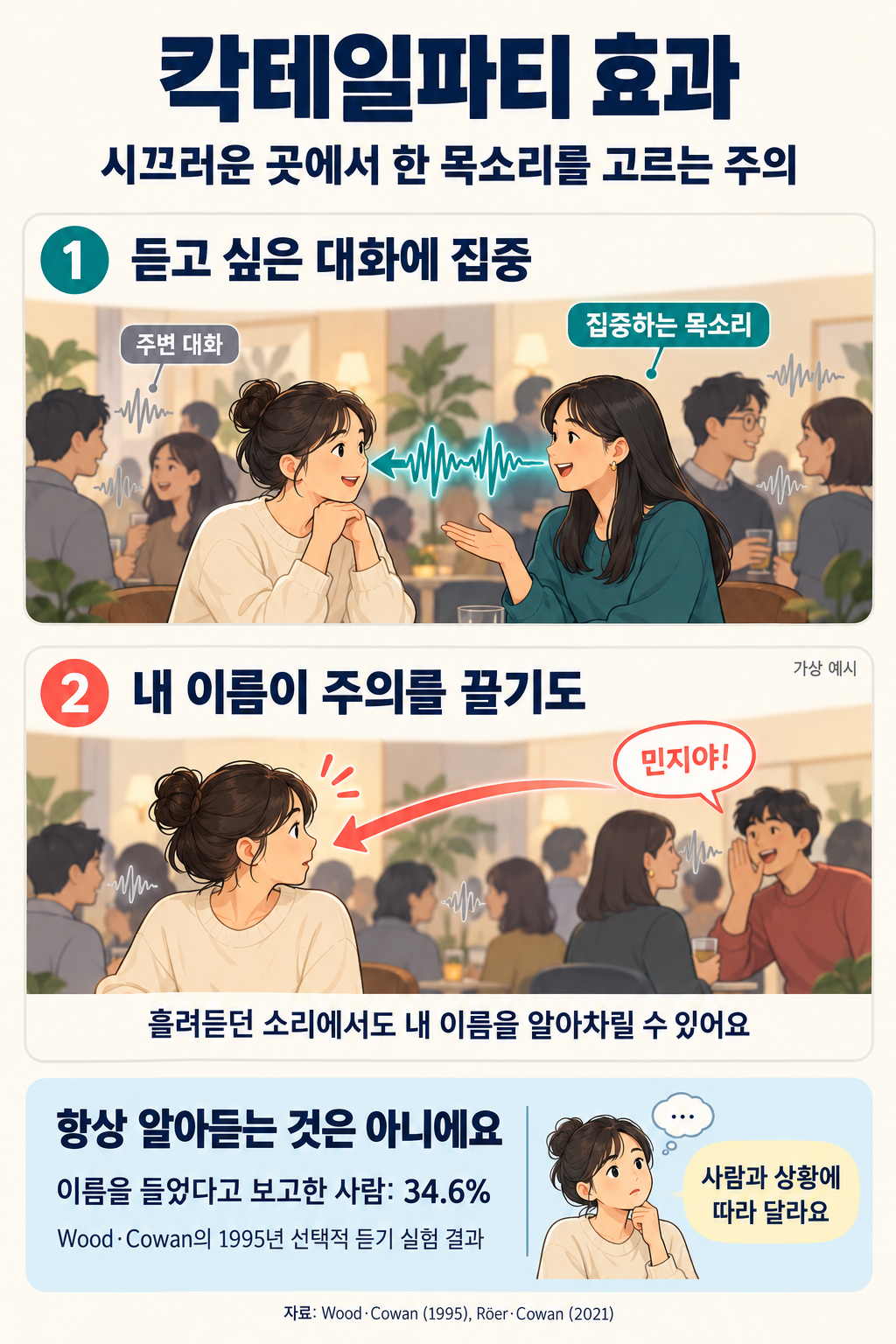
Even in a crowded restaurant or a noisy gathering, we can understand the voice of the friend sitting across from us without much trouble, even though dozens of people around us are talking at the same time. Curiously, though, while we are absorbed in conversation, our head often turns on its own when someone far away calls our name, even though it was a sound we were clearly not listening to.
This phenomenon, ‘focusing attention on and picking out one desired sound in an environment where many sounds are mixed together, while still reacting to important information such as one’s own name in the sounds being ignored’, is called the ‘Cocktail Party Effect’. The name is easy to understand if you picture a party where people holding cocktail glasses are each engaged in their own conversations.
In this article, we will look in turn at the background of how the cocktail party effect was first studied, the theories about how ignored sounds are processed, the individual differences hidden in this phenomenon, and its uses in daily life and technology.
The Power to Pick Out One Voice in the Noise: The Cocktail Party Effect
Experiments Listening With Only One Ear

The first person to study this phenomenon systematically was Colin Cherry, a British engineer and cognitive scientist. In a study published in 1953, he called the question of how people can follow just one voice when several people speak at once the ‘cocktail party problem’ and investigated it through experiments.
(1) The Dichotic Listening Task
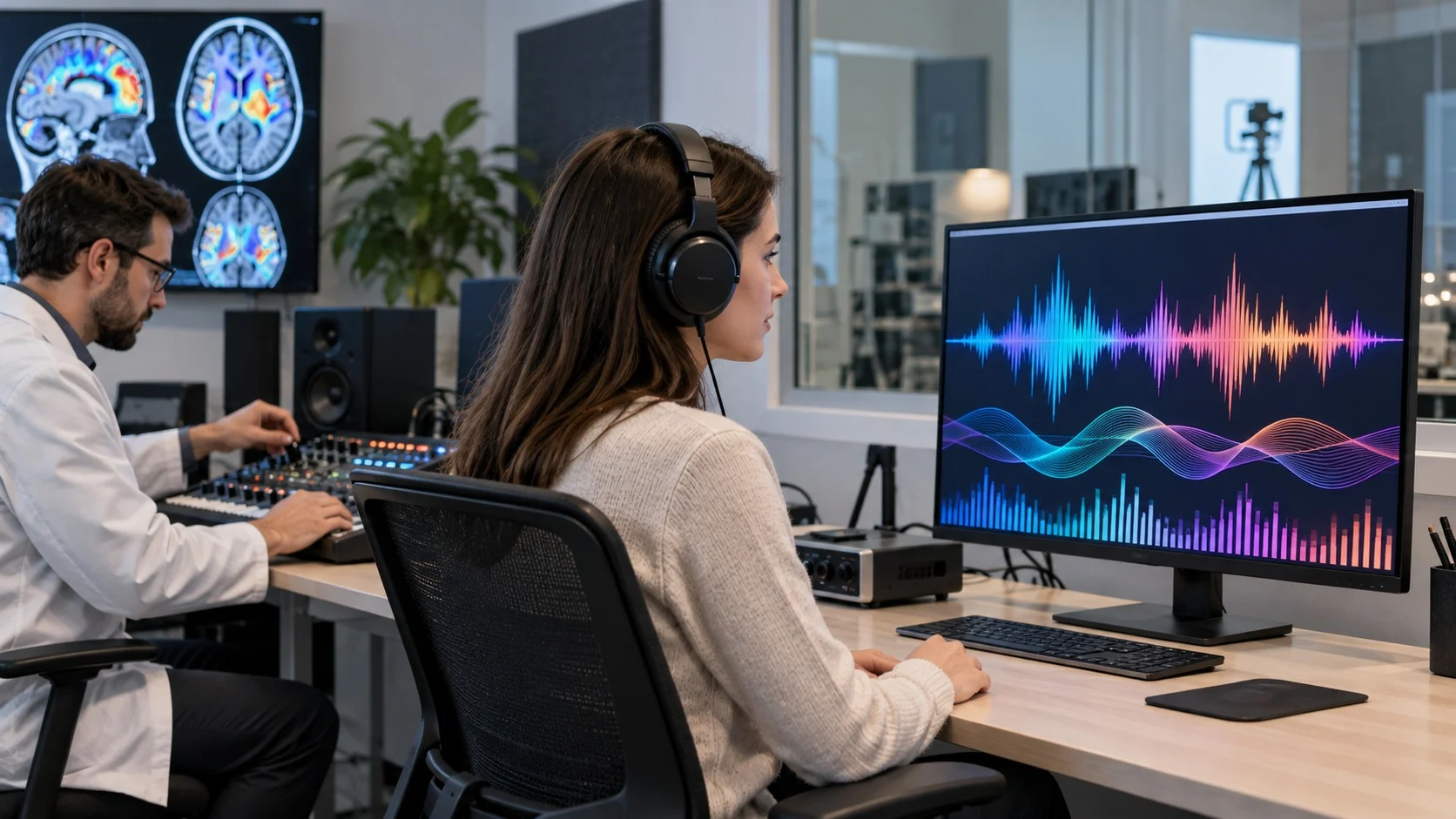
Cherry played different speech into each ear of a participant wearing headphones at the same time. This is called ‘Dichotic Listening’.
(2) Shadowing
Participants had to repeat aloud, word for word, the speech they heard in one ear. Doing this naturally draws attention to just that one ear.
(3) Memory of the Ignored Ear
When asked after the experiment about what they had heard in the other ear, participants could recall almost none of its meaning. However, they did notice physical features, such as whether the voice was male or female, or whether it was speech or a simple tone.
How Far Are Filtered-Out Sounds Processed?
Building on Cherry’s results, psychologists put forward theories explaining how people deal with sounds they are not paying attention to.
- Filter Theory: Proposed by Donald Broadbent in 1958. It held that sounds are first filtered by physical features such as the pitch or direction of a voice, and that unselected sounds are blocked before their meaning is analyzed.
- Attenuation Theory: Anne Treisman argued that filtered-out sounds are not completely blocked but keep flowing in at a reduced volume. This explains why important words, such as your own name, can be noticed even from a weakened signal.
- Late Selection Theory: The claim that all incoming sounds are processed all the way to their meaning, and that which sound to respond to is chosen only afterward.
The decisive evidence that shook filter theory was a name. In 1959, Neville Moray mixed participants’ own names into the other ear while they were shadowing. If sounds were filtered out by physical features alone, the names should not have been heard either, yet some participants noticed their own name.
Not Everyone Hears Their Own Name

The cocktail party effect is often thought of as something that happens to everyone, but the experimental results are a little different. In Moray’s experiment, about one third of participants said they heard their own name, and when Noelle Wood and Nelson Cowan repeated the experiment with a more refined method in 1995, the proportion was still 34.6%.
So who notices their name? In 2001, Andrew Conway’s research team found the answer in ‘Working Memory’ capacity. Working memory is the ability to temporarily hold and handle the information needed while thinking.
The results showed that only 20% of people with high working memory capacity noticed their name, while 65% of those with low capacity did. This suggests that hearing your name may be less a sign of superior ability and more the result of a weaker ability to block out distracting sounds, letting attention leak away easily.
The Cocktail Party Effect in Daily Life and Technology

The cocktail party effect shows up in many forms outside the lab as well.
Examples in Daily Life and Technology
- Calling by Name: In a classroom or meeting, addressing someone by name makes it much easier to catch their attention.
- Hearing Loss and Hearing Aids (Hearing Aid): When hearing declines, picking out one voice in noise becomes especially difficult. That is why hearing aids put great effort into features that make speech clearer and reduce background noise.
- Speech Recognition: Separating a single person’s voice from a recording in which several people speak at once has long been considered a difficult challenge in speech technology as well.
- Focus Environment: The reason the conversations around you are especially distracting when you study or work is that meaningful speech is not filtered out and pulls your attention.
In the end, the human brain does not hear every sound equally; it protects our ears by choosing the sounds that matter now and turning the rest down.
The cocktail party effect shows that we sort through far more sounds than we think, and that even the sounds we ignore do not vanish completely. It also reveals that this power of selective listening differs from person to person.
In a noisy world, what we hear and what we let pass by is ultimately decided by our attention. Noticing where your ears are directed is the first step toward reclaiming focus amid a distracting daily life.