Compilers are essential to software development, playing the important role of converting source code written by programmers into a form that computers can understand. Compilers go beyond simple conversion and also play a central role in optimizing software performance, making a proper understanding of these roles essential for software developers.
This material systematically examines compilers, beginning with their definition and main functions, then covering their components and various techniques for optimizing performance. Through this, readers will gain a concrete understanding of how compilers fulfill an essential role in the software development process.
What Is a Compiler: Concepts and Definitions

The Role and Concept of a Compiler
A compiler is a key tool that converts source code written by programmers into machine code that computers can understand. This allows programmers to develop software without directly understanding complex hardware operations, serving as a bridge between human language and machine language.
A compiler handles the programming language in which source code is written and the target language into which it will be converted, namely machine code. In this process, the compiler enables software to run by converting the code written by programmers into a form that machines can execute. In this way, compilers are indispensable to software development.
Types of Compilers
Compilers are broadly divided into transcompilers and interpreter-based compilers. Transcompilers are used to convert code from one high-level language to another, helping port programs to specific environments. Interpreter-based compilers, on the other hand, do not convert source code directly into machine code, but execute it in an intermediate code form and perform translation in real time.
The History of Compilers
The history of compilers dates back to the late 1950s. The first compiler was developed for Fortran, one of the early programming languages, and this laid the foundation for the development of compiler technology today. Since then, compilers have steadily evolved alongside advances in various programming languages and hardware.
Advances in compiler technology have gone beyond simple code conversion to provide an environment in which programmers can develop more complex software. In particular, error detection and optimization are among the important features that modern compilers must provide.
The Functions of Modern Compilers
Modern compilers do more than simply convert code into machine code; they also include features such as code optimization and error detection. These features maximize software performance and help developers create programs without errors. Compilers maximize software efficiency by automatically detecting errors that programmers might overlook and improving code for better performance.
In this process, compilers apply various optimization techniques to analyze source code, remove unnecessary parts, or rearrange it into a more efficient structure. This allows software to run faster and more reliably while making effective use of system resources.
The Importance of Compilers
Compilers have established themselves as an important technology in modern software development, extending beyond their role as simple code conversion tools. Advances in compilers improve the efficiency of software development and provide a foundation for building more complex and varied applications.
A thorough understanding of compilers is essential knowledge for software developers and plays an important role in developing higher-quality software. Compilers will continue to advance through optimization techniques and the integration of new technologies, opening up new possibilities for software development.
The Main Functions and Components of Compilers

The Basic Components of a Compiler
A compiler consists of three main components: the front end, the intermediate stage, and the back end. Each component is responsible for processing and optimizing source code to ultimately generate machine code. Through the interaction of these components, the compiler efficiently converts code written by programmers.
Front End: Parsing and Error Detection
The front end, the first stage of a compiler, plays the important role of analyzing the syntax of source code and detecting errors. The front end primarily identifies syntax errors in source code and reports them to programmers, while checking the code's logical consistency through semantic analysis. This process is an important task for checking whether code has been written correctly, and when errors are found, it clearly communicates the relevant information to programmers so they can make corrections.
The front-end stage also analyzes the structure of source code and converts it into an internal representation. This converted internal representation is used in subsequent stages and is prepared to interact with the compiler's other components.
Intermediate Stage: Optimization and Improved Efficiency
Source code that has passed through the front end is converted into an intermediate representation (IR), which plays an important role in increasing the compiler's flexibility and portability. The intermediate stage primarily performs code optimization, including removing unnecessary code and optimizing repetitive loops. Techniques that maximize the code's execution efficiency through data flow analysis are also applied.
Optimization in the intermediate stage is an important process for improving software performance. Optimizing code at this stage can improve execution speed and reduce the resources used by a program. Using an intermediate representation allows the same software to run efficiently on various platforms and architectures, making it one of a compiler's core features.
Back End: Conversion to Machine Code and Executable Generation
The back end is the stage that converts code in an intermediate representation into actual machine code to generate the final executable. At this stage, the intermediate representation is converted to suit the processor's architecture, and various techniques are applied to maximize performance. The back end enables the processor to execute code efficiently through register allocation, instruction selection, pipelining, and other techniques.
In the back-end stage, it is particularly important to optimize code to reflect the characteristics of the target hardware. The main goal of the back end is to maximize performance and improve the efficiency of the executable by converting code to suit each processor's architecture. This allows the compiled program to run smoothly on the corresponding hardware.
The Role and Importance of Intermediate Representation
The intermediate representation stage, located between the front end and back end, plays an important role in improving the compiler's flexibility and portability. Intermediate representation enables consistent conversion across various programming languages and hardware platforms and provides opportunities to apply optimization techniques.
The optimization techniques used at this stage are important factors in maximizing software performance. Through intermediate representation, code is adjusted to suit the platform and unnecessary operations are removed, producing faster and more reliable programs.
The Ongoing Development of Compilers
Compilers are continually advancing to reduce the complexity of software development and maximize program efficiency. Their components interact to improve code performance and ensure consistent performance across various platforms.
Advances in compilers provide software developers with a better development environment and contribute to reducing code errors and maximizing performance. Compilers will continue to evolve through a wider range of optimization techniques and technology integration, making software development more efficient and powerful.
From Source Code to Machine Code: An Analysis of the Conversion Process
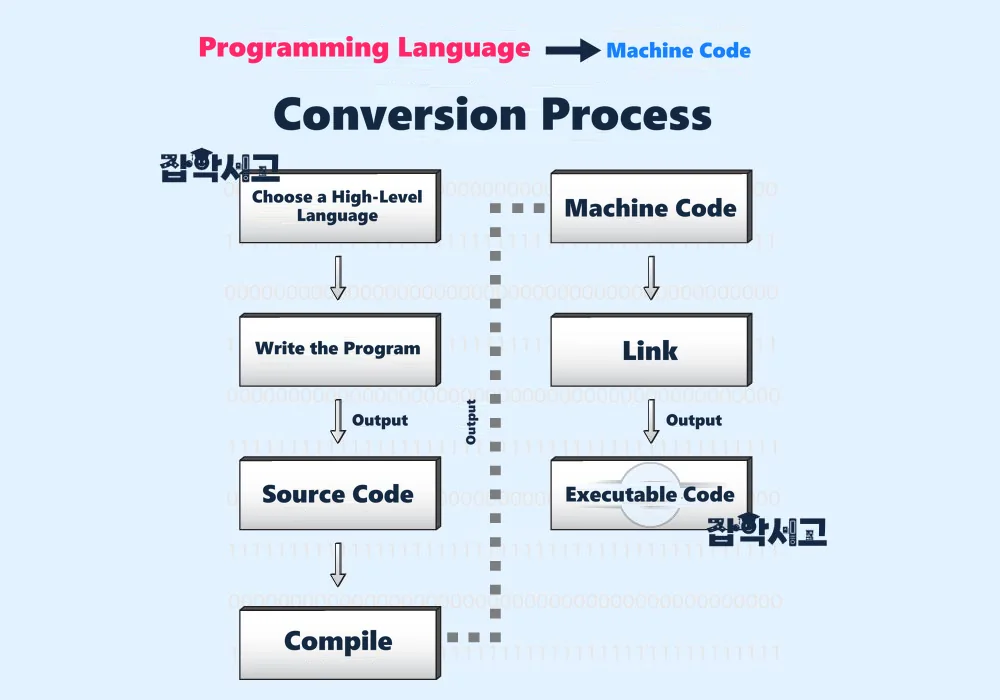
The Complete Source Code Conversion Process
The process by which a compiler converts source code into machine code consists of several stages. Although this process is complex, each stage plays an important role in optimizing software performance and generating executable machine code. Through this process, the compiler fulfills the key role of transforming code written by programmers into a form that computers can understand and execute.
Parsing: Understanding the Structure of Code
Parsing is the stage in which a compiler first processes source code and is an important process for understanding the code's structure. At this stage, lexical analysis identifies each element of the source code, which is then converted into a syntax tree to visually represent the code's logical structure. This allows the compiler to check whether the source code follows the correct grammar and detect incorrect parts so they can be corrected.
Lexical analysis divides the characters and symbols in code into meaningful units and converts them into 'tokens.' The subsequent parsing stage checks whether the tokens are arranged according to the rules and converts them into structured data. This process examines whether the code is formally structured correctly.
Semantic Analysis: Understanding the Meaning of Code
Parsing is followed by the semantic analysis stage, in which the code is analyzed for its meaning. Semantic analysis checks variable and function declarations, types, the validity of function calls, and other aspects to ensure that the code can operate as intended. This is an important process that goes beyond simple syntax errors to check whether the code is also logically consistent.
This process specifically checks whether the variables and functions used in a program are correctly declared and used, and also checks consistency between types to prevent logical errors in advance. Through semantic analysis, the compiler ensures that code can operate as its author intended and helps improve its correctness.
Optimization: Maximizing Efficiency for Performance
The optimization stage is one of a compiler's core tasks, applying various techniques to maximize the code's execution efficiency. During optimization, unnecessary operations are removed and code is transformed so that it can execute more efficiently. Major optimization techniques include dead code elimination, which removes unnecessary code; loop optimization, which improves loops; and strength reduction, which simplifies complex operations.
This process focuses on increasing execution speed and reducing resource usage, allowing optimized code to run faster and consume fewer system resources such as memory. These optimizations significantly improve software performance, and their effects are particularly important in large programs.
Code Generation: Conversion to Machine Code
In the code generation stage, the optimized intermediate representation is converted into actual machine code. This stage generates an optimal instruction sequence suited to the processor's architecture. Register allocation and instruction selection allow the processor to execute code efficiently, while techniques such as pipelining further maximize execution efficiency.
Code generation is the process of ultimately converting code into a form that machines can understand, and at this stage the compiler ensures correct execution while maintaining optimized performance. The resulting machine code is output in a form that the computer can execute directly.
The Importance of the Conversion Process
The compiler's conversion process plays an important role in software development. The parsing, semantic analysis, optimization, and code generation tasks performed at each stage fulfill their respective roles and contribute to improving the efficiency of the overall compilation process. These processes are important factors that determine software performance and quality, and the performance and accuracy of compilers greatly improve productivity in software development.
The Role of the Compiler's Conversion Process
A compiler's source code conversion process is an important part of software development, achieving both efficiency and optimization within a complex process. Through this process, the compiler enables code written by programmers to be implemented with the best possible performance and provides an environment in which programmers can write code without being constrained by complex hardware details.
Compiler Optimization Techniques and Ways to Improve Performance

The Importance of Compiler Optimization
Compiler optimization is an essential process for improving the execution performance of source code and managing memory usage efficiently. This allows software to make the most of limited hardware resources, while the compiler generates optimized code to deliver faster and more reliable programs. Various optimization techniques improve performance in different ways and maximize the software's execution efficiency.
Code Motion: Minimizing Unnecessary Operations
Code motion is a technique that moves results repeatedly calculated within a loop outside the loop. This technique reduces unnecessary duplicate calculations and eases the computational burden inside the loop. For example, instead of performing the same operation on every iteration inside a loop, the operation can be moved outside the loop so that it is calculated only once. This improves program execution speed by reducing the number of repeated operations.
Constant Propagation: Eliminating Unnecessary Operations
Constant propagation is a technique that calculates expressions that can be evaluated as constants in a program in advance and replaces them with constants. This process can reduce unnecessary operations and increase execution speed. For example, when a constant is assigned to a variable, the code is simplified by subsequently using the constant directly instead of that variable. Constant propagation is particularly effective for operations performed repeatedly.
Inline Expansion: Reducing Function Call Overhead
Inline expansion is a technique that inserts a function's body directly at the call site to reduce function calls. Function calls incur overhead such as managing the stack and storing the return address, and skipping these processes can reduce execution time. Inline expansion is particularly useful for short, frequently called functions, improving overall program performance by reducing the burden of function calls.
Register Allocation: Reducing Memory Access Time
Register allocation is a technique that reduces memory access time by appropriately placing variables in processor registers. Because processor registers can process data much faster than memory, assigning variables to registers greatly improves program execution speed. This technique is applied particularly to frequently used variables or data that plays an important role within loops, minimizing memory access and maximizing execution performance.
Dead Code Elimination: Simplifying Code
Dead code elimination is an optimization technique that deletes unnecessary code that does not affect program execution. Deleting code that is no longer referenced or executed within a program reduces code size and improves execution efficiency. Because dead code does not need to be retained, removing it reduces the size of the compiled output and allows the program to run more lightly and quickly. This process plays an important role in generating optimized executables.
Applying Optimization Techniques and Improving Performance
Compiler optimization techniques are applied according to the circumstances and play an important role in improving software performance. Various techniques, such as code motion, constant propagation, inline expansion, register allocation, and dead code elimination, maximize performance in different ways, and compilers combine these techniques to generate optimized code. This allows software to use limited hardware resources efficiently and deliver optimized performance.
The Value of Compiler Optimization
Compiler optimization is an important process for maximizing software performance, and its various techniques improve program efficiency in different ways. These optimizations go beyond simply increasing execution speed, also reducing memory usage and enabling effective management of hardware resources. Optimized software is more reliable and can deliver excellent performance even in large programs that handle complex operations. Compiler optimization is an important stage in the software development process, and its effects are clearly evident in the final output.
Compilers are one of the important technologies in modern software development, playing an important role not only in converting source code into machine code but also in improving program performance through code optimization. Advances in this compiler technology greatly improve the efficiency of software development, and knowledge of it has become essential for programmers.
A proper understanding of the roles and principles of compilers provides an important foundation for improving software quality and maximizing performance. Compilers will continue to advance through the introduction of various optimization techniques and new technologies, opening up new possibilities for software development.