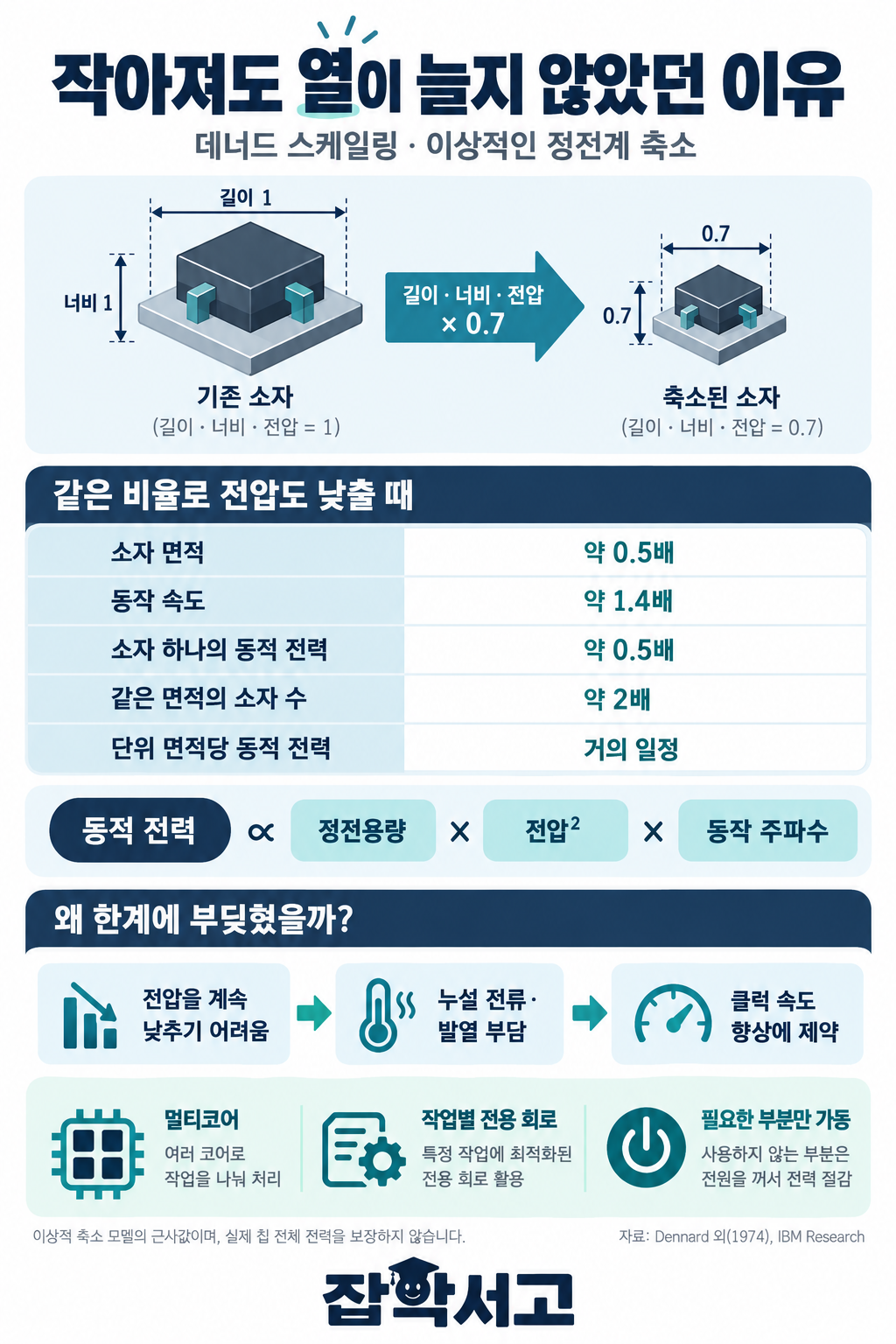
In the 1990s and early 2000s, every time you bought a new computer the numbers grew noticeably bigger. Processing speeds of a few hundred megahertz jumped to several gigahertz within a few years, and yet computers did not get that much hotter or consume several times more electricity. From the mid-2000s, however, the speed figures almost stopped moving, and manufacturers began boasting about how many cores a chip had instead. The rule behind this shift is ‘Dennard scaling’.
Put simply, Dennard scaling is the semiconductor scaling rule that ‘if transistors are made smaller while voltage is lowered by the same ratio, the power used by a given area of a chip stays the same’. If Moore’s law, which says the number of transistors doubles, describes ‘how many’, Dennard scaling explains why chips could keep getting faster without burning up even as that number grew.
In this article, we will look in turn at the background of Dennard scaling, the principle by which shrinking delivered free performance, why the rule broke down, and how computers have raised performance since then.
Faster as They Shrank, and the End of That Era
A 1974 Paper from IBM Research

The rule is named after Robert H. Dennard, an electrical engineer at IBM Research in the United States. He is also famous for inventing the DRAM cell, which stores one bit using a single transistor and a single capacitor. Most of the main memory in today’s computers and smartphones is based on this structure.
- Starting point (Original Paper): In 1974, Dennard and his colleagues published a paper in a journal on semiconductor circuits describing how to design very small MOSFET transistors.
- Key condition (Constant Field Scaling): They proposed shrinking size and voltage by the same ratio so that the strength of the electric field inside the transistor stays constant.
- Origin of the name (Dennard Scaling): This scaling rule later came to be called Dennard scaling, after the paper’s first author, or MOSFET scaling.
If Moore’s law was an observation forecasting trends in the market and in manufacturing, Dennard scaling is closer to a design guideline that relied on the laws of physics to calculate what changes, and how, when things are made smaller.
Free Performance from Every Shrink
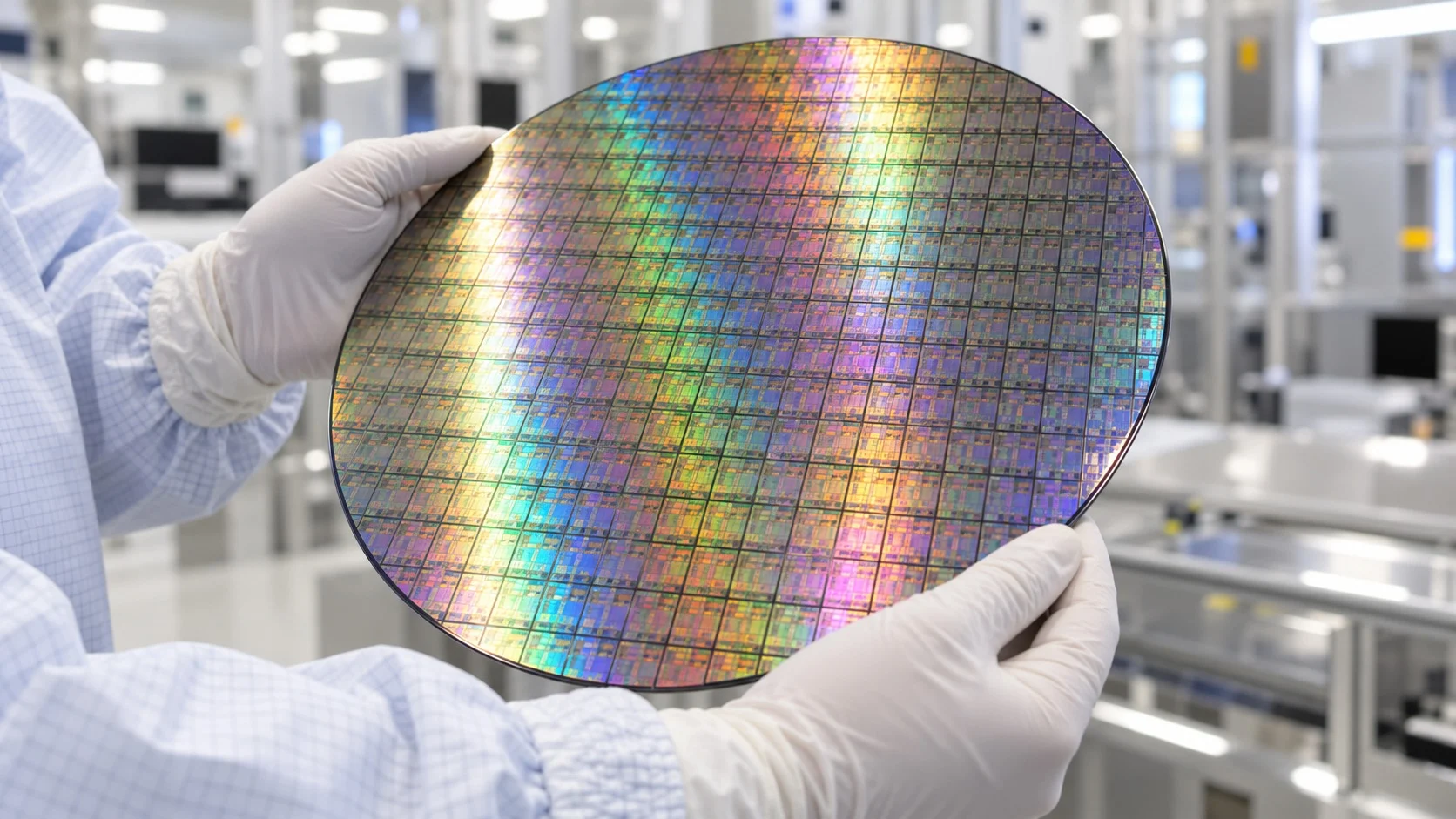
The math behind Dennard scaling is simpler than you might think. Suppose that with each generation the length and width of a transistor are reduced to about 0.7 times.
(1) The area is halved
If the width and height each become 0.7 times, the area becomes about 0.5 times. That means twice as many transistors can fit on a chip of the same size.
(2) Switching gets faster
As transistors get smaller, the time it takes them to switch on and off also drops to about 0.7 times. So the same design can run about 1.4 times faster.
(3) Power density stays the same
The power a transistor uses is roughly proportional to capacitance × the square of voltage × operating speed. Since capacitance and voltage both drop to 0.7 times, even with the higher speed the power of each transistor is about halved. Because the area has also been halved, the power used by the same area does not change.
In the end, each time chipmakers shrank their process by one generation, they could get twice the transistors and higher speeds while keeping power and heat almost unchanged. Software developers, too, could enjoy faster programs on new computers without changing anything.
The Power Wall of the Mid-2000s
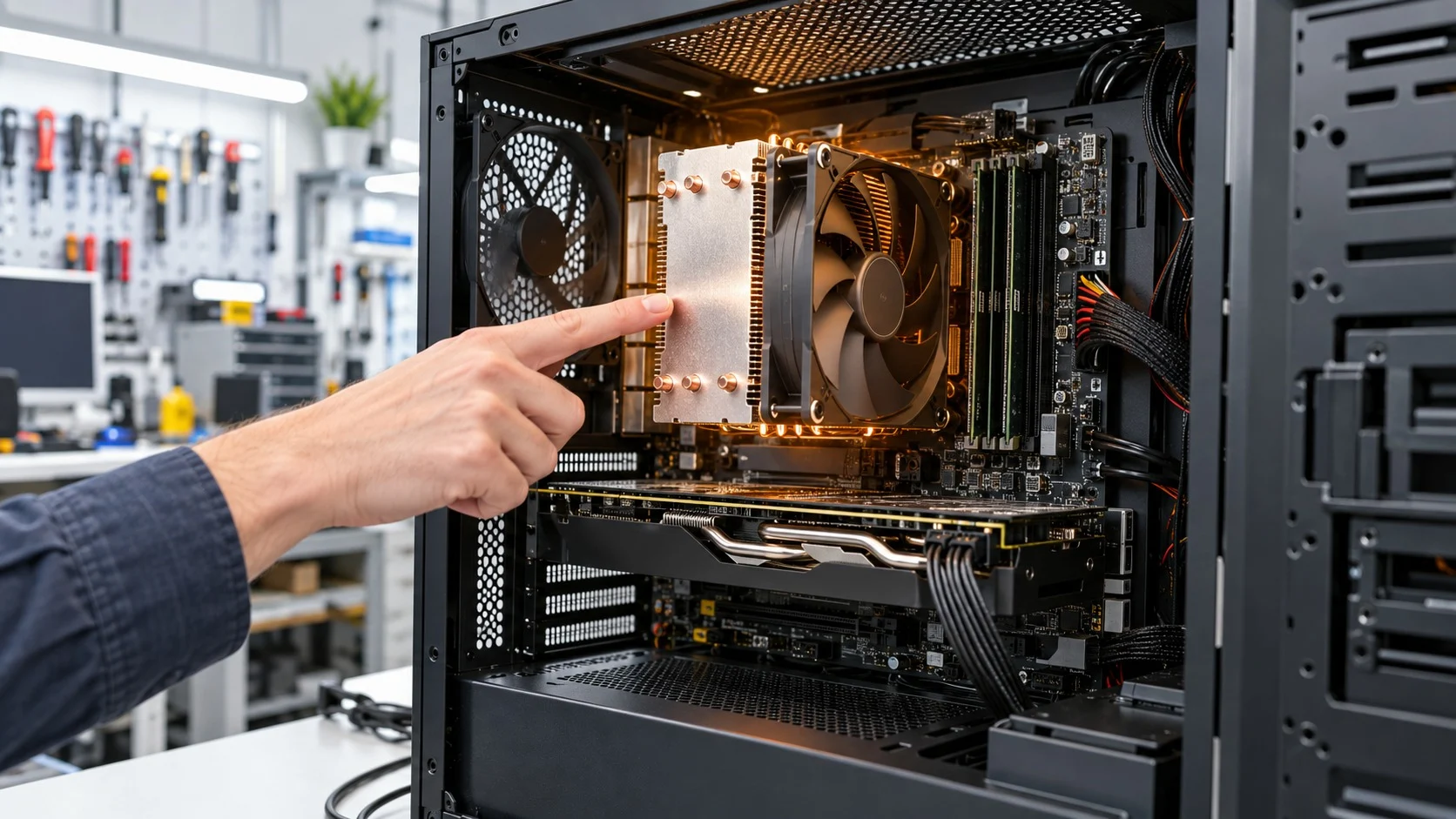
From around the mid-2000s, this rule stopped holding. Size could still be reduced, but it became difficult to lower the voltage along with it.
Current That Leaks Even When Off
As transistors became extremely small, leakage current, the small amount of current that seeps through even when they are switched off, grew larger. Lowering the threshold voltage at which a transistor turns on makes leakage rise sharply, so it also became hard to bring the supply voltage below a certain level. With voltage no longer falling, making transistors smaller actually increased the heat generated in the same area.
The Moment the Speed Race Stopped
As chips reached the limits of how much heat could be removed, the industry called this the ‘Power Wall’. In 2004, Intel canceled its plans for next-generation processors aimed at higher speeds, and since then the base speed of desktop processors has generally stayed at around 4 gigahertz.
Raising Performance After Dennard

Once speeds could no longer be raised freely, the computer industry changed the very way it improves performance.
(1) Put in multiple cores
Multicore processors, which place several processing units called cores on a single chip and divide work among them, became commonplace. However, if the work cannot be split into small pieces, adding cores has limited effect, so programs must also be written to run in parallel to gain performance.
(2) Use dedicated circuits suited to the task
Dedicated circuits that perform only specific tasks very efficiently, such as graphics processing units (GPUs) and chips for AI computation, have become more common. To do more computation with the same power, it pays to give up a little generality.
(3) Power only what is needed, not everything
In 2011, researchers pointed out that because of power limits, not all of a chip’s transistors can run at full speed at the same time and some must be kept switched off, and they called these idle areas Dark Silicon. That is why today’s chips save power by shutting off parts that are not in use and briefly raising speed only when needed.
Dennard scaling shows at once why an era in which simply making things smaller improved everything was possible, and why it ended. The fact that smartphones and data centers today treat power efficiency as the most important number is also a task left behind by this rule.
Thinking about how to share out power where free performance has ended: that is the first step for computing in the post-Dennard era.