Role Theory is one of the important approaches to understanding and explaining human behavior in the social sciences, particularly psychology. Its basic premise is that individuals perform specific roles within society and that these roles significantly influence their behavior and interactions.
This material will examine the concepts and basic principles of role theory, its history, and the research of its leading scholars, and will analyze role theory through a psychological approach. It will also discuss the influence of role theory on human behavior in depth, focusing on improving our understanding of social interaction and behavior within organizations.
Concepts and Basic Principles of Role Theory
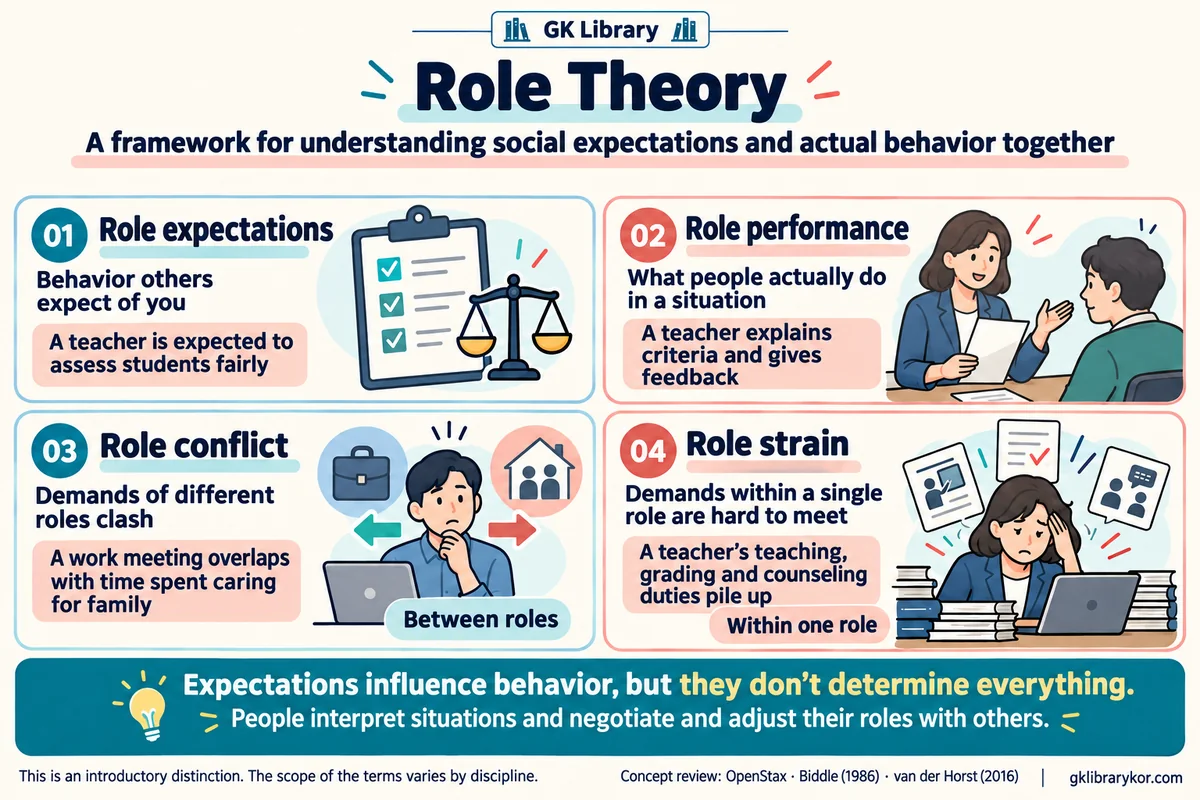

The Concept of Role Theory
Role theory examines how the various roles individuals assume within society influence their behavior and identity. It explains that people perform multiple roles in social contexts and that the roles formed in this process decisively shape their behavioral patterns and psychological states. For example, an individual may simultaneously perform the roles of parent, employee, and friend, with different behaviors and norms expected of each role.
Role Expectations and Role Performance
The core concepts of role theory are divided into 'role expectations' and 'role performance.' Role expectations refer to the behaviors and attitudes society requires of someone performing a particular role. Shaped by social norms and rules, these expectations provide standards for how individuals should perform that role. Role performance, on the other hand, refers to how individuals actually perform the role and is influenced by various factors, including their personality, experience, and skills. When a gap arises between role expectations and actual role performance, it can lead to conflict and stress.
Role Conflict and Role Strain
Role conflict and role strain are problems that arise when individuals perform multiple roles simultaneously, and they are important concepts in role theory. Role conflict occurs when the demands of different roles clash, such as when roles at work and at home conflict with one another. This can lead to psychological stress and anxiety. Role strain, on the other hand, refers to a state of tension caused by a gap between the expectations demanded within the same role and actual performance. These conflicts and strains can undermine individuals' psychological stability and, if left unresolved, can lead to long-term stress.
Role Learning and Role Socialization
Role learning refers to the process of acquiring behaviors appropriate to a new role when an individual assumes that role. This process occurs in various settings, including work and family life, and individuals learn social norms and expectations to adapt to their new roles. Role socialization is the process through which individuals internalize a particular role through social interaction and, on that basis, acquire social norms and values. Through this process, individuals come to naturally accept the behaviors expected of them in society.
The Importance of Role Theory
Role theory provides a highly important framework for understanding individuals' identities, psychological states, and social interactions. It explains how the roles individuals assume influence their behavior and how conflicts or strains arise between roles, thereby making it possible to predict individual behavior in social contexts. Furthermore, role theory can be usefully applied to analyzing behavior within organizations and designing social intervention programs. A deep understanding of role theory provides an important foundation for effectively analyzing complex human behavior and developing appropriate responses.
The History of Role Theory and Its Key Scholars

The Origins of Role Theory
Role theory developed from various academic traditions in sociology and psychology, and systematic research into it began in the early 20th century. Early studies primarily began as attempts to understand social interaction and individual behavior, forming the foundations of role theory today. This theory provides an important conceptual framework for analyzing how the various roles individuals assume within society influence their behavior and identity.
George Herbert Mead and Symbolic Interactionism
One of the key scholars who contributed to the development of role theory is George Herbert Mead. Mead, the founder of symbolic interactionism, argued that individuals form their selves and roles through social interaction. In particular, he viewed the self as being created through interaction with others, a process in which individuals internalize social norms and perform various roles on that basis. Mead's theory provides an important foundation for explaining the interaction between individuals and society.
Ralph Linton and Social Position
Ralph Linton is regarded as a scholar who systematized role theory by emphasizing the relationship between social structure and roles. He explained how social positions and roles are connected, arguing that the positions individuals occupy within society determine the roles they perform. Linton's research provided an important theoretical framework for analyzing the interaction between social status and roles.
Talcott Parsons and Functionalism
Talcott Parsons interpreted role theory from a functionalist perspective, viewing roles as serving an important function in maintaining the stability and integration of social systems. He believed that society operates functionally through various roles and explained that each role is essential to achieving harmony and balance in society as a whole. Parsons' theory emphasized that roles extend beyond individual behavior to serve as important mechanisms for maintaining social order.
Erving Goffman and Dramaturgical Role Performance
Erving Goffman explained role performance by comparing it to theater, and his research made a major contribution to explaining role performance in everyday life. Goffman argued that people act out specific roles like actors in social interactions and thereby construct the self and social reality. In his book "The Presentation of Self in Everyday Life," Goffman analyzed how people present themselves in everyday life in accordance with social norms and expectations. As a result, role theory became an important tool for understanding the relationship between the self and reality in social interaction.
Kurt Lewin and Group Dynamics
The psychologist Kurt Lewin laid the psychological foundations of role theory by studying how individuals' roles within groups influence their behavior and attitudes. He explained that behavioral patterns vary according to the roles individuals assume in the groups to which they belong, emphasizing that roles are important elements in understanding group dynamics. Lewin's research demonstrated that role theory can be applied to explaining individuals' psychological states and interactions within groups.
The Development of Modern Role Theory
Modern role theory has developed through various interdisciplinary approaches. In fields such as organizational psychology, educational psychology, and clinical psychology, role theory is used as an important tool for understanding and predicting human behavior. In particular, it has become an important theoretical framework in various areas, including role performance within organizations, role modeling in educational settings, and resolving role conflicts in clinical situations. Role theory continues to expand its usefulness in analyzing social interaction and individual behavior, thereby providing an in-depth understanding of human behavior.
Analyzing Role Theory Through a Psychological Approach

Role Internalization
Role internalization refers to the process through which individuals internalize the social expectations and norms associated with a particular role and make them an important part of their identity. It explains how deeply individuals engage with the roles they assume and accept those roles as part of themselves, and it is closely related to the formation of their self-identity. People with strong role internalization define themselves through that role and may consequently experience higher levels of psychological satisfaction. In contrast, those with weak role internalization are more likely to experience psychological conflict or stress while performing their roles.
Role Stress and Role Conflict
Role stress is a concept that describes the psychological pressure individuals experience when performing multiple roles simultaneously. It is particularly likely to occur in modern society when roles involving work, family, and social relationships overlap. Role stress adversely affects individuals' mental health over the long term, and excessive stress can lead to negative outcomes such as burnout. Role conflict stems from clashes between these roles, and individuals experience psychological tension when opposing role demands collide. If role stress and conflict are not properly managed, they can undermine individuals' psychological stability and lead to psychological health problems.
Mismatch Between Role Expectations and Role Performance
A mismatch between role expectations and actual role performance is one of the main factors that causes psychological anxiety. When individuals cannot meet the level of role performance expected in society or within an organization, they may experience reduced self-esteem and psychological anxiety. For example, when individuals are expected to perform at a high level at work but cannot meet those expectations, this negatively affects their self-esteem and, over the long term, adversely affects their job satisfaction and psychological stability. Such mismatches are also treated as an important research topic in organizational psychology.
Role Learning and Role Socialization
Role learning is a concept that describes the process through which individuals acquire new roles. It includes learning social norms and expectations and adjusting behavior accordingly. Role socialization is the process through which individuals acquire and internalize roles through various social interactions, and it is an important research topic in developmental psychology and educational psychology. In particular, the process of learning social roles from an early age significantly influences role performance in adulthood and enhances the ability to adapt to roles in various social environments.
Autonomy in Role Performance
Autonomy in role performance is a concept that assesses how much autonomy individuals have in performing the roles they assume. Role performance with a high degree of autonomy is directly linked to individual satisfaction, and individuals experience high psychological satisfaction when they can make their own decisions and act on their own initiative while performing their roles. In contrast, when autonomy is lacking, role performance is driven by external coercion, which can cause psychological pressure and stress. Autonomy in role performance receives particular attention in work environments and greatly influences individuals' job satisfaction and performance.
The Importance of Role Models
A role model is a person whom an individual looks to as an example when performing a role. Positive role models provide an important stimulus that helps individuals perform their roles effectively. This is a particularly important concept in educational psychology and organizational psychology, as role models such as teachers, supervisors, and parents greatly influence individuals' growth and development. Role models are themselves a source of motivation and provide a sense of psychological stability as individuals perform their roles.
The Importance of Role Theory Through a Psychological Approach
Through a psychological approach, role theory becomes a useful tool for deeply analyzing individuals' behavior and psychological states. Various concepts, including role internalization, role stress, and mismatches between role expectations and performance, play an important part in explaining the complex psychological processes individuals experience while performing social roles. Such analysis contributes to promoting individuals' psychological stability and, furthermore, to proposing ways to efficiently improve social interaction and role performance within organizations.
The Influence of Role Theory on Human Behavior

Role Theory and Identity Formation
Role theory significantly influences the formation of individual identity. People form their selves while performing various roles within society, and these roles are deeply involved in their self-perception and self-esteem. For example, individuals who assume various roles, such as parent, employee, and member of society, define themselves through those roles and enhance their self-esteem in the process of performing them. In particular, the more important a role an individual assumes, the greater its influence on self-identity.
Social Interaction and Role Confirmation
Role theory also plays an important part in understanding individuals' social interactions. People confirm their roles through social interaction and, on that basis, act in accordance with social norms and expectations. These interactions extend beyond simple conversations or actions to become important processes that determine how individuals are perceived and evaluated within society. For example, a role at work influences relationships with colleagues or supervisors, and receiving feedback about that role through these relationships allows individuals to reaffirm their roles.
Role Conflict and Its Psychological Effects
Role conflict and role stress significantly influence individuals' psychological states. When the demands of multiple roles performed simultaneously clash, they can create psychological pressure. For example, when an individual's role as an employee conflicts with their role at home, the individual experiences role conflict and increased psychological stress. Over the long term, such role conflict can cause psychological problems such as depression and anxiety disorders. In contrast, when individuals feel autonomy in role performance or are highly satisfied with their roles, they can maintain psychological stability and experience an improvement in their overall quality of life.
Behavioral Change and Role Redefinition
Role theory also serves as an important tool for understanding changes in individual behavior. Individuals' behavior changes as they assume new roles or redefine existing ones. For example, individuals who are promoted at work change their behavioral patterns and working methods to suit their new roles, acquiring new skills and attitudes in the process. Such role redefinition makes an important contribution to individual growth and development and strengthens the abilities needed to adapt to new environments.
Roles Within Organizations and Group Dynamics
Role theory provides an important framework for analyzing the allocation of roles within groups and behavior within organizations. Individuals assume various roles within organizations, and each role greatly influences the organization's structure and culture. When roles are clearly defined and appropriately performed, organizational efficiency improves and members' satisfaction increases. In contrast, role conflict or the absence of roles can create confusion and conflict within organizations. Therefore, analyzing the allocation of roles and interactions within organizations through role theory is essential to maintaining organizational performance and stability.
Role Theory in Education and Training
Role theory also provides an important foundation for developing education and training programs. In educational settings, students acquire various social roles through role learning and role socialization, thereby developing their social skills and self-esteem. For example, educational programs that use role-playing allow students to practice various roles in realistic situations, enabling them to effectively learn the skills required in actual society. Such educational programs play an important part in improving students' ability to interact socially and their self-esteem.
The Multifaceted Influence of Role Theory
Role theory provides a useful framework for understanding human behavior from multiple perspectives and is highly important in various fields, including identity formation, social interaction, psychological health, behavioral change, the allocation of roles within organizations, and education and training. It enables an in-depth analysis of how individuals, organizations, and society interact and develop, and can contribute to creating better social and psychological environments.
Role theory provides an important theoretical framework for analyzing and understanding human behavior from multiple perspectives. It is used as a useful tool for explaining how people behave and interact in various social contexts.
Role theory provides an important foundation for explaining individuals' identities, psychological states, social interactions, and behavior within organizations, enabling a deep understanding of the complex processes of human behavior. A deep understanding of role theory not only helps predict the behavior of individuals and groups but also provides an important basis for designing effective social and organizational interventions.