When you first install a music app, you can listen to songs without paying. But ads slip in between tracks, and when you try to pick a specific song or download it, a screen pops up promoting a paid plan. Some of the people who have used it for free for a while eventually open their wallets.
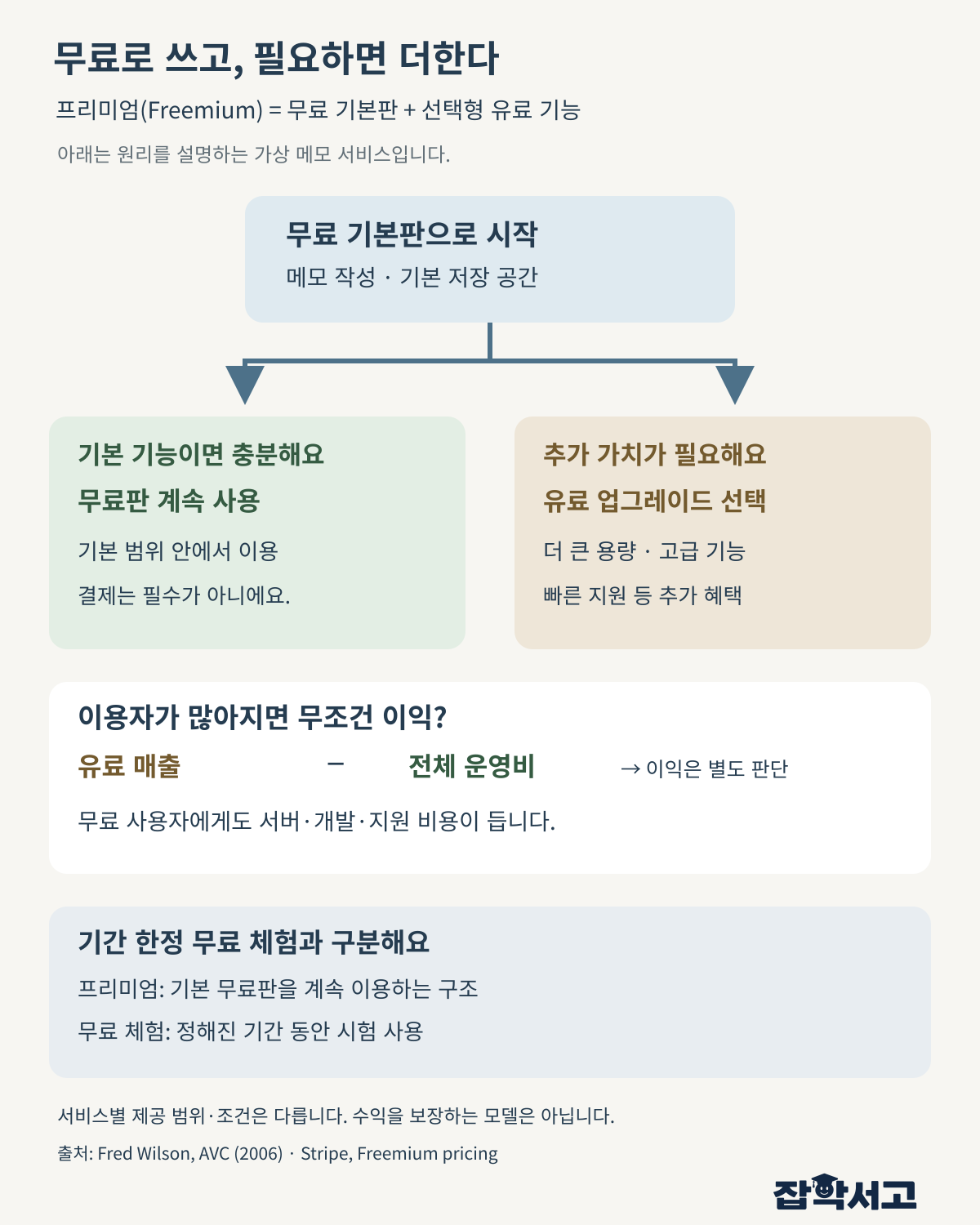
A pricing strategy like this, which gives away the basic product or service for free and charges for better features, more capacity, or added convenience, is called ‘Freemium.’ The word combines the English Free, meaning no cost, and Premium, meaning an extra charge. In Korean it is also called partial monetization, and it is a different word from premium in the sense of high-end.
In this article, we will look in turn at how the term freemium came about, the principles by which this model makes money, the various ways of limiting the free version, and finally the difficulties and criticisms encountered when designing freemium.
Gather with Free, Earn with Premium: The World of Freemium
How the Term Freemium Came About

The approach of spreading a free version first and selling a paid version later was already in use in the software industry in the 1980s. The name for it, however, came much later. In 2006, American venture capitalist Fred Wilson summarized a business model on his blog: give a service away for free to acquire a large number of customers efficiently through word of mouth, referrals, and search, then offer those customers premium add-on services or an enhanced version for a fee.
After this post appeared, Jarid Lukin of Alacra, a company Wilson had invested in, suggested calling this approach ‘freemium.’ Once it had a name, similar businesses that had been scattered could be discussed as a single model. In 2009, Chris Anderson explored business models built around free offerings in depth in his book Free, which brought the concept to a wide audience. Today, many online services use this approach, such as the professional networking service LinkedIn, the music streaming service Spotify, and the messenger Discord.
How Free Becomes Money

The secret to making money while giving things away for free lies in a few economic principles.
(1) Adding One More User Costs Almost Nothing
Once software or an online service has been built, the cost of taking on one more user is very small. So even as free users multiply, the loss is not large. By contrast, physical goods that require material costs for every additional unit do not fit the freemium model well.
(2) Free Users Are the Billboard
The free version is itself a marketing tool. People who have tried it recommend it to those around them, and through rewards for inviting friends, users bring in more users. The customer base can grow without spending heavily on advertising.
(3) A Few Paying Customers Support Everyone
In freemium services, the users who pay are usually only a fraction of the total. Even so, if the number of free users is large enough, the money from a small group of paying customers can sustain the entire service. In the end, the success of this model depends on how many users it attracts and how many of them it moves to paid plans.
Ways of Limiting the Free Version

Freemium takes different forms depending on what is held back from the free version. Common methods include the following.
- Limited Features: Basic features stay open while only advanced features are put behind a paywall. For example, a free video calling service may block calls with several people at once.
- Limited Capacity: Caps are placed on storage space, data size, or number of uses. A cloud storage service setting a free storage allowance is a typical example.
- Limited Use License: Free use is allowed only for students, individuals, or educational purposes.
- Limited Use Time: The product can be used for free only up to a certain amount of time or stage, after which users must wait or pay to keep going.
- Limited Support: Fast technical support or consultation is offered only to paying customers.
There is also the approach of showing only a few articles a month for free, as with newspapers’ digital editions, which is called a Soft Paywall, meaning a gentle pay barrier. Free-to-play games, which are downloaded and enjoyed for free while players are encouraged to buy in-game items, are also a branch of freemium.
Difficulties and Criticisms in Designing Freemium

Freemium is a strategy that is harder to balance than it looks. If the free version is too good, there is no reason to pay, so the paid version does not sell; if the free version is too meager, people never gather in the first place. It must keep the free version from eating into demand for the paid version while still being useful enough to keep users around.
(1) The Cost of Free Users
Even if the cost per person is small, once users number in the millions, server and customer service costs grow too large to ignore.
(2) Customers Used to Free
People who have used something for free for a long time tend to take that price for granted. Later reducing what is free can provoke a strong backlash.
(3) Excessive Push to Pay
Some free-to-play games are criticized as Pay-to-win because their structure gives an advantage to those who spend more money. There are also persistent complaints that they lure people in with the word free and then encourage excessive spending.
Good freemium gives free users enough value while laying a path for heavier users to naturally want the paid version. Deciding not how much to give away but what to give away for free is the first step in designing a freemium strategy.