In this post, I will explain blue oceans and red oceans, two basic concepts you should know about the environment of product markets. In addition, I will also introduce the purple ocean, which combines the blue ocean and the red ocean.
To make the examples easy to understand, I will base them on a single market and introduce cases where a blue ocean was created and cases where it later turned into a red ocean over time. The market I will look at is one almost everyone will be familiar with: [for Kakao games].
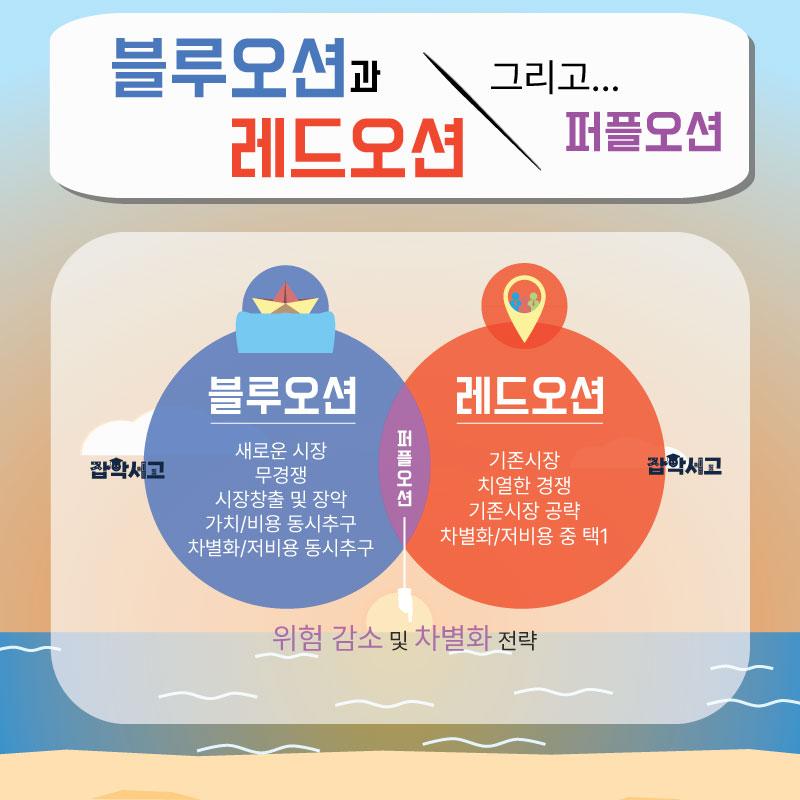 Blue Ocean, Red Ocean, and Purple Ocean
First, I made an image so you can see the blue ocean, red ocean, and purple ocean at a glance. As shown in the image above, a blue ocean refers to a new, uncontested market, while a red ocean refers to an existing, fiercely competitive market. And a purple ocean can be seen as a concept that combines the blue ocean and the red ocean.
From here, I will go through each of them in detail one by one.
Blue Ocean
 What if I could have all these fish to myself??
A blue ocean, by analogy with fishing, means a wide, deep blue sea where you can catch plenty of fish. In practice, it refers to an uncontested market in which a new product created by one company occupies the market on its own.
In a blue ocean, market demand is obtained through creation, and it opens up opportunities for enormous profits and rapid growth.
Examples
![[Anipang], the starting point of for Kakao games](https://www.gklibrarykor.com/wp-content/uploads/2023/09/%EC%95%A0%EB%8B%88%ED%8C%A11.jpeg) [Anipang], the starting point of for Kakao games
[Anipang], the starting point of for Kakao games![[Dragon Flight for Kakao], which succeeded around the same time](https://www.gklibrarykor.com/wp-content/uploads/2023/09/%EB%93%9C%EB%9E%98%EA%B3%A4-%ED%94%8C%EB%9D%BC%EC%9D%B4%ED%8A%B8.jpeg) [Dragon Flight for Kakao], which succeeded around the same time
[Dragon Flight for Kakao], which succeeded around the same time
As mentioned earlier, if I introduce examples based on the for Kakao game market, Anipang can be singled out as a representative case of pioneering a market that did not exist before.
Until then, Kakao had many users of its messenger, KakaoTalk, but was struggling because it lacked a proper source of revenue. However, when Anipang was released, it partnered with Kakao, and by letting players send hearts to friends registered on KakaoTalk while playing and show off their scores, it created an enormous word-of-mouth ripple effect.
Through this, Sundaytoz, the developer of Anipang, and Kakao, the platform, earned huge profits and began to grow rapidly as companies. Kakao in particular opened up a new platform market called Kakao Games and grew at a tremendous pace as it took in countless new for Kakao games.
 Everybody's Marble for Kakao
Everybody's Marble was a later entrant than Anipang, but it created a market within the blue ocean with a new concept. It achieved great success by bringing a nostalgic board game that people used to enjoy offline as children onto the internet and blending it with the features of for Kakao games.
Because the timing is ambiguous, it could also be seen as a success story within a red ocean, but I judged that at that time for Kakao games had not yet become a red ocean, so I introduced it as a blue ocean example.
![[Pokémon GO], which opened the door to the AR market](https://www.gklibrarykor.com/wp-content/uploads/2023/09/%ED%8F%AC%EC%BC%93%EB%AA%AC%EA%B3%A0.jpeg) [Pokémon GO], which opened the door to the AR market
[Pokémon GO], which opened the door to the AR market
Separately from for Kakao games, I am also introducing Pokémon GO because it is another case of pioneering a new market. Pokémon GO is a representative success case built on augmented reality, known as AR, and it caused a huge craze around the world.
The secret behind the great attention it drew was the combination of the popular Pokémon characters, a location-based system, and the novelty of augmented reality. The later decline in the number of users due to problems such as the handling of cheating and a lack of content should be seen as a separate issue.
Red Ocean
 What will you use as your weapon to jump into a fiercely competitive market?
A red ocean refers to a competitive market that is already well known to the public, where competition between early and late entrants is so fierce that they must shed red blood. Because competition is intense, success is hard to expect, and it covers all existing markets.
If you jump in without any differentiation, you should expect to fail in most cases, and a company must choose either differentiation or low cost to attack the existing market.
Examples
 Countless for Kakao games
Many of the later for Kakao games struggled in the market or disappeared. Their number grew so large that just looking at the image is enough to take your breath away.
 The No Brand strategy
 The Paik's Coffee strategy
However, being in a red ocean does not mean everyone is doomed. As representative outside examples, there are cases that captured the public's hearts, such as E-Mart's No Brand, which succeeded by putting value for money (performance relative to price) first, and Paik's Coffee, which achieved great success among an overflowing number of cafés. What they have in common is that they tried to set their prices from the customer's point of view.
Of course, for Kakao games and many other mobile games, with their short life spans, endlessly push players to spend money, so it would be hard for them to win the public's hearts the way the examples above did.
Purple Ocean
 What is a purple ocean?
The term purple ocean was coined by combining the blue ocean, where there are no competitors, and the red ocean, where fierce competition takes place. It comes from the fact that the color you get when you mix blue and red is purple.
It refers to creating new value from existing, familiar ideas or business models by shifting your way of thinking, and it is a market in which you try new changes within a fierce red ocean to pioneer and overcome it.
It is a strategy that reduces the risk of pioneering a new market in a blue ocean while trying to escape the red ocean through differentiation. One Source Multi Use (OSMU), in which successful characters such as Kakao Friends or the Marvel heroes are applied to a variety of markets, is a representative successful purple ocean strategy.
Examples
![[Friends Pop], similar to Anipang](https://www.gklibrarykor.com/wp-content/uploads/2023/09/%ED%94%84%EB%A0%8C%EC%A6%88%ED%8C%9D-500x331.jpeg) [Friends Pop], similar to Anipang
[Friends Pop], similar to Anipang![[Friends Marble], similar to Everybody's Marble](https://www.gklibrarykor.com/wp-content/uploads/2023/09/%ED%94%84%EB%A0%8C%EC%A6%88%EB%A7%88%EB%B8%94-500x283.jpeg) [Friends Marble], similar to Everybody's Marble
[Friends Marble], similar to Everybody's Marble
Examples of success after jumping into a red ocean include Friends Pop and Friends Marble, which put Kakao Friends characters front and center. Both games entered the already saturated for Kakao game market, and with games similar to the existing Anipang and Everybody's Marble at that.
Even so, they gained popularity thanks to the power of [Kakao Friends], already much loved as emoticons on KakaoTalk and elsewhere, and succeeded in the fiercely competitive mobile game market.
That concludes this introduction to the concepts and examples of the blue ocean, red ocean, and purple ocean, which are worth knowing for management, marketing, public relations, and more.
To explain them as easily and accurately as possible, I limited the explanation to the scope of for Kakao games so that the cases would be easy to compare.
There are countless markets, so researching the competitors in the market you want to enter is essential, and I hope you thoroughly analyze what you can count as your own (or your company's) differentiating factor before entering the market.