The Guinness Book of Records, officially known as Guinness World Records, is a chronicle that brings together the world's most diverse records, reflecting humanity's tireless spirit of challenge and passion. By documenting astonishing achievements that transcend human physical and mental abilities, along with remarkable natural phenomena, the Guinness Book of Records serves as a unique record of people's challenges and the achievements they attain along the way. As a result, it goes beyond simply listing records to capture how people from diverse backgrounds around the world realize their dreams and push beyond their limits.
This article examines in depth how the Guinness Book of Records began, the criteria used to select records, and the book's impact on society and culture. It also explores the passion and courage of those attempting Guinness records and how their challenges inspire people around the world.
The History of the Guinness Book of Records: The Origins and Development of World Records

The Birth of the Guinness Book of Records: The Beginning of World Records
The history of the Guinness Book of Records began in Ireland in the early 1950s. Hugh Beaver, an executive at the Guinness brewery, argued with friends about the speed of birds during a hunting trip in 1951, but realized that there was no way to identify the fastest bird. This incident became the starting point for the idea of systematically collecting world records. Beaver subsequently decided to create a book compiling world records.
Beaver hired the twin brothers Norris and Ross McWhirter as editors and began collecting and compiling records in earnest. The first Guinness World Records book was completed in 1954-11 and officially published on 1955-8-27. The book made a major impact immediately after publication, becoming one of the bestselling books in Britain, particularly during the Christmas season.
The Guinness Book of Records Goes Global: Expansion into Different Languages and Media
By the 1970s, the Guinness Book of Records had gained international popularity as it was translated into multiple languages. After its initial publication in English, it was translated into various languages, including French, German, and Japanese, sparking interest in world records among people in countries around the globe.
From the 1980s onward, the influence of the Guinness Book of Records grew further as it expanded into various media. Videos and television programs brought the excitement and emotional impact of records to more people, and in the 2000s, online platforms made it possible to share new records in real time in step with the digital age. These changes further broadened the scope of the Guinness Book of Records and created an environment in which the diverse records of modern society became more easily accessible.
The Social and Cultural Impact of the Guinness Book of Records
The Guinness Book of Records has become more than a collection of records, establishing itself as an important worldwide symbol of the spirit of challenge. People began taking on challenges to set records of their own and continually tried new things to have their names included in the book. Through this, the Guinness Book of Records came to play a symbolic role in celebrating individual challenges and achievements and became a tool for inspiring people across various fields.
The passion of those attempting Guinness records has produced original and innovative records across various fields. The Guinness Book of Records celebrates their achievements and has provided a platform through which people around the world can participate in challenges. This has given people opportunities to watch and support one another's challenges and to push beyond their own limits.
The Future of the Guinness Book of Records: A Chronicle of Unending Challenges
Today, the Guinness Book of Records continues to enjoy widespread popularity around the world, with new records being updated each year. The book has value beyond simply documenting records, serving as a platform that celebrates humanity's challenges and achievements. As new records continue to be added, the Guinness Book of Records offers people even more inspiration and opportunities to take on challenges.
Record Selection Criteria: Maintaining Fairness in the Guinness Book of Records

The Guinness Book of Records' Selection Criteria: A Symbol of Fairness and Trust
The reason the Guinness Book of Records has maintained worldwide trust for so many years lies in its strict and thorough criteria for selecting records. Rather than merely collecting records, it follows various criteria and procedures to maintain fairness and objectivity, becoming a symbol of challenge trusted by people around the world.
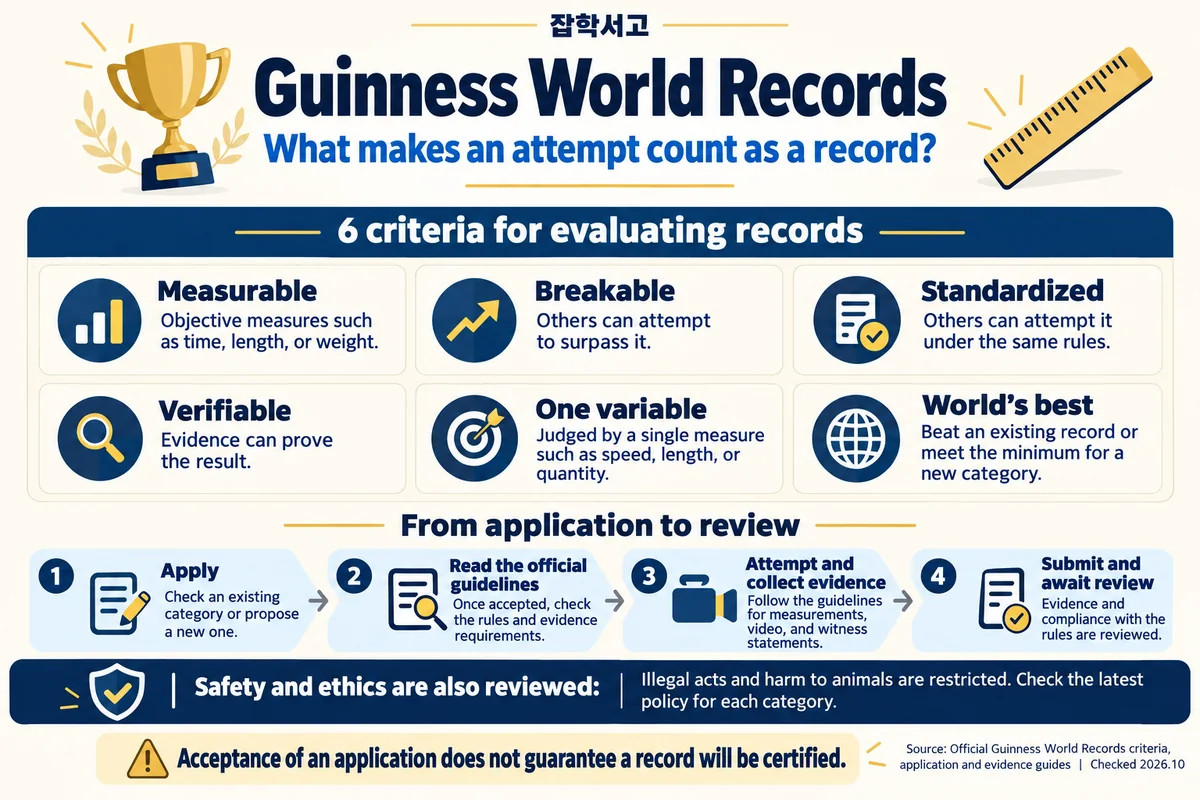
To be included in the Guinness Book of Records, a record must be clearly measurable and achieved under standardized conditions. These procedures ensure the reliability of records and help anyone attempt them under the same conditions. Fairness and reliability are important reasons why the Guinness Book of Records has become more than a record collection and established itself as a global symbol of challenge.
Measurable Records: Standards of Clarity and Consistency
To be included in the Guinness Book of Records, a record must take a measurable form. Every record must be definable through clear numerical values or results, and abstract concepts or ambiguous outcomes are not accepted. Records must follow uniform criteria and be repeatedly reproducible under the same circumstances. For example, only records that can be measured with clear numerical values, such as the longest distance, the greatest quantity, or the fastest time, can be included in the Guinness Book of Records. This is an important principle for maintaining the fairness and objectivity of records and a key element in preserving the authority of the Guinness Book of Records.
Records are measured using consistent criteria, and measuring instruments used in various areas, such as time, size, weight, and speed, follow internationally standardized methods. This enables people to attempt records under the same conditions and ensures an environment in which records can be evaluated fairly. These strict measurement standards further strengthen the reliability of records and are one reason the Guinness Book of Records is trusted worldwide.
Record Selection Criteria That Prioritize Life and Safety
The Guinness Book of Records follows a principle that prioritizes the lives and safety of those attempting records, alongside the fairness of the records themselves. Everyone attempting a Guinness record must put life and safety first, and dangerous challenges are generally not permitted. For example, extreme challenges involving physical danger or challenges that could threaten life are not approved, and these safety standards are strictly applied during the record selection process.
Although the Guinness Book of Records honors the human spirit of challenge, it does not accept records achieved through excessive attempts or dangerous behavior in the process. This shows that the Guinness Book of Records is more than a collection of records and carries a sense of responsibility for guiding humanity's challenges and achievements in healthy and safe ways. These safety rules are one important reason the Guinness Book of Records has maintained worldwide trust over many years.
A Thorough Record Review Process
A record must undergo an exceptionally thorough review process before it can be included in the Guinness Book of Records. Those attempting records must provide clear evidence substantiating their achievements, and Guinness adjudicators carefully examine it to verify the authenticity of the records. The review process requires photographs, videos, written evidence, and other materials, which are used to assess whether a record was properly achieved. Through this process, strict controls prevent the inclusion of inaccurate information or exaggeration.
The review process requires time and precision, and after completing a record attempt, participants must provide clear documentation supporting the record. For example, records in athletic competitions require accurate measuring equipment and official record keepers, while other records must meet the specific criteria required by the Guinness Book of Records. This thorough review process contributes greatly to the reliability of the Guinness Book of Records.
Collaboration with Experts from Various Fields
The Guinness Book of Records works closely with experts from various fields to improve the accuracy and fairness of records. Experts in each field help ensure that records in their areas are measured and evaluated accurately, further increasing the reliability of the Guinness Book of Records. For example, scientific records strictly follow scientific measurement tools and procedures, while sports records involve experts in the relevant field who evaluate their validity.
Collaboration with experts plays an important role in maintaining the fairness of records, and through this collaboration, the Guinness Book of Records has established itself as an authoritative record collection across various fields. Such collaboration helps ensure that records are evaluated fairly and reliably and is an important factor in the worldwide recognition of the Guinness Book of Records.
A Global Platform Encouraging the Spirit of Challenge
The Guinness Book of Records serves as more than a collection of records, acting as a global platform that encourages people around the world to take on challenges. Fair record selection criteria allow everyone to attempt records under equal conditions, and these records remain important examples demonstrating humanity's achievements and potential.
The record selection criteria of the Guinness Book of Records open up opportunities for challenges and allow new records to emerge continuously across various fields. This system provides fair opportunities for people attempting records around the world and plays an important role in establishing the Guinness Book of Records as a worldwide symbol of challenge and achievement.
An Analysis of the Social Impact and Cultural Role of the Guinness Book of Records

The Social Impact of the Guinness Book of Records: A Source of Challenge and Inspiration
The Guinness Book of Records has become more than a collection of records, establishing itself as an important medium with social influence around the world. The new records announced each year encourage people to take on challenges and motivate them to push beyond their limits and attain new achievements. This serves as a driving force that extends beyond individual achievement to bring about positive change throughout society.
The records in the Guinness Book of Records demonstrate possibilities not only through conventional achievements but also in every field where individuals can take on challenges, playing an important role in encouraging diverse challenges and achievements within society. Through inspiring challenges from around the world, the Guinness Book of Records also has an important influence on the development of groups and societies, as well as individuals.
A Global Platform That Respects Cultural Diversity
The Guinness Book of Records encompasses records achieved by people from diverse cultural backgrounds around the world, helping promote exchange and understanding between cultures. The records included in the book document achievements from different countries and cultures, contributing to mutual respect and understanding of cultures worldwide.
Drawing on this cultural diversity, the Guinness Book of Records inspires people around the world and plays an important role in encouraging the spirit of challenge. The fact that records go beyond the meaning of achievement and originate in diverse cultures and backgrounds shows that the Guinness Book of Records functions as a forum for international cultural exchange.
Positive Role Models for Young People
The Guinness Book of Records has a particularly strong influence on young people. Records and examples of challenges undertaken in various fields provide the younger generation with positive role models for challenge and achievement, inspiring them to work toward their dreams. By seeing these records, young people gain opportunities to test their limits, set new goals, and grow.
The Guinness Book of Records also has important educational value. In particular, through the examples of people who have set records not only in academics and sports but also in various fields requiring creativity, individuality, and perseverance, young people learn that they can realize their potential in many areas. This goes beyond challenge and achievement alone, playing an important role in helping young people develop positively.
Public Awareness and Influence through the Media
The Guinness Book of Records has gained greater recognition worldwide through the media. As the stories of people attempting Guinness records have become widely known through television programs, documentaries, interviews, and other media, public awareness of the Guinness Book of Records has increased significantly. This media exposure encourages people to appreciate the value of taking on challenges and become interested in the Guinness Book of Records, making more people want to attempt Guinness records.
In particular, vivid portrayals of record attempts through mass media such as television allow people to appreciate the effort required to achieve a record. This influence through the media is an important factor in making the Guinness Book of Records a worldwide symbol of challenge.
Charitable Activities and the Guinness Book of Records: A Platform That Fulfills Its Social Responsibilities
The Guinness Book of Records is also closely associated with charitable activities. Many record attempts are undertaken to raise funds for charity, showing that the Guinness Book of Records has social value beyond records alone. People often attempt Guinness records to raise donations for particular charities or to convey socially meaningful messages.
Through these charitable challenges, the Guinness Book of Records serves as a platform that fulfills its social responsibilities, emphasizing that record attempts can have a positive impact on society as well as being personal achievements. In this respect, the Guinness Book of Records plays an important role in promoting social change through records and conveying positive social messages around the world.
A Symbol of Challenge and Achievement That Inspires the World
The Guinness Book of Records has become more than a record collection, establishing itself as a symbol that awakens the spirit of challenge worldwide and has a positive social impact. The records included in the book document the achievements of people from different backgrounds and cultures, conveying the message that diverse challenges and achievements are possible. Through the media and charitable activities, the Guinness Book of Records also fulfills its social responsibilities and continues to communicate the value of challenge and achievement to people around the world.
The Passion and Spirit of Challenge of People Attempting Guinness Records

Attempting Guinness Records: A Symbol of Passion and the Spirit of Challenge
People attempting Guinness records do not simply aim to set records. They have a strong passion and spirit of challenge that drive them to push beyond their limits and explore new possibilities. Their efforts to set new records across various fields inspire many people, and attempting a Guinness record carries meaning beyond the record itself.
Reasons for Taking on Challenges: Diverse Motivations and Goals
People attempt Guinness records for many different reasons. Some have dreamed since childhood of having their names in the Guinness Book of Records and work tirelessly to make that dream come true. Others want to share their special talents with the world. The challenges undertaken by those seeking to document their distinctive abilities or hobbies as records arise from their own particular passions.
Guinness record attempts are also undertaken to convey social messages. Many participants link their record attempts with charitable activities to bring about positive change in society, giving these challenges considerable social significance as well. Undertaken for diverse purposes and reasons, Guinness record attempts have thus established themselves as important activities that extend beyond personal achievement to enhance social value.
Efforts to Set Records: Thorough Preparation and Training
Attempting a Guinness record requires considerable time and effort. For challenges that test physical limits, repeated training and maintaining physical fitness are essential. Participants train their bodies rigorously and make continuous efforts to stay in the best possible condition to achieve a record. Mental preparation is essential alongside physical fitness, and through this process, participants gain a sense of achievement from pushing beyond their own limits.
Challenges based on ideas and creativity likewise require extensive preparation. Setting a new record requires thorough research and experimentation, and participants repeat countless attempts and failures to arrive at a perfect result. This process gives participants a sense of accomplishment that goes beyond the challenge itself, allowing them to take pride in what they have achieved.
The Will to Overcome Failure and the Value of Trying Again
Failure is common during a challenge. However, many people attempting Guinness records demonstrate a strong determination to overcome failure and try again rather than becoming discouraged. Failure teaches participants new lessons and becomes a stepping stone for pushing beyond their limits. The experience and growth gained through renewed attempts are deeply meaningful to individuals, becoming an important driving force for personal growth and development beyond simply setting records.
This spirit of challenge is one of the core values of the Guinness Book of Records. Both failure and success in the process of setting records are recognized as parts of participants' growth, helping them discover their potential and set new goals. This process can also become an important turning point in their lives, and through their efforts, the Guinness Book of Records has established itself as a symbolic platform for challenge and achievement.
The Stories of Participants: A Source of Emotion and Inspiration
People whose names appear in the Guinness Book of Records are more than record holders; they share their own unique stories with the world. Their challenges move many people and motivate them to take on further challenges. The processes and achievements these participants experience have a powerful resonance in themselves, further strengthening the role of the Guinness Book of Records as a chronicle of challenge and achievement.
Each participant shares achievements gained through patience, passion, and tireless effort within their own story, and through the Guinness Book of Records, they help people around the world see the meaning of taking on challenges in a new light. Their stories motivate people to pursue their own dreams, and through this, the Guinness Book of Records gives them opportunities to rediscover the meaning and value of life.
Challenges That Symbolize Humanity's Boundless Potential
The passion and spirit of challenge of those attempting Guinness records extend beyond simply setting records. Their challenges demonstrate humanity's boundless potential and communicate the value of challenge and achievement to the world. The Guinness Book of Records goes beyond being a forum for records, continuing to uphold its value by capturing the process through which humanity explores new possibilities and achieves its goals.
The Guinness Book of Records has established itself as an important platform symbolizing humanity's boundless potential and spirit of challenge, rather than remaining merely a collection of records. The book celebrates humanity's spirit of challenge through diverse records achieved by people around the world as they push beyond their limits and realize their dreams.
The passion and achievements of those attempting Guinness records give people hope and inspiration, continually encouraging them to pursue higher goals. The Guinness Book of Records will continue to explore humanity's boundless potential through new records and unending challenges, remaining a chronicle that provides enduring inspiration and motivation to people around the world.