In modern society, government policy announcements have a tremendous impact on people's lives. However, identifying the true intentions and strategies hidden behind these announcements is not easy.
This article examines the government's hidden intentions through backbriefing and analyzes how it manages the messages communicated to the public. It also sheds light on stories the media do not cover.
The definition and importance of backbriefing
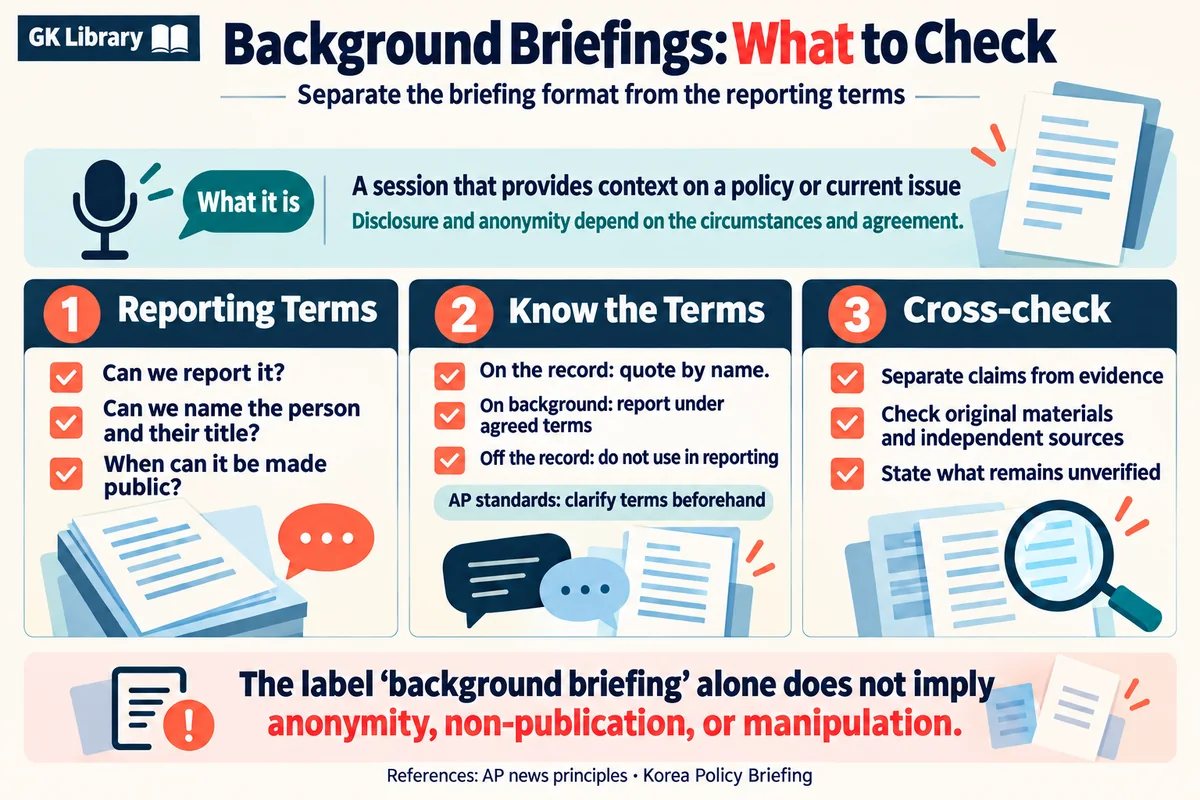
 What is backbriefing?
Backbriefing is a way for the government to communicate informally with the media before or after announcing major policies. In this process, the government provides journalists with information that is not publicly available, using it to explain the background and context of its policies. Unlike official briefings, backbriefing is informal and is not disclosed directly to the public, which makes it particularly significant.
The purpose of backbriefing
The purpose of backbriefing goes beyond simply conveying information. Through backbriefing, the government seeks to indirectly control how the media report on its policies. In this way, it can manipulate public perceptions or encourage positive responses to its policies. Analyzing backbriefing is therefore essential to understanding the government's hidden strategies.
Forms of backbriefing
Backbriefing can take various forms. Examples include informal meetings with selected journalists and telephone conversations in which anonymity is requested. In this process, the government can present its position favorably and conceal or distort sensitive information. This raises serious concerns about the transparency and trustworthiness of democracy.
The importance of timing in backbriefing
Another characteristic of backbriefing is the importance of timing. The government may try to shift the mood through backbriefing just before announcing an important policy or when public opinion is worsening. Accordingly, backbriefing needs to be analyzed with its timing and context in mind.
The effects of backbriefing
Political experts argue that the effects of backbriefing on press freedom and government transparency must be closely observed. This is because they are ultimately directly connected to the public's right to know. It is therefore very important to analyze the content of backbriefing and identify its intentions.
The subjectivity of information and the need for critical analysis
Unlike official statistics or data, information provided through backbriefing may include subjective interpretations. Such information has a significant influence on journalists and is then passed on to the public. Efforts are therefore needed to critically analyze the content of backbriefing and identify its hidden intentions.
Backbriefing is one of the important ways the government announces policies and communicates them to the public. However, given the information distortion and transparency problems that arise in this process, it is very important to critically analyze the content of backbriefing. Doing so can help us understand the government's hidden strategies and maintain the transparency of democracy.
Hidden intentions: Tracing the truth behind policy announcements
 What lies behind policy announcements?
Surface-level policy announcements and hidden intentions
On the surface, government policy announcements appear to be intended to benefit the public, but various hidden intentions may lie behind them. For example, a particular policy may benefit the public in the short term while serving as a means of achieving specific government goals in the long term. Identifying these hidden intentions is very important.
The importance of timing and context
To identify the hidden intentions behind a policy announcement, we must first analyze the timing and context in which the policy was announced. For example, a policy announced ahead of an election may be intended to win voter support, while one announced during an economic crisis may be intended to alleviate public anxiety.
Analyzing policy content and follow-up measures
The content of a policy and the follow-up measures taken in response must be analyzed closely. Examining which bills were passed and what budget allocations were made after a policy announcement can reveal the policy's true intentions. For example, if a policy favoring a particular company or industry is announced, there is a strong likelihood that lobbying or political backing lies behind it.
Stakeholder analysis
Another way to trace the truth behind policy announcements is to analyze the stakeholders involved. Investigating which individuals or organizations exerted influence before and after a policy announcement can make its hidden intentions clearer. For example, if a company's stock price surges after a particular policy is announced, there is a strong likelihood that lobbying by that company lies behind it.
Comprehensive analysis of materials and information
Government policy announcements often involve complex, multilayered intentions. Therefore, identifying their true intentions requires the ability to comprehensively analyze various materials and information. This calls for in-depth inquiry that goes beyond surface content.
The role of the media
The media play an important role in uncovering these hidden intentions. Journalists must go beyond simply relaying government announcements and make an effort to identify the truth hidden behind them. Through this, the public can obtain more transparent and accurate information.
Identifying the hidden intentions behind policy announcements is essential to protecting the public's right to know. To do this, various methods must be used, including examining timing and context, policy content, and stakeholders, and thorough investigation by the media is needed. When these efforts come together, we can identify the government's true intentions and create a more transparent society.
Government message management: How the government persuades the public
 What does the government's message management process involve?
The importance of message management
The government uses various message management approaches to communicate policies effectively to the public and gain support for them. In this process, it employs various strategies, such as emphasizing certain messages or concealing unfavorable information. This can be interpreted as reflecting an intention to manipulate public perceptions.
Preparation before policy announcements
The first stage of message management is preparation before a policy announcement. Before announcing a policy, the government develops a public relations strategy for it and creates a plan for communicating with the media. Through this, it works to build public anticipation or alleviate anxiety even before the policy is announced.
Message management at the time of policy announcements
Message management is also important at the time of a policy announcement. The government carefully chooses the order of the content it announces and how it is expressed. This is intended to help the public easily understand the policy's key points and receive them positively. It also minimizes unfavorable content or treats it as less important.
Ongoing management after policy announcements
The government's message management continues after a policy is announced. Through ongoing communication with the media, the government seeks to encourage positive responses to the policy and minimize negative public opinion. To do this, it uses regular briefings, the distribution of press releases, and other methods. It also communicates directly with the public through social media, emphasizing the policy's necessity and effects.
Message management during crises
The government's message management strategies often demonstrate their true value during crises. For example, during an economic crisis or a natural disaster, the government seeks to alleviate public anxiety and stabilize the situation through rapid and effective message management. Providing accurate information and communicating credibly are important for this.
The importance of maintaining trust
However, government message management can sometimes lead to a loss of public trust. If the government deliberately conceals information or provides distorted information, this can instead create public distrust. The government must therefore continue its efforts to earn public trust through transparent and honest communication.
Government message management is essential to successfully communicating policies and securing support. This requires thorough preparation, careful announcements, and ongoing communication. Effective message management during crises also plays an important role in earning public trust. Through transparent and honest communication, the government must maintain and strengthen its relationship of trust with the public.
Analyzing backbriefing: Stories the media do not tell
 Backbriefing: How do the media respond?
The definition and role of backbriefing
Backbriefing is a way for the government to communicate informally with the media, but its content is often not reflected in media reports. This is because the information provided during backbriefing can be used as a tool to indirectly control the direction of media coverage or conceal certain information. Analyzing the content of backbriefing is therefore important to understanding the stories the media do not tell.
Presenting the government's position favorably
The first purpose of backbriefing is to present the government's position favorably. To do this, the government provides journalists with specific information or offers interpretations. Such information is often directly reflected in media reports and conveyed to the public. However, unfavorable information may be concealed or distorted in this process.
Adjusting the importance given to issues
Backbriefing serves to steer the media away from intensive coverage of particular issues. For example, through backbriefing, the government can encourage the media to treat a particular issue as less important or to focus on other issues. This can prevent the public from being sufficiently aware of particular issues.
The inclusion of subjective interpretations
Information provided during backbriefing may often include subjective interpretations. This has a significant influence on journalists and is reflected in what they report. However, such information may not always be objective and is likely to represent the government's position. It is therefore necessary to critically analyze the content of backbriefing.
The need to verify information
The media need to make an effort to verify the information provided during backbriefing. They must go beyond simply conveying the government's position and confirm the truthfulness and accuracy of the information. Through this, they can provide the public with more accurate and objective information.
The importance of ensuring transparency
Backbriefing is an important tool for the government to communicate messages to the public through the media, but its content is not always transparent. It is therefore very important to analyze the content of backbriefing and identify its hidden intentions. Through this, the public can obtain more accurate information and develop a proper understanding of government policies.
Backbriefing is an informal form of communication between the government and the media, and its content is often not conveyed directly to the public. It can be used with the intention of presenting the government's position favorably and concealing unfavorable information. Efforts are therefore needed to critically analyze the content of backbriefing and identify its hidden intentions. Through this, the public can obtain more accurate and objective information and develop a proper understanding of government policies.
Backbriefing is one of the important ways the government communicates with the media, and its content has a significant impact on public perceptions. However, this information often contains hidden intentions and strategies, making critical analysis necessary.
The media must verify the information provided during backbriefing and make an effort to uncover the truth. Through this, the public can obtain more transparent and accurate information. Ultimately, through government message management and the analysis of backbriefing, we can achieve a healthier democracy.