
When you walk into a restaurant and are handed a menu packed with dozens of dishes, you often stare at it for a long time and end up ordering your usual. At a place with only three or four items on the menu, by contrast, you finish ordering in no time. The more there is to choose from, the slower the decision becomes.
In design and ergonomics, this phenomenon is explained by Hick's Law. It states that the more options there are, the longer it takes a person to choose one, and it is also called the Hick-Hyman Law after the researcher who studied it alongside Hick.
This article explains, in easy-to-understand terms, what Hick's Law means and how it came about, the calculation the law involves, examples of how it is used in screen and space design, and points to keep in mind when applying it.
Understanding and Applying Hick's Law
A Law That Began with a Lamp Experiment
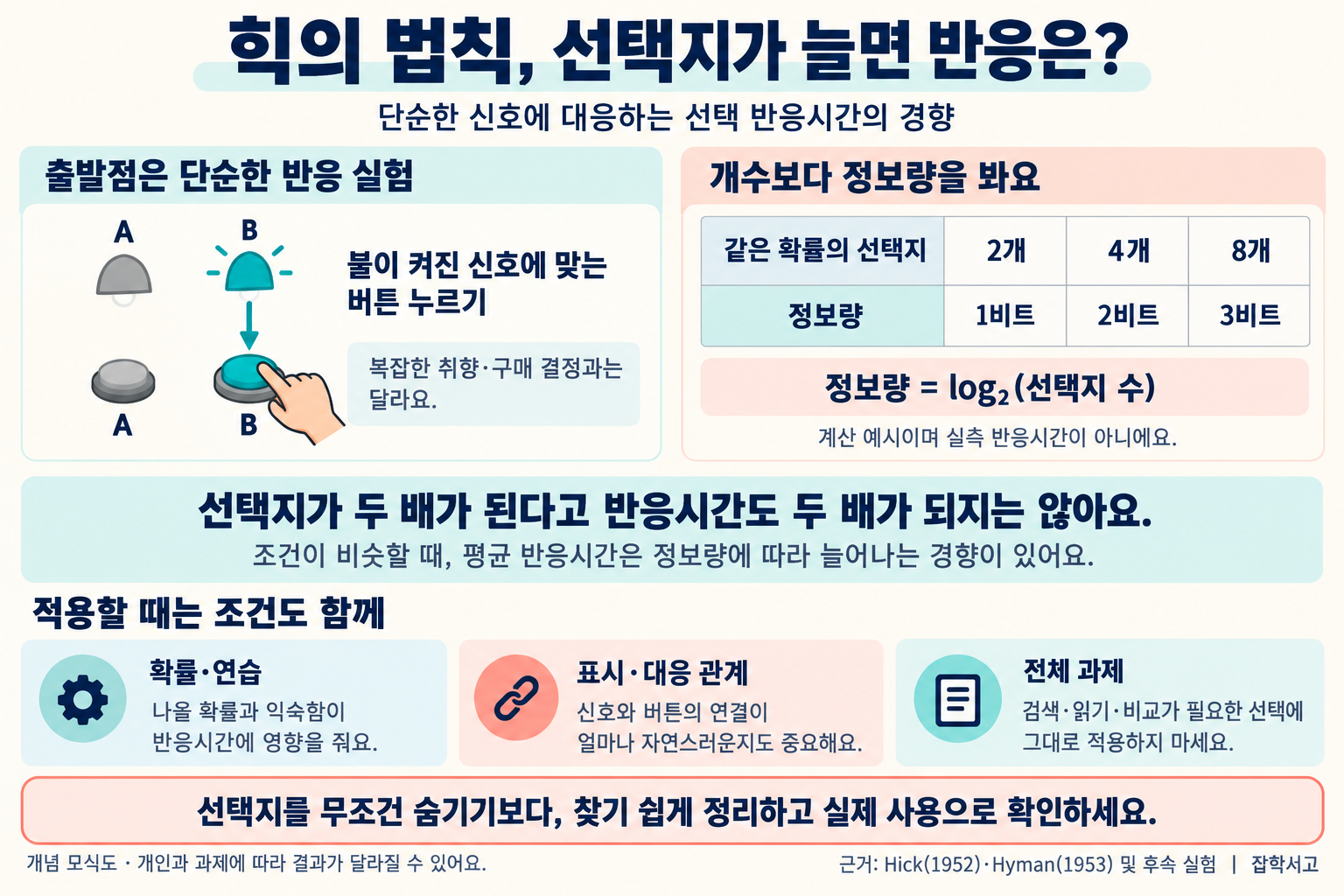

The law originated in the 1952 paper “On the Rate of Gain of Information” by the British psychologist William Edmund Hick. Hick conducted an experiment in which, when one of 10 lamps arranged in a circle lit up, participants pressed the key corresponding to that lamp with a finger.
Hick measured reaction times while varying the number of lamps that could light up. He found that reactions slowed as the number of options increased, but the time did not grow in direct proportion to the number of options. Even when the options doubled, the time taken did not double; it increased only by a fixed amount.
The following year, in 1953, the American psychologist Ray Hyman conducted a similar experiment. Hyman showed that reaction time changes not only with the number of options but also when the probability of each option appearing is changed. People respond quickly to signals that appear often and slowly to signals that appear rarely. Together, the two researchers' work became today's Hick-Hyman Law.
The Relationship Between Options and Decision Time

Hick's Law is commonly expressed as RT = a + b × log₂(n + 1). Here, RT is reaction time and n is the number of equally likely options. a is the base time required regardless of the choice, and b is the rate of time needed to process information. Adding 1 to n accounts for the case of ‘doing nothing.’
The key to this equation is the logarithm. A logarithm has the property that its increases get smaller and smaller as numbers grow. So if you compare going from 1 to 3 options with going from 15 to 17, the former increases decision time far more.
This shape is explained by the idea that people do not examine every option one by one but process information as if they were narrowing the range by halves. Borrowing from information theory, Hick regarded the human decision process as a channel that takes in information at a constant rate.
From this experiment, Hick reported that the amount of information people take in is roughly constant at about 5 bits per second. A bit is a unit for the amount of information needed to pick out one of two alternatives. The explanation is that more options mean more information to sort through, so it takes correspondingly longer.
Hick's Law in Screen and Space Design
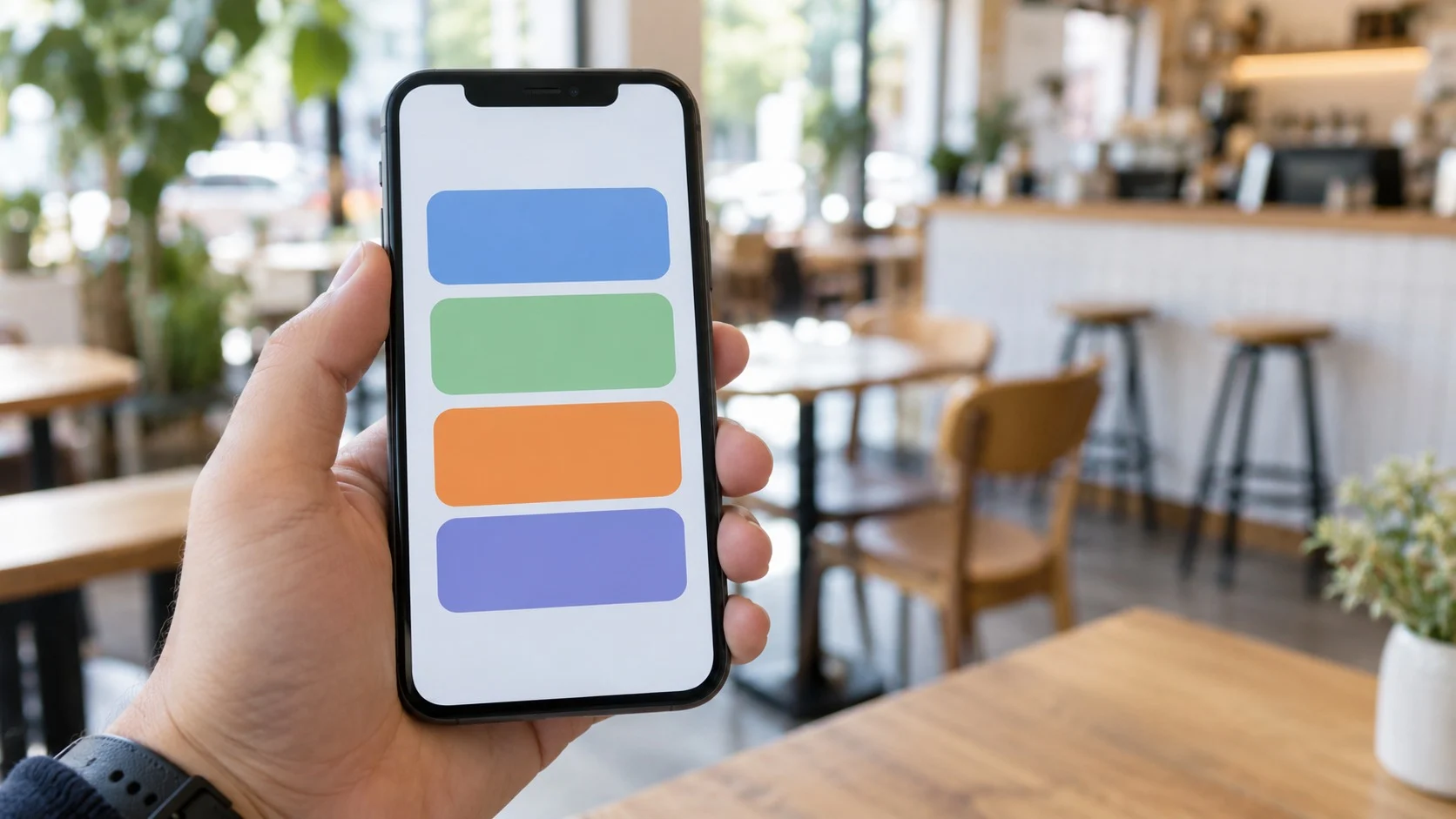
Hick's Law is often used when designing websites and app screens. If the home screen has too many buttons and menus, users hesitate because they do not know where to tap, and in the worst case they leave without doing anything. That is why many services choose to put only the essential features up front and hide the rest further back.
Methods designers commonly use include the following.
- Categorization: Group similar options into a few large branches and then let users choose again within them.
- Progressive disclosure: Show only the basic features at first and reveal detailed settings when the user wants them.
- Highlighting: Make the most frequently used option stand out so that users can pick it right away without deliberating.
This principle also works beyond the screen. Reducing the buttons on a remote control, putting only essential information on signs in airports and subway stations, and splitting sign-up forms into several steps all come from the same idea.
Hick's Law is often introduced together with Fitts's Law. If Fitts's Law deals with the time it takes to move a hand or mouse to a target, Hick's Law deals with the time it takes to decide what to press. Considering both laws together lets you estimate more accurately how long it takes a user to press a single button.
Points to Keep in Mind When Applying Hick's Law

However, Hick's Law does not apply as is to every situation. The law comes from situations in which people respond immediately to a simple signal. It is hard to apply directly to complex decisions that require reading and comparing long texts or weighing unfamiliar options one by one.
Familiarity is another major variable. Even when a program people use every day has many menu items, users find them quickly because they have memorized their positions. In such cases, forcibly cutting down the menus or repeatedly moving items around can actually make the program less convenient to use.
Reducing options is not always a good thing, either. If you cut them back too far, users have to tap through several levels to find the feature they want, so even if each screen's decision is faster, the overall process gets longer. Designers therefore need to strike the right balance between the number of options and the depth of the steps.
What Hick's Law tells us is that showing a lot is not the same as being helpful. Design becomes truly easy to use only when options are organized with careful thought about what people see first and how they choose.
Simple options that reduce hesitation: that is the first step toward design that is easy to use.