Do you remember meeting fractions for the first time with slices of pizza in elementary school, then meeting them again every year through addition, multiplication, and division, and once more in middle school under the name of rational numbers? It may have felt tedious to learn the same thing over and over, but this is a design choice made on purpose when a curriculum is planned. This approach, which returns to the same topic over several years while treating it at a higher level each time, is called the ‘spiral curriculum.’
Simply put, the spiral curriculum means ‘a curriculum built so that core ideas are not finished in one go but are revisited more deeply and broadly as students move up through the grades.’ It was proposed by the American cognitive psychologist Jerome Bruner in his 1960 book The Process of Education, and its name compares learning to a spiral staircase that keeps circling the same spot while climbing ever higher.
In this article, we will look in turn at the background from which the idea emerged, the four features of a spiral curriculum, the three modes of representation described by Bruner, and finally the criticisms and present-day uses.
A Design for Meeting the Same Topic Again from Higher Up
1. The Woods Hole Conference Sparked by the Sputnik Shock

When the Soviet Union launched the satellite Sputnik in 1957, worries grew in the United States that science and mathematics education had fallen behind. In this climate, in September 1959, about 35 scientists, scholars, and educators gathered in the seaside village of Woods Hole, Massachusetts, and spent ten days discussing what schools should teach and how.
(1) A ten-day meeting organized by the National Academy of Sciences
The meeting was organized by the U.S. National Academy of Sciences, and Bruner served as its chair. Bringing together people from physics, mathematics, biology, history, psychology, and other fields to think about curriculum together was itself a new attempt at the time.
(2) The Process of Education, a summary of the meeting
Bruner summarized the discussions from the meeting and published The Process of Education in 1960. The book stressed teaching the ‘structure’ of a subject, that is, the basic ideas and principles that hold up the discipline, and it was here that the spiral curriculum was introduced in a systematic way.
(3) The hypothesis that anything can be taught to any child
The book’s most famous sentence is the hypothesis that “any subject can be taught effectively in some intellectually honest form to any child at any stage of development.” It means that difficult ideas should not be postponed until children are old enough, but met early in a form that suits each child’s level.
2. Four Features of a Spiral Curriculum

A spiral curriculum is different from simply repeating the same content many times. Ronald Harden, a medical education researcher at the University of Dundee in the UK, and N. Stamper summarized four features of a spiral curriculum in a 1999 article in the journal Medical Teacher.
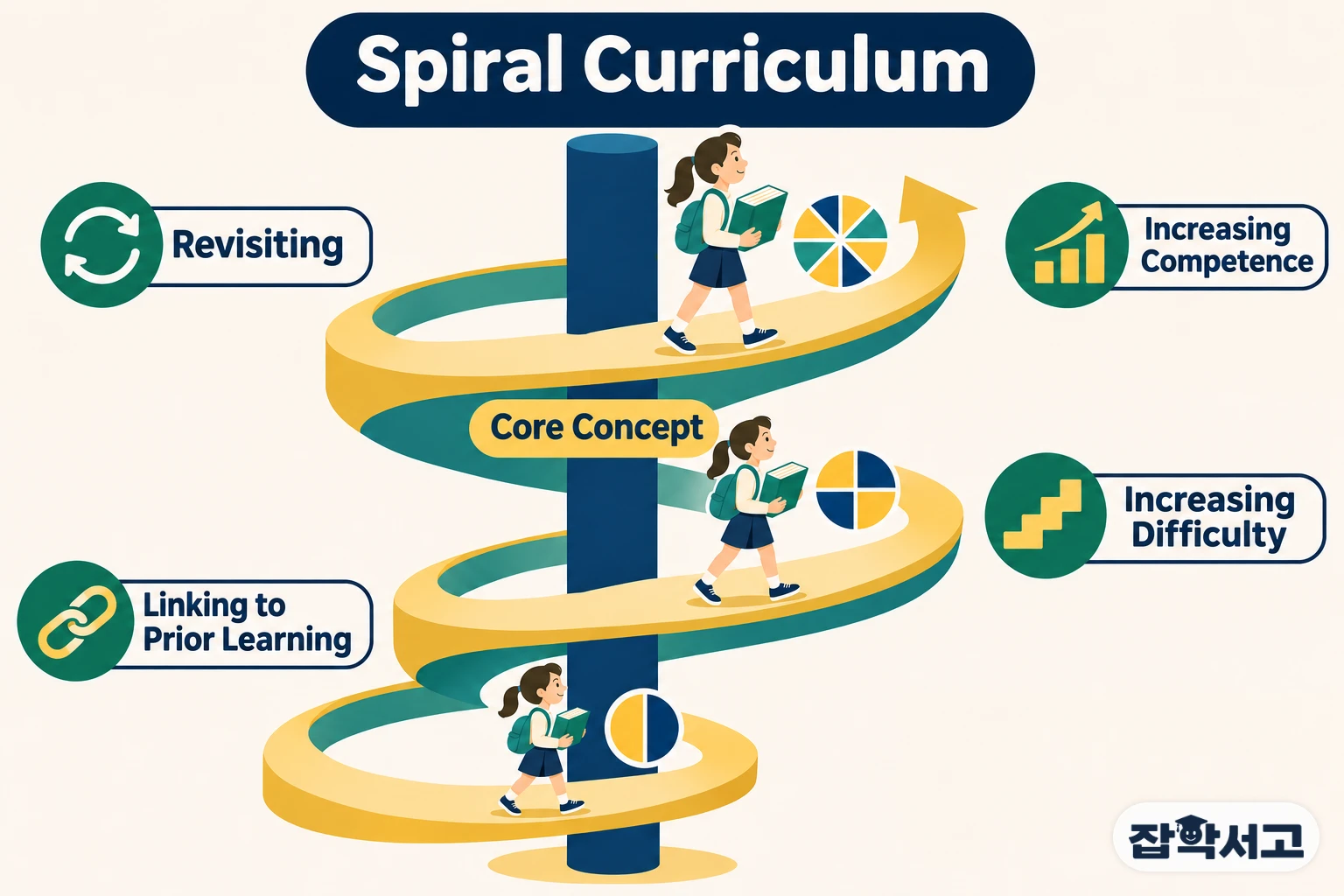
- Revisiting: The same topic or idea is taken up several times across the whole course.
- Increasing Difficulty: Each time it returns, the depth and difficulty of the content go up by a step.
- Linking to Prior Learning: New content is built on top of, and connected to, what was learned earlier.
- Increasing Competence: Through this process, the learner’s understanding and ability grow steadily.
In other words, the heart of a spiral lies in ‘rising’ rather than ‘repeating.’ Even when circling the same spot, you must stand a little higher each time for it to be a spiral; if you only go around at the same height, it is merely a circle.
3. Three Modes of Representation: Action, Image, and Symbol

In his 1966 book Toward a Theory of Instruction, Bruner divided the ways people represent knowledge in their minds into three. These three modes are also used to decide in what order to climb the spiral.
(1) Enactive representation
This is knowing by touching and moving things with your own body. Splitting a pizza-shaped teaching tool by hand and feeling what ‘half’ means belongs here.
(2) Iconic representation
This is knowing through images such as pictures or diagrams. An example is looking at a drawing of a circle cut into four pieces and picturing how much of the whole one piece is.
(3) Symbolic representation
This is knowing through abstract symbols such as words, numbers, and signs. Calculating with fraction symbols like 1/2 or 1/4 is this stage, and as the way of representing the same idea changes like this, the spiral climbs one turn at a time.
4. Turning Repetition into Depth: Criticisms and Uses Today

The spiral curriculum has influenced subject design in many countries, but it has also been criticized because, when poorly run, it can turn into shallow repetition.
(1) A mile wide and an inch deep
A Splintered Vision, a 1996 report from the international mathematics and science comparison study TIMSS, analyzed 628 textbooks and 491 curriculum documents from many countries and criticized U.S. mathematics and science textbooks as ‘a mile wide and an inch deep.’ While other countries covered a topic briefly and moved on, in the United States a topic, once introduced, never dropped out and kept going, so coverage was broad but not deep.
(2) The spiral spreads to medical education
Spiral design is now widely used beyond school subjects, including in medical education. The medical school at the University of Dundee in the UK ran a three-phase curriculum that moved from the normal structure and function of the body to clinical application, arranged so that basic knowledge learned early would be met again later together with patient cases.
(3) What makes a good spiral
For a spiral curriculum to work, it must be clear what becomes deeper each time a topic returns. Earlier learning should be checked and new ideas placed on top of it; repeating the same explanation at the same level only feels like boring repetition to students.
The simple idea that we learn the same thing again not because we forgot it but to see it once more from higher up is the first step toward understanding the spiral curriculum.