In a meeting, which team performs better: the one where someone can say first, “I think I made a mistake here,” or the one where everyone knows but stays quiet? In the 1990s, a researcher studying American hospitals found a surprising result: the teams that reported more mistakes were actually the better teams. The key to explaining that difference is “psychological safety.”
Psychological safety means, simply put, “a belief shared by team members that on this team they will not be embarrassed or punished for asking questions, admitting mistakes, or voicing a different opinion.” The term began to appear in psychology and organizational change research in the 1950s and 1960s, but it became a core concept in management after Harvard Business School professor Amy Edmondson framed it as a team-level concept in 1999.
In this article, we will look in turn at how psychological safety was first studied, the four zones that appear when it is viewed together with performance standards, what Google’s research on teams showed, and how leaders can build psychological safety.
The Belief That It Is Safe to Speak Up Changes Teams
1. The Hospital Teams That Reported More Mistakes

Psychological safety first drew attention through a study of medication errors in hospitals. The researchers initially expected that units with better teamwork would make fewer mistakes.
(1) A Result Opposite to Expectations
In the mid-1990s, Edmondson joined a medication error study led by Lucien Leape and David Bates and analyzed the error records of 8 hospital units. Yet the units rated as communicating well had more recorded errors. It was not that they made more mistakes, but that they reported more of them instead of hiding them.
(2) Managers in Business Suits and Managers in Scrubs
In strict, punishment-oriented units, the nurse managers worked in business suits, and a nurse who had made a mistake said she was “made to feel like a two-year-old who had been bad.” In the open units, by contrast, the managers worked alongside the staff in scrubs and talked openly with them about their own mistakes.
(3) A Concept Defined as a Team Belief
In 1999, Edmondson published a study of 51 work teams in a manufacturing company in the journal Administrative Science Quarterly. There she defined psychological safety as “a shared belief held by members of a team that the team is safe for interpersonal risk taking,” and showed that this belief leads to performance through the team’s learning behavior.
2. Four Zones Seen Together with Performance Standards

Psychological safety is different from a loose, “anything goes” atmosphere. Edmondson explains that when psychological safety is viewed together with performance standards, a team’s state can be divided into four zones.
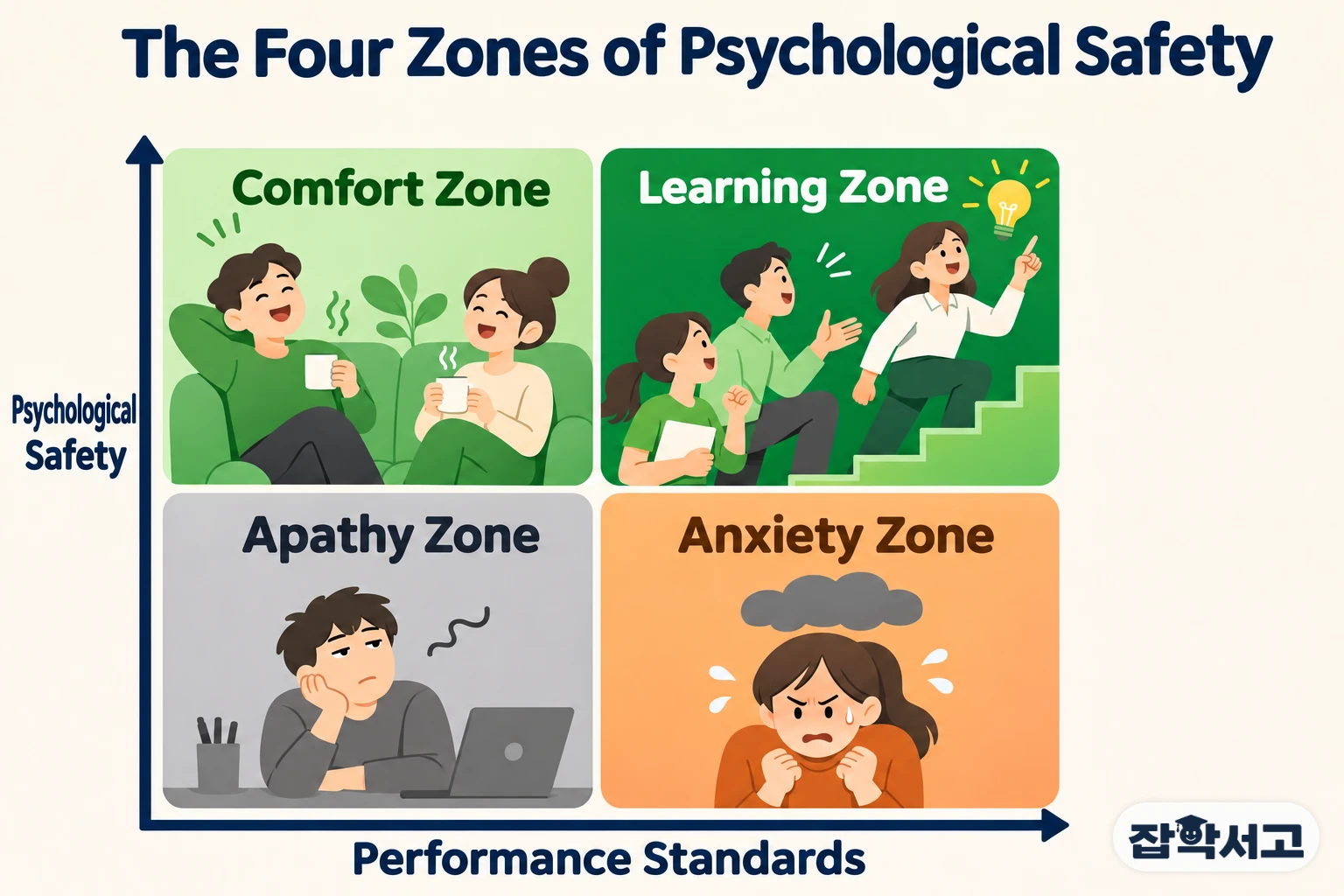
- Apathy Zone: Both psychological safety and performance standards are low, so members do not care about the work and do only what is strictly necessary.
- Comfort Zone: The atmosphere is relaxed but standards are low, so although people get along well, no one takes on the challenge of getting better.
- Anxiety Zone: Standards are high but people are afraid to speak up, so they tend to hide problems they know about for fear of being scolded, leaving few chances to learn and innovate.
- Learning Zone: Both psychological safety and performance standards are high, so members ask questions frankly, debate, and learn together while working toward ambitious goals.
In the end, psychological safety is not about lowering standards but about creating an environment where honest words flow so that high standards can be met. It is not the “nice team” that only says pleasant things but the team that can also voice uncomfortable facts that is in the learning zone.
3. The Conditions of a Good Team Found by Google

What spread psychological safety widely in the business world was Google’s research on teams. To find the conditions that make a good team through data, Google carried out “Project Aristotle.”
(1) A Study of 180 Teams
Google analyzed more than 250 survey items and hundreds of variables across 180 teams in total: 115 engineering teams and 65 sales teams. Its conclusion was that “how the team works together matters more than who is on the team.”
(2) The First of Five Conditions
Google named five conditions of effective teams: psychological safety, dependability, structure and clarity, meaning of work, and impact of work. Among them, it regarded psychological safety as the most important condition, the one that supports the other four.
(3) A Difference That Showed Up in Results
According to Google, members of teams with high psychological safety were less likely to leave the company, made better use of their teammates’ diverse ideas, and brought in more revenue. They were also rated as effective by executives twice as often.
4. Leadership Habits That Build Psychological Safety

In meetings, people do not ask questions for fear of looking ignorant, do not admit mistakes for fear of looking incompetent, do not offer ideas for fear of looking intrusive, and do not point out problems for fear of looking negative. Edmondson organized the leader behaviors that reduce this silence into three stages.
(1) Setting the Stage
Leaders first make clear that the work involves uncertainty and failure, and share the purpose of why the work matters. Members then come to see speaking up not as showing off but as part of the job.
(2) Inviting Participation
The leader first admits, “There are things I don’t know either,” asks good questions, and listens to the end. Building places to speak into the system, such as meeting formats in which anyone can share an opinion, is also part of this stage.
(3) Responding Productively
Leaders thank those who speak up and, rather than blaming failure, look together for what to do next. The managers Edmondson met said only about 1–4% of failures truly deserve blame, yet they also said that 70–90% are treated as if they were blameworthy. Even so, clear violations of rules are still held to account.
Psychological safety does not appear overnight, but a leader’s small words and reactions add up and change a team’s atmosphere. The simple thought that “on this team, I can speak up even if I might be wrong” is the first step to understanding psychological safety.