
Imagine a library that wants to build up its collection of journals in a new field of research. There are hundreds of journals related to the field, but the budget is limited, so it cannot subscribe to them all. Which journals should it choose first so that researchers can find as many of the papers they need as possible?
In library and information science, a long-standing clue to this question is Bradford's law of scattering. It is the rule that the papers on a given subject are heavily concentrated in a small number of core journals, while the rest are scattered thinly across a great many journals.
This article explains, in easy-to-understand terms, how Bradford's law came about and what it means, how to divide journals into zones, its uses in libraries and research, and points to keep in mind when applying it.
Understanding and Applying Bradford's Law
How Bradford's Law Came About

The first person to describe the law was Samuel Clement Bradford, a librarian at the Science Museum Library in London. He had long been concerned with the problem that scientific information was scattered across so many journals that researchers could not find all the papers they needed.
Bradford chose two subjects, applied geophysics and lubrication, and counted one by one how many related papers had appeared in which journals. In 1934, he published the results in the British engineering magazine Engineering.
The findings were clear. A handful of journals carried a great many papers on each subject, while most of the remaining journals carried only one or two relevant papers each. Bradford called this phenomenon ‘scattering,’ which is why the law is often also called Bradford's law of scattering.
He had good reason to dwell on this problem. Scientific journals were multiplying rapidly at the time, but the abstracting journals and indexes that gathered and reported those many papers by subject covered only some subjects. Bradford believed that you needed to know what appeared in which journals in order to build a complete information service, and this survey grew out of that concern.
How to Divide the Core Zone from the Outer Zones

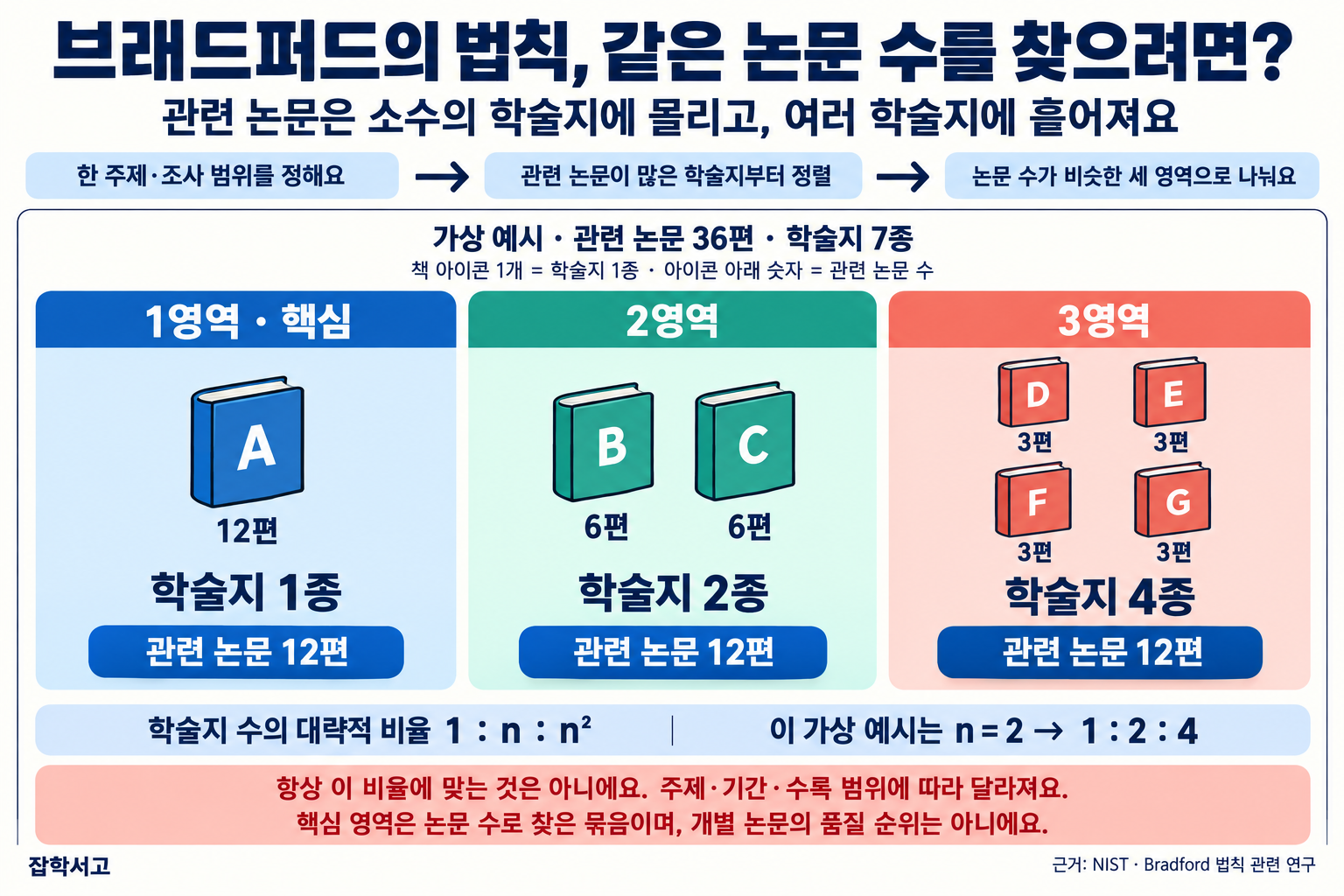
To check Bradford's law, you first rank the journals on a subject in order of how many relevant papers they carry. Then you split the journals into three groups so that the total number of papers is divided into roughly three equal parts.
(1) The core zone
The first group fills one-third of all the papers with only a very small number of journals. These are called the core journals of the field.
(2) The second zone
Filling the same number of papers requires several times as many journals as the core zone.
(3) The third zone
Filling the last third requires looking through several times more journals again than the second zone.
The numbers of journals in the three zones then form a ratio of roughly 1 : n : n². For example, if n is 5, the numbers grow from 5 core journals to 25 in the second zone and 125 in the third. In other words, the more papers of the same amount you try to gather, the more the journals you have to look through grow exponentially.
From a researcher's point of view, this is even more striking. Looking through just a few core journals will turn up a large share of the important papers, but finding every remaining paper means combing through tens or hundreds of journals with unfamiliar names. Compared with the effort put into searching, the number of new papers you find keeps shrinking.
Uses in Libraries and Research

The first place Bradford's law was put to use was library collection management. Using the law, librarians can choose first the journals most useful to their users, even on a small budget.
- Journal subscription: Subscribe first to the journals in the core zone, and supplement papers from the outer zones through interlibrary loan or document delivery services.
- Literature search: Researchers can find many important papers in a short time by starting with the core journals.
- Indexing database: Academic databases refer to this distribution when deciding which journals to include first.
The idea later influenced Eugene Garfield when he created the Science Citation Index. Garfield's observation that a small number of journals play a core role in common across many fields also extends the concentration and scattering that Bradford had shown.
Points to Keep in Mind When Applying Bradford's Law

Bradford's law is very useful, but it is not a law of nature that fits every case exactly. The actual distribution varies depending on how broadly the subject is defined and how long a period is surveyed.
In interdisciplinary fields where several disciplines mix, the core journals are often unclear and papers are scattered much more widely. In fields such as the humanities, where books matter more than journals, the law is hard to apply as is.
Also, keeping only the core journals can mean missing new and original research published in the outer zones. Rather than discarding all the journals in the outer zones, it is better to keep reviewing the collection regularly while paying attention to user requests and research trends.
Bradford's law is called one of the three laws of bibliometrics, together with Lotka's law, which deals with the distribution of the number of papers per author, and Zipf's law, which deals with how often words are used. All three laws share the feature that a large amount is concentrated in a small number of items, so knowing them together gives a broader understanding of how scholarly information flows.
Bradford's law was the first rule to show in numbers that information is not spread evenly. Understanding it helps libraries spend their limited budgets more wisely and helps researchers find their way through the flood of papers.
Looking first where things are concentrated without forgetting where they are scattered: that is the first step toward gathering scholarly information wisely.